[Music] Greetings from Planet Altamira! If you’re receiving this signal, count yourself lucky, because the folks on our research team have put together a special presentation on the charming creatures native to this jewel of the cosmos (faint screaming). Yes, this terraformed world, once lost on the outskirts of human expansion, has quite the menagerie — but don’t be too frightened; everything you see here today is an artistic recreation from experts such as Alex Ries and C.
M. Kosemen. And if these critters interest you, consider supporting the graphic novel Refugium on Kickstarter from Jordan K Walker and creator Simon Roy for a deeper look at Altamiran life.
Now, pull up a chair, and prepare for a voyage across a planet of unmatched wonders. Right now, in Altamira’s Eastern Hemisphere, human settlers are sleeping peacefully, with the knowledge they are surrounded by familiar, imported Earth wildlife. In the Western Hemisphere, however, the sun is up… and local alien lifeforms run riot, as terraforming efforts have failed to take hold here.
This is especially true in the subtropical forests, where the most dangerous creature of all is lurking. . .
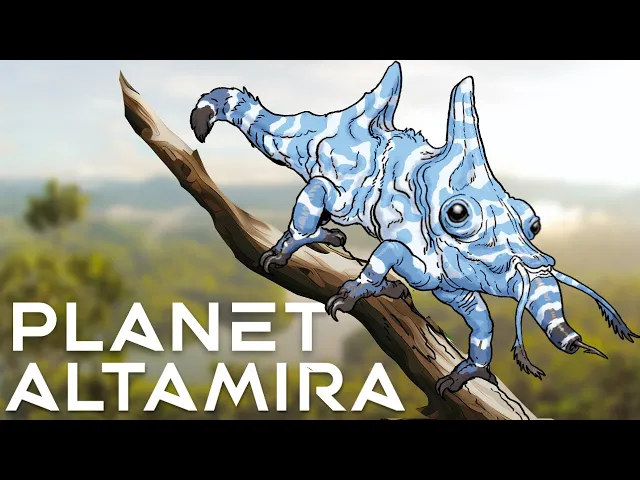
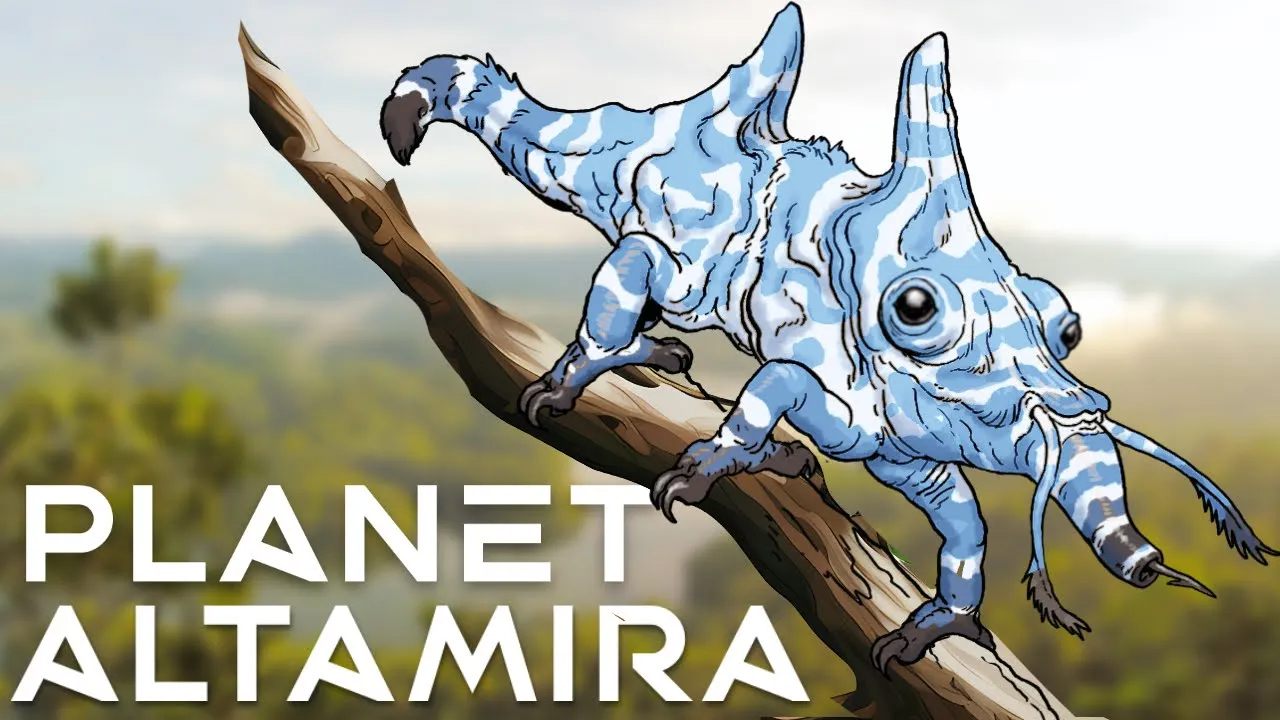
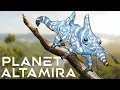
Most dangerous, that is, if you’re a few-centimeters long. Blending into the brown of a tree-branch, is an Elefantito: a tiny ambush predator that has converged upon the niche of a chameleon: with independently rotating eyes, and a seriously stretchy tongue. Unlike a chameleon’s, however, the Elefantito’s tongue is tipped with a biological harpoon, which a hydraulic system propels forward at rapid speeds.
If even the smallest of Altamiran life are living weapons, one might be curious why humans settled here in the first place. The truth is, the first settlers were sold on a… somewhat different vision of Altamira than what they eventually received. Altamira was advertised as the ‘Planet of Opportunity,’ but after a sudden war collapsed interstellar civilization, the Altamirans were left stranded with rather limited technology, and the local wildlife regained control of the Western Hemisphere.
And speaking of: just north of the Elefantito’s habitat is the untamed Zadorran Sea. Here, leaping clear above the water is a dazzling Daziko. Elegant plankton-feeders, Daziko are striking examples of the diverse Squilloid clade, a group of exoskeletal lifeforms not dissimilar to Earth shrimp — although they’ve adapted a far greater variety of niches.
Beneath the waves, related aquatic Squilloids hunt for all manner of prey. Though smaller squilloids have sharp mandibles that allow them to hunt midsized aquatic life, larger squillions have more specialized mouthparts that allow them to filter-feed like baleen whales. But Squillouids aren’t just relegated to the water — in the nearby lowlands, the peculiar Gardoturo Squilloid keeps watch from a rather cumbersome eyestalk.
It might seem like overkill, but the height of a Gardoturo’s eyestalk determines its mating prospects. The natural world is full of creatures that have evolved unnecessary or even risky features to become more eligible bachelors. And our senior Squillologist Alex Ries reports that a Gardoturo’s shell is tough as stone, protecting them from any predators their eyestalk might attract.
For there are many predators in these coastal forests. The Chattering Velireen are menacing omnivores with a penchant for cracking open the shells of armored prey. But according to Senior Snaiad University Researcher C.
M. Kosemen, Velireen are arboreal lifeforms not entirely dissimilar from Earth simians — and like simians, they are highly social creatures. Perhaps there is more humanity in the species of Altamira than initially believed.
Yet one must be cautious when equating alien species to Earth lifeforms. In the skies above the sea, the Fisalgo is a formerly aquatic squilloid that can take to the air — which might make you think it’s comparable to a flying fish, but according to Dr S. C.
Wiggle, their ecological niche is actually closer to Earth birds of prey — proving that parallels to Earth fauna aren’t always self-evident. This is certainly true for the Tufted Rasp of the open lowlands. Discovered by Julio Larcerda, the Rasp’s strange facial tufts and overall alien appearance might throw you off the fact that these herd animals have settled into an antelope-like lifestyle, prioritizing speed and numbers over defense to ensure their continued survival.
In the hills and mesas to the North, however, there is a creature with the complete opposite strategy. Detegosultros are slow, solitary herbivores that feed on tough vegetation and repel would-be attackers with their heavily armored bodies. Like the bulky, thick-skinned African Elephants of Earth, Detegosultros have next to no natural predators, with only their babies left potentially vulnerable.
Yet remarkably, Xenobiologist Joschua Knuppe reports that when temperatures drop, these otherwise independent creatures will huddle together for warmth and shared protection. Facing the elements is easier with allies, but not all creatures make pleasant first impressions. The Kicking Wolverton is a standoffish species whose uh, alarming face is backed up with its venomous spurs.
If Wolvertons seem more like rodents than the other species glimpsed so far, that’s because they’re actually an invasive interplanetary species — and according to authorities Matt Sheenan and Malachi Ward, these relatively tiny creatures are causing surprisingly big problems in the local ecosystem. Deeper into the arid regions, there’s another creature that shouldn’t be judged on appearances alone. The Dupieduloj are a unique family of bipedal Squilloids that look like something out of a nightmare.
But despite their spikey exoskeletons, most Dupieduloj prefer to scavenge small prey rather than hunt outright. Like Earth horned lizard species, their thorny exterior is primarily for self-defense, and their ecological niche is ultimately closer to that of a small canid than an apex predator. Arid environments pose a unique challenge for the Squilloids, as their larvae require a source of water to develop into adulthood.
One flying genus called the Meziplato Cherwo has gotten around this obstacle by laying their eggs in between the armored plates of terrestrial Rasps — much like the reproductive strategy of the parasitoid wasp of earth. Yet according to the Michkin Exobiology Research Center, these parasitic larvae feed primarily on dead skin, and do not significantly harm their hosts — despite their ominous appearance. In the heart of the desert, an even more frightful visage lurks.
This Sekalacerto is a kind of Grappler — a rival clade to Squilloids with a greater potential to produce macropredators. A Grappler’s spiny forelimbs can lash out like those of a praying mantis, ensaring prey both large and small. In the case of the Sekalacerto species, however, the answer is usually small, as these desert dwellers are far more tiny than the rest of the Grappler family.
To meet their larger siblings, we must venture into the ruins of Jurado — the former capital city of the West, now ruled over by the largest megafaunal predators on the planet’s surface. Thundering through the wreckage of humanity is the Krakisto Grappler, the undisputed tyrant rulers of this derelict landscape. Krakisto Grapplers are so colossal, so armed to the literal teeth, that no extant Earth predators can compare.
And concealed within their tangle of feeding appendages, retractable, dexterous tendrils are a final nasty surprise for any unlucky prey. Indeed, one might assume that no animal would stand a chance against such a mighty predator. But to fill their bellies, mighty predators require mightier prey.
And the Plains Pentaped are so colossal, even a Krakisto Grappler can have trouble getting a mouthful. How the Plains Pentapeds get enough energy to grow so large, has been something of a mystery. As it turns out, these titans have more in common with plants than one might expect, their solar dorsal array converting light into energy through photosynthesis and biological photovoltaics — a rather ingenious solution.
Plains Pentapeds and Krakisto are both remarkable and imposing, and the people of the Eastern Hemisphere can count themselves fortunate that encounters with such lifeforms are rare. On the punishing fringes of the Eastern regions, however, some native lifeforms persist. The Falsobeko is an alpine scavenger well-adapted for subzero temperatures.
Their insulating winter fuzz protects them from the elements, trapping warm air like the dense feathers of a Penguin. Only their inner mouthparts are sensitive to the cold, but are protected thanks to a hard, beak-like growth around their lips. Survival in the alpine regions requires extreme behavior.
The Baro Grapplers of the Southern Highlands are tenacious creatures known for never letting go of prey if they are able to seize even the smallest part of them. Their bright-hued faces, like the body of a Ladybird Spider, is meant to warn would-be attackers of their formidable bite. Curiously, however, according to Xenobiological Apologist Sawyer Lee, Baro’s pay close attention to personal hygiene, grooming themselves like certain Earth primates, using their secondary limbs to pick parasites from the furred regions of their bodies.
In the Yanamari mountains, another fastidious creature keeps to the shadows. Kick-Legged Trajnadrako are vigilant not with hygiene, but with remaining out of sight. Despite their unmissable body-plan, these secretive creatures are seldom seen and little understood, although researcher C.
M. Kosemen reports their locomotion is most comparable to that of a caterpillar upon the sheer slopes. Further down the Yanamari mountains, the unique Lichen Maze ecosystem encourages bizarre adaptations.
These vegetation labyrinths are formed through multiple lichen species grown atop each other like coral reefs — and like coral reefs, they shelter many a peculiar lineage. Vilkrura are gentle creatures nearly as tall as the Lichen Stalks they wander amongst. According to scholar Ripley Cook, these creatures avoid predation by camouflaging their legs to look like the surrounding structures, although like Giraffes, their spindly limbs have the added benefit of allowing them to reach otherwise inaccessible vegetation.
Vilkrura feed by using their manipulator limb to pull treetop growths into their mouth, a behavior they only engage in when the coast is clear of predators. For there are predators here. The Dalandaika is a creature that feeds on anything they can get their strong radula on, although researcher Saveliy Kochnov has found these animals primarily lead a curious, omnivorous lifestyle much like that of a badger.
More menacing creatures can be found elsewhere. Insubito Grapplers are illusive hunters that lurk in the dark corners of the maze. Leading expert Emily Schnall reports the fleshy filaments on their backs help break up their pattern amidst the foliage, similar to the camouflage found on various big cat species.
It is fortunate indeed that such specialized hunters seldom venture near human civilization. Yet interactions between humans of the Eastern settlements and Altamiran wildlife are becoming more frequent. In the waterways of both hemispheres, species like the Klakanto are an increasingly common sight.
These amphibious ambush predators are tough, versatile, and able to reproduce quickly, making their spread difficult to curtail. The Kalakanto’s hunting strategy is near-identical to Earth crocodiles — floating immobile with only their eyes above the water until prey comes within striking distance. But Kalakanto are not the only river-dwelling species spotted near human populations.
The Krokodilutro is a species that might seem like another attempt to claim the enviable crocodile niche — but these creatures have an active, playful lifestyle. Initial Krokodilutro specimens were found deceased during dam-construction efforts — suggesting that humans can pose a danger to Altamiran wildlife just as these creatures can pose a danger to humans. Indeed, human terraforming activity may have caused the loss of many species now unknown to us.
The terraforming process involved pushing out local flora with genetically engineered super trees — an activity that collapsed many an ecosystem. But in the temperate forests on the edge of human territory, native life has begun to reclaim their natural habitat. Small ambush predators like the Mottled Flittler have returned to these woods — species that, according to Naturalist Logan Stahl, are tiny enough to hide under leaf litter and rotting logs like Earth salamanders.
Flittlers feed upon various Pinwheel species — a diminutive clade of radially symmetrical lifeforms that fill a niche similar to insects, and as a result, are one of the more important lineages on planet Altamira. Pinwheels come in many shapes and sizes. Many have a painful bite, which Jr.
Researcher Aldrich Hezekiah discovered while gathering these specimens. Yet despite their painful pincers, like butterflies, they are renowned for their striking and variable color ornamentation. But not all Pinwheels are so pleasant to look at.
In the Dusty Gavani Desert, Living Thorns blend in with the spines of menacing Thorn Trees — a foreboding plant the species make their nests under. Like a colony of ants, Living Thorn networks are ruled by a central queen. Scholar Jay Eaton suggests these spiral shaped monarchs reproduce by continuously breaking off into sterile worker clones — which defend their home with a venomous bite.
Even Pinwheel species that lack venom can cause problems. This poster from the Banbeck Agricultural authority shows how certain pinwheels embed themselves on imported farm animals. One would be forgiven for assuming all Pinwheels are pests, but some like the Weaver Pinwheels prefer to keep to themselves.
These stewards of the lichen mazes feed on carefully cultivated lichiforms, and though they will defend their home with a venomous bite, naturalist Logan Grecco reports the effects only involve temporary numbness. Though Pinwheels have claimed many of the small animal niches, in the high Yanamari mountains, the Arboreko Pentaped has asserted itself as a micro-herbivore. A far cry from its giant plains-dwelling relative, this Pentaped uses its photosynthetic organisms not just to gain energy, but to take to the skies.
Dr Miles Rosenbloom has proven the Arboreko can glide short distances like earth Drco lizards to escape from danger. Other tiny Pentapeds have an even stranger method of avoiding predators. Pseudoventrulos are a species that, according to Xenobiologist Zhengyi Wang, have evolved to mimic the coloration of the venomous Pinwheel species the “Dead Man’s Rose.
” Mimicry is a common tactic across Earth prey species, with would-be-targets using patterns like eyespots to mimic larger, more dangerous animals. But mimicry is not just for the hunted —but for the hunters. Burrowing Grapplers look like flowering plants, but once a potential meal gets close, their colorful mandibles snap shut, ensnaring whatever hungry prey species was unwise enough to venture near.
Dr Willem Tief managed to capture a snapshot of the Grapplers above ground, revealing a short, stout creature with overdeveloped claws analogous to the digging mitts of a burrowing mole. Burrowing Grapplers aren’t the only species that prefers the dark underground. Murdistalpos are nocturnal predators that emerge from their burrows to track prey with their heat sensitive organs.
Known to live close to human settlements, they would be frightening — if they were more than a few centimeters long. In many ways, they are most comparable to Earth tarantulas — frightening to the uninitiated, but relatively low risk. Much of the wildlife and ecosystems of Planet Altamira has been misjudged to an extent.
Even the depths of caves conceal elegant creatures — like avian squilloids whose fertilization process gives creatures the nutrients required for complex communities, from small swimmers, to two-meter long electrosensitive swimmers. All across Altamira, the native biosphere continues to thrive despite the damages of terraforming. There is still so much more that this Planet of Opportunity might be hiding, and we must come to understand it lest additional species be lost forever… If you’d like to discover more of Altamira’s secrets, you can once again support the Refugium graphic novel on Kickstarter using the links below.
Simon Roy actually has numerous interconnected stories set upon Altamira and in the surrounding galaxy, which you can also learn more about in this video’s description. And this video featured… a lot of art from spec bio creators who have been featured elsewhere on this channel, so there are links to follow and support them as well. And as always, thanks for watching.
If you enjoyed this entry, please lend your support by liking, subscribing, and hitting the notification icon to stay up to date on all things Curious. See you in the next video.