so in the assignment you need to this the same question for each dilemma first dilemma is on page 353 you need to name dilemma that the consultant faces another way to think of it is what is the ethical decision to be made and then you need to decide what you would do if you and a consultant face with the same ethical dilemma and you need to First decide what professional code of ethics you would use decide what to do and those professional codes of Ethics are this sit on page 375 to 378 which professional code
of ethics would you not use you said I forget what it's called but whatever one has Academy which everyone has a Academy okay Academy of hrd right or the management so the two that have Academy in them and why don't we use those because that would be in an educator because those are only for higher education right so they wouldn't be used for a for-profit organization consultant okay so you pick one of those um codes of Ethics um and then you use the specific guidelines for that particular code of ethics and then you tell me
what those specific guidelines are please list them don't just say they're in the book list what those specific guidelines are and then using those specific guidelines tell me what you would do what would you tell the board about the executive director's role in the organization's problems yes do you want us to name all of the um like guidelines or just the ones we would use for this specific case the ones that you would use to decide what to do in this specific example so in this specific example the decision that you need to make is
to decide whether or not to tell the board about the executive director and their role in the problems that the organization has and then why or why not would you tell the board of course that would be based on the specific guidelines from the code of ethics that you chose so there's no right or wrong code of ethics to choose right they're all perfectly legitimate codes of Ethics except for the acad ones that's the only way you lose points is by picking the academy ones so the only way you lose points on this is by
not following the guidelines that you say you're following right or not picking specific guidelines that are in that code of ethics so as long as you pick a code of ethics it's not the academy as long as you follow those specific guidelines that are from that code of ethics to to make your decision then you're fine it's not a trick question not one code of ethics that you need to follow right as long as you follow one of these professional go codes of Ethics you find that's the point of the assignment is to pick a
code of ethics and follow their guidelines to make an ethical decision to guide you through the Dilemma you have two ch to do that we get two dilemmas the second dilemma is on page 365 and this case you need to figure out whether or not to take the assignment whether or not to take the job basically so that's on page 365 so you have to name the Dilemma then again you need to pick a code pick the guidelines and use the guidelines to decide whether or not you will take the consulting job not and then
why or why not would you take the job don't forget to tell me why or why not to say no I won't take the job using the guidelines well it's not enough right you know why am I not using the guidelines how did the guidelines guide you to a yes or no answer okay so we get on assignment one right then go to assignment two do next week all right so for assignment two we're going to questions at the end of the chapter first four questions first question is with which of the marketing methods do
you feel most comfortable in the book and also in the Powerpoints so I'd like you to list two of the marketing methods that you feel most comfortable with and then why don't forget the why question two is with which of the marketing methods do you feel the least comfortable and why and again pick two and then the third question is what do you think you could do to overcome your lack of comfort with the methods identified in question two so answer that for the first method you feel at least comfortable with and then answer that
for the second method that you feel least comfortable with so questions 1 two three refer to external OD Consultants question four refers to internal OD Consultants because your answer is going to be somewhat different but it's still important for an internal OD professional to Market themselves so question four asks why it's obvious why an external OD consultant has to Market themselves but why does an internal OD professional still need to Market themselves so that's the question number four and the second part of the assignment is to write a contract for an OD project between you
the OD consultant and a client organization and it's fine if it's one you make up doesn't have to be a real organization so what's an OD project we talked about last week chapter 1 has a lot of examples there are examples on page five of project projects that mlan has done then there are examples [Music] on page 26 of a number of different OD projects that can be done so you can pick any one of those so don't pick a project like a hair salon or a lawn cutting business those are not booty projects so
ideas that you might have for small businesses typically are not OD projects OD projects are to solve some kind of problem within an organization generally so you need to include all eight items that we described last week and as I said last week it's fine to go ahead and just make a list of all the items in the contract you want to title your contract this is a contract between me Consulting and client organization to do this OD project who does what each item is worth Four Points what are the desired outcomes so at the
end of your project what will the company now be able to do or what Solutions will be implemented will they have increased sales will they have fewer problems will their communication problems be solved they now have better teamwork what as a result of this project being done will be the outcome that the organization will now experience what's the timeline this means when are you going to start when are you going to finish are there any U Milestones along the way then what is confidential and how long will details of the project be confidential then what
Personnel Resources will be needed from both the consultant and the client if you're just a one person show then it's just going to be you what Personnel Resources will be needed from the client how many people you need from them then fees we spent a lot of time talking about fees last week how much you going to charge how are you going to charge charge for expenses what are going to be the fees for your project then deliverables is what are you going to hand the client will you give them a written report will it
just be an AAL report um is there going to be a team training what kinds of things are you going to give them so it's different from the outcome right the outcomes is what will the client now have in terms of outcomes at the end of the project right that's different from what are you g to give them in terms of report or training or something like that right and the last one is a recourse for non-performance will there be mediation what will happen if you don't do what you said you were going to do
so the client needs to know what will they do if you don't perform so those the eight items you need to include all eight items if you don't include an item that's an automatic four points off for that item and then you just need a signature line and um a line for date now if you don't do an OD project then your assignment will return to you and you will lose five points for a rewrite I will not accept an assignment that is not for an OD project so be sure you're doing an OD project
so any questions on assignment number two okay I did mention last week that there is a sample contract on page 17 so don't make your contract with the bullet points or the numbers that are on page 17 these are not the right items but can look at the title and it does have the signature lines so you can use it as far as what do my contract look like from a title and signature line standpoint but don't just change the name names and stuff inside the contract and just use what's in the contract because these
are not the same items same eight items that are in the text of the chapter they're not the same eight items that are in the assignment guidelines so don't just use this contract I point that out because sometimes students will just take this contract and say oh it just should look like this and then change a few things around and then submit this and that's not to get you the points you need okay are we good on this all right okay so now we're going to shift um away from entry and Contracting um we're now
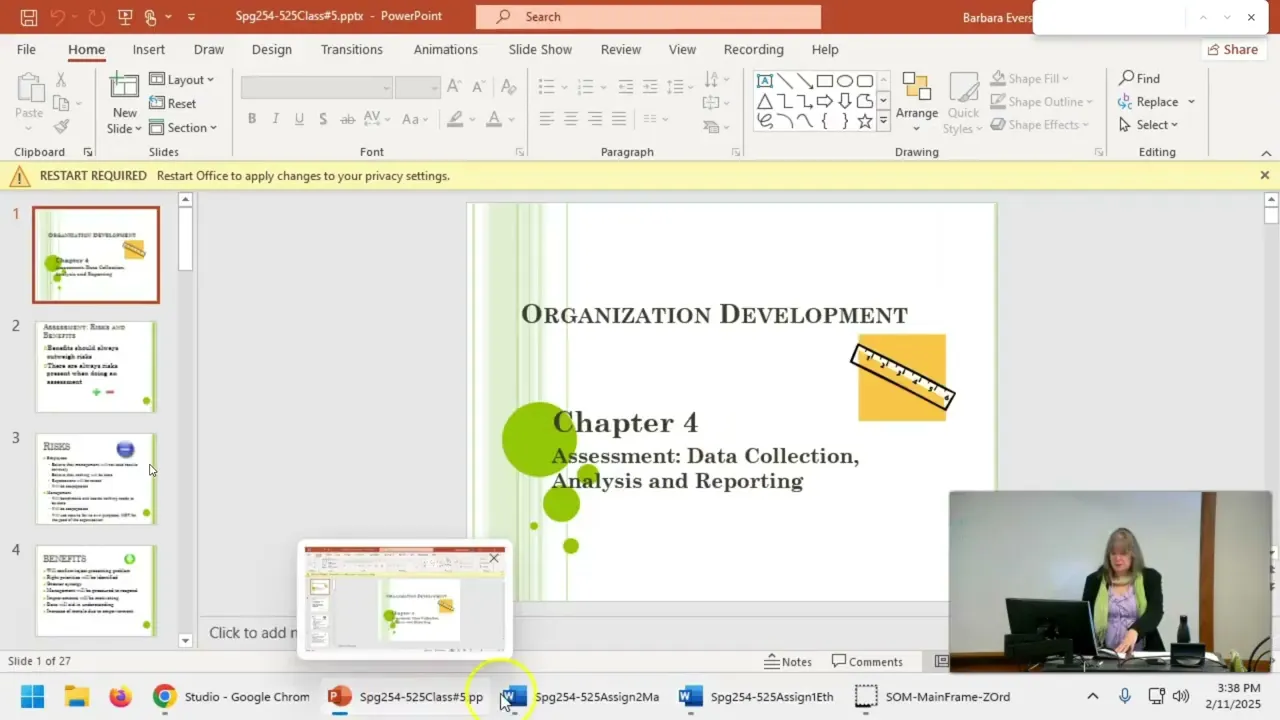
inside the organization we've talked about how we're going to think about the organization right we talked about systems thinking how we're going to um look at the organization and we talked about how OD is a datadriven process now we're going to talk about how are we going to get that data because we're going to make decisions about the organization and about what interventions we're going to do which are the things that we would do to solve the problem s within the organization but we can't do any of that until we collect data about the organization
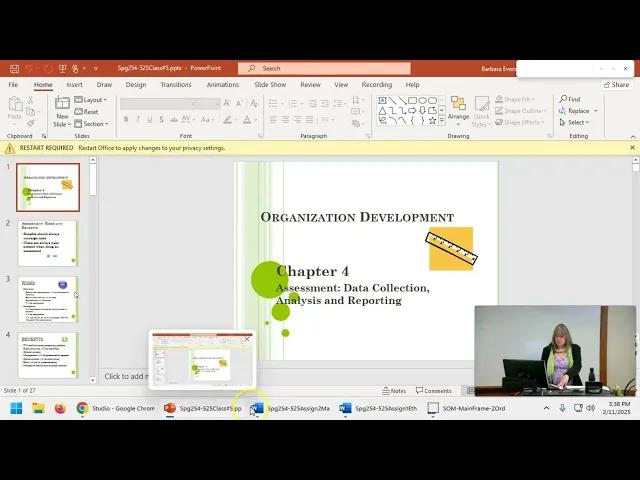
because we're going to be data driven first we have to collect the data which we call assessment so that's what we're going to talk about now and chapter four in your book is about assessment organizational assessment and Reporting because once we collect the data then we need to do something called feeding it back to the organization which is an important step because we collect the data from the system and then to make sure that the data is reflective of the system we feed it back to the system as a check to make sure that the
data that we collected is accurate and the only way to do that is to feed it back to the system and have the system say yes this is our data you collected it from us and it accurately reflects what we have told you all right so as in anything right assessment has risks and benefits and as with anything that you're going to do you want to be sure that your benefits always outweighs your risks right so to do like a risk benefit analysis and there are always risks present when we're doing an assessment so what
do you think some of those risks might be can you think think of some of the risks that might be there for employees yeah um an employee could lose their job employees could lose their job okay so um there's it could be risk a risk to them personally interest terms of their employment okay yes nothing could change if there's like a something wrong with the culture and employes want a change and then nothing that's is okay so they could put all this work into answering surveys or whatever data collection methods there are and then nothing
actually changes right okay anything else how about risks to man managers are there any risks to managers yeah I mean they have the same risk of being replaced or um getting put in a lower level job they may get demoted yeah as a result of the survey Okay so some information came out that may come out that is at risk to them personally if they are bad managers okay anything else what are some of the benefits yeah it represents like a the Readiness to change like management and everyone participating is like the first step to
creating the change I want to say yeah so some data some information may come out that will actually help the organization make a change that is good for it any other benefits yeah maybe like increase in production and profit from like you know if things are going better employees are working more so the organization stands to benefit from the information that comes out sure okay all right so as as we said that um employees may not believe that management will take the results seriously they'll put time and effort into this and nothing will be done
and you raise expectations and then nothing happens this particularly will happen for example if you do this on a regular basis and you keep collecting data from employees and you keep raising their expectations and then nothing happens then employees can become very jaded and cynical and consider this to be the flavor of the month oh we're going through another climate survey or we're going through another um OD survey and every time we do these things nothing happens so the worst thing you can do is keep on asking employees for their opinion and then you get
their opinion and then nothing changes because then employees will become very cynical and then employees are also as we've said are worried that they will be scapegoated that everything will come out it's their fault and these are supposed to be anonymous surveys but doesn't always mean that they are so um I used to work our department used to work in the College of Technology and um we had a Dean over there who's no longer there but um we had a supposedly Anonymous survey on her third year performance and after that came out she basically walked
around telling everybody intimating that she knew who said what on the survey so you can imagine what kind of a effect that had on all of us over there it was pretty bad and then she always just said that she was only kidding or that she didn't mean that she actually knew individuals or anything but you know we all had the feeling that she actually knew who said what and it was very bad so this definitely risk to employees right it's supposed to be anonymous but what if it's not right how much in a low
trust environment and it definitely was a low trust environment over there a low trust environment you know you definitely um can be scared that you should if you should you give honest answers that um it won't actually be anonymous so um it's risky for managers too right they feel the same thing they can get scapegoated right if their particular Department isn't doing very well then it comes out everybody else is doing great but your Department's doing poorly what's going to happen to you right so managers are scared about that um they may actually decide nothing
needs to be done even though there's problems we just say oh we're just going to Benchmark this you know and we're just going to use this for later we'll just see how we do against this even though there are problems and there results may be used for top manager own purposes and not for the good of the organization so they're definitely risks involved but there are also many benefits so we'll get the information that either confirms or rejects remember that presenting problem so most of the time the presenting problem is not the real problem but
occasionally it is right but most the time it's not but we will get the information that confirms or rejects the presenting problem tells us what the real problem is what the right priorities are so that's a major benefit of collecting data and we get greater Synergy by being able to collect the data and know exactly what's going on and when we have data right that actually pressures management to really do something so that's the flip side of you know we've got the data but we don't do anything about it but having data actually does pressure
management to do something and when we do some improvements based on the data that actually motivates us to do more improvements so it's kind of a self-fulfilling prophecy we keep getting better and better and having the data actually helps us understand what is going on right so it aids in understanding and what we do something Based on data right that increases morale of our employees because everyone feels empowered we've collected this data and we did something based on this data and that is very empowering which leads to improved morale in the organization so there are
definitely um many benefits to collecting data in the end as an OD consultant we will only proceed with the assessment if we feel that the benefits will outweigh the risks and if we are working in a very low trust environment where multiple assessments have already been done and where the employee population is exhausted and cynical maybe it's not worth it maybe the benefits will not be able to outweigh risks in that case because employees may not be honest maybe there's a high chance that nothing will be done again and so it may not be worth
the risks in that case so that's another thing that the OD consultant needs to decide okay so let's talk about um measurement psychometrics whole idea of what we do so one basic is reliability and validity which is um sometimes difficult to understand and it's easy to mix them up but just very simply I reliability just means can you repeat the results if I'm giving the same test to the same person I should get the same results over and over again that makes it reliable I should get the same results over and over again if I
don't then it's not reliable idity on the other hand measures whether or not it's true in other words it's actually measured what it's supposed to measure which is different than something being reliable I can get the same measurement over and over and over again and have a very reliable measure but it might be measuring the wrong thing it could be completely invalid and I could have a test that's measuring what it's supposed to but if it's not reliable I don't get the same measurement every time and that's also no good right I need something that
is both reliable and valid for it to be any good as a measurement make sense I want something true and I want something that gives me the same answer every time I measure it all right so we've got several choices in terms of assessment we can use observation we can use secondary data we can use interviews we can use individual interviews we can use group interviews or we can use surveys so we have two ways to observe we can either use what's called a participant observation or a nonparticipant observation what do you think the difference
between a participant and non-participant observation is yes Josh I would say par participant means that you could be um you would either change something or you would U maybe be in that environment well the observation periods going on whereas non participant would be you're totally removed from it you're observing things as they normally would be right so in anthropology for example a lot of times observers will go into the group and work alongside them while they're observing them so that would be a participant observ so if I were observing a group of people I would
be working alongside them living with them as I'm writing down my observations whereas nonparticipant of course I'm not interacting with the group that I'm observing I'm observing them and they don't know that I'm observing them they may or not they may or may not know that I'm observing them but I'm not interacting with them as I am observing them I would be looking from afar or behind a glass or whatever so um if I'm wanting to see how really good performers do their work then that would be um I would be recording frequency of work
behaviors on a checklist for example if I want to observe exemplary performance of workers I wouldn't be um working with them right that would be a non-participant um observation so it's ideal for identifying training for manual laborers for example but not necessarily for employee development for developmental needs right for anything that's cognitive but for manual labor it's ideal because you can actually watch somebody performing a manual task and see what are the things that they do that makes it Exemplar so do you think it could be used for identifying training and educational needs for white
collar workers Can You observe what a white color worker is doing yes okay how can you do that I can't think of situation could you speak up a little I say I can think about um like situation right now but um what are some of the things that we might be able to observe in a white collar yeah um it might be helpful if the uh consultant is um internal or um like knows the industry really well cuz then you're able to see you would have to be a participant I don't know if there's any
like nonparticipant observation that you can make that would like kind of look at a specific like worker like what they're doing and everything but they're participating and like you can tell that maybe someone doesn't know things that they probably should or um maybe you can like if you're like just chitchatting with someone you're working with someone you can kind of see if there's like educational gaps so if you were a participant Observer you might be able to observe some of the needs of a worker that you were working with if you were in this let's
say in the same type of job right you might be able to see some of the needs that they had because you knew let's say you were um doing the same job but you were somewhat more experiened experienced or educated you might be able to see what they needed more training on Yeah by watching what they did yeah that's a good example so what are some of the advantages and disadvantages of using observation as an assessment what are some of the advantages of using observation yeah you don't like directly affect the like results of the
observation that's a great point but is that true well I guess not directly or not necessarily no if people know that they might be observed after the fact then they would behave maybe differently yeah so if they don't know they're being observed that's absolutely true but if they do know that they're being observed it's something called the Hawthorne effect which actually means that the act of observation actually changes what's being observed and it can go either way right because I'm observing you right or let's let's let's leave use because let's say if I'm being observed
right as a teacher which happs happens right so the beginning of my career before I got tenure right I would be observed by a colleague or it could be my my department chair but someone would be observing me and have a little little checklist here of things that I'm supposed to be doing as an instructor and because they're there it could either make me so nervous that I do poorly because they're watching or I could be more on my game because they're watching right and so you know who knows which way I'm going to react
but probably it's going to be one or the other I'm probably not going to be so confident that I'm going to be unaffected by the fact that they're there but their presence is probably going to have some effect on me either making me nervous or making me you know that much more energized because I know I have to do a really good job because they're there right so I'm going to be really a lot better and you know I can't even remember what which way it went it probably made me more nervous but typically you
know actually they a lot of times the AC of observation actually makes people feel better because it makes them feel like someone is paying attention right someone is actually taking notice of them and cares about what they're doing so it actually increases their productivity when they know that they're being observed which is another which is actually the um the main effect of the corthorn effect is that if you know that you're being observed you actually do better because somebody actually cares about what you're doing you know somebody actually you know thinks you make a difference
so that's the horor effect but yeah that there's definitely um an effect if people know they're being observed but yeah if they don't know they're being observed right then there's no subjectivity evolved right they just you just can factually see what's going on without any subjectivity so it's really objective how about what's another advantage of observation as an assessment method yes I think with observation it helps the consultant like come to their own conclusion of what they think the issue is they can actually see what the workers are doing or like why um someone might
have reached out to them to come like observe in the first place but they can also they can take that into account and look out for that but they can also see kind of things that maybe the managering um guess there's no way for um say a manager or somebody else to bias them in any way over what's going on right so you see it for yourself and nobody else can say well look this way or look that way you see exactly what's going on in another way that makes it more objective yeah and it
might be issues that like maybe the employees aren't even that aware of like if you gave them a survey that might not be one of the things you even asked them on the survey or like something that if it was on the survey they would have said yes or no too right right so you take out also the the participants own bias you might see something that's important that the that the um participant didn't even realize was important anything else yes it might help you like see things at like a in a more broad sense
like when you're a participant you kind of like like you said you only have that like perspective of being the participant but as a non-participant you can see like the whole picture a lot more clearly of how it's going to affect all the participants how it might affect managers and like vice versa so more big picture yes wi yeah anything else how much does it cost right it's one of the least costly methods of assessment right it's really cheap right consultant just comes and watches it just take their time so as far as um assessment
methodologies just one of the least expensive so that's that's a big advantage of observation what's some of the disadvantages of observation yes a disconnect from like the work being done and like the actual process like there might be just like a like a tone deafness to like the voice of the workers well it's limited to only what you can see yeah so you don't see there's nothing else but what you can observe they don't have the like experience of doing it to understand why it might come to that thing they just see the what's going
on right you don't get any insight into behaviors or motives or anything like that just it's just what you see people do which has more limited utility for some more knowledge worker type jobs you might have to be more participating as we talked earlier to get more insight into training or educational issues so observation tends to be somewhat Limited in terms of the type of things that you can assess the more you get to higher level tasks more towards knowledge work or tasks um it's less and less useful so for um so for manual type
of tests more useful you can you can certainly observe group interaction that's definitely valuable because you can see how people behave by what they how they act toward each other and what they say to each other so group observation can be somewhat useful and again it's cheap but you don't get beyond the surface level of what people are saying okay let's take a 10 minute break and then we'll talk about interviews okay so interviews interviews can either be formal or they can be informal formal interviews of course are highly structured um you have no freedom
to vary the wording um we have an intrview schedule and you just ask um questions at the same time um a more informal interview we just have a outline of subjects topics or issues and you have kind of an interview guide that um you record answers on um whether you choose a more formal interview or a formal one formal or informal um basically depends on who you're asking and what you are asking about um so I'm sure um most of you have been through interviews before what would you say the advantages of interviews are yes
we get a little bit more of like an unfiltered answer to your questions that if it was a survey because I feel like when you're kind of interviewing and you gain that trust in a person they might tell you a little bit more than if they're like staring at a screen looking at their answer um so that might be an advantage um I think that's what I want yes so you definitely get more information from an interview right and particularly if it's informal interview you can always dig into to an answer and so you can
kind of follow where the interview goes right so um you can probe for more information you can go off in Tangent so you could definitely get more information for using an interview as a as a um data collection technique what might another um advantage of an interview yes Josh um along with the verbal communication you also get the nonverbal communication VI by your body language or right by different tone changes around certain topics right right so you certainly get a lot of non-verbal information from from a personal interview yeah that you wouldn't get from a
excuse me a survey how about disadvantages of interviews yes the interviewee might feel like potenti if there's like a bad work environment like a mistrustful environment they might feel questioned or put on the spot are like coerced in answers okay yeah in a low trust environment maybe a interviewee might not feel like sharing much because it's not Anonymous that's the problem with interviews is that um it's even if the OD consultant is um keeps it confidential right confidential is not the same as Anonymous right there's no way to keep an interview Anonymous it would just
be confidential so a a respondent might feel exposed right because the OD consultant does know who's giving the answer so they might not be as truthful or forthcoming in an interview situation what's another disadvantage of interviews yes time consuming if it's time consuming what does that mean like it takes away from whoever is like doing their job they have to now stop doing their job and go get interviewed and like right some changes or whatever with someone they don't really know so then you know that just takes away from them and it also like it
takes away a little bit I guess the OD wouldn't mind because they're getting paid for it regardless but if the OD is wanting to maybe do this faster management want it's done like I feel like interview should take some time um even if you do have like a scheduled amount of time it can sometimes be hard to like actually keep the interview to that a lot of time and you have to interview I mean you do group interviews but you could also just interview one onone you get different information from either of them so I
feel like they just end up taking a lot of time yeah and if something is time consuming what does that mean it is I'd say like it may feel like unimportant to some employees so something time consuming is also costly right the time is money right so interviews tend to be um take more time and therefore they're more expensive right in terms of data collection methods interviewing is the most expensive right because you're taking not only time for the consultant right who's maybe billing by the hour but also taking the um employees time away from
their work so it's also costly in terms of um their time which is money so um some core interview questions might be you know what are the strengths and weaknesses of this organization um what kinds of changes might you recommend um that might that should be happening what kinds of things should I know and sometimes um employees are very anxious to give that kind of information um in a low trust environment as Michael was saying maybe they don't want to tell you these things and if you're using a appreciative inquiry approach which is um the
opposite of a problem-based approach then you might be asking questions like what's going right what kinds of things can we build on here um so what are the things that uh effective interviewers do um the most important thing is they are aware of their bias because everyone has their own biases so it's important for an interviewer to understand what their own bias is before they go to an interview um of course it's important to take good notes because nowadays it's really easy to record because everybody's got a phone so you can record easily you always
have to ask the interviewee if they are comfortable being recorded the best part about interviews is that you can ask follow-up questions with probing ones right you can probe to find out more go deeper with your questions which is very difficult to do with any other uh type of data assessment a good interview of course in informal interviews this doesn't always happen but um it's good to ask the same questions of every interviewee because then you get the same data from everybody you need to create trust and rapport with your interviewee um that way you
can be um assured of getting truthful responses particularly important in a low trust environment because where the person you're interviewing is inclined to um not want to be honest um if the more you can create trust and rapport with them the more likely you are to get more of an honest response it's important to maintain good eye contact to have open body language inter like this although In some cultures that's and also more women are more comfortable with this kind of posture the more you can maintain a more open body language with um your interviewee
not interrupt your interviewee also sometimes silence can be your friend you don't jump right into the next question if you maintain a little bit of Silence give your interview a little bit of space to add a little more only asks questions and not leading questions at that but you know don't fill the Silence of the space with anecdotes or stories just asking questions some point and the um exception to only asking questions is to clarify for understanding so um particularly if something is not quite clear to you in terms of what the interview he has
said it's important to clarify for understanding so that you know exactly what the person has told you I I heard you say this is this what you've said and then make sure that you have understood and manages your time you know if you've only got an hour for an interview or a half an hour for an interview don't let the interview go by and you've only answered you've only asked half your questions so you got to make sure that you all your questions answered in the alive time so we can also do interviews oh we're
going to role play okay two four six oh right we have an even number all right let's break up into pairs go to a pair with someone you haven't paired up with yet somebody new all right each of you will practice being the interviewer for five minutes then switch interviewer is an OD consultant you're going to interview each other about what's going on in their workplace so you each get to be the OD consultant for five minutes I'm going to start on second don't start till I do my timer hang on hang on situation all
right the first first person to be the OD consultant Starts Now it's really random he walked up picked up lemonem why are beliefs coming all right so we can also do interviews in groups which obviously would reduce your costs reduce your time um so you can use them when you have time restraints we don't have as much money you interview people in a group um group interviews um can also be useful because you can have um individual responses kind of triggering other people's responses so so you know I hear you say something and that makes
me think of oh yeah that happened to me too or oh that makes me think of this um so uh you should have everyone see each of the individual responses and you have to make sure that everyone has a chance to participate so um you need to have a good um moderator who is just there to make sure that everybody gets to participate and again you need to clarify responses especially if something's not clear um sometimes groups can get stuck on a particular um topic and then you need to move the group on and sometimes
you can have an individual personality dominate the discussion and you have to be sure you don't have that happen so you need to take care of that person who's dominating and don't go fishing don't have some answer that you want the group to come to and um lead them in that direction you want to make sure that you're being objective with your group interview so any question about interviewing as a data collection method Okay so talk about surveys so a survey is basically an interview that's reduced to writing so written questionnaire could also be a
telephone survey two types open-ended which is basically an essay response right so you ask a question and then person can just respond any way they like or a closed ended survey item restricted Choice like yes or no or a scale response like a liquor scale um so agree slightly agree strongly agree strongly disagree have numbers for those person advantages is they're much cheaper than interviews and you can collect info in different Lo locations at the same time disadvantages they're more difficult to analyze and because you have numbers you think you're have a real illusion of
certainty um what other advantages or disadvantages can you think of for surveys yes on the survey someone could kind of just easily lie and get away with it like there's no like truth indicators that can just put down any falsity and there's no reason to suspect that that's not true whereas in an interview can you tell if someone's lying you can't necessarily like infallibly but you are going to have that like pick on some mannerisms some weird like inconsistencies people may be less likely to lie in person they might be more likely to lie if
it's Anonymous but an advantage there is that a survey is anonymous so you might be more likely to be truthful in an anonymous situation where it might be harder when you know that it's not Anonymous it's only confidential or surveys are or should be completely Anonymous yes surveys are cheap when compared to the interviews yeah surveys are a lot cheaper what's the disadvantage of a survey over an interview yes you might run into things like non response bias where you might run into things like non response bias where only do answering survey are people with
very extreme mindsets towards or against one thing another yeah or you could have somebody just strongly disagree for everything or strongly disagree for everything yeah that can happen what can you do with a interview that you can't do with a survey seek clarification and dig into questions alone no clarification right what else can't you do you can't ask followup questions right no follow-up questions no probing you can't you know you don't have any freedom to if something's interesting you want to find out some more information about it can't do that with a survey so you
kind of limit it that way so what makes a good survey so you can either make it standardized or you can customize a survey you need to have clear and understandable items so items need to be written in such a way that they cannot be understood misunderstood right so that everybody who reads them here's the same thing you can um make them randomized that makes a good survey um so we talked about that a little bit um last week a random survey is um one that is representative of the entire population you want a high
response rate for your survey again that will also make something that's representative usually surveys should be less than 10 minutes because a longer survey makes it more difficult for your respondent to actually fill it out you should have some questions in the reverse so they're not all um if they should not all be um agree some should be disagree distribution of items should be random should be easy to read and this is an important one sometimes questions you get fancy at the questions and you put more than one Concept in a question well then the
person answering has a hard time if they have a different answer for each concept which way did they go so make sure you only have one concept for each question and you want to make sure that you force their choices right they have to go one way or another so um you want to have four to six choices so don't have five choices because then you have something called central tendency soes anybody know what central tendency is that's when um white people are going to choose the middle since there's a Center Point okay so if
I have a scale like this where this is like strongly agree and this is strongly disagree what am I most likely to pick because I'm like I'm just neutral and if you know you've got like a whole bunch of questions and someone's likely to do this so yeah I don't know that doesn't give me any information right I get a whole bunch of Threes so Force choice is I do 1 2 3 4 so I force you to either go this way or this way I don't give you an option of neutral you either have
to disagree or agree so that's a first choice how do you create good survey items well you can brainstorm to find the clusters of information that we need and again one concept per item make them simple and short again make sure they're clear unambiguous so they cannot be misunderstood and this an important one use the language of the people that you're surveying right so if it's in a company make sure that you know the language that the employees of the organization use every item should have a verb so it should be active make sure you
don't make any mistakes in the survey and you know do a do a uh preest but you know do a uh what do they call it do a test run do a test run with a startup group you can create some survey survey items for a possible survey to assess organizational culture oh we're not going to do this all right so in terms of choosing data analysis figure out who's going to read the analysis make sure that it is read really Anonymous protect the anonymity of your subjects if you're using qual tricks there are things
you have to do in qual tricks that will not protect the anonymity of the person taking the survey so you have to make sure you know qualtrix well enough to be able to do things that will protect the IP address because qual Trix automatically collects that information the IP so you have to do things the quri to tell it don't collect that information make sure that really is a and make sure you don't have any errors right any errors you'll lose credibility you have typos in your survey all right so now we're going to talk
about some metrics how many of you have done any stats okay in high school or in college in college okay so you know what nominal ordinal interval data are yes yes okay so what's nominal data I don't mean to put you on the spot no it's okay I just had to maybe look up the answer because I forgot um it is the simplest measurement scale we can use um so no uh quantitative data so it's going to be like um gender eye color hair color so it's categories right and so then what's ordinal does anybody
know anybody else done stats I'm reading the definition but it's kind of confusing it says scale use to label variables to have a natural order but no uh quantifiable differences between values so um an example they used was like satisfaction so you're either very satisfied ified unsatisfied neutral satisfied or very satisfied so it's rankings the intervals between the rankings are not okay so nominal measures you don't as Bella said you don't quantify the attributes they're just categories so gender job okay and you use them for counting okay so you can have you know three women
and five men we have eight people in hrd we got seven people in hrd 425 one person hrd 525 so it's just categories that's just nominal data nominal for naming so it's just how many people you have in a category then ordinal measures show ranking ordinal for order but the intervals between like first place and second place and third place right are not equal so we don't know the size of the differences between the different ranks so we can use them for performance evaluations for example the top candidate may be the best but we don't
know by how much so first place is first place but first place we don't know how much better first place is than second place it's just ranking first second third one two three that's ordinal data so interval data means the intervals between numbers are equal there's no true zero so liquate scale data like 1 2 3 four five you never see a zero when you see a liquid scale because there's never a zero the lowest is a one but the difference between one and two two and three three and four and four and five are
equal that makes it interval data so bonus question what else is interval data so what does I what at what temperature does water freeze zero 0 degrees what scale CI Centigrade Celsius but that's not a true zero right you have minus 10 see- 20 so it doesn't have a true zero true zero meaning no quantity of it right is there a temperature scale that does have a true zero have any scientists in here or anybody who knows something about science you taking a physics class in high school took a physics class right anybody take a
physics class in high school I don't even remember about to physics so long ago now I can't even remember but like motion be like 100% still that would be zero what would be motion motion well I'm talking about um a temperature scale that has 0 degrees a true zero any heard of it Kelvin yes very good yes yes so Kelvin the Kelvin scale as 0 degrees oops 0 degrees that is a true zero no temperature at 0 degrees Kelvin that's the only temperature scale that is not interval but ratio so ratio data is the best
kind of data because you can do anything you want with ratio data intervals are the same you have a true zero you can compare values which means 20 = 10 * 2 you can't do that with any other kind of data you can't say that a Liker scale four is 2 * 2 however we social scientists cheat all the time and make averages out of liquor scale data which technically we really shouldn't do because you can't calculate averages with interval data we do it anyway but we can compare values and do oper operations which is
add subtract multiply divide with dollars number of employees percentages and time as some examples that's called ratio data that's because you could have zero dollars you can have no employees you can have zero% you can have no time as when you run out of time on your meter so that's called ratio data okay now I have a couple of videos and I know I'm not sure what's going to happen when I play these videos for my okay so those of you on the web you'll have to watch these videos by yourself because what's going to
happen is the sound's not going to come through and if I try to put the sound through it's G to get all messed up so instead I'm just going to say watch the two videos and then do the quiz and I have the answer key there so do the quiz first and then look at the answer key watch these two videos I'm GNA say e e