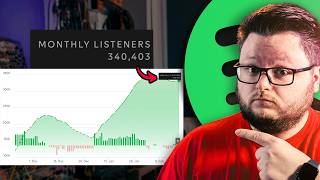
We spent over $2 million promoting music on meta ads. And that's just in our ad accounts alone. In fact, this current ad account that we're using has run over 651 campaigns.
Spent over or nearly a half a million dollars just in this ad account. And we've had several that we use. But keep in mind, we also have access to over a 100 client ad accounts.
So, if we're doing larger campaigns, often we'll run it in the client's ad account if they happen. So, I don't know exactly how much money we've spent in ads, but it's a lot. And in this video, I want to just give you some lessons learned so that we can save you some time and hopefully also save you some money.
So, lesson number one is that the song is more important than the creatives, which is more important than the targeting. And more specifically, I made this little cheat here. So, the songs are more important than the creatives, which is more important than the targeting.
But inside of the creative category, which the creatives are the actual videos that you use in your ad campaigns, there's also kind of an order of operations here. The part of the song is generally more important than the video that's on screen, which is more important than the text that's on screen, which is more important than the text on screen. So, when it comes to your videos, the text you put in the primary text that goes like above or below your video in your ad matters very little.
Like, it matters. It's just the least important thing you could worry about. The text on screen would be more important.
The video on screen, the part of the song. So, if you're not testing the part of the song you're using, you're essentially missing out on the one of the easiest and/or best ways to improve your campaign. Now, if you're not putting any effort into the video that's on screen, you're also missing out on one of the biggest best ways to improve your campaign because because these two, I'd say, are actually pretty similar.
And it kind of depends on the the genre and and the song even. So the part of the song video on screen matter immensely and the a lot of people spend a lot of time worrying about what to write on their ad. It's important again but just the least important.
So if you if you have a certain amount of time to allocate to running campaigns, you want to prioritize what's going to make the most impact. Um so like yes, care about your targeting. Use targeting that makes sense, but don't stress about it.
It's not it's like one of the least important things nowadays when it comes to your creatives. Don't worry too much about text compared to the actual like video and the part of the song. And then also like kind of lastly related to that is be willing to pivot if the song's not working.
Some songs you just can't make work. Like this isn't this isn't black magic. Some songs won't work and some songs will do better than others.
And the sooner you accept that the sooner you can start making your campaigns better. Lesson number two is that the worst performance you're going to get in your campaigns is going to be at the beginning. And typically your campaigns are going to get better over time to a degree.
And let me show you some some graphs just to clarify this. So we're looking at the cost per conversion and it was the worst right at the beginning. First today is 40 cents, 40 cents, and then 28.
And then it kind of settled in by day four and it's been hovering around this 20 cent range. And that's this is a very typical graph. In fact, let me flip to another one.
This has been running a little bit longer, about a month. First day 71 cents, second day 36, and then it's kind of generally gotten better before it plateaus around the mid20s, right? And it does go up and down a little bit, but honestly, over this whole month, it's gotten better.
If I change the the averaging here to look at by week, look at this trend line, right? 39, 29, 25, 23, 27, but this is the current week. The current week kind of always goes up.
Months is just like basically a straight line down from 30 to 20. And this is super typical. Now, these are two streaming campaigns, but this is actually almost more true for a sales objective campaign.
So, this is looking at a a free CD plus shipping and handling CD funnel. It's like, hey, get this CD for for free and all that stuff. And then you we charge for shipping and then we upsell different products along the way.
And this one's the same thing. Now, here I'm averaging by week just because the the number of conversions is much smaller. Like if I average by day, you see it's like really hard to get any idea of what's happening.
[laughter] So if I average by week, it's just an easier way to see the trend line. You can see at first we we we got some lucky results. It seems the the first week was great and then it shot up to $73.
But then since then it's been better. In fact, the last three weeks have been significantly better than the first three weeks. So in all three of the campaigns I've shown you, things are the worst at the beginning and they get better over time.
Now, what you will see when you're spending like thousands of dollars is you'll you'll have this kind of like swoop down like you saw and then slowly it kind of creeps up over time and that's because you start getting audience saturation. You start getting creative fatigue. Meta can't just look for the easy number of conversions anymore.
It has to reach to harder places. So, imagine like a tree, an apple tree or whatever, and and there's there's these apples at the bottom and those are the ones that get picked first. And then as the bottom ones get picked, you have to start getting a ladder.
You have to start climbing the tree to get harder to reach apples that are near the top. And that's kind of what meta ads is doing. If it can get you easy, cheap conversions.
It does, but when you run out of those, you have to go to people that maybe they don't need one impression to convert. Maybe now you're reaching people that need like three, four, five impressions to convert, which just costs more money. And one final thing on this topic, this is further assasperated exasperated.
This is this is even worse if you're running the campaign in a new ad account. So, if you've never done like a purchase campaign before, a lot of people are shocked at how brutal the first week or two running a sales campaign can be. Like often if I'm running like a a merch campaign, I'm assuming the first like $100 we spent is going to be obscenely bad.
So, when you're running like a meta streaming campaign, it's going to be bad in a new ad account, especially. It's always bad in the first few days, but new ad accounts even worse. If it's a sales campaign, it's like even slower to get started.
So, you you really do have to find some patience in that way. And that actually flows really nicely into lesson number three, which is don't panic. It's it's very easy to panic when you're running ads because every day you're running them, you're spending money.
And if things are going poorly, you feel like you're just burning cash. But the reality is campaigns need time to evolve and learn and optimize. Like my general rule I would say is don't touch your campaign at all in the first 48 hours.
It when your campaign's running, it's going through what's called a learning phase. And part of this is like a very discreet thing where on meta you might see something that literally says learning, you have this many conversions to go until you exit learning phase. But as your campaigns run, just overall the more data it has, the smarter it's getting.
So officially the learning phase is 50 conversions per ad set. But your campaign's always learning. But also keep in mind if you have more adsets in your campaign then you're going to have your learning like split across more things.
So it's not necessarily the case where you want like more things testing is always better. There's this balance of you want to have like a certain budget proportion to how many adsets and how many ads you have. Otherwise you're fracturing your learning.
But but the real like lesson I want to have in this particular lesson is don't panic. Don't touch your campaign at all in the first 48 hours and don't make any changes like daily. Like you want to every time every time you tweak a campaign, you want to give it two to three days to see what happens.
And you don't want to spread your budget too thin because the thinner your budget is spread across different ads and adsets. That learning phase, that 2 to three day window like actually gets longer. Like if you're spending $5 a day and [music] you have five adets with 10 ads in each, that's way too thin.
you're going to have to let your campaign run for like a week or two before you do anything because your budget is so like fragmented across all these little things. So, in a nutshell, I would set up your campaign where you have at least $1 per ad per day. So, if you have five ads, let's just say you have 10 ads because the more ads the better, right?
At the very beginning of this, I said the ads are the most important thing. Let's say you have 10 ads, you have three audiences, you have 30 ads running, so your budget should be $30 a day. Um, and that's actually how I figure out I don't use that to figure out how much money I should spend per day.
I use the amount of money the campaign has and the amount of money we're spending per day to dictate how many ads and adsets that you have. And that's where this kind of 2 to three day learning window is calculated for me. Now, there is one exception to this.
If there's something catastrophically wrong with your campaign, then of course touch it in the first two days. For example, let's say your pixel's messed up and it's not firing conversions. Your landing page is messed up.
you you clicked one of the advantage plus buttons in your campaign and it's just burning money and sending it to countries and just hitting bots or whatever. That is is obviously a problem and you should fix that immediately. Lesson number four is to spend the most amount of money on your winners and spend the least amount of money on your losers.
Just to make the math and numbers easy, let's say you're going to release 10 songs throughout the year, which is actually a lot of music to release in a year. Um, and you have $10,000 budget for those. You have $1,000 per song on average.
You shouldn't spend $1,000 per song, no matter what. You should plan that your average is going to be $1,000 per song. You should market every single song because you need to see how it's going to do.
But by the end of the year, you're probably going to see that you're going to have like out of those 10, two that are great, awesome performers, two that are horrible, awful losers, and then the other six are some bell curve in the middle. And I've seen this across like super talented artists and I've seen it across amateur artists. The super talented professional people like may have a little bit of a better skew in that bell curve and the the more amateurs might have a little worse skew in that.
But for the most part it holds true. Why fight what's working, right? Don't abandon the current song that's working to promote to drop another one that's statistically not going to work as well.
the chances of you dropping two super high performing campaigns in a row is just not that high. Uh, and then maybe you're super talented and you're the exception, but I think it's better in life to assume that you are not the exception. You're going to be average.
And if you end up being exceptional, great. But we want to bank on on likely numbers here. So, when you find a winner, milk it for all it's worth.
When you find a loser, uh, be willing to kill it sooner, as devastating as that can be, because all your songs are your babies and you you love them equally. Lesson number five is to not waste your time on what I'm calling micro adjustments on Meta. For example, just let Meta allocate the distribution of spend between your ad creatives and your ages and your genders and your countries, unless you're seeing that they're actively not doing something that you want them to do.
Or maybe you realize that your campaign wasn't set up perfectly the way you wanted it from the beginning. Let me show you what I mean cuz I think an example is clear. If we have this campaign here, if I go to breakdowns, we can see the how the money was spent by age, for example.
And some people will come in here and they'll say, "Oh, our best performing age range was 25 to 34 and our worst performing age range was 18 to 24. " So, what they might do in that situation is go edit the campaign and basically make the campaign 25 to 54 and they remove an age range. Or maybe they just make it 25 to 34.
And then they'll go further and say, okay, let's look at breakdowns by demographic, gender, and okay, it's doing way better with men. So, let's make it just men. What is it?
25 to 34. And now, let's look at countries, and let's see how these did. out of a thousand conversions, we seem to have some cheap stuff happening in Japan.
So like the conclusion someone would make from this is let's get rid of Australia, let's get rid of the US, let's have this just be Japan and Mexico and Brazil, for example, and just men from ages 18 or 25 to 34. And a few things happen when you do this. One, meta is way better at allocating budget between things like this that any human would be.
Humans can pretty reasonably look at a XY graph and figure out a trend from some data, right? You can see all these dots going up and you can mentally in your head draw a line between those dots. And you can even do that in three dimensions.
If you have a three-dimensional graph, you can pretty easily find a trend through a three-dimensional graph of data. But what about a 150 dimension graph? you we can't even visualize how to interpret something optimizing for 150 different dimensions, but a computer can.
In fact, that's like a normal thing for a machine learning model to do is optimize for like a 100,000 parameters. And that's what Meta Ads and all these ad platforms are doing is they're looking at the cost per age and the cost per gender and the cost per placement, the cost per country, and the cost per ad creative, the cost per audience, the cost per everything, and they're trying to get you the best result in their system and they're going to do a better job than you can most of the time. Now, there are some exceptions.
If I go into this, um, you see they are generally spending the most amount of money in the adset that's doing the best. This is our best performing two adsets are getting the most amount of money. This one's worst by a pretty significant amount.
28 cents compared to 21 and 20. [music] Uh, and it's it's getting the least money. Um, now this is actually tier one.
These bottom ones are tier one countries or HP higher paying countries is what we call them. And this is tier two. So, it's actually doing just about as good in the tier ones as it is the tier twos.
Um, which is awesome, right? So, Meta is kind of balancing both of these markets. But if I go inside one of these, we're going to see a distribution of ad creatives here.
So, for example, this one video is getting 20 cents and it's getting the most amount of conversions. All the other adsets or ads are getting a worse cost per conversion. They're getting less money.
That's not always the case. Sometimes you'll see that some ads are cheaper, but they're not getting any money. Just be mindful of small sample sizes, right?
This ad only has two results. This only has three results. So, we can't really trust if it's good or bad.
Uh, it looked like we turned this one off already. And Meta might have automatically turned it off, too. They sometimes will just turn off ads if they haven't been getting any spend for like a certain amount of time.
But, you know, you don't want to be misled by you have a a a result that's like one conversion for seven cents, seven conversions for 3 cents, and then like now you're turning off every ad but that one. Like, that's not a rabbit hole you want to go down. But periodically, you might see, oh, these have enough data.
Why is meta making that call? Let's go run a separate test where we can see if we're right and Meta's wrong. And then if we are, then we'll pivot over to that.
But you don't want to be doing these edits in like the main campaign. And lesson number six is to watch this video on the basics of running meta ads for music because there's all these little things that you might not know how to use in the platform that are just making you slower andor costing you money because you don't know how to use these features. And also make sure to subscribe and ring that bell so you don't miss an upload on my channel.
Anyways, thanks so much for watching. Hope you found that helpful and I'll see you in the next video. Bye.