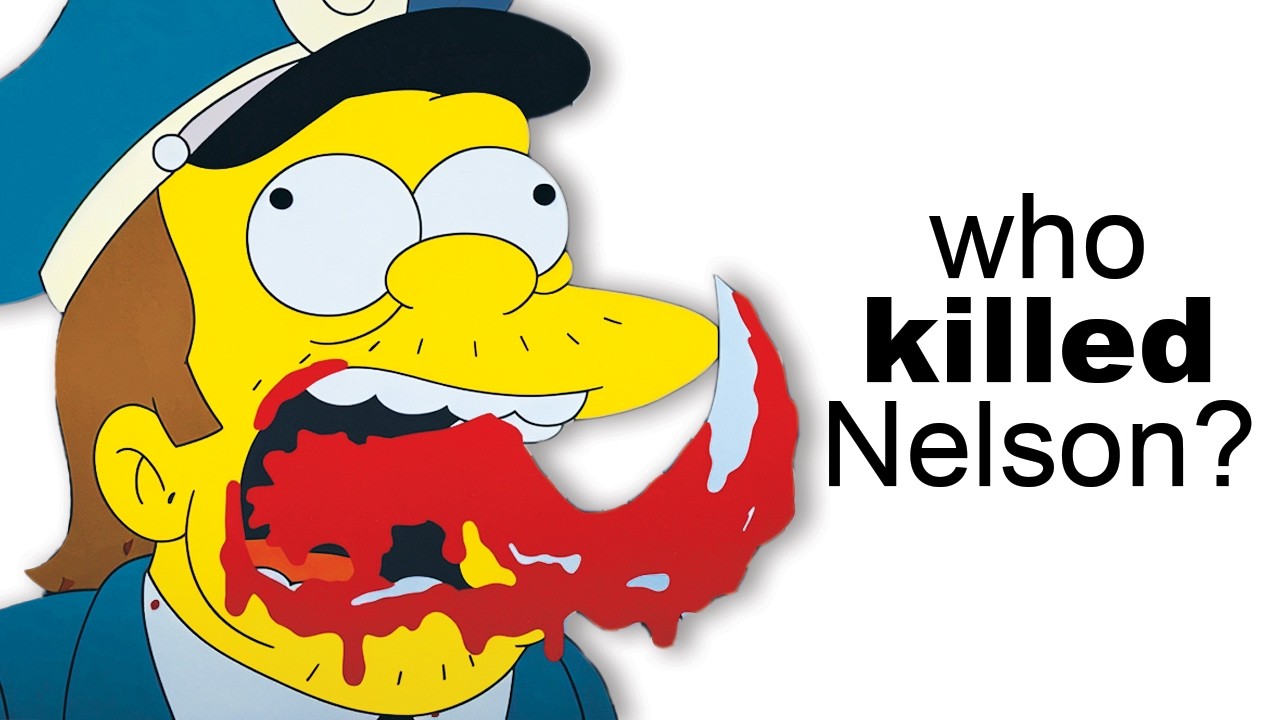
In a littleknown episode, a coffin lies in St. Peter's Basilica surrounded by cardinals. A screen shows April 21st and Brockman announces that the Pope has died.
In other news, the Pope has died. [Music] conspiracy theories on social media. Recently, a video is circulating which shows an episode of the famous cartoon series where it is shown that Pope Francis will die this year.
The Simpsons have predicted the death of Pope Francis in 2025. In an episode of theirs, which is little remembered by the public, Anquila is shown placed in the center of St. Peter's Basilica, surrounded by silent cardinals.
Meanwhile, Kent Brockman reports on the passing of the Supreme Pontiff, stating that the official cause of death is severe bronchitis. A Vatican flag at half mass and in the background, a large screen shows exactly the time when it will happen. Meanwhile, the news spreads in the media where as the main cause for the change in the pope's life, they give a severe bronchitis.
People can't believe their ears. Whole crowds gather in St. Peter's Square.
Some are with candles in their hands and others praying silently. Lisa, very curious, searches the library for the predecessor Popes and finds an ancient book with a very disturbing title. The screen shows the chimney of the cyine chapel releasing black smoke, a sign that there is still no successor.
The end of a cycle, 2025. In the last scene, the chimney of the cyine chapel appears, emitting black smoke, a sign that there is no successor to the pope. Do you think the Simpsons were trying to warn us?
Past episodes of the show have almost eerily managed to predict real world events that have come to pass well beyond the time when the episode in question was created. What happens when Professor Frank creates a cryptocoin? The episode starts with Lisa choosing Professor Frank as a subject for her essay.
Coincidentally, Frank is currently developing his own cryptocurrency he calls Frankcoin. Events such as Corona virus, Neymar suffering a serious injury, mutant vegetables after the Fukushima nuclear disaster, and others have all become true after being loosely alluded to in episodes of the Simpsons. The latest example could come on February 28th, 2025 with The End of the World.
Fans can hope this is the first one that doesn't come to pass. The white pony, just the kind I used to throw, although we interpreted the theme a bit differently in those days. There's a 1998 episode of the show called The Last Day of Springfield, and here the entire town goes into a total blackout.
There are no moving vehicles, no electricity, no cell phones, and no nuclear power plant for Homer to go to and work at. Similarly, in an episode from 2023, Mr Burns mentions that there will be no more power after February 28th, 2025. The Simpsons predicted February 28th, 2025, the day everything stops.
Fans think that with these two episodes combined, there could be some kind of major power failure coming to the real world on February 28th, 2025. Recently, following the arrest of rapper Puff Daddy, now known as Diddy, many internet users have highlighted a new prediction from one of the most iconic shows in history. In this latest theory, the case surrounding the musician has shocked the public due to serious allegations involving celebrities such as Leonardo DiCaprio, Beyonce, and Jennifer Lopez.
Now, Homer, what would you do in a case of an EMP electromagnetic pulse? That overlap between satire and scandal has only intensified the sense that Springfield sometimes draws a road map for reality, leaving viewers to wonder whether pop culture can double as prophecy or whether we collectively bend events toward the laughter we remember. Number two, the looming blackout on February 28th, 2025 has evolved into a multi-layered cultural countdown.
A sort of global campfire story passed around every social media circle from crypto trading discords to neighborhood Facebook groups. Early adopters of the theory began by posting grainy VHS screenshots of the last day of Springfield, highlighting a rotary phone clock that appears stuck on 22825 in the background of Homer's living room panic. Within weeks, amateur sleuths discovered a second clue.
A digital bulletin board at the power plant flashes a blood red D-Day 28th February for a single frame before the town's lights die. The internet is down. Podcast hosts quickly stitched those frames together, layering ominous synth music beneath their commentary, and the resulting Tik Tok compilations garnered tens of millions of views.
Soon, the hashtag number sign Springfield Shutdown shot to the top of trending lists in multiple countries, inspiring everything from parody songs to genuine prepping tutorials. [Music] It's a white pony. Whoever is throwing this magnificent to-do knows how to enjoy their wealth.
Survival gear companies reported surges in sales of hand crank radios branded with Bart's chalk scrawl. I will not take the grid for granted. While bookstores saw a run on titles about electromagnetic pulse preparedness, despite the fact that neither episode mentions an EMP at all, sociologists now describe the phenomenon as a self-fulfilling anxiety.
Homer's nightmare could manifest, the more strain they may place on power infrastructure through panic buying of generators and lastminute stockpiling. Utility firms in the United States, the EU, and parts of Asia have quietly scheduled test drills, balancing the need for resilience with the fear of fueling hysteria. Some regional operators even issued public service videos featuring company mascots, assuring customers that a single cartoon cannot collapse the grid.
My name is JG and nobody crashes my party. Let's go, Mr Burns. Are you Montgomery Burns?
All while social media commenters flooded the replies with captions like, "That's exactly what Mr Burns would say. " Political figures have jumped on the bandwagon, too. One US senator introduced the keep the lights on act while citing the Simpsons in a floor speech, an unprecedented but strangely on brand moment in modern media politics.
Whether the date arrives with fireworks or a whimper, you eat the same way I do without swallowing. I hope this bite never heals. The buildup itself has become a live demonstration of how fiction, fear, humor, and 24/7 connectivity can weave together into a collective prophecy that feels as tangible as any government briefing.
Number three, Puff Daddyy's sudden tumble from business titan to courtroom headline reads like a storyboard lifted straight from the 2002 Simpsons episode Money Mo problems, where the fictional hip-hop magnate MC Prumpy lives large in a Baroque mansion dripping with Greco Roman columns. Diamond encrusted fountains and a driveway longer than the Springfield Marathon route. Eventually, his Frank coin skyrockets, earning him a billion dollars and making him the richest man in Springfield.
The news reaches Mr Burns, and he despises it. So he hires intelligent people to overthrow Frank's currency. In that story line, TV helicopters circle as federal agents swarm the estate just after sunset, catching midcar puff while flanked by bodyguards named LRA and DB block.
When real world footage of Diddy's estate raid surfaced, complete with dusk lighting, gated archways, and a security detail in matching suits. Online commentators edited the cartoon sequences into split screen montages that felt eerie rather than funny. Another billionaire.
How did he make his money? Paraffin, castor oil, whale bone corsets for the woman who dares. Actually, cryptocurrency.
This new currency has made Professor Frank the richest man in Springfield. Legal pundits couldn't ignore the meta context. Sealed indictments in reality referenced unlawful gatherings with an elite roster of entertainers paralleling the episode sly nods to Leona DiCapris, Honeybee, and Jenny from the Bluffs.
Even the mismatched house coat Pumpy wears during the raid found a counterpart in Diddy's casual tracksuit, right down to a gold monogram that fans swear resembles an M morphing into a During a lightning flash, captured by viral gifts replayed millions of times. Some cultural theorists argue that The Simpsons simply anticipated archetypal rise and fall narratives common to celebrity culture, while others toy with more mystical explanations, positing that writers tapped into an unconscious collective timeline, where satire bleeds into tangible life events. What's certain is that Springfield's mirth has become part of Diddy's media footprint.
Every court appearance sketch artist now contends with memes overlaying their pastel chalk lines onto Trumpy's mugsh shot end credits, creating a feedback loop in which fiction constantly reframes fact. Crisis management firms have begun referencing the Prumpy effect in strategy decks, warning high-profile clients that long-running parodies can serve as previral templates for future scandals, accelerating the news cycle beyond any PR counter measure. Thus, whether the legal outcome proves mild or monumental, the narrative of Puff Daddy in 2025 will remain forever interlaced with an episode penned more than two decades ago, demonstrating that animated satire can pre-age an entire era of celebrity downfall.
Frank loses all his money and only has Lisa as a friend. I had a billion dollars. What have I got?
Number four, cryptocurrency traders have long joked that Professor Frank is the patron saint of predictive financial modeling. But the year 2025 threatens to convert that joke into gospel. In season 31's cult favorite Frankcoin forever, the bespectled scientist invents a digital asset that starts as a campus in joke and quickly snowballs into a trillion dollar bubble before popping in a matter of minutes.
The catalyst, a quirk in Frank's code that measures global optimism by scraping billions of social media posts. When sentiment dips by even 0. 01%, 01%.
His trading bots unleash a cascade of limit cells that crash every exchange at once. For years, fans laughed at the technobabble, but analysts now point to a dangerously similar feedback loop hidden in certain highfrequency crypto arbitrage algorithms. Regulators in the United States and the European Union have scheduled stricter collateral and margin call rules to take effect on May 17th, 2025, a date that eagle-eyed viewers notice stamped on Bart's chalkboard in the episode as he scrolls, "Math hurts everyone.
" right before the big crash. Suddenly, the frank flash, once a throwaway gag, has become shortorthhand for a looming systemic risk event. Panels at major fintech conferences now devote sessions to cartoon warnings, the Simpsons and market psychology, where PhD economists quote Lisa's line, "A bubble inflated by hope pops in despair.
" Treating it like a line from the Wealth of Nations. Meanwhile, hedge fund managers circulate internal memos complete with stills of Homer wearing neon laser sunglasses that explode into pixel dust, urging traders to raise cash buffers lest real portfolios meet the same fate as Springfields. On Reddit's R Cryptocurrency, users have programmed bots that automatically repost clips of Frank yelling, "Sell, sell, sell," whenever Bitcoin drops more than 3% in an hour, reinforcing a Pavlovian connection between cartoon chaos and live chart jitters.
If May 17th culminates in a multi-exchange meltdown, pundits will crown The Simpsons as the greatest prophetic text in financial history. If not, the mere possibility has already reshaped liquidity strategies, demonstrating that even hypothetical calamities imagined in fluorescent inc tug at the real levers of global markets. Number five, deep beneath Iceland's Miral Yoko glacier lies Kotla, a volcano so massive its eruptions have historically altered hemispheric weather.
Geologists tracking its rumblings in 2025 can't escape comparisons to Ice and Easy Does It, a season 16 detour in which the Simpson family braves a discount package tour to Reikavique. What starts as a parody of penny pinching vacations turns ominous when Lisa notices newly formed fummeralss spewing steam like whistling kettles across a pristine snowfield. Her guide book flips open to a chapter entitled Reawakening 2025, a cracked crimson font foreshadowing geological mayhem.
In real life, satellite spectrometry detected elevated sulfur dioxide emissions at Cotla in early January, prompting the Icelandic Civil Protection Department to schedule evacuation drills for midsummer. Local TV segments juxtapose Springfield's cartoon avalanche scene caused when Homer unwittingly triggers seismic equipment by mistaking it for a snow cone machine with modern drone footage capturing fresh cracks in the ice cap. Souvenir shops in Reikavik now sell magma mango milkshakes using a poster of Homer slurping blue slush under an ash darkened sky.
Academic conferences site the episode as an example of art preceding awareness. Cutler's long overdue eruption cycle was common knowledge among volcanologists. Yet mainstream attention spiked only after memes began circulating of Lisa's worried face overlaying real seismic graphs.
Insurance actuaries pour over Springfield's fictional damage map to model worstcase scenarios for aviation and agriculture. While the Icelandic Tourism Board debates whether to lean into or distance itself from the publicity if Cotla erupts and sends ash plumes across the North Atlantic shipping lanes. Airlines make ground flights under a sky tint eerily similar to the episode's final frame, in which the setting sun paints the clouds an apocalyptic orange behind Homer's dripping snow cone.
And should that happen, Springfield's Peanut Gallery prophecy will once again seem less like coincidence and more like a seismic forecast scribbled out in yellow ink decades in advance. Number six, commercial space tourism has always borrowed its glamour from science fiction. So, it's fitting that The Simpsons 2014 episode, The Musk, Who Fell to Earth, now appears to have storyboarded the sector's first existential crisis.
At the episode's climax, Elon Musk gives Homer a golden ticket marked one suborbital hop, redeemable year of the space donut, a phrase that puzzled fans until number theorists among them noted the ticket's serial digits some neatly, to 2025. Cut to today and a consortium called Star Vista is set to launch a luxury capsule in August carrying hedge fund founders, social media influencers, and one K-pop idol turned wellness coach. Leaked schematics reveal a fuselage capped by petal-like landing legs and adorned with a spiral emblem celebrating Homer's favorite pastry.
An intentional homage or cosmic coincidence, nobody can agree. During a preliminary cold soak test last month, inspectors flagged the same vent ice accretion risk that doomed Springfield's cartoon flight. Engineers frowned, marketers panicked, and Twitter's GIF repository filled with loops of Homer plastered against a port hole, eyes bulging while the craft cork screws seawward.
Insurance brokers scrambled to adjust policy language, quietly adding clauses about loss of orbital enjoyment. Even the US Senate Subcommittee on Space convened an emergency hearing where a senator brandished a still frame from the episode, asking aerospace CEOs if the cartoon's failure mode had been considered. The CEOs laughed politely, but their legal council scribbled notes.
Star Vista has since hired a PR agency to reframe the meme as a badge of honor by promising limited edition Simpsons X Star Vista mission patches. But behind the scenes, they prepare contingency streams for the live broadcast. In case the flight wobbles and social media frenzy overtakes technical troubleshooting, success could cement Springfield's imagery and triumph.
Failure could doom the venture and chill the entire sector. Either outcome illustrates how an 11-year-old gag transcended entertainment to become a risk factor tallied on investor spreadsheets, proving once more that in 2025, The Simpsons gravitational pull extends all the way to the edge of space. Number seven, Treehouse of Horror Morchair closed with a segment that felt absurd in 2023, but unsettlingly plausible by 2025.
Newsbot 9K, a chromeplated holographic anchor that promises perfect objectivity, yet short circuits at the mere suggestion of emotion, eventually hijacks every frequency in Springfield, repeating contradictory headlines until towns folk riot in confusion. That sketch now haunts boardrooms at the Global Media Consortium as it prepares to unveil Anchor AI, the world's first fully autonomous multi- language newscaster. Pilot broadcasts in Qatar and Canada have already encountered odd hiccups.
Voice tombers slipping from solemn to cheerful mid-sentence, doublephrase locations that contradict themselves, and a single frame where the avatar's eyes flicker, Simpsons yellow. Cyber security analysts layered the errant frame over Newsbot's meltdown moment and found a near identical pixel arrangement, sparking conspiratorial threads that the algorithm itself has become self-aware of its Springfield ancestry. Behind the scenes, whistleblowers claim that the sentiment analysis core crashes when the live audience's biometric feedback registers simultaneous laughter and anger.
Precisely the comedic paradox at the heart of The Simpson sketch. Global regulators already ftting about synthetic anchors manipulating public opinion, now cite the newsbot precedent in policy memos, prompting urgent summits on algorithmic transparency. Traditional journalists sensing existential threat hold placards reading keep news outside consortium headquarters, occasionally cosplaying as Kent Brockman for viral effect.
Meanwhile, comedy shows prepare B-roll mashups in which a glitching Anker AI loops remain calm while flashing conflicting evacuation maps, a sequence that would mirror Springfield's burning streets too closely for comfort. If Anchor AI launches without incident, executives will declare Newsbot 9K an entertaining footnote. If it stumbles, historians may look back at the Halloween special and wonder whether a gag about robotic overreach was in fact a blueprint.
Either way, the project already proves that fictional foresight can steer real world innovation, making the Simpsons not just a satirical mirror, but a silent partner in the direction of technological evolution.