so welcome to unit five notes compasses and tilting this is video five geology time and what is relative dating what is relative dating so I mentioned relative dating in the last video uh so up until really recently measuring the actual Rage of a rock has been impossible um so like if you look if you think of like carbon dating or like radioactive isotope dating like a halflife dating that has only been a really recent invention and even that it's not incredibly common lots of sedimentary rocks in particular don't have a large amounts of radioactive isotopes
to do uh radioactive dating um and so still pretty uncommon especially for like generic field workor because like to radio to to date a rock age precisely it takes a lot of uh takes you have to take the rock back to lab and analyze it and so like when you're out on the field um it's it's it's impossible to do out on the field and then once again it's pretty hard to do for the majority of rocks side note on that becoming more and more common like all technology um radioactive dating is becoming cheaper and
easier and faster and smaller think of like computers right like all of this is becoming more and more available I do foresee some probably sometime in the day in the future where uh we get rid of relative dating we could just use actual age um eventually but that's probably still a while off okay so relative dating is uh is using relative age which is the comparison of an age to other rocks near it so you it's not like this you you remove the number from the you you remove the number from the age so it's
like say saying like uh this rock is 800 million years old and this rock is 500 million years old you just say this rock is older than this rock okay so it's like you know same thing with me you really don't know how exactly old I am but but you know I'm older than you okay um which is fine I'm older than you and then I'm younger than your grandparents if though you know so like that situation like you don't need to know the exact age of people in some cases which is fine okay so
how do we determine relative ages of stuff the primary way is the layer order once again have I as I have a a set of rock layers the one on the bottom is the oldest and the one is that top is youngest and it literally goes progressively so this one's younger this one's younger this one's younger this one's younger and then as I go down it get they get each get older and older and older and older okay I could often use what are called index fossils um common fossils found around the world that are
unique to a specific time so this is um these are fossils that were prevalent for a long period of for a period of time in Earth's history and then essentially they died off and they were never seen again okay so um like example like an alligator you know which turn you know have you famously or if I use something like um freaking um yeah like an alligator that has been you know like oh it hasn't evolved in the longest like it hasn't evolved in the longest time I would never use alligator bones because if the
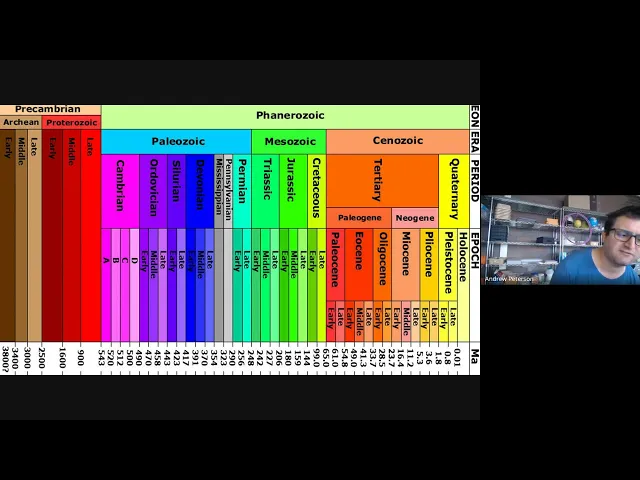
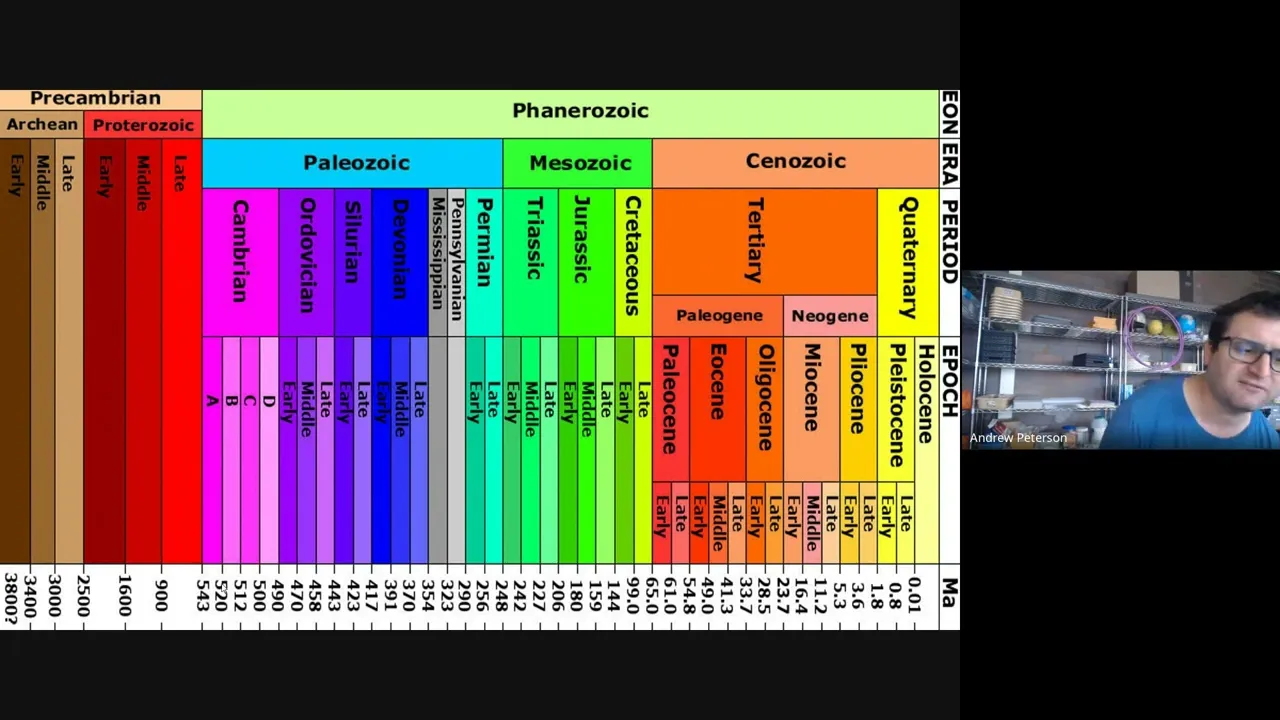
alligator hasn't evolved then it could indicate a bunch of time periods but I'm looking for are animals that are common around the world but we're only common very during a specific window time um so technique of relative dating has us used a category Rock age rather than just giving that a number so what we often do with relative a aging is we put it into a geologic time period instead of giving an exact age um I'll come back to that in a second so here is geologic time I have this poster uh vertically in my
classroom um and so the U the history of the world is broken down into sections first eons so we have the Precambrian fenzo Eon um and then from there you know eras Paleozoic Mesozoic and then from there we put them into periods Cambrian odian so it's just categories inside categories okay and what's cool is each of these categories has an an aging so like the Cretaceous if I look uh started around 144 million years ago and ended uh 65 five million ago ma is millions of years ago ma is millions of years ago okay so
like as I go what be to the left or down in this diagram the numbers get bigger because that means older and older and older and older one thing why we don't really love relative like if I use like radioactive dating one thing I really don't one thing that's really not great about radioactive dating is two things first off it returns a large range of numbers so like radioactive dating is it's only accurate to a couple depends on the sample but like it doesn't give you like this is exactly you know 128. 653 million years
old it gives you like it's probably around this age and then from there there's a huge error window you know a couple thousand million years in window the other reason why we don't really love radioactive dating yet is once again uh is because most Rock lers take you know hundreds or thousands of years to develop so saying it happened now is also wrong so the use of categories in this case is actually very warranted because first off it's hard for us to get exact numbers and then second most of these things are not happening instantaneously
they take Millions you know thousands of years to develop and so saying trying to give an one exact age is also wrong um um so that's so that's something to keep in mind uh leading us into the next thing please note that uh the big boundaries in these so like the the the big groups between the periods and the a eras and definitely the eons are essentially Extinction events okay very famous ones right so the difference between the meso and the zenzo was the you know was the was the thing that killed off all the
dinosaurs so like essentially what what's sad to think about this diagram is all these lines which are vertical but actually horizontal if you look at this properly all these lines represent a mass extinction event and what's crazy is the longer the line the bigger the extinction event okay so you know the longer the line is so like you know the difference between the late the early and the late uh cous was a small Extinction event the difference between the Jurassic and the cous was a larger Extinction event meaning more and more animals died off the
difference between the CR the meso and the cazo was a very very very large uh Extinction event um two things else I want to point out about this diagram first off over here on the right we know that the numbers are not linear they are uh almost relatively exponential so each a if I go as I go down and get older and older and older the eons actually cover larger and larger time periods so here like the coordinate the the Hine period runs from now current to 0.01 million years ago side note there's really current
argument arguing we have left the hallene um for a new Epoch with the argument that humans have caused enough global climate change that there's now a large geologic difference in the Rock layers um uh to Warrant be calling on a new Epoch but back to it once again if I look so once again the halio scene is 01 million years if I just even go back to to the Pennsylvanian period here it goes from 209 it goes from 323 million years ago to 290 million years ago so that is a difference of uh what's that
like 10 30 33 million years so this Gap is 33 million years this one is 0.01 million years the primary reason for that is as we go back uh later old into older and older times as we go back into older and older times we have less stuff around from that period of time and so we're not able to make as as many unique distinctions okay so like as we get closer and closer to Modern Times there's more rock layers there's more um there's more rock layers there's more fossils that are Remnant that are still
left over and so we could take those that ex that amount of information and help us break it down into more and more categories as I go further and back there's less and stuff remaining so I have less and less stuff to to use to basically build categories that's really evident here where we see like the Mesozoic um the Paleozoic are not really broken down into Epoch but here uh in the czo the czo is broken down into different epochs and then on top of it are broken down into late and early so literally like
the difference between we get a whole another system of categories uh we develop a whole another system of categories between the meso and the cazo side note on this on the test in class I'm never going to have you memorize this I will always give you this diagram I will always give you the diagram last thing I want to point out the Precambrian please note that once again my scale is exponential and it gets really really exponential when I reach the pre-cambrian so once again the Cambrian if I just use the Cambrian the Cambrian runs
from 543 million years to uh 470 million years so that's what like uh 73 3 million years period so the camarina is a 73 million year period if I get into the protozoic you know you're talking about almost 2,000 million or 2,000 million years okay so you're talking about this protozoic is being roughly two billion years old a window the primary reason for that is once again lack of evidence the preber pazo boundary so this boundary here the Cambrian pre-cambrian boundary is literally when fossilized Life Starts so when life that left behind bones or shells
was common enough for us to for that became common enough for them to leave evidence behind so really before this we have pl we have a fair amount of rocks before this the problem with the the Rocks is they don't have fossils in them for us help to do relative dating um after this period though fossilized life became very very very common and so we were able to start to make more and more categories whenever I talk about fossils people get really really really excited and then in this slide they get really really really depressed
here is some major uh index fossils from each uh time period in order to be an indox fossil two things need to be need to happen first off you needed to be very common during one period and not very common during the next so I'm looking for an animal that evolved and then died off and was not seen in another period example like right because like if the Fosso occurred in you know all the periods I couldn't use it to distinguish times apart from each other the second thing is they need to be incredibly common
on that that means they need to basically be uh small shells found in oceans why small shells found in oceans because oceans are way more common than land and so most index fossils are all Oceanic creatures because on Earth oceans are way way more common than land and so I'm more likely to find way way way more ocean fossils or fossils that were formed in the ocean okay so everyone's like oh we're going to talk about like T-Rex bones and what no no because T-Rex bones we would never use as a nid fossil because they're
incredibly rare the point is the index fossil is I could use it to compare different Rock layers from around the world world and T-Rex bones if they're only you know primarily found in like South Dakota that's not going to help me compare Rock layers in other countries to each other speaking of comparing Rock layers to other countries here's an example of that so these this is two columns two stratag graphic coms more on stratagraph coms later in the year that are you know hundreds thousands of miles away apart from them so when I look at
the Rel when I look at the Rock CS the first thing I know is once again in this one like Layer Three is older than layer four layer four is older than layer six layer six is older than layer seven and layer seven is older than eight and same thing on the right I know one is the oldest layer on the right and six is the youngest layer on the left or on the right okay the question is like how would I compare do how would I know that layer one is older than layer three
especially if they weren't just obviously numbered and so what I could use is index fossil so I see I see I find the same index fossil in this layer as in this layer so I could assume that these layers are relatively the same age okay and so I know that two and one are older than that layer okay so once again like layer four I see the same fossil in both layers so I could say even though these are 100 miles apart and it's hard to compare the elevation or whatever they're probably the same age
because they have the same indox fossils in them last note to this um please note that they've in this diagram they have the right side lower than the left to imply that the right side is older than the left side which makes sense but this would not happen in the real world you know the right side could be in the you know you know hund thousands of feet up in the up in elevation and this one could be at sea level but I could still use the index fossils to identify which layers are the same
age and then once I know which layers are the same age I could then compare the layers of all the ages based on their elevation last thing I don't love about this diagram I don't like that all the layers have fossil most layers in the real world won't have fossils okay what's more than likely what would likely be realistic is like layer four would have a fossil in it and so I would know like layer four is the same age in the right as it in the left but all the other layers wouldn't have fossils
in it and so I would then have to try to conclude relative AGS based on the height of it relative to layer four okay so once again this one's really nice because all the layers have fossils most sedimentary rock layers Mo all inas rocks don't have fossils in them