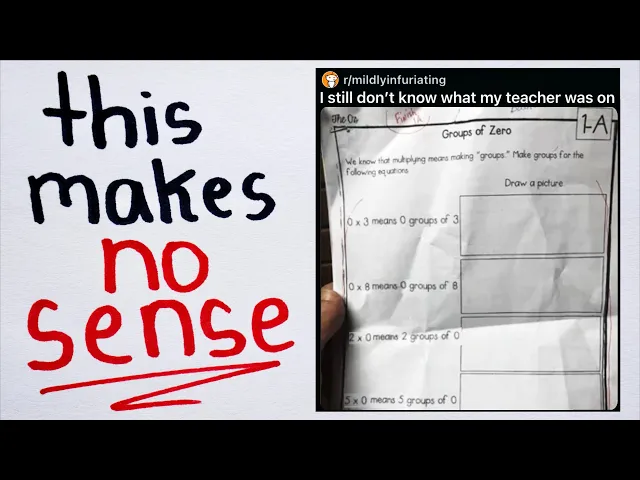
All right, we're gonna finish this poor guy's second grade math homework. I know, I know. Why would we waste our time doing someone else's homework, but it's not like it's advanced fourth grade math.
This is second grade, which means it's only half as hard. So, let's take a look. This is worksheet 1A.
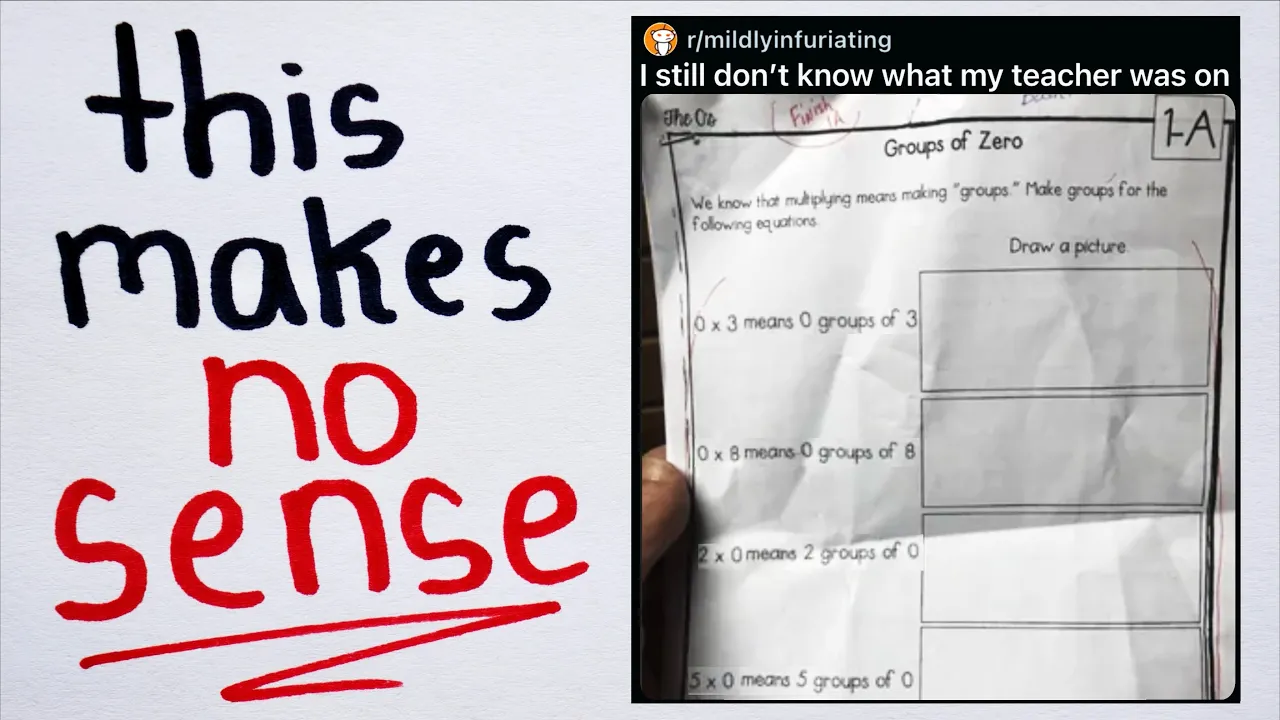
It says, we know that multiplying means making groups. Make groups for the following equations. And we can see over here on the right, we'll have to draw pictures for a few different multiplication problems.
And that's super easy. So, I really don't know what all the hubups about. In case you've never done something like this, 2 * 3, for example, is two groups of three.
So, if we wanted to draw a picture to represent that multiplication, we could just draw two columns of three dots each. We could count it up. See, there's six dots, which tells us that indeed 2 * 3 is 6.
So, that's all we have to do. Now, let's finish this darn homework. Let's see.
The first one is 0 * 3 means 0 groups of three. Um, well, let's let's come back to this one. The next problem is 0 * 8 means zero groups of eight.
Uh, 2 * 0 means two groups of five. WHAT? WHAT?
BRO. OH, if anybody shows this to Dena, it's so over. It's so over.
How are we supposed to draw 1 2 3 four groups of no groups of anything? You might think, well, it's a little silly, but obviously the correct answer is to just leave the pictures blank. It's a trick question to make sure you're paying attention, but that's what the OP did, and it was marked wrong.
You can faintly see in red pen how she has kind of circled these problems as if they haven't been completed. And it says on the top finish one A. And it's not like the student just turned in a blank worksheet.
At the end it asks what do you notice? And OP writes it's impossible to draw a picker. The presence of this question makes it seem clear that the teacher knows these problems are a little weird.
So what was he supposed to do? Oh boy. It's going to be tough to run defense on this one, but run defense we must.
What is the teacher on about? If this is wrong, what was a student supposed to do for these zero multiplication problems? Well, when second graders are taught multiplication, they're taught to think about it very concretely.
Research has shown that jumping into abstract things like pi multiplied together square root of two times is an ineffective way to get the multiplication message through to even the most precocious second graders. So how can it be made concrete? Well, like we just saw, we can actually draw out and arrange the objects that represent the multiplication.
3 * 4 is three groups of four. We can see concretely what this operation represents. But a more memorable level of concreteness can be obtained with manipulatives.
So I went to the store and bought 40 apples. Students may use things like this so they can really feel like the multiplication sign. What's 5 * 8?
It's like five groups of eight apples. In this way, even the groups themselves, not just the 40 apples are acting as objects we can see and touch and crinkle and cut. If the students were taught multiplication this way, then maybe it was the teacher's intention for the students to actually draw out the groups on this worksheet.
Maybe the students had been taught to represent 2 * 3 as two groups of three. So two boxes each with three circles in them, for example. Then for 2 * 0 on this worksheet, that means two groups of zero.
So just two empty groups. For five time zero, we would draw five boxes of nothing. And then going back to the top, for 0 time three, we um well, if if you just assume that 0 equals 1, then 0 * 3 is the same as 1 * 3.
And so obviously the answer would be this. But uh why would we assume that 0 is equal to one? I mean, that's hogwash, right?
0 time anything equals zero. So it's simple. There's no need to over complicate this.
The student should have received credit. But if we think they should have received credit because 0 * anything is equal to zero. So all of these pictures should be empty.
Well, is that something we can prove? It might seem like a basic fact, but mathematicians love proofs. If we could prove this, then that would show the students righteousness once and for all.
And what if we could prove that zero equals 1 and show that maybe the teacher was on to something? Today, we're going to do both. You might think that proving anything time 0 is 0 is basic math, but you'd only be half right about that.
If you want to train up for this sort of thing, check out today's sponsor, brilliant. org. To prove anything about zero, we're going to have to discuss some fundamental properties of algebra.
And Brilliant can take you from knowing these properties as a list of rules to understanding them deep in your very essence. Often, math teachers try to explain the intuitive processes underlying mathematics. But students forget about intuition when they're busy grinding out problems from the textbook.
What I love about Brilliant is how their exercises emphasize simplicity and interactivity in a way that whiteboard demonstrations and textbook exercises can't really replicate. There's a great selection of courses in math and science. For example, the visual algebra and quadratics courses will build on and test your understanding of some of the most critical properties necessary to prove basic and more complicated algebra facts.
To learn for free on Brilliant, go to brilliant. org/wrathofmath. Scan the QR code on screen or click on the link in the description.
Brilliant has also given Wrath of Math viewers 20% off an annual premium subscription, which gives you unlimited daily access to everything on Brilliant. And now it's proven time. Let's begin by proving 0 equals 1.
There are actually many proofs of this fact. For example, here's one from my first edition copy of Spivac Calculus. This proof shows that two is equal to one.
And of course, from there, it's a cinch to just subtract one from both sides of the equation and arrive at our result, 1 equals 0. But you might have noticed this proof isn't very convincing. We start off by letting x equal y.
Multiply both sides by x. So x^2 equ= xy. Then subtract y^2 from both sides.
On the left, we have a difference of squares which we can factor. On the right, we can factor a y out of both terms. Then divide both sides by x - y to get the x + y equals y.
x and y are the same. So x + y is the same as 2 y. And then just divide both sides by y to get 2= 1.
And then of course 1= 0. But when we say that x= y, well that means x - y equals 0. So when we divide by x - y here, that is bad news.
Dividing by zero is the oldest trick in the book. I mean, it can be used to prove anything, even absurd claims like women prefer dating older men because older men have more impressive collections of math books. If we're going to prove that 0 is equal to one and show that that teacher might have been on to something, we're going to need a proof that's a little more compelling.
Let's try this. What is an exponent? Well, it's repeated multiplication.
X ^ of 2 is just X * X. And what's multiplication? It's repeated addition.
Something like 3 * X is X + X + X. So that means X^2, which is X * X, must also equal X copies of X added together. So X2 equals this.
Now we use calculus. We're going to take the derivative of both sides of this equation. We don't have time to do a calculus intro in this video, but all we need here is what's called the power rule, which tells us the derivative of x to the n is n * x^ nus1, provided n isn't zero.
Thus, in the case of x^2, the derivative is 2 * x 2 -1. So, x 1. And in the case of the derivative of x, well, the unwritten power here is 1.
So applying the power rule we would get 1 * x^ the 1 - 1. So x to the 0. Anything to the 0 is one.
So this derivative is just one. One other important property we need is the linearity of the derivative operator. So to take the derivative of the right side of this equation, we can actually just differentiate the individual terms.
That's not how it works with multiplication. if we were taking the derivative of a product, well then we really need to consider that product. We can't just take the derivatives individually of the two factors.
But with addition, it does work that way. So on the left, we have the derivative of x^2 and on the right we have the derivative of all of these individual x terms. Like we went over, the derivative of x^2 here on the left is 2 * x.
On the right, we have x copies of the derivative of x. The derivative of x is just one. That means we have x 1's all added together, which is just x.
Then just divide by x to find that 2 = 1 and subtract one from both sides to find that once again 1 is equal to 0. The teacher then could simply argue that because 1 equals 0, these are the correct answers to the worksheet. And so the student deserves zero points.
So one point. We will come back to this argument later. But let's move on to the student's weapon.
A proof that 0 * anything equals 0. After all, even if 0 is equal to 1, if the student can show that 0 * anything equals 0, then answers are still correct. Saying we're going to prove 0 time anything equals 0 raises one big question.
If we can't just assume that 0 * a always equals 0, then what the heck can we assume? We can't just prove this fact out of nothingness. We need some agreed upon truths.
And these are called axioms. When doing multiplication and addition with integers, there are a variety of axioms we assume to be true. But let's just look at the ones we're actually going to need.
First, the fact that there is an additive identity called zero. This means that we have this integer called zero. So that if we add it to anything on either the right or on the left, it produces the same number.
It preserves its identity. Adding zero doesn't change anything. If you're ultra skeptical, you might ask, what if it's some other number that has this property?
Some number that looks like this. What if it isn't zero? Well, that's not how it works.
It's not that zero happens to have this property, but rather whichever number has this property, that's the one which dawn the noble robes of zero. Another axiom we need is that the integers have what are called additive inverses. Take any integer called say uppercase J.
Then there must exist another integer called negative uppercase J so that when it's added to uppercase J, the additive identity zero is produced. We'll also need the famous distributive property. This property tells us how multiplication interacts with addition.
And keep in mind some of the versatility of the distributive property. Yes, we can distribute a factor through a sum in the parenthesis, but we can also go the other direction, taking a common factor outside of a sum, and we can take that factor out on the left, or if we prefer, we could take the factor out on the right. Those are all the axioms we need.
We're going to start with 0 times an integer k on the right. and we're going to apply the properties we just discussed to eventually arrive at equals 0. You might want to pause the video now and try to see if you could save our unfortunate second grader and prove that this equals zero.
If not, no worries. Let's go ahead now and fill in the details. If you don't mind, just for the cleanliness of this presentation, let's omit the multiplication sign.
So 0 * k will write like this. Then we know that without changing the value of this expression we can add zero. We know that because there's an additive identity and its name is zero.
Then remember one of the ways that we can produce zero. If we combine additive inverses we get zero that additive identity. So if we wanted to, which we do, we could replace 0 with 0 * k minus 0 * k.
Then here we can apply the distributive property. We have 0 * k + 0 * k. Let's go ahead and take a k out of that and we're going to slide it out to the right.
Thus, we now have 0 + 0 and we've slid the k out of the parenthesis using the distributive property. and then minus 0 * k. Just to be pedantic, let's write that like this.
Plus negative 0 * k. Now what's 0 + 0? Well, adding 0 doesn't change anything.
So this is just 0. Hence, we can write this as 0 * k plus 0 * k. But then this and this are additive inverses.
They combine to produce what else? Of course, it's zero. And with one more axiom, the commutative property of multiplication, we know that order of multiplication doesn't matter.
So not only does 0 * k equals 0, but also k * 0 equals 0. Now there's no denying it. The teacher unfairly and illegally stole this students points.
He should have earned full credit because indeed all of these products equal zero. And so all the boxes should be empty. I wish we could go back in time and see how the teacher would argue this grading.
If the student asked, "What was I supposed to have written? " What would she say? We do have some anecdotes in the Reddit thread of people with similarly baffling grading issues.
Let's see how these played out. This guy says, "Reminds me of my second grade English teacher who denied me the chance to get 100% on every assignment because she said pickle was only one syllable and not two. " You Mr.
Johnson. My sixth grade English teacher told me colloquial wasn't a real word. My English teacher told me bizarre wasn't a real word and then gave me detention when I showed the dictionary entry to him.
At least good ending here. The detention was cancelled once she explained to the head mistress that it wasn't her fault that the teacher looked stupid. My teacher in fifth grade forgot to use an apostrophe on the blackboard.
And when I raised my hand to let him know, he sent me to inschool detention. This person also got a small amount of justice by being sent back to class because they couldn't be punished for being correct. Man, with teachers like that out there, maybe someone actually is teaching that zero equals one.
So, I suppose we better clear this up. What's the error in this proof? Naturally, your eyes might jump to the division by X at the end here and think, well, what if X equals 0?
Surely, this would be a problem. But it's really not a big problem. I can just say, assume that X is greater than zero.
Because the things we're considering are functions. X isn't some unknown that sneakily is already equal to zero. X is a variable that can take on infinitely many different values.
So if that's not the problem, then what is? Well, we can point to two big issues. Restricting X to be greater than zero is not a problem.
But there's another significant restriction that's implicitly forced by how we've gone about this. Does x * x^2 really equal x + x + and so on x? Yes.
but only if x is an integer. Whereas in the function x^2, even if we assume x is greater than 0, it's certainly not the case that x has to be an integer for this function to make sense. This is a graph of y = x^2 with x restricted to be greater than 0.
But if we look at the function from the right side of the equation where x has to be an integer, this is what it looks like. This is x= 1, y = 1, x= 2, y = 4 and so on. As you can see, it's way different from the function on the left.
And importantly, since we are taking derivatives, the function on the left can be differentiated. Let's give a quick explanation of the derivative just to make sure that this point is clear. The derivative of the function takes on different values at different points of the function.
And the idea is that at each point of the function, the derivative gives us an idea of the slope of the curve. Everybody's familiar with slopes of lines cuz that's really straightforward. A line just goes in one direction at the same rate forever.
And to find its slope, we take the rise and divide it by the run. In other words, that's the change in y written as delta y divided by change in x. On curves, this simple definition doesn't work so well because curves change direction as they go.
So the way we get around that with the derivative is to look at the point where you want the slope and then consider some point that's nearby. We can then draw what's called a secant line through those two points. The slope of this secant line gives us an idea of what the slope is at this point.
To get a better idea of the slope, take a closer point and look at that new secant line. By taking points closer and closer to the point we're actually interested in, we can get secant lines with slopes that are approaching what we consider to be the slope of the function or the derivative at this particular point. The key is that to find the derivative at the point, we're looking at secants through increasingly closer points on the curve.
But that's just not possible with this function on the right where x has to be an integer. Let's say we want to take the derivative right here. Okay.
Well, then I can draw a secant line through this other point over there. That gives me an approximation of the slope, but it's certainly not the derivative. And that's really my only choice.
I can't get any closer to this point because there's no closer points on the function. So for this function, the derivative does not make sense. So we tried to exploit a certain way of writing x squared but writing it this way implicitly has important restrictions that this proof does not account for.
The other more significant issue is also more subtle and that's the fact that we can't simply differentiate each of these terms individually and that's because the entire sum depends on x. If we just have x + x and that's our expression, then it's no problem at all to differentiate this entire sum by taking the derivatives of the two terms individually. How much change in x is there per change in x?
Well, of course, they're the same exact quantities, so the answer is one. X is the same as X. So, as X changes, X changes the exact same way.
Same thing over here. The derivative is one. The big difference with x + x plus and so on x times is that the sums structure itself depends on x.
In the simple expression x + x, what happens if x increases by some small amount delta x? Well, each of these terms will also increase by delta x. Simple.
But over here if x increases by delta x it's not just that each expression increases by delta x but the number of expressions itself increases by delta x. It's completely different. And because the structure of the sum itself changes with x, we can't simply differentiate it with respect to x term by term because then we'd be failing to take into account the change in the number of terms.
And when we're taking derivatives, we need to account for all of the change caused by the independent variable. So lo and behold, 0 doesn't actually equal one. And with that established, I'm finally confident in saying I have no clue what the teacher expected the student to write in these boxes.
If you have an idea, please share in the comments. And maybe with all of our combined energy and professions of saintliness, we can summon the students lost points from that sullen moment of the past wherein they were unduly ripped from his worthy hands. And be sure to subscribe for more of the swankiest math videos on the internet.
>> Texas instruments don't reply. I think this time it might be fatal. Wish to sell my own.
Hate the odds that I calculated and pull my brain all the way through the whole planet. >> Psychomatic habits. No sun.