Hello and welcome. In the second video, we will have a look again to our winning behavior. But this time we are looking how we can use the wind.
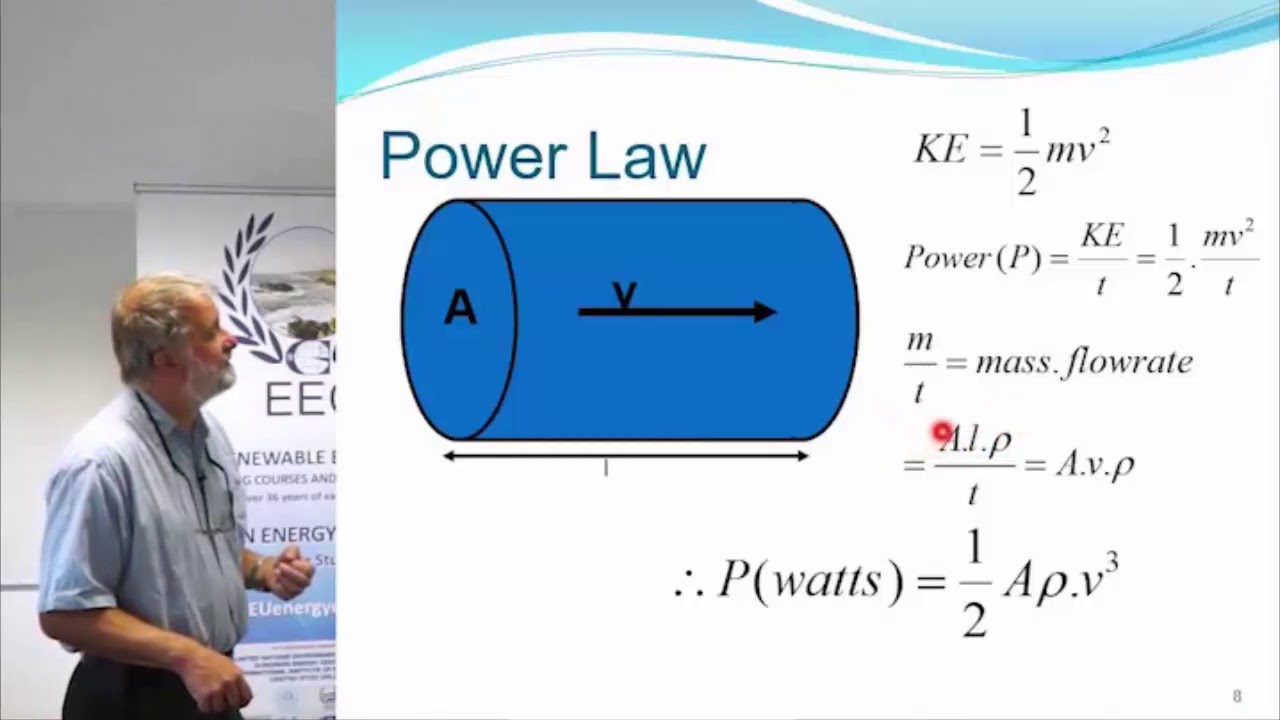
Is it possible to extract all the power from the wind or is there a natural limitation in this process? And therefore we are considering the bets impulse theory. So we have now the same cylinder of air that is moving around and now we are looking.
What happens when this cylinder approaches a wind turbine and then when the wind turbine is reached, what we are doing, we want to slow down the wind. And when we slow down the wind, we take power out of the wind. And definitely the wind speed behind the turbine is then at lower well you than before.
And as a consequence, it looks much more like we see here. So once more we assume that the wind we one approaching the wind turbine is quite large. Then probably the wind speeds at the wind turbine itself is we.
And when we have slowed down, the wind is definitely behind the turbine. The wind velocity, we too must be slower. So we have we too.
That is lower than we want. But now we see in the picture that this cylinder is getting wider. And why is that?
And that is due to the fact that finally the air mass remains the same before a wind turbine and behind the wind turbine . So we use the power of the wind, but we are not consuming the wind. The wind turbine is not eating or drinking wind.
So therefore, the amount behind must be the same. And when the velocity here is fast, then the area a1 needs to be different from the area a to. That means when the speed behind is slower, then the area just must be bigger.
And that means that the a two is bigger than the A one. And the first man who ever had a look to this question how much wind we can extract from the wind by a wind turbine that was stays bets and according to his him the impulse furious called the bets impulse fury there we would like to have a closer look first what we could. Express the power that we take out of the wind is the force the wind is giving to our rotor blades.
And that's we can do by the impulse rule that we say the force F is equivalent, the mass flow times, the difference of the wind speeds, we one minus we two. And that would be then our equation five. And we also considered the enumeration of expulsions from the last video.
So and then we also know that the power is equivalent to our force times the velocity and we use our expulsions three and five. Then we can express that the power p is the mass flow times the velocity of V one minus v two times two wind speed and the wind turbine itself. And we can express that with the density times the rotor area times the velocity to the to v one minus we to.
We also can have we look to the power of the wind turbine that it extracts from the wind by the different energy condensed in the wind before and behind the wind turbine. So we also could express that the power that we are extracting is just the kinetic power of the wind that we have for the turbine, minus the kinetic power that we have behind the wind turbine. That would be a conversion rate.
And when we know that it is equivalent to the expression of equals seven, then we get that the air mass times the V one minus two we two times the we that is equivalent then one half the air mass flow times we one to the square minus we two to the square . And then we also could eliminate the mass flow. And then when we solve the equation towards the wind velocity in the wind turbine area itself, then we get here.
That is one half times we want to the square minus we two to the square divided by we one minus we two. And there we see a by gnomic formula and that means that is we want minus we two times we one plus we two divided by one minus we two. And there we can eliminate those two.
And then we have the result that the velocity at place of the wind turbine is just one half times we one plus we two. That is not really surprising that the wind speed directly at the turbine is just the geometric mean of the wind speed before and behind the wind turbine. Nevertheless, we use that now to express the power that we have.
That we are able to extract. And when we put here the quotient nine in seven. Then we get here.
That is the density times the rotor area times one fourth times we one plus we two to the square, times we one minus we two and that is equal ocean ten. And now we are interested. What can we do?
What is the maximum power that we can extract? And when we have a function where we are interested in the maximum value, we need to have the derivation, the derivative of this equation and setting that to grow to zero. The question is to what we are deviating the equation and for sure density area are constants.
The V one is the inner velocity there. We are almost not able to influence that. So what we are able to influence with our technology, with the wind turbine, that is the velocity behind the wind turbine.
So in order to look for the maximum power, we write the P and make the derivate towards the velocity we two and then we do so we get here by the product rule, we get here that is one half row times, eight times we one plus we two times we want minus we two. And then it is minus one fourth. Road times a times we one plus we two to the square.
And that's when we are looking for a maximum real setting equals zero. So we could make that a bit easier by formulating this into one. How we want.
Plus we to. We want minus. We do.
Mine is. 144 times a wee one plus we two and we one plus we two. And then we can extract here one fourth row times, eight times this we one plus we two, and then we have 4/2 expression.
And there we have four limits to we one. Minus two we two. Minus we one.
Minus we two. And that we can express then as one fourth row times eight we one plus we two and then we have left here two, we one minus three times we two. And that still needs to become a zero.
And now we have two brackets expression. And that means one of those two needs to be zero to become zero in total. Then we have the first solution.
That would be that the we two is equal to minus two we one. That is from a mathematical point of view, a good solution, but from physics are more or less impossible. That would mean the wind that approaches the wind turbine is reflected with the same value in the different in the opposite direction.
At least up to now. Nobody has invented the wind turbine that works like that. So we have the second solution when the second bracket, the expression is becoming zero.
And that means we would have turned the we to is equivalent one third we won and that seems to be a logical expression. That means when the wind is approaching, if we one, we slow it down by two forward and behind the wind turbine, it is one third of the wind velocity we already have had. And when we now put this 11 into our E quotient ten, we get the expression for the maximum.
However we are able to extract. And that is one fourth row times a. Times 16 divided by nine we one two the square times 2/1 times we one and that we can express in a different way.
We use the expression one half for all times. Eight times we won to the free. And that is exactly the power of the wind.
And then we have remaining here a factor of 16 divided by 27, and that is exactly the maximum efficiency we ordered, the maximum part that we can extract from the wind. And that is approximately 60%. It is more 59 or something else percent.
So that is the maximum. In reality, we are a bit below this maximum value because in reality the picture looks a bit like that here. That means that our wind turbine, the rotor, is influencing our air cylinder by its presence and that means all the cylinder is getting in the rotation itself.
And when it's getting in the rotation, that means there's also energy needed to put the air cylinder in rotation and that we cannot convert into electrical power. And then we also observe for the rotor blades that we have such turbulences around the rotor blades that we also find. Then here in those parts behind the wind turbine, all that means that the efficiency in reality is even a bit lower than this theoretical 60%.
But with modern wind turbines, we are approaching quite close to this theoretical limit. And in the next with you we will then discuss why we need statistics to describe wind conditions and the energy yields of wind turbines. Thank you very much.