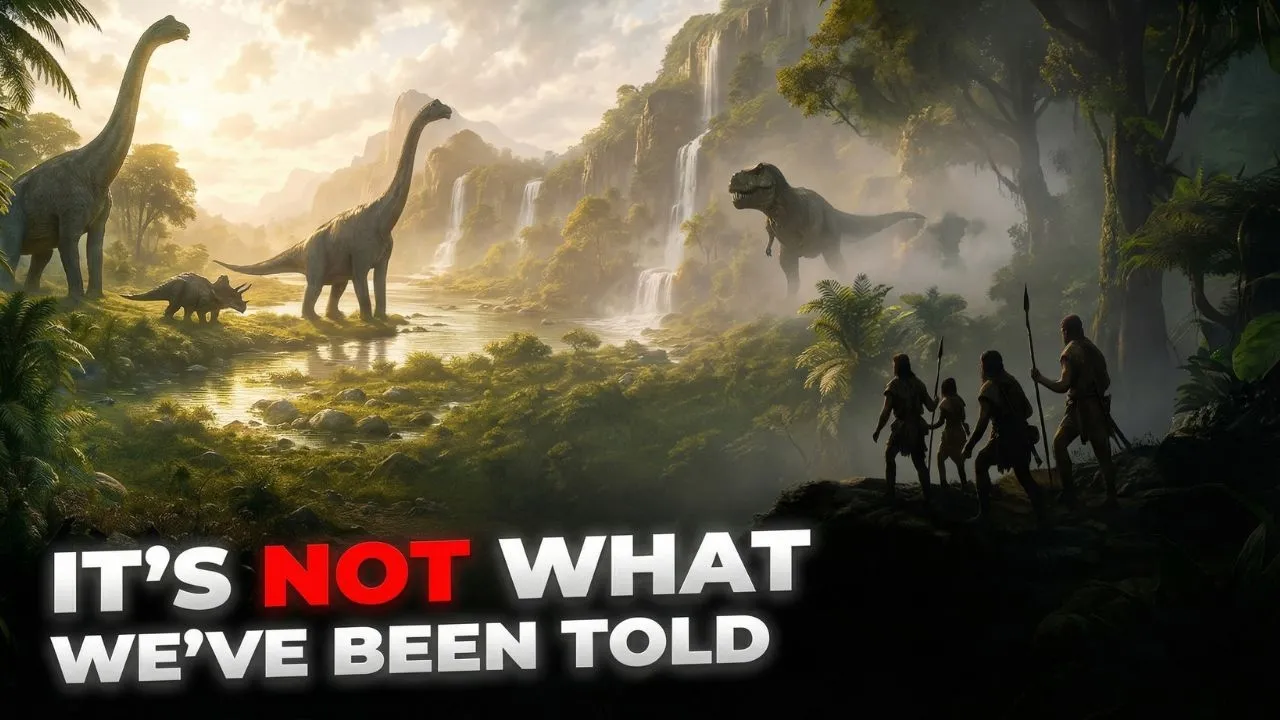
Those of you who have already walked through the pages of the sacred and have touched, even if only with your eyes, the ancient texts know that the Bible is not merely a book of answers. It is also a profound source of questions, mysteries, and curiosities that span centuries. Throughout the scriptures, there are accounts that challenge immediate understanding, passages that awaken silent [music] doubts, unspoken questions, and lingering unease that have accompanied attentive readers and scholars of the faith for generations.
One of these curiosities, perhaps one of the most intriguing, concerns [music] colossal creatures, giant beings of almost unimaginable proportions, whose existence is not only narrated, but attested to by remnants scattered throughout [music] the deepest layers of the earth. We are speaking of creatures we now call dinosaurs, beings whose existence is confirmed by countless fossils, petrified bones found [music] in rocks, mountains, and deserts around the world. In light of this, [music] an inevitable question arises, especially among Bible readers and students of theology.
Did dinosaurs really exist? And if they [music] did, where do they fit within the biblical narrative? According to historians and scientists, these creatures inhabited the Earth millions of years ago.
Modern science asserts that they became extinct [music] due to a catastrophic event, possibly a meteor striking the planet, causing an explosion of global [music] proportions, altering the climate and sealing the fate of these life forms. But does this explanation truly [music] close the matter? Does it answer everything that needs to be answered?
Or are we facing a story that is deeper, older, and perhaps less wellknown? What after all does the Bible say about this? In this video, we [music] will approach this subject with care, respect for the scriptures, and close attention to detail.
Not with the goal of creating conflict between faith and science, but of understanding what the sacred texts truly say, and what has often [music] been forgotten, ignored, or reinterpreted over time. For this reason, I ask you to stay with me until the end because I will bring to light some little known information, reflections rarely discussed, and connections that may surprise even experienced readers. If you are interested in the Judeo-Christian scriptures [music] or are a student of theology, you have likely encountered numerous questions while immersing yourself in these ancient texts.
And among them, one almost always emerges. Where do these gigantic [music] creatures fit into biblical history? The science dedicated to the study of these fossils, the bones transformed into stone over time, [music] is called paleontology.
However, long before this name existed, long before laboratories, modern dating methods, and classifications, these bones already intrigued humanity. [music] In the Middle Ages, when such remains were discovered accidentally, many believed they were the bones of dragons, beings similar to those described in medieval European mythology [music] and also in ancient Chinese traditions. Winged serpents, immense creatures, some described as breathing fire or ruling [music] the skies and the seas.
These discoveries fueled the imagination of writers, chronicers, [music] and entire peoples. But perhaps they were not merely the product of imagination. In light of [music] this, the question arises once again.
What does the Bible say about all of this? The doubt exists because at first glance, the Bible does not mention the word dinosaur. But this happens for a simple historical reason.
The term did not exist at the time the sacred [music] texts were written. To understand this issue correctly, it is essential to understand the origin of words. The term [music] dinosaur was coined only in 1841 by Sir Richard Owen.
He combined [music] two Greek roots. Dinos meaning terrible or powerful and soros meaning lizard. Thus, dinosaur literally means terrible lizard.
But this raises an even more interesting question. What were these creatures called before that? Especially in biblical times for centuries across different cultures around the world a different term was used dragon.
Over time meanings changed words were reshaped and the history [music] behind them was gradually lost especially to more recent generations. Few people know that the word dinosaur is a relatively modern creation while dragon was the ancient and universal term. And here we arrive at a [music] crucial point.
This is precisely the word that appears in the scriptures. In the Old Testament, originally written in Hebrew, [music] the word used for dragon is tanin. However, over the centuries, some translations chose to soften or reinterpret this [music] term.
In modern versions, such as the New International Version, it is rendered as great sea creatures or even as [music] monsters. Even in the book of Job, when the text describes the enigmatic behemoth, some footnotes attempt to identify it as nothing more than a hippopotamus. Yet, the biblical text itself describes a creature whose tail moves like a cedar, a description [music] that raises serious questions and invites the reader to look more carefully at what is being reported.
And it is precisely from this point that our investigation deepens. Historians state that dinosaurs inhabited our planet approximately 233 million years ago. An immense span of time when compared to the moment in which modern nmanllete was assigned to them.
This great temporal [music] distance between the existence of these creatures and the name they received raises [music] in itself an important question about how they were understood and described in the past. According to historians, these calculations are based [music] on the study of bones and remains found in various parts of the world. Fossils of these animals have been analyzed by numerous scientific authorities who sought to understand how they lived, how they behaved, what their natural environment was like, and above all, how their [music] extinction occurred.
From these analyses, modern science has constructed theories about the Earth's distant past. But in light of all this, the central question arises once again. What does the Bible really say about this subject?
The book of Genesis clearly and solemnly reveals how God created the universe, the heavens, the earth, the animals, and everything that exists within it. The biblical narrative presents an order in creation, showing that the first living beings created by God [music] were aquatic animals. Scripture declares that God said, "Let the waters abound with living creatures and let birds fly above the earth across the expanse of the heavens.
" It then [music] states that God created the great aquatic creatures and every living creature that [music] moves in the waters, each according to its kind, and also every winged bird according to its kind. And God saw that it was good. Immediately after the creation of aquatic creatures, [music] the biblical account describes the creation of land animals.
God creates the animals of the field, domestic animals, and wild animals, each according to its kind. It is at this point that many scholars understand it to be possible to include the creation [music] of dinosaurs, even though the text does not use that specific term. The book of Genesis declares that God made the wild animals [music] according to their kinds, the livestock according to their kinds, and all the creatures that move along the ground according to their kinds.
And God saw that it was good. The Bible does not explicitly mention an animal called a dinosaur during the creation account. This is the only moment in which these creatures can be placed [music] when considering the category of wild animals and the great beings created by God.
The absence of a specific name raises questions, but it also invites us to analyze how nmente was used in ancient times. To gain a clearer understanding, [music] it is necessary to examine other passages of scripture that may offer clues. In different biblical texts, we find names attributed to creatures of extraordinary proportions.
One of these names is Leviathan, described as a monstrous and gigantic being that dwelt in the waters, mentioned in vivid detail in the book of Job in the Old Testament. [music] In addition to Leviathan, we also find the figure of Behemoth likewise mentioned in the Old Testament. Unlike Leviathan, behemoth is described as a terrestrial creature, gigantic and powerful, whose strength and size surpass those of any ordinary animal.
According [music] to various scholars, dinosaurs included both land dwelling and aquatic species, [music] which causes these biblical descriptions to align, at least in part, with what science today [music] identifies as large prehistoric reptiles. In this way, the information found in the Bible when it speaks of Leviathans, giants, [music] and creatures of unparalleled strength does not necessarily stand in contradiction to studies that indicate the existence of dinosaurs of different kinds. It is important to remember that the term dinosaur emerged only in the 19th century and literally means [music] terrible lizard or powerful lizard, reinforcing the idea that these creatures were reptiles that [music] reached colossal proportions.
Ancient Jewish traditions, especially those preserved in the book [music] of Job, deepen this theme even further. For this reason, we will now look carefully at one of the most intriguing passages in scripture. In Job 40:es 15- [music] 24, we find a detailed description of Behemoth.
The text says, "Behold now, Behemoth, which I made along with you. He eats grass [music] like an ox. Behold, his strength is in his loins, and his power in the muscles of his belly.
When he [music] wills, he moves his tail like a cedar. The senus of his thighs are tightly [music] knit. His bones are tubes of bronze.
His limbs are bars of iron. In these verses, we observe striking characteristics. [music] Immense strength, bones described as metal, powerful muscles, and most notably, a tail compared to a cedar, a large and sturdy tree.
This description does not easily fit any animal known in the modern world, but it closely resembles in a surprising way [music] the image of a large herbivorous dinosaur such as a titalaur. The Bible therefore does indeed [music] mention creatures that fit perfectly within what we now call dinosaurs. By carefully examining the verses [music] just cited, we see that the biblical text describes in rich detail [music] the strength of this creature, highlighting the power concentrated in the muscles of its belly, the robustness of its loins, the imposing structure of its body, and above all, its tail compared to a massive cedar.
This description does not correspond to any common animal known today, but aligns remarkably well with the anatomy of a large dinosaur. The text also reveals that this creature was herbivorous, feeding on grass like an ox, which further reinforces this association. In verse 18, we read that its bones are compared to tubes of bronze and its limbs to bars of iron.
A metaphor that emphasizes the density, strength, and structural resilience of this colossal animal, suggesting an extremely robust skeleton consistent with creatures of gigantic proportions. [music] From verses 19- 24, Behemoth is presented as a true masterpiece of the ways of God. The text states that it receives pasture in the mountains where all the animals of the field may find rest.
It hides under shaded [music] trees among reeds and marshes surrounded by willows along the rivers. A scene that [music] conveys tranquility, mastery of its environment, and a calm demeanor [music] despite its unmatched strength. The account further states that this animal is capable of drinking so much water that a river seems insignificant before it as though it is [music] not disturbed even when the waters overflow.
This imagery reinforces the idea of a being [music] of extraordinary size and endurance. In verse 24, the text emphasizes that there is no way to capture or subdue it, highlighting its majesty, superiority, and invulnerability in the face of [music] humanity. The description of behemoth in the book of Job bears a striking resemblance to that of a titanosaur, a type of herbivorous dinosaur known for its colossal size, extremely dense bones, and long, powerful tail.
The comparison of its tail to a cedar, a tree symbolic of strength and stability, fits with remarkable precision the characteristics of these [music] prehistoric giants. In this way, the animal mentioned in the scriptures can be understood as a type of dinosaur created by God himself, demonstrating a harmony between the biblical narrative and studies that point to the existence of these creatures [music] in the earth's remote past. Far from being incompatible, these accounts may be seen as ancient descriptions of realities that science today seeks to understand through different means.
When we analyze the meaning of the name Behemoth, we find even more revealing elements. The term behemoth of Hebrew origin derives from the word for beast and in its expanded sense means [music] great beast or colossal beast. In Hebrew and Phoenician contexts, the term carries the idea of something gigantic, of extraordinary proportions.
In Aramaic, the meaning is similar, reinforcing the image of an immense, powerful, and awe inspiring creature. Behemoth, therefore, does not refer to an ordinary animal, but to something vast, dominant, [music] and beyond known standards. The book of Job leads us to a clear conclusion within this interpretive framework.
dinosaurs did exist. More than that, the text itself suggests that when God created the dinosaurs, he also created humankind. When God says to Job, "Behold Behemoth, which I made along with you.
" The expression indicates that this creature was made [music] during the same period as the creation of man. Biblically, this suggests that human beings and dinosaurs [music] coexisted at some point in the history of creation. However, an important observation must be made.
Not all types of dinosaurs [music] would necessarily have existed since the days of Adam. Some variations may have arisen later through processes of adaptation, fusion, and amalgamation, a subject that will be explained further ahead. An additional curiosity regarding Behemoth is that there is no direct mention of its entry into Noah's ark.
If this [music] specific creature had been preserved on the ark, the term behemoth would likely have appeared in the flood narrative. The absence of such a reference leads some to conclude that behemoth [music] or at least this gigantic species of dinosaur either survived the flood by other means [music] or became extinct after that event. Thus, we can conclude that these colossal creatures mentioned in the scriptures were part of divine creation and undoubtedly disappeared at some later point in history, leaving behind only remnants, fossils, and accounts that continue to raise profound questions about the earth's past and the mysteries of the ways of God.
There is yet another extremely interesting and curious [music] point related to this topic. One that leads us to an ancient and controversial book. The book of Enoch.
According to this text, these gigantic and colossal creatures often associated by many with dinosaurs were not simply ordinary animals, but the result of something far more complex and disturbing. The book of Enoch states that these beings were anti-deluvian amalgamations directly linked to the activity of the Nephilim. But what exactly does the term amalgamation mean within this ancient and biblical context?
According to the book of Enoch, an amalgamation would be a fusion, a mixture [music] between two distinct beings, generating something that would be neither a pure species nor part of the original creation as God had established it. This forms the basis of the [music] idea that certain colossal beings did not arise naturally, but through forbidden mixtures. According to this perspective, [music] dinosaurs would have emerged from some form of anomalous union between different creatures, meaning they were not [music] pure species.
Within this context, the figure of the nephilim also emerges. A nephilim is in [music] many accounts the result of the birth of a hybrid. In some cases, it is explicitly described as such.
In others, it is not directly labeled [music] that way. Yet it carries characteristics that point unmistakably in that [music] direction. According to this perspective presented in the book of Enoch, the Nephilim would be the offspring [music] of a union between fallen angels and human women.
However, the text also suggests something even more unsettling. The possibility of unions between fallen angels [music] and terrestrial animals created by God, such as reptiles. From these interactions, various species of gigantic, monstrous beings [music] of a corrupted nature would have emerged.
The Book of Enoch even reports that these beings possessed colossal [music] stature and extremely violent behavior. They would represent a distorted [music] form of creation, the direct result of a violation of the order established by God. It is important to remember that this view of the Nephilim and the giants who inhabited the earth connects to the same tradition that speaks of the origin of giants.
Still, according to the book of Enoch, the giants were born primarily from the relationship between fallen angels and human women. In the anti-delivian context, [music] that is before the flood, the amalgamations would have been essentially fusions between beings of demonic nature and terrestrial animals already created by God, especially reptiles. In this way, certain dinosaurs, particularly carnivorous, bestial, and monstrous ones, would have been the direct result of these unnatural mixtures.
Within this framework, dinosaurs would not be merely prehistoric animals, but manifestations of a corrupted creation, the product of unions between fallen angels and earthly creatures. Although non-cononical, this interpretation is present in the book of Enoch and strongly influenced ancient traditions concerning giants and monsters that once inhabited the earth. An additional curiosity within this perspective is the explanation for why many of these animals were not placed on Noah's ark.
The idea is that these creatures were meant to perish in the flood since they were [music] not part of the original creation and represented a profound corruption of the order established by God. According to this view, the earth could no longer endure so much pain, suffering, violence, and bestiality, especially in light of the presence of countless monstrous [music] creatures spread across its surface. Thus, God would have sent the flood not only as judgment upon a corrupted humanity, [music] but also as a means of purifying creation, eliminating most of these hybrid beings.
Only a small portion would have survived [music] for a limited time as would be the case with Behemoth which according to this interpretation would have become extinct shortly after the flood as we may infer from the book of Job. In the book of Job, Behemoth is described as a gigantic creature compatible with the image of a large dinosaur, more specifically a titanosaur. This reinforces the idea that not all such creatures disappeared immediately, but that some survived for a short period after the flood until they finally became extinct.
In this way, the modern theory that a meteor was responsible [music] for the extinction of the dinosaurs comes into direct conflict with this biblical perspective. Biblically, [music] the event that destroyed most of these creatures would have been the flood, leaving only a few survivors already destined for extinction. I hope you enjoyed this video.
Now I would like to know your opinion. Do you believe in these thesis and interpretations that I have shared here? Dinosaurs were indeed magnificent and gigantic beings [music] that inhabited the ancient earth.
Leave your thoughts on this subject in the comments as well. The fact is that dinosaurs did exist and the behemoth described in the scriptures fits the image of a titanosaur. Soon we will return with more profound reflections [music] on the mysteries of creation.
See you soon.