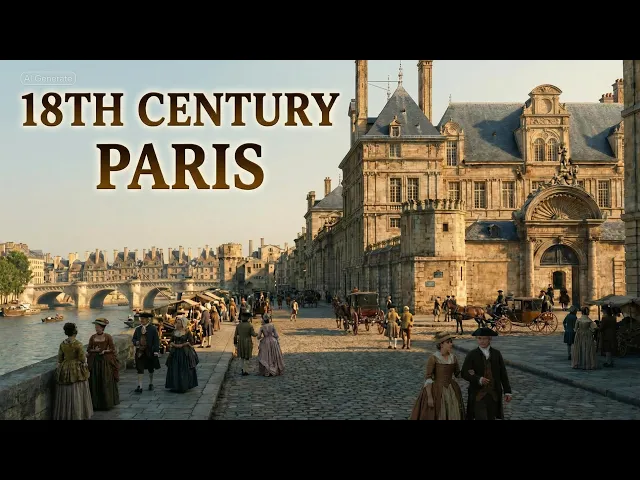
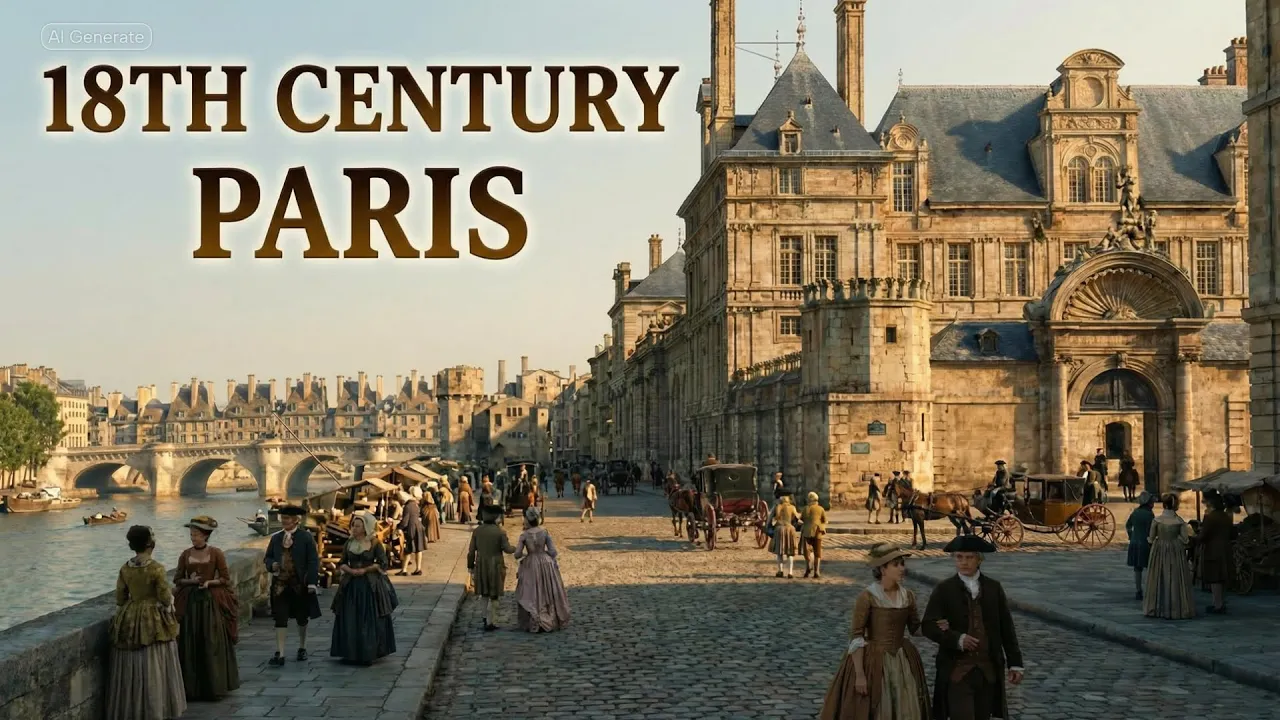
Welcome to a tour of Paris in the 1700s, one of Europe's greatest cities during a century [music] of elegance, enlightenment, and ultimately revolution. Using advanced AI technology, we'll be transforming centuries old engravings and paintings into photorealistic scenes, giving you a true sense of what life was actually like in 18th century Paris, France. Throughout the 18th century, Paris was home to about [music] 600,000 people, making it one of the world's largest cities.
It was the center of art, philosophy, and culture, [music] home to Voltater, Rouso, and the Enlightenment thinkers who questioned everything about how society should work. But behind the grand palaces and elegant architecture lay a city of stark contrasts. While aristocrats lived in luxury along the Sen, most Parisians struggled in crowded, filthy neighborhoods.
At the end of this video, we'll also show you images of the French Revolution brought to life. The explosive moment in 1789 when centuries of inequality finally erupted into violence that changed France and the world forever. This is the Sen River looking toward the eel deacete painted in the 1750s by Nicola Jean Baptiste [music] Ragun.
The Pornerf spans the river though by this [music] time it was already over a century and a half old completed in6007. The Sen was a working river crowded with timber rafts, cargo barges carrying wine from Burgundy, and merchant [music] boats bringing coal and grain to supply Paris's 600,000 inhabitants. The keysides bustled with steodors and carters hauling goods through muddy streets.
On the right bank stands [music] the astitute defos with its gilded dome built in the 1660s. In the distance lies the twin towers of NRAAM Cathedral on the Il Deacles, the medieval island that had been Paris's birthplace. But the river was far from pristine.
Raw sewage and industrial waste flowed directly into the Sen, creating a powerful stench. Yet Parisians still drew their drinking water from this polluted [music] river. Today the sen has been cleaned and the keysides [music] transformed into UNESCO World Heritage sites.
This engraving by Peter Shank shows NRAAM Cathedral in the early 1700s. The heart of Paris on the eel deacete. Construction began in 1163 and took nearly two centuries to complete, creating one of the finest [music] examples of French Gothic architecture.
The cathedral's iconic twin towers and magnificent rose window dominated the medieval island. Unlike today's open plaza, NRAAM was surrounded by densely packed buildings that came right up to its walls. The narrow streets were dark and filthy, covered in horse manure and waste with open sewers creating an overwhelming stench.
Despite the squalor, NRAAM remained Paris's spiritual center, hosting royal ceremonies, religious festivals, and daily masses attended by all levels of society, from kings to beggars. Today, NRAAM still stands on the eel deete, though the medieval buildings around it were cleared in the 1800s. The cathedral was severely damaged by fire in [music] 2019 and despite reopening in 2024, the final repairs are still ongoing.
This is the Hotel Deson, a magnificent palace built for Katherine de Medici between 1572 and 1584. The most distinctive feature was the tall astronomical column tower on [music] the right, a 28 m high structure designed for astrological observations as Catherine was deeply interested in astrology. By the 1700s, the palace had passed to the princes of Swasson [music] and housed various nobility, though it was no longer a primary royal residence.
The formal gardens [music] feature geometric parts typical of French Renaissance design, creating an elegant oasis in what had become one of Paris's most densely populated districts. The palace was located near Leal, Paris's central food market since the 12th century. The surrounding streets were among the city's busiest and filthiest.
Perpetually covered in [music] rotting vegetables, fish guts, animal blood from butchers, and mountains of horse manure. The stench from the market was overwhelming, [music] and the narrow medieval streets were dark, crowded, and muddy. The contrast between these elegant palace gardens and the squalid streets just beyond its walls was extraordinary.
The palace gradually fell into [music] disrepair and was demolished in 1748. Today, the site is part of the [music] modern Leal shopping district with no trace of Katherine Demadichi's magnificent palace remaining. This is the pale dutmplar showing the entrance to the headquarters of the Knights of Malta in Paris.
Originally built as the European fortress of the Knights Templar [music] in the 11th and 12th centuries, the property passed to the Knights Hospitaler after the Templars were suppressed in 1307. By the 1700s, this neocclassical gateway led into the residence of the Grand Pri of Malta in France, often held by French princes. The temple enclosure was a semi- autonomous zone within Paris, exempt from normal laws and taxes.
This special status attracted aristocrats seeking privacy and craftsmen seeking freedom from guild restrictions. The district became famous for workshops producing luxury goods outside guild regulations. The temple's most dramatic moment came [music] during the revolution when the medieval tower became the prison for King Louie V 16th and his family in 1792.
Napoleon demolished the entire complex in 1808 to 1811 to prevent it becoming a royalist shrine. Today, no trace of this once mighty fortress remains. This is the Fu Sanja, one of Paris's most famous seasonal fairs.
Held annually for 6 weeks from February to Easter on the grounds of the Abbey of San M Pre. The elegant neocclassical galleries housed hundreds of temporary [music] shops selling luxury goods, silk fabrics, jewelry, books, porcelain, and exotic imports. The upper level [music] pavilion featured theatrical performances including early opera and comedy.
All social classes mingled here, aristocrats in elaborate silk coats alongside merchants and street vendors. The covered arcades also housed cafes, [music] restaurants, and gambling establishments, making it essentially a temporary shopping mall and entertainment complex. The fair was suppressed during the revolution in 1789, and the buildings were demolished in 1813 to 1818.
Today, no trace remains of this once magnificent seasonal spectacle. This is the Hotel Duin, a grand aristocratic palace belonging to the Duke of Luen, located along the Sen on the left bank. The Luen family were prominent French nobility and their dup was created in 1619 for Charles Dalbear, a favorite of King Louis I 13th.
The palace exemplified the [music] lifestyle of French high aristocracy in the 1700s. It featured elegant classical architecture with multiple wings, steep slate roofs, and ornate facads typical of noble residences. Having direct river access was both prestigious and practical.
Boats could deliver goods and guests directly to the palace's private landing. These aristocratic palaces contain dozens of rooms [music] for grand entertaining, private apartments, servants quarters, and formal gardens. The private keys were better maintained than public streets, regularly swept by servants despite heavy pollution [music] from the Sen.
By the revolutionary period, such aristocratic luxury became controversial. Many noble palaces were destroyed during the French Revolution and the Hotel Duin no longer exists [music] today. This is the Palace of Versailles, the magnificent royal residence located [music] about 12 mi southwest of Paris.
While not technically in Paris, we couldn't make this video about France in the 1700s without covering it. Built by King Louis I 14th between 1661 and 1715. He transformed his father's hunting lodge into Europe's largest palace with over 700 rooms, sprawling gardens, and elaborate fountains.
The palace was dramatically expanded in the 1680s, creating the massive wings and courtyards we see here. In 1682, he moved the entire French court and government from Paris to Versailles, making it the center [music] of political power. Arriving nobles approached through three successive courtyards.
The palace's imposing facade growing larger with each [music] step. Inside, thousands of courtiers competed for the king's favor through elaborate ceremonies. On the garden side, formal parts designed by Andre Leno feature geometric layouts, [music] fountains, and treelined prominards where aristocrats strolled in their finest clothing.
The gardens were meticulously maintained, though horse manure from constant carriages and the sheer number of people meant conditions weren't as pristine as they appear in paintings. But Versailles extravagance came at enormous cost, consuming vast tax revenue while ordinary French people struggled with poverty and hunger. This disconnect between royal luxury and public suffering [music] would eventually fuel the revolution.
Today, Versailles remains one of the world's most visited monuments, a UNESCO World Heritage site [music] attracting millions of visitors annually. This is the Observator Perry, one of the world's oldest astronomical observatories still in operation. Founded by King Louis I 14th in 1667, construction was completed in 1672.
The building was specifically designed for astronomical observation. Its four facads face the cardinal directions precisely and its meridian line became the reference for all French maps until the Greenwich meridian became the international standard [music] in 1884. The observatory represented Louis I 14th's commitment to science and his ambition to make France the center of European scientific achievement.
It housed the newly founded academy dece and attracted prominent astronomers from across [music] Europe including Giovani Cassini who discovered four moons of Saturn from this building. The location was chosen on the southern edge of Paris away from city smoke for clearer observation. In the 1700s, this area was still semi-ural [music] with fields and gardens.
The observatory remains active today as a leading astronomical research institution after over 350 years of continuous scientific work. This is Lesin Valid founded by King Louis I 14th in 1670 as a military hospital and retirement home for wounded soldiers. Before this, disabled veterans were often left to beg on the streets.
Louis I 14th wanted to honor those who fought for France by providing them with care and dignity. The massive complex could house up to 4,000 veterans at a time with dormitories, infirmaries, workshops, and this vast esplanard parade ground. The iconic golden dome [music] designed by Jules Hardwan Mansard and completed in 1706 became one of Paris's most recognizable landmarks.
This engraving from around 1710 shows Lein Valid when it was brand new. Veterans lived under military discipline, attending daily masses, working in workshops, and participating in ceremonies. The area was cleaner than crowded central Paris, benefiting from open space and military maintenance.
Today, Lein Valid remains a working military hospital and houses the Musea de la and Napoleon's tomb beneath the Golden Dome, which was added in 1861. [music] By the late 1780s, France was in crisis. Decades of expensive wars and extravagant royal spending [music] had bankrupted the kingdom.
Poor harvests caused bread prices to sore while the [music] nobility paid almost no taxes, leaving ordinary people bearing the entire burden. When King Louis V 16th summoned the estates [music] general in May 1789, for the first time in 175 [music] years, the third estate representing commoners demanded real political [music] power. The king tried to suppress them.
On July 14th, 1789, [music] Parisians stormed the Bastile prison. The French Revolution had begun and violence spread across Paris [music] as crowds attacked symbols of the old regime. This depicts the violent pillaging of prison San Lazar on July 13th, 1789, [music] the day before the storming of the Bastile.
San Lazar was originally a medieval leper hospital that became a monastery, then a prison holding debtors and [music] people imprisoned by royal orders without trial. Paris was experiencing severe bread shortages and rumors spread that grain was being hoarded at San Lazar while people starved. On July 13th, angry crowds stormed the complex, freed about 50 prisoners, [music] and ransacked the buildings.
The mob seized stored grain, wine, and supplies, loading them onto carts to distribute in the streets. They systematically destroyed the prison, smashing windows, breaking [music] down doors, and causing an estimated 400,000 LRA in damage. Ironically, during the reign of terror in 1793 to 1794, [music] S Lazar became one of Paris's most notorious revolutionary prisons, holding aristocrats and suspected counterrevolutionaries awaiting the guillotine.
The complex was eventually demolished in the 19th century, and the Gar San Lazar train station [music] now occupies part of the site. This engraving by Helman shows the storming of the Bastile on July 14th, [music] 1789, the day after the San Lazar attack and the most iconic moment of the French Revolution. The Bastile was a medieval fortress prison in Eastern Paris, a hated symbol of royal tyranny where the king could imprison anyone [music] without trial.
On the morning of July 14th, thousands of Parisians marched to the Bastile, demanding weapons and gunpowder stored inside. The fortress's governor, Bernard Renee Delone, refused to surrender. After hours of negotiation, the crowd attacked with cannons and fierce fighting [music] erupted with musket fire and artillery creating clouds of smoke.
The battle lasted about 4 hours. Nearly 100 attackers were killed, but eventually the defenders surrendered. The crowd stormed inside, freed the seven prisoners held there, and brutally [music] killed Governor Deloney and several guards.
Their heads were paraded through Paris [music] on pikes. Though only seven prisoners were found inside, the fall of the Bastile became the revolution's defining moment. It proved that the people could defeat [music] royal authority through force.
The Bastile was completely demolished by November 1789. Today, the Plasta Bastile and the Coland de Jouier monument mark the site and July 14th remains France's national holiday, Bastile Day. The magnificent palaces, churches, and institutions we've explored today tell only half the story.
Behind the grand facades, most Parisians struggled in conditions we can barely imagine today. The ideas of liberty, equality, and [music] democracy that emerged from revolutionary Paris spread across Europe and beyond, reshaping how we think about government, human rights, and society itself. If you enjoyed this journey through 18th century Paris, please comment below what city and what era you'd like to see next, and your hometown may be featured in the next video.
Thanks for watching, and as always, we'll see you in the past.