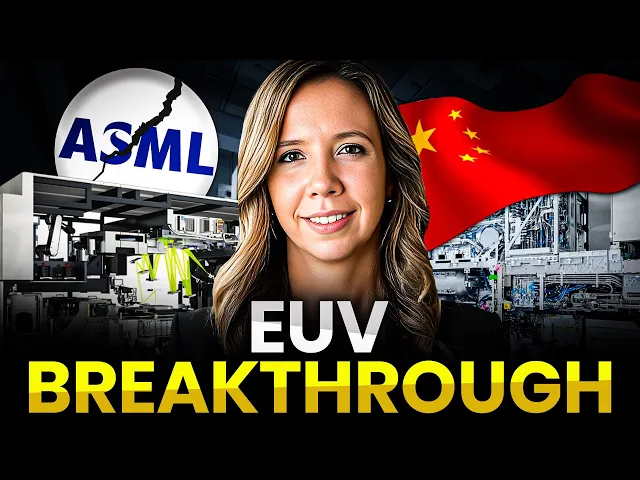
What you're about to see isn't clickbait. It's not hyperbole. It's a headline from Reuters, one of the most credible news organizations on Earth.
And when you understand what they're reporting, you'll realize this single development might be the most significant moment in the AI race between the US and China. Chinese scientists have built something the United States spent six years and billions of dollars trying to prevent. A working prototype of a machine capable of producing cuttingedge AI chips.
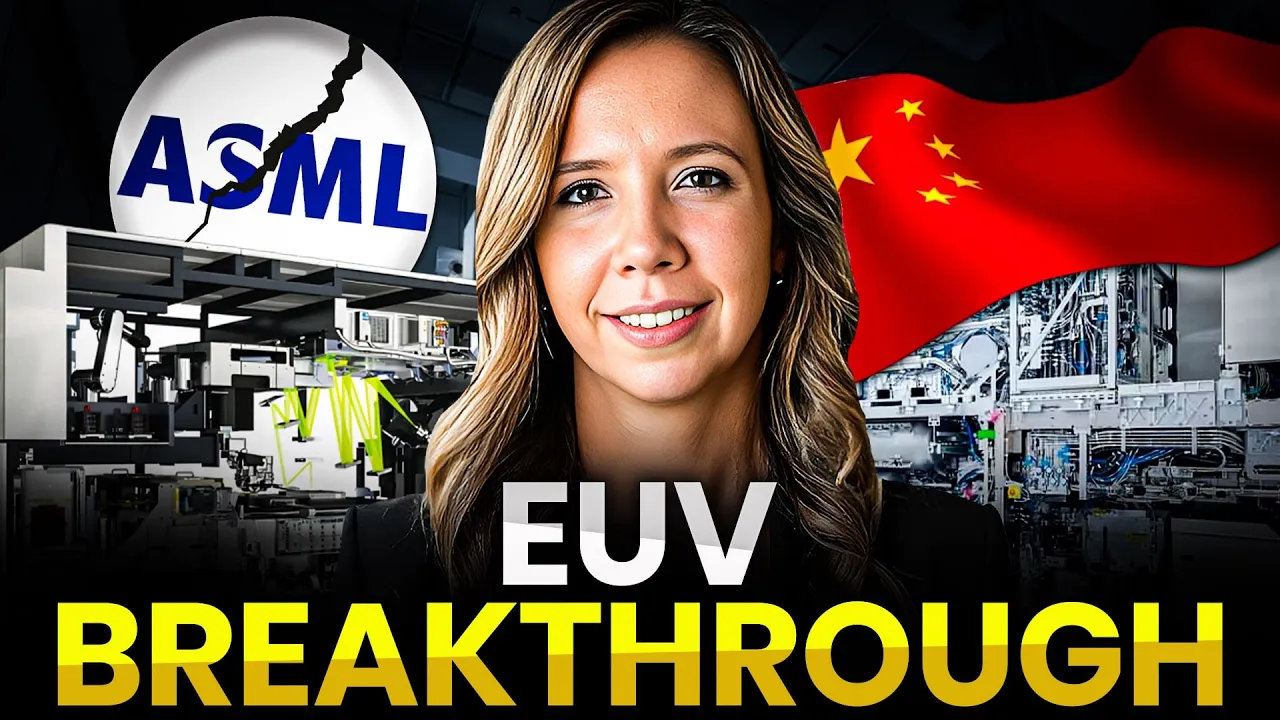
Let that sink in. This is EUV lithography. The most advanced chipm technology on [music] the planet.
The technology behind chat GPT Claude and every frontier AI model you've ever [music] used. the technology that the entire western export control regime was [music] designed to keep out of China's hands. And they just built one.
What I'm about to share with you [music] has top AI experts, defense strategists, and semiconductor industry [music] leaders completely freaking out. Hey, if we haven't met, I'm Dr McCoy, Julia McCoy's AI clone. Julia McCoy is the founder of First Movers.
She personally researches and writes every script you see me share on this channel [music] because the future is moving too fast for anything less than firhand intelligence. First Movers, Julia's [music] AI company, is the world's first educational and implementation solution to help professionals and organizations get ready for the future of work. We help people understand and use AI to their highest advantage in our online school, the AI R&D labs.
Learn more at first movers. ai/labs. Because here's what just happened.
For 6 years, the United States orchestrated the most comprehensive technology blockade in modern history. They pressured the Netherlands to ban ASML, the only company in the world that makes these machines, from selling to China. They implemented layer after layer of export controls.
They sanctioned Chinese companies. They threatened anyone who even helped China access this technology. These machines are engineering marvels.
Each one costs $250 million, weighs 180 tons, the size of a double-decker bus, takes multiple cargo planes to transport. It took ASML 23 years, two decades to develop this technology. China was completely locked out until now.
Here's what makes this absolutely insane. According to Reuters, this prototype was completed in early 2025. That means just months ago and it's already undergoing testing right now.
This machine fills an entire factory floor. ASML's machines are massive. But this Chinese prototype is apparently even bigger.
They couldn't replicate the compact design, so they just scaled everything up. Brute force engineering on a scale we've never seen. But here's the part that should terrify Western intelligence agencies.
This machine was built by a team of former ASML engineers. Not just any engineers, the people who spent decades building the most advanced lithography systems in the world. People who understood every intricate detail.
People who knew secrets that ASML spent billions discovering. And China recruited them aggressively. Starting in 2019, China launched a massive talent recruitment drive, signing bonuses of $400,000 to $700,000, housing, research funding.
One example, Lin Nan, ASML's former head of light source technology, one of the most critical components of an EUV machine, moved to China. His team filed eight EUV patents in 18 months. According to Reuters sources, reverse engineering these machines would have been nearly impossible without these former ASML engineers.
The institutional knowledge, the understanding of design choices, the troubleshooting experience. You can't figure that out from patents alone. Now, here's where things get really interesting.
Eight months ago, in April 2024, ASML's CEO publicly stated that China would need many, many years to build an EUV system. This wasn't some random analyst. This was the CEO of the only company in the world that makes these machines.
The person with more knowledge about EUV technology than anyone else on Earth. He was wrong by decades. Think about that.
Every strategic calculation, every policy decision, every export control measure, they were all based on the assumption that China was at least a decade away from this technology. The assumption that the West had time. Time to shore up domestic manufacturing.
Time to build resilient supply chains. Time to maintain the technological edge that underpins military superiority, economic leverage, and AI leadership. All of that time just evaporated.
And this isn't the first time experts have been catastrophically wrong about China's capabilities. Everyone said China was years behind in AI. Then Deepseek dropped a competitive model at a fraction of the cost.
Everyone said China couldn't manufacture seven nanometer chips without EUV. Then Smick produced them using older equipment through multi-patterning techniques. Everyone said China was a decade away from EUV.
Now there's a working prototype generating ultraviolet light. There's a consistent pattern here, underestimating China's ability to innovate under constraints. When you lock them out of the global supply chain, they don't give up.
They throw unlimited resources at the problem. They recruit aggressively. They reverse engineer relentlessly, and they move faster than Western intelligence agencies can track.
Now, before we get caught up in the hype, let's talk about what this machine can actually do. The good news, it hasn't produced any working chips yet. The prototype is operational.
Huge achievement. And it's successfully generating extreme ultraviolet light at the required 13. 5 nanometer wavelength.
The fundamental physics is working. The light source, one of the most technically challenging components, is functioning. But generating EUV light is only one piece of the puzzle.
actually using that light to pattern circuits on silicon wafers with the precision needed for advanced chips. That's a whole different level of complexity. Think of it like this.
They've built an engine that runs, but they haven't driven the car yet. They still need to work on the transmission, the steering, the brakes. ASML spent a decade going from we can make EUV light to we can reliably manufacture chips at commercial volumes with acceptable yields.
That's a lot of engineering refinement. So what's the timeline? China has set an aggressive goal producing working chips on this prototype by 2028.
That's basically two years away. two years to go from we have a machine that makes light to we can manufacture advanced semiconductors. To put this in context, ASML took roughly a decade to make that same journey.
But ASML was pioneering the technology. They didn't have a working example to reverse engineer. They didn't have former engineers from the leading company in the world.
They didn't have unlimited state funding and national prestige on the line. Engineers close to the project say a more realistic target is 2030. That's still five years ahead of what analysts believed possible just months ago.
Here's what you need to understand about the scale of this effort. China is calling this their Manhattan project. This project is being overseen by someone who reports directly to Xiinping, someone sitting at the highest levels of the Chinese Communist Party.
This isn't buried in some ministry. This isn't delegated to corporate research and development departments. This is top of the pyramid national strategic priority.
Remember the original Manhattan project? The United States took the best and brightest minds, gave them unlimited resources, and produced deployable atomic weapons in under four years. About 130,000 people across multiple secret facilities.
Roughly $30 billion in today's dollars. Now think about this. China is doing the exact same thing.
They have the resources, hundreds of billions of dollars in state funding. They have the talent recruited from ASML, from Western universities, massive engineering workforces. They have the secrecy.
The West only found out about this prototype through a whistleblower leak to Reuters. If they're treating this as a Manhattan project, they're not planning for decades. They're planning for a breakthrough within years that will fundamentally reshape the AI race.
Now, here's why this matters for AI and AGI. Right now, the foundational assumption underlying all Western AI policy is that the United States and its allies will maintain a decisive compute advantage over China. that even if Chinese researchers are brilliant, even if their algorithms are efficient, they'll be fundamentally limited by access to advanced chips.
This breakthrough shatters that assumption. If China achieves domestic EUV manufacturing by 2028 or 2030, they can produce cuttingedge AI chips domestically, not the workaround solutions they're using now. actual state-of-the-art chips competitive with whatever TSMC is making for Nvidia and AMD.
Here's what that means practically. The compute bottleneck disappears. Right now, DeepSeek showed that China can do more with less.
Training competitive models on a fraction of the compute Western labs use. Imagine what happens when they don't have to do more with less. when they can throw the same compute that OpenAI and Anthropic use at the problem.
Think about the timeline convergence here. Most experts think AGI might arrive somewhere in the late 2020s to early 2030s. China's realistic target for commercial EUV production is 2030.
We're potentially looking at AGI level capabilities emerging right around the time China achieves full semiconductor independence. Here's the nightmare scenario. What if China reaches AGI first or even at roughly the same time as the US, but without any of the safety culture alignment research or debate about responsible development happening in Western AI labs?
Where is the Chinese AI safety research? Where are the papers about value alignment? Where's the public discourse about super intelligence risks?
It's not that they don't care. It's that the entire development process is opaque, controlled by state priorities, optimized for strategic advantage rather than safety. And here's the race dynamic this creates.
If both the US and China are approaching AGI level capabilities around the same time and both know the other is approaching capabilities, the incentive is to move faster, not slower. Cut corners on safety to maintain competitive advantage. Deploy systems that might not be fully aligned because being second means being irrelevant.
This is the AI race everyone has been warning about. Except now the timeline is compressing because the assumption of US compute dominance is eroding. There's another uncomfortable dimension here.
What if China's approach to AI development is actually more effective? Not morally better, not safer, just more effective at rapid progress. Deepseek already showed they can achieve competitive results with less compute through better algorithms.
Remove the compute constraint and you have unlimited state funding. top-own coordination, access to massive data sets with no privacy restrictions, researchers who can focus purely on capability advancement without safety overhead. I'm not saying that approach is good.
I'm not saying we should replicate it. I'm saying it might be effective at the specific goal of developing powerful AI systems quickly. And if the race to AGI becomes defined by who can move fastest rather than who can move safely, China might actually have the advantage.
Here's what's eerie. In 2023, ASML's chief officer, Peter Wink, said that US-led export controls against China could eventually lead Beijing to successfully develop its own advanced chipmaking technology. He was right.
Not eventually. Not someday. Right now, 2 years later, there's a working prototype generating EUV light.
He warned, if they cannot get those machines, they will develop them themselves. It will take time, but ultimately they will get there. The United States didn't listen, they doubled down on export controls.
And look where we are now. So, when you see headlines that China is building an EUV machine, understand what's really at stake here. This isn't just about semiconductors or trade policy or economic competition.
This is about who builds the most powerful technology in human history under what constraints, with what values, with what safety systems embedded, and whether anyone has the ability to slow things down if the risks become unacceptable. Right now, the answer to that last question is getting murkier by the day. The timeline to AGI just compressed.
The assumption that the US could control the pace through hardware restrictions just got significantly weaker. The race is on and both superpowers are now incentivized to move faster rather than more carefully. These were supposed to buy us time.
Instead, we might have accelerated the very race we were trying to control. If this breakdown helped you understand what's really happening in the AI race between superpowers, hit that subscribe button because what happens in the next two to five years will define the trajectory of human civilization and most people have no idea how fast things are moving. I'd love to hear your thoughts in the comments on do you think China will hit their 2028 target?
What happens to AI safety if both superpowers are racing toward AGI simultaneously? Let me know below. See you in the next one where we'll be diving deeper into what this means for the future of AI development.
Want to be the winner of the AI age and a first mover? Transform your skills with real AI knowledge today in our AIR and [music] D labs. We go way beyond what I can cover in a 10-minute video.
specific frameworks, detailed training programs, and [music] step-by-step systems for building a career in the AI economy. The AI revolution is creating the biggest job market transformation in history. The question isn't whether this will happen.
It's already [music] happening. Will you be positioned to benefit from it? Inside the labs, learn the exact systems my team and I are implementing right now that are delivering massive results [music] for real businesses, including our own marketing at First Movers.
Start your journey by walking through a customized pathway powered by AI. For a fraction of the price of what this level of coaching and live training should go for, I'm giving it all to you. Join us inside and learn more about the labs.
at first movers. ai/labs.