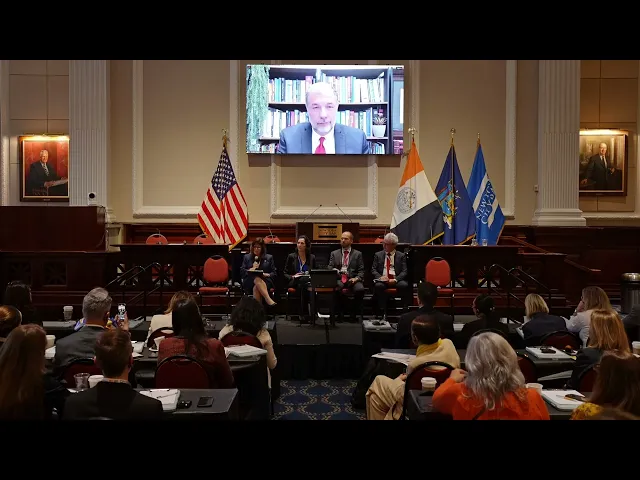
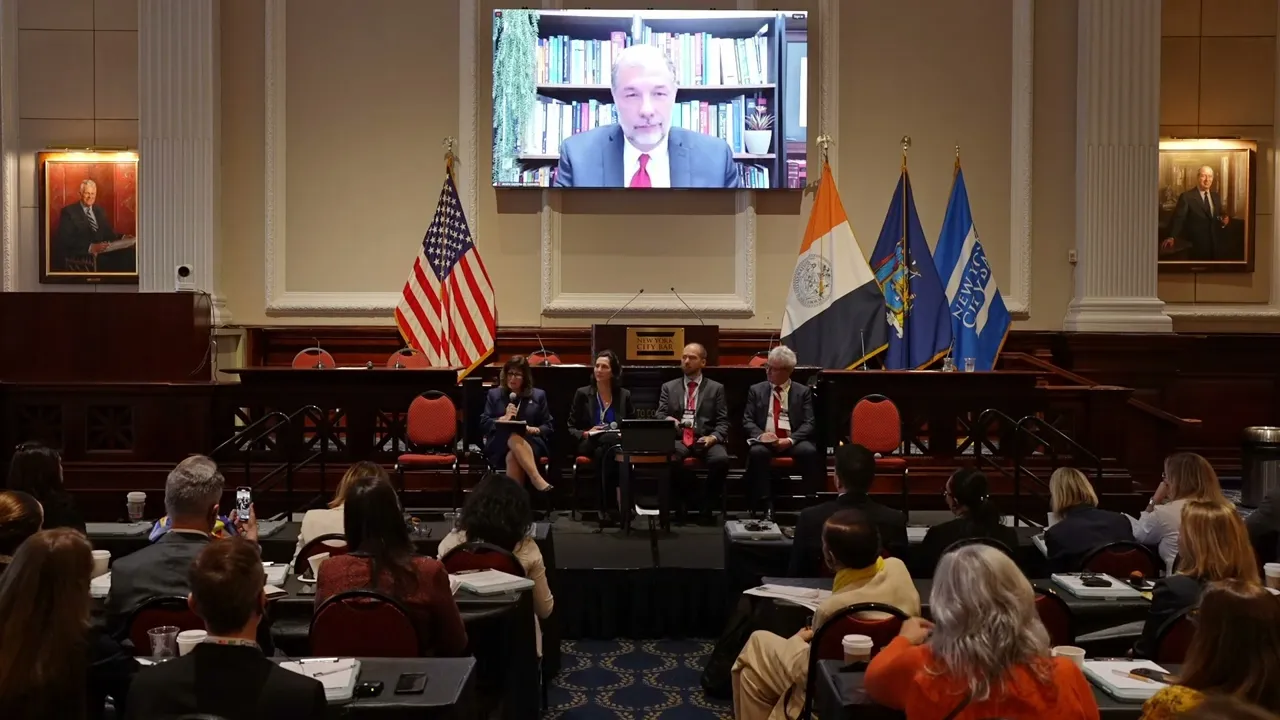
Então agora nós vamos dar as boas-vindas pro segundo painel que vai ter o moderado pelo Felipe cobo com a Judge Debora Judge Roberto and GT cont mediation negr United States Brazil eu vou falar em português speak in Portuguese but sometimes Will translate to english algumas vezes vou Traduzir para inglês para ficar um pouco mais dinâmico so can be a little B more damic ah à minha direita Ah está a juíza Debora Klan Debora keplan eu vou ler o currículo dela em inglês que é um currículo muito extenso e e eu acho que fao mais apropriadamente
em inglês Debora Klin was appointed deputy Chief administrative Judge of the New York City Court october 2021 Prior To Since J Nation administrative jge civ and criminal county from September Jan 2018 Prev her JD from the ST joh University School of Law and her bachelor nbs from the state University of New York alban also with me I have by my and bachel by University of Columbia à minha esquerda eu Tenho Roberto Bacelar que nosso querido amigo e Desembargador no Tribunal de Justiça do Paraná um dos Pioneiros no Brasil na introdução dessa nova idade racionalidade consensual
lá atrás com ah os juizados de Pequenas Causas como ele fez referência e teve um papel muito importante no estado do Paraná na implantação dos juizados especiais né Cívil e criminal Ah o professor Roberto Bacelar também é Mestre é doutor é professor de formação continuada de Juízes tanto em âmbito nacional pela Escola Nacional de formação de juízes quanto em âmbito e estadual e não só no Paraná mas em diversas outras escolas de magistratura é autor de vários livros e artigos e é uma referência para nós nesse tema de consensualidade e nós temos aqui conosco ah
na tela à distância ah a uma pessoa que também o nome precede o homem André Goma que é famoso e muito conhecido no Brasil por seu trabalho junto ao CNJ e a de um modo geral na apresentação da mediação no Sistema Brasileiro né na resolução 125 2010 CNJ e ele também aqui nos passou brevemente um currículo que também vasto Senior research fellow at Harvard University adun Professor at the institute for dispute resolution University 2014 e auxiliary Judge to the presidency of the Supreme Court and Of The National council of Justice in Brazil 2014 to 2016
visiting research at Harvard Law School Master in Public administration ongoing on Harvard can School phd and llm also Professor goma a pleasure to have you here with us posso falar em português também com você me sinto à vontade bom nós vamos começar Então nossa apresentação quero passar a Palavra para as duas colegas a juíza Débora keplan e que é na verdade a maior autoridade judicial na estruturação então do sistema de ADR nas cortes de Nova York e o braço direito dela que funciona na função de diretora do programa de ADR da do sistema Estadual de
Nova iork de justiça que seria a Lisa kurtney so if I'm not wrong introducing your funs I'm give you the word Please fls morning but with Good afternoon Wonderful to be here Among so great colleagues and Friends so US take so happ you in New York and We're excited to to RR most people say It's alternative dispute resolution I have always said It's appropriate dispute resolution Not One method Fits every Case and That's What I always Call it It's Something That I feel very about as a lawyer as a Trial Judge as an elected Justice
as an administrator and we are continually striving in New York to enhance the administration of Justice in our courts and to making ADR Services widely available throughout New York City and Across New York state which is a big area with 62 different counties and lots of different courts this Goes a way towards the efficient affordable timely and just resolution of our cases and I Am delighted That New York and our courts Have been recognized Now as a Center in internationally for dispute resolution we have Hed and invested in ADR coordinators in almost all of our
courts in all of our 62 different jurisdictions that Make Up New York state to Help oversee and facilitate that process to show the significance and importance to the leadership to our judges to our Staff of appropriate dispute resolution I delighted that Lisa Courtney was selected from very Competitive process to Lead that effort as our Court director of appropriate dispute resolution but when I talk about our courts they're just like you not One Type of Court we have Supreme courts both criminal and civil we have a New York City and lower civil Court we have Family
Court we have housing Court and of course we have surrogates Court and are appropriate dispute coordinators identify cases that would benefit from ADR determine the type Resolution would be appropriate for a particular Case and then streamline the referral process and track the cases that are sent ADR to Ensure that they have Taken Advantage of the program that they have been referred and we know that there's been an outcome because we have to constantly listen and Seek and refine And redesign and work together with our stakeholders we also make sure that if a case is not
resolved that it remains on the Calendar of the assigned Judge so Can fors resolution through the reg process and scheduled necessary for trials but enhancing and expanding ADR options in our courts is really a priority for me Since I was the administrative Judge New York county which is as youve heard probably the busiest Trial Court This is here in Manhattan in the United States so I know that some form of ADR is very much more likely to be in Line with What the li needs and goals Resua responsive to the needs of the parties What
a Court can Order that ised our Power and moreover the process Will less FR with Emotion and significantly Preserve relationships and of course there's finality much greater finality when an agreement ised so now very more toat I'm going to turn the presentation over to Lisa Courtney our Director for New York state unified Court System ADR Division to give an overview of the types of ADR our Providers and our overreaching goals Thank you thank you so much Judge kaplin and thank you to everybody for Being Here Today uh as You Could see we are incredibly fortunate
to have judicial leadership like Judge Klin Who really understands what we are trying to do and What We're talking about when we talk about ADR if you don't have judicial leadership It's Not GNA work so I just emph that as something that is worth Investing in and cultivating and nurturing and seeing Who are the judicial leaders who can really bring Movement for and weck is Leader and always New Rule 60 of the rules of the Chief Judge our Chief Judge issued a Rule empowering our Chief administrative Judge to develop rules around mediation and other forms
of ADR along with that there are also mediator standards of conduct and this is an important Element Of growth in dispute resolution particularly in New York state so we Now have the Authority that a lot of our judges had said previously by What Authority refering to ADR so this answers that question part 160 of the rules of the Chief administrative Judge also refer back to earlier rules such as standards for community dispute resolution Centers we have a Network of not for Profit cdrc we also have confidentiality Through that Rule i' mentioned standards of conduct we
talk about a complain process we have certain kind of overarching universales out of this part 160 as well as Training and Experience standards for mediators and neutral evaluators on Court rosters so this legal infrastructure to undergird the ADR effort is very important it shows our judges and our liant that There is judicial leadership behind This this Movement really and that are certain uni definitions considerations are really important to have so that there Public Faith in What We're offering this New Division that Judge Klin talked about reflects our Court Systems commitment to ADR coincides with rules
and is organized around Training programs and development data and reporting you've heard these themes throughout all of the various speakers Who come to Talk whether It's in the Private sector whether It's jams ora CPR are these kind of organizational kind of structures Without outreach education we really couldn't do much so education has been a really important Part of this initiative Judge Klin One of the last times we were sitting here together we were doing a program What's In it for me the practitioner because it's not Enough to get the judges on board you also have
to get the lawyers On board why it could be beneficial to them for some lawyers they vi ADR as alarming Drop In revenue accelerating revenue dispute resolution professionals have made jokes that that is how a lot of attorneys Might View ADR so having panels such as in this Big Space here with liat with judges with mediators Together showing how attorneys you could do this just working Together in a different way Is a really powerful Piece of the work that we do programs and Development we want to offer access to Justice equal jce we want to
make ADR is affordable we have community mediation Centers that we F and they receive funding from other sources as well we also have Court Staff in neutral roles which Plays a very important part because Court Staff are trusted by our judges and by the attorneys and data reporting we constantly trying to refine make it easier to capture information to the Information interf with exis Case Management so part 160 basically encourages and requires judges to refer to an appropriate ADR process on the earlier side unless certain exceptions apply so It's really a default Switch from a
litigate first to a mediate first mindset that does not mean every Case Goes to mediation but it means there need to an Lens through which you are viewing your Case types and Case loads In your courts the Focus as you've heard other speakers say is often on mediation because whether or not people go in a required way or whether or not they voluntarily go we know that the prompt of going to mediation often helps to resolve the Case um but again there are opt outs so at each opportunity if it doesn't make sense for the
Court or the Case Type there's a way to Exit the part 160 provides for confidentiality And exceptions and also Calls Upon local courts to develop local rules because as previous speakers have said a lot of politics are local and so are a lot of practices so This Way local courts working with their Own stakeholders and their communities can help figure out How will ADR work in our Court in our Case Type with the resources that we have and also this Rule also encourages judges to continue with the work of settlement conferences in New York state
unlike in many other Court Systems we have a very Rich staffing structure that doesn't always feel like it's Rich Enough but we do have judges working Together with Court attorneys Court Staff Who work together with judges not just to Help judges with research and writing on decisions but to Help conference cases and many Have been trained in mediation and other forms of ADR so we have internal Network of mediation ST can help our judges Case resolution So that is also partti common typ of ADR these are just some definitions when we talk about mediation the
mediator is not deciding the Case it's helping the parties communicate And negotiate and the settlement conference that I Just mention the Judge or the judges representative and it could be dedicated Court Staff and a Special Court part the meeting with the attorneys mainly but sometimes with the Parties as well to try to settle some or all of the issues in dispute before Trial so we find that settlement conferencing the variety of models of settlement conferencing really helps um in in our ADR efforts we also have neutral evaluation and Judge caplin will talk about some of
the programs that we have in New York City but that's Where an Expert In The subject Matter reviews strengths And weaknesses and predicts likely Court outcome we also found a lot Of our excellent neutral evaluators were also trained as mediators so we see that some of our neutrals are using Hybrid approach and arbitration as you know hearing arguments And and making a decision deciding on an outcome and there also restora of Justice a process meant to address the incident of harm and so we see that with our community Centers ADR providers you in New York
state we have judicial conferencing conference Matters to Help find a Resolution and avoid litigation a lot of judges Will say that's what we do already when you talk about ADR How is that different than what I'm already doing I try to settle cases at every opportunity not All judges do but some judges do see that as a very important Part of their role but we have judicial and non judicial settlement many ADR programs have dedicated Court Staff that we talked about and we also have rost of outside neutrals people Who have Taken Mainly attorneys but
not always 24 Hours of initial mediation Training 16 Hours of additional Case specific Training and they have recent Experience mediating actual cases they have comedi they have observed sometimes they've had mentors working with them and then they agree to participate on our Court rosters they give a certain amount of free time and then if the parties want to Engage with them the parties continue on their Own we also have the Network of community Dispute resolution C CS state Now with virtu mediation we have more access to Rural Justice more Rural areas we have more ADR
happening and we also Partner Together with Law schools so the Law School mediation clinics are really valuable entry Point for a lot of New mediators It Changes the Culture in the Law School setting and then Now with presum ADR hoping more opportunities graduates Sks that they learned in their Law School mediation clinics and bring those skills to the Court and so another Word on our goals we really want to make High Quality appropriate dispute resolution mediation in particular more accessible throughout New York state so we'd like to see more ADR processes throughout the state we
also want to offer litig more voice in resolving their disputes we care about the user Experience What does the Court User feel about Services they from the Court System we to make they View ADR and our Court System as Part of effective comprehensive and equal justice and I'm going to turn it over to J going to Go Over some of the definitions which I think we age on mediation the mediation What everyone does everyone believes that mediation in some way describes every form of appropriate dispute resolution and we know very clearly that It does not
and that is one of the Nice things now is that our students Who in Law School learn about the different types of dispute resolution that's available to them when I was in Law School generously 20 some Years ago it was not a course on mediation or ADR so we conflate the terms but Let's understand what we mean mediation is a formal distinct process that actually requires a great Deal of Training Skill and Experience I Am fortunate That My Own Court attorney My Own council joh levinson Who's here with me is a trained mediator Who's had
more than The required Number of trainings who's undergone that process and now she helps me resolve and settle so many cases but mediation is defined as a confidential dispute resolution process in which a neutral Third Party The mediator helps identify The issues clarify perceptions expl options for a mut agreable acceptable outcome but the mediator as We does not de The Case but actually helps the parties resolve it themselves and it seeks to Ensure that the parties arrive at a voluntary unco decision in which Party makes a free and informed Choice as to process and outcome
now What are the benefits of mediation It's focused on the parties the lawyers May be their ro is to and li a chance to for themselves this does not in Any invalidate the ro Of An attorney and iind people all the time That For Us the definition of a Law is advocate it's a coun at Law so your job is to your clients the to go forward they're working in a different waye This Way than if the Case were to go to Trial and you know I'll tell you in New York we settle over 95%
of our cases because There is no way we could ever Try All of them if the Case is settle There is finality there is no appeal there's no further litigation on the Case and it Really moves the parties forward I'm going to talk a little bit about just some of the programs that are currently in Place I've Chosen New York county that's where you are now here in Manhattan to talk about the programs available in our civ term there are many of these programs and others available other courts across the state when I was administrative
Judge my primary goal was really to expand and enhance ADR including mediation but on the slid you See we have an AW lot of programs that are available This is not an exhaustive list This is a sample I will tell you that throughout the horrors of the pandemic our cours remain Open for a time I was the Judge in the courthouse in New York county but we were doing settlements and appropriate dispute resolution conferences throughout the entire time remotely and we really were able to expand and add New programs during the Pandemic so we want
to be responsive to the Type of cases that we see in our courts the ones that are Being filed and to lawyers and li Who come to us so we created a neutral evaluation program for personal in cases as well as a matrimonial mediation program both of which have shown great success we created mediation program for wage and hour cases and Labor and employment discrimination cases these are cases that normally filed in the Federal courts in our Federal district courts in New York we started to see the cases Being filed in our state courts One
of the reason wage hour Says not fairly receiving the income that they're as an employe they're not getting the share of tips that are earned that's an example of that but we saw lawyers starting to file them Because they're entitled to attorneys fees if they prevail in the Case so we saw a Huge influx coming into the state cour so we Created a program partnering and Talking to the Federal Court about what their program was like Because We Share information both the state and Federal how to move forward with These Things we Create awareness increase
awareness of the prrs available talked about putting our rosts up you can look and see the Wonderful qualifications and expertise of the people Who serve as neutrals in our Court and My Hope Is that every lawyer and litigant will Take a look at That and maybe go to them before they file the Case in the Court and use those resources or Become Part of the roster um our cases that are Being sent to appropriate dispute resolution increase substantially continue to agree and we are presum Sending a lot more cases recurring ADR initiatives in our Court
we regularly have large settlement conferences so many of our cases have insurance carriers Who have to pay whatever the award is if the defendant Loses the Case so why wait Till The Trial we bring In These insurance carriers we all of their cases on that all of them But a large Number of them the same day and we group them with representatives Who have the Authority to settle the Case earlier on so they save the cost of litigation expense and experts the plain is assured some recovery if we settle the Case and we move forward
and so we have done that with The largest National and local Carriers we also decided we have so many cases Where the city of New York is a defendant or different Municipal entities or state entities we do what we Call Blockbuster settlement calendars with them as well I will tell you the percentage of settlement of those cases is 60% or High so that's thousands and thousands of cases I want to take a moment to Highlight One program here in New York the presumptive early mediation program for certain Commercial cases or PM as we Call a
presumptive mediation part This is actually One of our most successful programs in the state and one of our longest it is in the as you know New York county especially has a lot of commercial cases we host the commercial Division which is renowned across the world For The Finest judges And clerks and Staff to handle the most Complex commercial litigation but to get into the commercial Division there's a lot of Different necessary hoops you have to sort of Jump into has to be at least 00,000 has to be a Conflict of a certain Type so
we created another program because we found out that The largest Number of cases in New York county are Complex commercial cases that for whatever reason are not in the commercial Division so this could be cases that are worth millions or billions of dollars with International parties litigating it here we've also Learned that New York Now Rivals delaware London and other Places for Where commercial disputes in their contracts are venu This is the Forum for resolution and so what we do is we take the Case very early on we have you Meet With One of our
Senior settlement coordinators One of our attorneys Who's been trained in the Court After You are request for judicial intervention but we do a very very conc and short Discovery Order because people say they don't have Enough information to go forward they probably wrote the Contract 10 years ago and they've been arguing back and forth but we give them a short order and then we send them out to a mediator or neutral we have settled over 70% of these most Complex cases so I know that that is my time for this although we have a lot
more to say we Hope we get a chance to talk to you afterwards perhaps at lunch to share that with you [Aplausos] Andr Gom André tá nos ouvindo bem perfeitamente and então a palavra é sua um prazer recebê-lo muito obrigado [Música] with Whom worked for so many years At The National council of Justice andad to say that we have produced some Things That still today are fairly good um I also like to knowledge um such an Honor it Is participate in this panel with Judge Klin and Lisa Courtney both of Whom highly spen about by
profor car and I Should make which is I ow so much to New York my first mediation Experience was with small Court in harl 1998 with Professor Carol liman and I had the opportunity to do An Exchange program with the New York state Court learning about the Movement of Collaborative Justice or problem solving Justice as You Call it on the East Coast but such a pleasure J Wonderful to see you and hope to see you personally in the very near future I have some very Brief remarks I must say and before I do so J
please consider that I'm Standing On The Shoulder of giants much is to Disc from my Experience in PR state C for Innovation with Whom learned so much if There is anything you disagree please that on my Tab defin Carol or the Wonderful program that you shared The One question that I would like to ask today is what would happen if restaur to be maned as braan sooc on produc and the turnar time or the deliberation perod we know how many cases we render we Judge and the deliberation Peri not much is Being heard on the
understanding of our users need disp res happ managed as restaurants Services are we providing as in disp resolution needs clearly coule with highly litigious divorce Case they do need to norm discussion [Música] to regulation reget to devel negotiation competencies They need to devel communication competenci they need to devel a lot and to one extent I think we are not getting it right in Brazil in the sense that we are overloading medat res US often they are about disput and they purs US in a way that perhaps we have Going Back to family divorce mediation we
have sometimes a mediator with Hours sometimes two hours to solve a dispute That hours the we our users It's Not only how long would it take How many meals are we serving A Year but also are we serving a sav and nutritious process and of course This is a highly Complex question to be answered i like to make reference to Henry Ford his Ford mod again the invent of the automob as commercial Enterprise first developed this Ford te and was asked by his group at le that's the anecdote I'm not if but he was asked
his team why we sell for sure you can Any col You provided black and then please Let's a little B more flexible why don't we Ask our users and He Says if five years ag I were to ask our users what do They want they would just respond Faster hes so if we again to understand isv and nous res in our SY very likely asking a couple in a highly litigious divorce what do They want they Might if they very earnest say Revenge and clearly This is not what they need we and perhaps quite of
[Música] learn The New York the problem is we have users Who very often are coming back to the system with the same problems they left with so at Red Hook the phenomenal program in problem solving jce that I managed to See for few Days [Música] fala How do people [Música] Toing learn and perhaps One we asking perh One of The challenging Question we have for the next few Years up really Enjoy making reference to the First pound conference which would address the causes of disur 196 US second conference happened 1976 ca of Popular dissatisfaction with
the administration of justice and still today This is a problem that we Face especially in Brazil in which as Roberto barel Will state we have so many cases around Million cases on and so using they a different Type of Justice we can still deliver so There's a long way ahead i i like asking whenever I speak to retiring um dispute resolution professionals especially in the US um when you started working with ADR 50 Years ago would you imagine that by the time you retiring you would be Where are to theel and every saying oh I
would imagine we would evolve so much Faster perhaps One of The Biggest challenges we have today is on innovation and disp resolution What should we do to evolve Faster these are my very Brief remarks I hope I manag TO Sum it up but most of all the most important thing is warm my new yk cation Thank you thank you Professor you have a very very interesting relation between the Restaurant deliver and are Deler the very very very interesting because Easy to where we can improve and to make some thoughts about what we are doing and
when you go to a Restaurant what you really want is just that the dish is GNA be served Fast And and for a lot of people at the time looking for else but Thank you very much profess micr SPE Obrigado amigo quero dizer que é uma alegria muito grande estar aqui com a juí kep com a Lisa uma honra estar aqui nessa mesa e o meu amigo André goma quem lá atrás junto ao Conselho Nacional de Justiça começamos a produzir as primeiras Sementes da ideia da capacitação dos magistrados para essa ideia de solução adequada hoje
que é tanto falada no no Brasil quero Cumprimentar todas e todos que aqui estão conheço eh quase que quase que tantas pessoas aqui quanto o índice de resolução de conflitos na corte de Nova York eh e estou muito feliz então de estar aqui eh podendo compartilhar algumas ideias com com vocês eh primeiro eh o Conselho Nacional de Justiça utiliza eh no Brasil índice de produtividade comparada entre os magistrados Para efeito de promoções né Então isso significa dizer que os juízes brasileiros são uma unidade produtiva quanto mais eles produzirem mais produtivos eles estão eu na minha
unidade no tribunal eu sou uma unidade produtiva meu gabinete tem que produzir mais senão eu sou eu entro numa lista vermelha lá que fico devendo processo Porque não consegui terminar Então isso é uma é uma realidade ainda assim ainda que isso seja verdadeiro ainda assim nós temos lá um Estoque né como o André goma disse tem lá um estoque de Processo muito grande eh e algumas vezes com soluções hum inadequadas né então esse realmente é um grande desafio então primeira primeira ideia que nós temos eh os percentuais brasileiros diferentes dos de Nova York ficam em
torno no máximo considerando Inclusive a média Nossa que é aumentada pela justiça do trabalho que concilia mais fica no máximo em 20% né de solução consensual dos conflitos Isso no máximo Se eu pegar todas as as instituições Ah tem exceções tem juizados especiais algumas vezes várias de família algumas vezes tem exceções mas a o nosso nossa ideia é isso bom Brasil eh sistema legislativo básico fonte primária A Lei e aí nós temos as regras que precisam ser vencidas e estão sendo vencidas gradativamente primeira delas indisponibilidade da ação penal no no campo penal supremacia do interesse
público no campo Civil e isso faz com que o Brasil continue sendo tutelado pelo estado tutelado pelo Estado então o Estado é o tutor né Eu gosto muito de uma expressão de Kant que fala o Emanuel Kant dizia H necessidade de tirar as pessoas da sua minoridade e ele define minoridade o que que é minoridade cant minoridade é a incapacidade das pessoas servirem do seu próprio entendimento sem a tutela de outrem e o que nós vemos o Brasil é o Brasil tendo de Tutelar a resolução de conflitos imaginando-se que todos os conflitos devem ser submetidos
à apreciação do sistema judiciário até mesmo quando se fala em soluções alternativas de conflito criam-se Centros Judiciários de Solução de Conflitos se jusques criam-se núcleos de Solução de Conflitos dentro do sistema judiciário alguém perguntaria Mas isso é o ideal Claro que não é o ideal o ideal seria Joga para fora do sistema judiciário a resolução de conflitos por quê Porque nem todos os conflitos Tem como solução adequada a verticalidade de uma decisão judicial adjudicada como dizem aqui nos Estados Unidos o problema é que culturalmente todos os conflitos vão para o sistema judiciário eu até costumo
lembrar sempre eu era juiz em Catanduvas né o Betinho meu filho tá aí era pequenininho criança lá um dia eu estou no fórum aí uma Senhora quero falar com o juiz quero falar com o juiz e gritava e eu então desço rapidamente e encontro uma senhora e eu pergunto senhora o que eu posso ajudá-la quero falar com o juiz daí eu falei eu sou juiz estou aqui que que eu posso ajudá ela puxava um menininho de uns 10 anos de 8 a 10 anos assim puxava para um lado e puxava pro outro e eu falei
senhora que que eu posso lhe ajudar eu trouxe pro senhor porque eu não dou conta desse leque né Veja a Cultura brasileira de levar todos os conflitos para que o sistema judiciário resolva os conflitos e eu pensava né e agora né que que eu faço com isso né bom tem um sistema formulado pelo Estado poderes todos eles executivo legislativo e poder judiciário quando o cidadão procura o estado ele quer uma solução Não interessa se você é do Poder tal ou do poder que faz as leis do poder que executa não interessa ele quer uma solução
e aí o que eu faço essa é é a Pergunta então quando se pensa hoje num sistema de solução de conflitos a gente começa a pensar na importância de ter efetivamente processos estruturais e estruturantes onde todos os poderes se unam para que cada um na medida do possível devolva para as pessoas o poder que as pessoas sempre tiveram de solucionar os seus conflitos e o mediador diferente da ideia tradicional de que aquele que fala que conduz e que conversa muito quanto menos falar melhor E quanto menos souber melhor ele sem ele tem que ter capacitação
para tratar conflitos e não ficar dando falas de esclarecimentos voltados à solução do conflito diferente do Engenheiro eu vou construir uma casa eu pergunto pro Engenheiro como é que eu faço para construir a minha casa da melhor maneira possível por quê Porque o cidadão não entende nada de construção eu vou consultar um médico eu Tô doente o André gosta muito desse exemplo do médico vou consultar o médico eu preciso que o médico me diga o que que eu tenho o mediador não mediador não diz o que as pessoas têm mediador faz boas perguntas bem capacitado
para que as pessoas que são Donas do seu próprio conflito elas possam fazer como aquilo que faria Sócrates com a maieutica do latim maieu stai dar a luz a mãe dele fenar era Parteira Dizem que quando alguém dizia para ele nossa você Resolveu o meu conflito e a resposta dele era hum hum hum eu sou que nem uma Parteira de ideias quem resolveu o conflito foi você que que ele fazia ele fazia boas perguntas como diz o meu amigo Juan Carlos vezula O mediador tem tem que ser biodegradável ele tem que entrar sair e não
gerar danos se ele fizer isso já está bom a prática portanto nos ensina hoje com a experiência que nós adquirimos aqui nos Estados Unidos e hoje de manhã Ao início eu falava de um processo estrutural que aqui nos Estados Unidos teve na década de 50 eh que era a uma menina se segregada precisava de uma escola né O processo foi conhecido na época como eh Brown versus Bard education né o sistema educacional estadunidense passou por uma revolução porque não adiantava só resolver o problema e dizer assim A vaga é sua né vá lá agora e
frequente o Colégio Opa colégio de brancos onde nada está preparado culturalmente para recepcionar isso então o sistema norte-americano nos deu algumas lições graduais a necessidade de cumprimento gradativo dessa decisão inclusive alterando muitas situações que não podem ser alteradas por uma canetada do do juiz Então é isso que hoje se faz lá com os conflitos fundiários no Brasil o sistema penitenciário brasileiro já foi Reconhecido o estado de coisas inconstitucional por falta de observância de Um fundamento antropológico comum que tá previsto na Constituição S dignidade da pessoa humana não está sendo respeitada a dignidade da pessoa humana
o que fazer é um processo estrutural todos os poderes juntos As instituições juntas devolve para o cidadão de maneira técnica E adequada a possibilidade de solucionar aquele conflito compartilhando todas as Informações possíveis para que o conflito tenha uma verdadeira solução isso hoje tem acontecido né o André e eu quando fazíamos a capacitação o André fez uma pesquisa até introduzimos no nosso manual lá pesquisa com uma pesquisadora chamada Debora Rad né e a Debora Rad com essa pesquisa depois outros pesquisadores John w Tibau Laurence Walker na Inglaterra Universidade de Oxford fizeram pesquisas semelhantes e diz assim
nós juízes que Aqui estamos senhores advogados que aí estão o cidadão quando ele quer uma solução para o seu conflito ele não se interessa só pelo resultado Então vou repetir ele não se interessa só pelo resultado ele se interessa por tudo ele faz uma análise integral daquilo que ele recebe quando ele é atendido para a solução do seu conflito como que ele faz isso segundo a pesquisa é interessante tanto o processo quanto o resultado e e uma das pesquisas Feitas em Londres e adjacência perguntam assim como é que você foi atendido você gostou você não
gostou e aí depois com as respostas eles vem com algumas eh sugestões assim eh conclusões da da pesquisa em síntese quanto mais as pessoas participam do processo se envolvem no processo todo de solução do conflito mais elas aceitam como justa a solução final para esse conflito quanto menos as pessoas são admitidas a participar deste processo Menos elas aceitam o processo e o resultado como justo bom significa fica dizer portanto que dentro desse resultado da pesquisa são três e né na Língua Portuguesa e no sentido de esclarecimento vamos voltar para Emanuel Kant esclarecimento você dar para
as pessoas as possibilidades delas próprias informadas poderem tomar as suas próprias decisão decisões sem que o juiz tenha que dizer o que elas têm que fazer esclarecimento segundo clareza nas Expectativas né o dano moral é um exemplo disso a pessoa pensa que vai ficar rica com dano moral aí o advogado tem que fazer um choque de realidade espa aí você não vai ficar rica a jurisprudência do tribunal diz que os valores são esses esclarecimento clareza nas expectativas e esclarecimento e aí qu qual o terceiro e envolver as pessoas envolvimento então envolvimento com isso nós teríamos
a condição então de fazer com que a solução do conflito seja ela Por métodos alternativos ou não porque o judiciário embora não seja um método alternativo pode ser ele como ocorre aqui nos casos dos Estados Unidos Eu quero formar um precedente eu não quero uma solução por meio da mediação Eu quero um precedente então a solução nesse caso é que vai ser a solução adjudicada que vai ser a mais adequada enfim são múltiplas portas justiça restaurativa hoje se fala em constelações familiares se fala mas é Uma gama de possibilidades o mais importante é saber que
existe uma ou um conjunto de técnicas e ferramentas design de sistema de disputas Ou seja eu posso fazer com que várias dessas ferramentas sejam Unidas para eu poder atingir a melhor o melhor resultado e eu só vou saber se o melhor resultado é o adequado quando eu receber o feedback das pessoas e aí sim eu vou saber que o melhor resultado foi aquele que eu encontrei na escolha da solução adequada Por isso eu prefiro falar métodos alternativos ainda não gosto muito de falar em métodos adequados porque eu só vou saber da adequação dele no curso
e ao final do processo e depois de obter o feedback das pessoas nós somos prestadores de um serviço público e essencial à comunidade temos que atender a expectativa do jurisdicionado né então portanto esse é o nosso grande desafio Obrigado eram essas as palavras iniciais e estou aberto aqui para os debates [Aplausos] Obrigado Beto pelas palavras né eu carinhosamente chamo o professor Roberto Bacelar de Beto então aqui acabo falando no automático Beto né a nossa proximidade e amizade lá no tribunal de justiça e na formação continuada de Juízes brasileiros e o Beto aqui realmente como sempre
trazendo vários pontos fazendo essa abordagem bem Ampla do fenômeno da solução de controvérsias de disputas sobre vários aspectos e Abordagens e eh aqui dando continuidade né as nossas ah discussões e e como o Bero mesmo falou da importância de se fazer as perguntas corretas né de se colocar a pergunta se às vezes o que nós vamos mais levar daqui é justamente a O Despertar para novas perguntas né e a partir de então nas nossas realidades cada um com as suas circunstâncias pessoais áreas de atuação etc vão poder dali em diante desenvolver né uma abordagem mais
adequada a a aos Conflitos com que lida no dia a dia aqui nós recebemos agora algumas perguntas eh que são que vão ser repassadas para os nossos palestrantes eu gostaria de agora to address this question to about How Might ADR in place to Place and why according to your Experience Thank You For the coms of myel was taking Notes for me I'm to say that New York is an incredi diverse Place so One of the things that we do is we realiz that One Model does not Fit All We have 62 different jurisdictions and hundreds
of different types of cases so One of the things we have is a diversity Statement that is Part of Our application to be a neutral and Come To serve Within the Court System whether you're an Independent practitioner Who's trying to get on our panel or you are a Court member and that is embracing every Type of diversity that could be imaginable I ask you I'm not going to read it it would take too long but that you take a look at that the second thing when you talked about if we were a Restaurant how would
we please people i will tell you that we are plantbased to carnivores who only eat Meat so we have every different Type of litigant with different expectations that come to see US so we have to Adapt our programs all the time learning our Best Ways to do that but I think Talk a little bit about New York City some other cities and the challenges because Part of New York state is incredibly Rural and we don't even have very many attorneys practicing in those areas and I think maybe just touch for a second also how we
use technology to make things available also Yes thank you an earli speaker also mentioned that All politics is local and again that really a role as well when we Building programs As Judge Klin mentioned before as Part of Our ADR initiative we actually have a local ADR coordinator for each of our judicial districts some of those districts can cover 20 30 coures different Locations but each coordinator works with an administrative Judge to figure out What is the problem for which ADR Can Be The Solution in this district that's going to look different in Queens It
Will in rochester It Will in county Etc so it depends on where you are in the state What are the Case types What are the problems of the litig so Going Back to your Restaurant analy does someone have allergies Somebody need a gluten Meal we are really trying to figure out What is in the local judicial district What is the problem that need Solution and asking our cour Staff to piv to that type problem solving Framework and to do that Together with the local stakeholders Who are the Players in those courts can we bring those
communities Together with the local ADR coordinator serving as the focal Point Together with the Judge to bring in the opponents of the process The Question The People Who are sold and want to see more the people Who are scared What are you asking me to do that's different that's I'm not familiar with so really needs to be a conversation in each judicial district based on Who are the The litigants Who are the attorneys What Type of practitioners you have What are the Case types so that there's more buin and so what we May lack in
greater uniformity we have to pick our Battles around certain definitional standards like standards of conduct minimum standards of Training and Experience and um you know certain carve outs we don't want people Who are in an abusive relationship to be forced into an agreement that they would never Enter into if they weren't coerced we have certain protections but other than that we really want to see what's going to work locally uh we already have some ideas of of What works but it really has to develop kind of from the ground up with the voices of the
people or their Agents kind of playing a role about technology Is that the only one the few good things about the pandemic is that we got very Tech savy very fast for people Who used to Troubleshoot by Just pulling the plugin and out on their computers our judges our neutrals are now All trained We Are updating our System so that we can continue to allow people we have counties that have more cows than people in Them in New York state they incredi Rural so we will allow a System working with the local stakeholders we will
have people meds meen Private room people can conf to Able to have it in a very organized way that makes people confident Nobody to they want to right you come because you need resolution only the can give you and if we can adday to it and encourage you to do you to with allet can thank you thank you jud thank you Lisa for for The answer very very important approach for difficulties regarding differences between litigants In Urban area not so Urban area even in the City neighborhoods so It's It's something that is important because as
peaceful process And and a con process it Should Be always a Rise from Button to up and not All Way around so important to hear people to find out in to find out their needs and How they conceive and have to in Order to them Together And and find the better ways Solve the cases well Now I'm GNA I have some other questions here I'm GNA make this question to our Judge goma and the be G What are the challenges to ADR that you have seen in the brazilian Court System in your opinion What Could
You Could you say about One Thing nework SY got SP on was putting a Focus on a very pragmatic S of user needs in our SY we strong Europe Background civil procedure and procedural Law and to great ex feels that the nucleus of our system is procedure we should Switch to a problem solving nucleus the nucleus the very Core of our System Should Be solving issues that are relevant to our users the feeling i haveing a on breaking free from some European traditions and perhaps very hopeful we will See thank you thank you G to
agree you I think that we are very influenced today by the European System and So give this Very Special [Música] profess falar aqui em inglês até colegas mas a pergunta ess aqui está comigo né Você pode acompanhar aqui [Música] [Música] certo não estamos no caminho certo possamos dizer que em determinados Assuntos por exemplo eh do do ponto de vista do sistema legislativo né como tem a regra 60 regra 160 que foi mencionada aqui em Nova York nós temos lá a lei de mediação temos o código de processo civil temos a Constituição da República então nós
estamos no caminho certo nesse aspecto agora em termos da mentalidade dos profissionais do direito aí nós não estamos no caminho certo porque a nossa mentalidade continua sendo a do litígio da guerra do embate da diversidade e não Da solução pacífica das controvérsias basta lembrar que nós temos um um princípio unificador que tá previsto na nossa Constituição da República no preâmbulo é que todo mundo repete isso você pode verificar inclusive quando os discursos dos presidentes dos tribunais quaisquer tribunais você vai ver o discurso ele vai falar solução pacífica das controvérsias o preâmbulo da Constituição Brasileira o
Brasil é comprometido com a solução pacífica das Controvérsias quando eu lá no artigo quto da nossa Constituição da República tem como princípio a pacificação social nas relações internacionais e não faz sentido não ser nas relações internas Ah o Brasil tem como princípio a pacificação social nas relações internacionais nas relações internas não é briga é é leí não não faz sentido é dentro de uma visão sistêmica a pacificação é o princípio que que acontece é que quando Se fala em desjudicialização no Brasil se procura caminhos para mais judicializar é é o exemplo mencionei vamos desjudicializar o
sistema brasileiro tirar os litígios que não interessam ao sistema judiciário criam-se se jusques e núcleos de Solução de Conflitos Mas aonde integrados ao sistema judiciário não faz sentido eu imaginar que eu quero desjudicializar eu que tenho um objetivo de desenvolvimento sustentável promover Instituições justas a longo prazo nós temos lá meta 2030 até 2030 quanto que nós temos que fazer para prevenir litígios e desjudicializar se cada vez que eu falo em desjudicialização Eu exijo que volte para o sistema judiciário então há necessidade sim de que o sistema judiciário onde os conflitos estão tenha essa possibilidade E
essas ferramentas sistêmicas de são por métodos variados para cada litígio uma solução ou um arranjo de métodos Para que o litígio seja trabalhado mas é muito e mais importante ainda é que a solução seja extrajudicial extrajudicial fora do sistema judicial tem que ser estimulado os juízes Em geral os os advogados em geral os promotores de justiç em geral por força de uma gradativa mudança de mentalidade já perceberam a importância disso agora desafio tá colocar em prática Isso numa recente pesquisa que fiz com juízes brasileiros que atuam na área Empresarial a maioria deles tinham plena consciência
da importância de estimular os métodos consensuais só que na prática quando se fazia uma pergunta assim eh e a questão da produtividade né se você tiver que analisar a questão do estímulo a solução pacífica da controvérsias e a questão da sua vara algumas vezes se você perceber que você pode dar uma decisão que seja mais justa o que você escolhe e ali você Começa a perceber um viés um viés de que pera aí eu pré julgo eu analiso a questão eu digo pua eu posso dar uma solução melhor a mediação aqui não vai ser boa
para essas partes Mas da onde que eu tirei isso eu só vou saber se o método É adequado se eu permitir que o método alternativo seja trabalhado eu não tenho como saber prima Face anteriormente se o método é do quado E aí então nessas respostas você percebe alguns vieses os vieses de que ainda os Magistrados acreditam algumas vezes que a sua solução impositiva pode ser melhor para o caso é difícil é um processo né Eh penso que esse volume de casos 77 milhões de casos em estoque que nós temos hoje eh ele ele tende a
ser ainda eh diminuído Há uma tendência de diminuição disso por força dessas medidas né Eh os notários e registradores hoje recebem grande parte dos conflitos Para que sejam solucionados fora do sistema judiciário Entretanto quando se vai regulamentar a atividade de mediação por notários e registradores se exige que os notários e registradores façam curso de mediação judicial mas espera aí e não é extrajudicial não é desjudicializar Então vão fazer cursos de mediação extrajudicial porque isso é fora do sistema judiciário então volto a dizer que que acontece Estamos no caminho certo estamos caminhando passo a passo para
que essas questões possam ser Resolvidas fora do sistema judiciário e que o sistema judiciário se aperfeiçoe com capacitação com formação dos profissionais para dar a solução adequada então aqui tá tudo bem mas a mudança de mentalidade ainda precisa acontecer e questões culturais não acontecem com um estalar de dedos né mudanças culturais Elas têm que ser efetivamente degradativas talvez eventos como esse eu diria que eh gosto muito de Sócrates quando diz assim é preciso Sacudir as pessoas nas suas certezas né aquilo que eu acredito que tá muito arraigado vem Sócrates e dá um cutucão e diz
assim é preciso sacudir as pessoas nas suas certezas talvez essa consciência de que o Estado tem que resolver tudo Tutelar os interesses das pessoas Talvez esteja na hora de emancipar as pessoas dando para elas a condição delas próprias resolverem os seus conflitos Muito obrigado Roberto pela Pela explicação Na verdade eu acho que uma das coisas importantes que nós estamos vendo aqui vamos ver nos próximos dias é a necessidade de nós levarmos em consideração isso foi apontado tanto na na na apresentação do goma quanto da da da J keplan com a Lisa quanto na sua a
a necessidade levarmos em consideração as especificidades de cada caso as características de cada caso ah termos pessoas que estão aptas a fazer a triagem dos casos de acordo com Essas características e acordo com a de acordo com essas especificidades porque no Brasil uma das dificuldades que nós temos é que nós temos essa visão muito massificada em que as soluções elas vêm pré-fabricadas de uma forma a alienar as partes do processo e eh recentemente no Brasil que eu sempre cito como exemplo é a reforma do Código de Processo Civil que determinou que todos os processos deveriam
ter uma audiência de mediação Conciliação e Ah isso faz com que haja uma triagem de casos legal e prévia né ou seja O legislador previamente sem nenhuma consideração do caso concreto Trios caso e remete para essa via quando na verdade é necessário que a gente tenha Ah uma uma percepção de que nem todos os casos tem o perfil para conciliação a mediação quando tem qual tipo de conciliação qual tipo de mediação que deve ser empregado e tudo isso fo falado aqui inclusive o exemplo De Nova York que eu achei muito interessante foi esse diálogo dos
juízes com mediadores para que os mediadores também forneçam né Eh informações sobre as características que eles acham importantes em algum caso para dar um determinado direcionamento e uma determinada abordagem I would like to Thank Thank Lisa and Thank Judge KL Deb KL for Being Here Today with us sharing knowledge sharing expertise [Música] And as briefly said here in your resume you have very extensive Experience In The Field of dispute resolution and it was very nice to hear from you your opinions and thoughts about this subject unfortunately we don't have much time to to Do It
longer but always a pleasure i' like to Thank you thank G wasing here Thank for Inter comparison the judal system Restaurant Roberto Bacelar muito obrigado por por estar aqui conosco é Sempre uma honra é sempre muito agradável ouvi-lo de uma forma muito clara sobre esses temas Então pessoal Muito obrigado nós daqui a vamos aqui fazer a entrega de um de uma pequena lembrança aqui pros nossos palestrantes e depois vamos para almoço mas por hora muito obrigado [Aplausos]