Hello. My name is Emma. Let's talk about phrasal verbs.
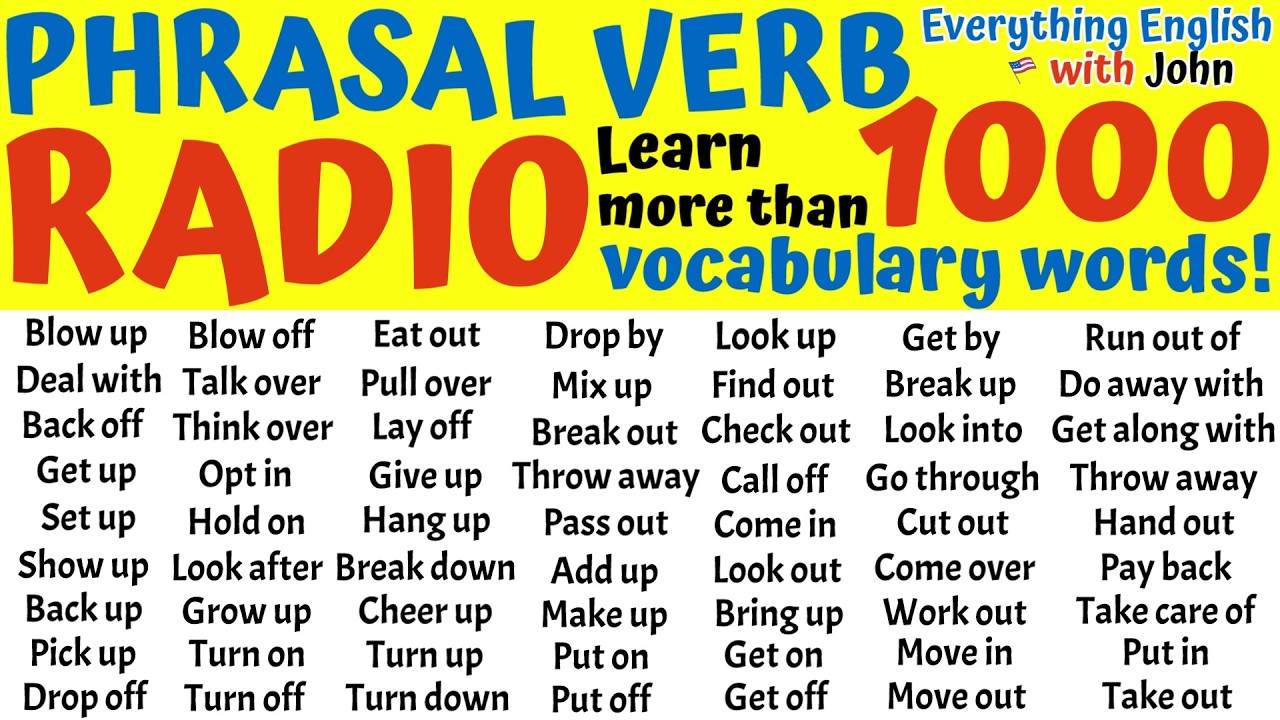
What is a phrasal verb? A phrasal verb is when there is a verb, which is an action word, so a verb plus a preposition. Prepositions are words like "up", "down", "in", "out", "over", "on", "off", "about", "at".
These words are prepositions. So, a phrasal verb is a verb plus a preposition. When we have a phrasal verb, it has a different meaning than a regular verb.
Let's look at some examples. For example, here is the verb "look". "Look" is an action.
I look at you. I am looking at you. The man looks at the cat.
So, the man is looking at the cat. This is a regular verb, "look". When I add a preposition, in this case, "after", "look after", when these words are together, they have a different meaning.
"Look after" means to take care of someone or something. The grandma is looking after the baby. So, the man looks at the cat.
The grandma looks after the baby. She takes care of the baby. So, when we add this word, it has a different meaning than without this word.
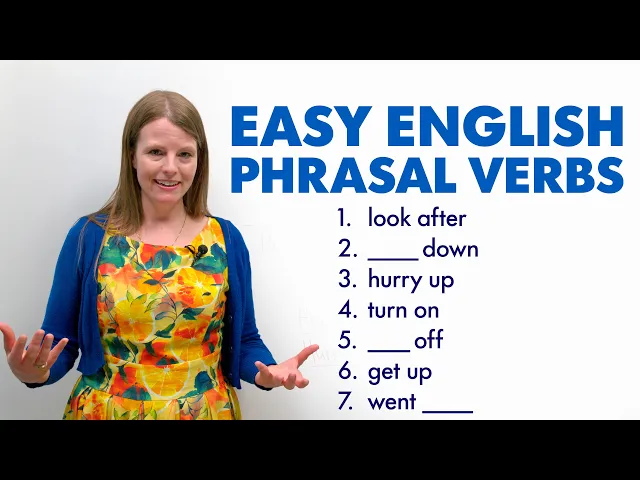
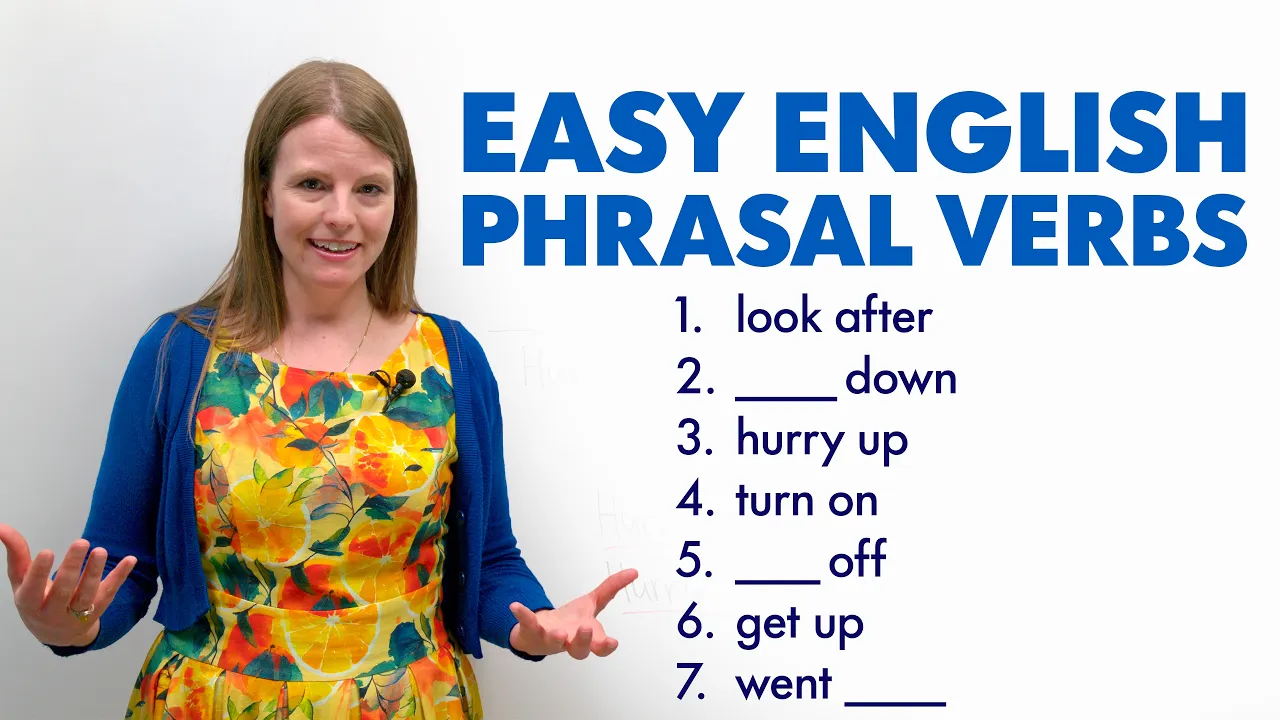
Let's look at common phrasal verbs in English. Today, we will learn the most common phrasal verbs for beginners. The first phrasal verb today is "slow down".
"Down" is the preposition. "Slow" is the verb. Together, "slow down" makes a phrasal verb.
What does "slow down" mean? "Slow down" means to tell someone to go slow. So, we use it to tell someone to go slow.
We can also use it for things like cars. When something is moving quickly, we can say, "Slow down. " It means go slow.
Here are some examples. "Slow down. Your English is too fast.
" Sometimes, students tell me, "Emma, slow down. Your English is too fast. " Here is another.
. . Oh, you can use this if someone is talking very fast.
You can say, "Please, slow down. I don't understand. " So, it's a very good word for people learning English.
We can also use it in other ways. "The car slowed down. " So, the car went slow, the car was going fast, and then slowed down.
Here's another example. "Slow down. You're eating too fast.
" What is the opposite of "slow down"? There is another phrasal verb that has the opposite meaning. That phrasal verb is "hurry up", "hurry up".
When you say "hurry up", it means you tell someone, "Go faster. " We use this usually when we are a little mad. It's a little impolite.
So, for example, "Hurry up. Get dressed. " This means be quick, be fast, put your clothes on.
"Hurry up and finish your breakfast. " This means eat quick, finish your breakfast. Many times, parents.
. . So, mom, dad.
. . Many times, parents use "hurry up" with children, or teachers use "hurry up" with children.
But we can also use it with other people. It means do something fast, be fast, and it's a little impolite. Let's look at some other phrasal verbs.
"Turn on" and "turn off" are two phrasal verbs. "Turn" is a verb, "on" is a preposition. Together, they make a phrasal verb.
"Turn" is a verb, "off" is a preposition. Together, they make a phrasal verb. Let's learn the meaning of these phrasal verbs.
"Turn on" means to start a machine or to activate something. For example, "Here is the TV. ", "Here is my remote.
", "I turn on the TV. ", "Turn on the TV. " Another example is, "This is a light.
", "I turn on the light. " So, this is a common phrasal verb. "Please turn on the light.
" The opposite of "turn on" is "turn off". "Turn off" means to stop a machine or to deactivate a machine. For example, "I turned off the TV.
" So now, it's off. "I turned off the TV. ", "I turned off the light.
", "I turned off the light. " That's how we use that. So, we looked at some other examples.
"I turned off the computer. ", "Turn off. ", and "We turned off the light.
" Let's look at another phrasal verb. You know the verb "get". "I get the marker.
" "Get" is a common English verb. When we add "up", we create a new verb. It's a phrasal verb.
"Get up" means to rise from bed, or to wake up, or to rise from a sitting position. Let's look at some examples. This is a man.
It's 8 o'clock in the morning. "He gets up at 8 a. m.
" This means he wakes up at 8 a. m. "He is not sleeping.
He gets up. He rises from his bed. " This is a girl.
This is a chair. "She gets up. She gets up from the chair.
" So, maybe she was sitting, and then she gets up. She rises from the chair. So, we use "get up" a lot in English.
It's a very common phrasal verb. The past tense, so when we talk about before, like "yesterday", "last night", the past tense of "get up" is "got up". "Today", "this morning", "I got up at 8 a.
m. " "What time did you get up at today? " Alright, let's look at the final phrasal verb "today".
A common phrasal verb is "go out". So, you know the word "go". "I am going to the store.
" "Go". When we add the preposition "out", "go out together" has a different meaning. "Go out" means to leave a room or a building, usually for the purpose of doing something fun.
So, for example, "I like to go out on Fridays. " This means I am not at home, I am outside my home. Maybe I'm at a restaurant, maybe a movie cinema, maybe the park.
"Go out" means to leave your house, usually for something fun. "Let's go out. " This is another example.
"When was the last time you went out? " So, let's talk about the past tense of this verb. The past tense of "go out" is "went out".
"I went out yesterday. " "My sister went out on Sunday. " "Did you go out this morning?
" So, we use "went out" for the past, and we use "go out" for the present tense. So, we have looked at many different verbs today. All of the verbs today are important verbs for beginners to know.
We use these phrasal verbs very often. So, thank you so much for watching. There is a quiz if you want to practice.
Come to www. engvid. com to practice these words.
Thank you for watching. Until next time, take care.