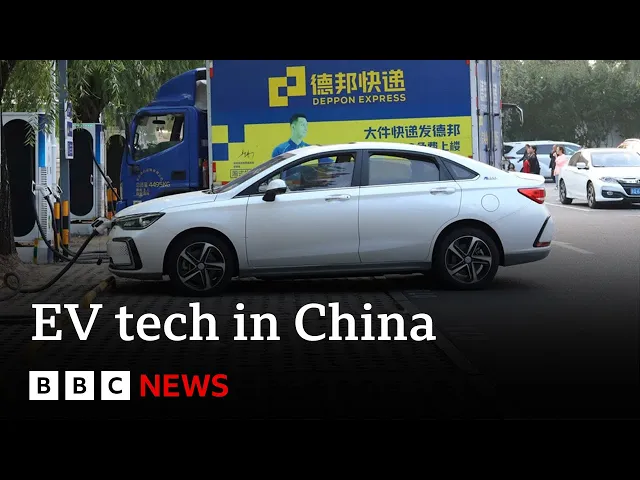
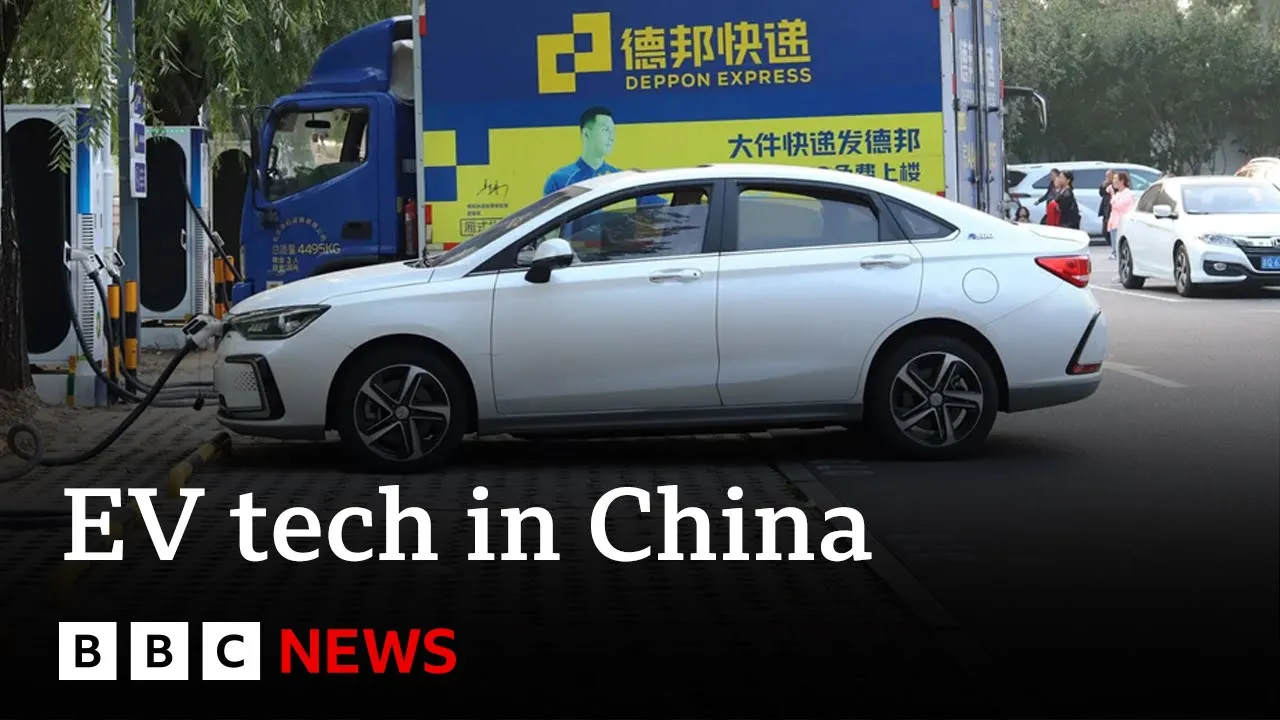
This is Guangjo. Traditionally, it was China's industrial heartland. Once known for its polluting cities, today the streets are a sea of green number plates.
The roar of rush hour has become a gentle hum. So, green means it's an EV and blue means that it's not an EV. But look, green.
Green is an electric moped. It's another green one. Another green one.
The point is that for most countries, EV is seen as the future of driving. But for China, the future has arrived. It's here now.
Thanks to heavy government subsidies, the former nation of bicycles has become the world's leader in electric vehicles. Whether you're buying the car or building the car, providing the electricity or assembling the battery, everyone in China is entitled to government money and assistance. It's led to dozens of Silicon Valley type startups across the country, but only the fittest have survived.
This is Xbang in Guangjo, where internet live streamers sell cars in real time. Barely a decade old, Xbang is already in the world's top 10 EV producers. Have a look, shall we?
Sure. Okay. Well, we are inside the Mona now.
Um, you were saying that this is a typical car for a firsttime buyer. I mean, I've seen the type of car that first time buyers normally buy. It doesn't really look like this.
Um, talk me through what we've got here. Yes, because we actually tailor for young customers preference such as this huge uh 15. 6 in screen which very smooth uh inter interaction with the customers.
We even offer the 18 speakers as a standard 18 speakers sound systems okay as standard and we offer this heating and ventilation seats which usually I mean appear on the luxury models so all the comfort features for our target customers. Mike says that young people are increasingly turning away from the western car brands that would have brought social status to their parents and instead they're prioritizing modcon features that the trendy domestic brands can provide. We then went on a test drive of a model that wasn't even on the market yet.
Their newest car has voice activation, an inbuilt entertainment system. This is video streaming, correct? It's also got genuinely impressive self-driving capability.
The car's just slowed down by itself. By itself. I My foot is actually off the brake pedal.
So, you're not touching anything? Not touching anything. And it was quickly put to the test.
What are these guys doing? Wo. Wo.
These guys are going down the wrong way. These guys are driving driving down the highway the wrong way. Yes.
To make a U-turn. Yeah. And we're still here.
Yeah. We are alive. No one's being hurt.
Yeah, this car's on the market for just $20,000. Having already fought off fierce competition within China, Xbang is now looking internationally. We are selling well in Europe.
We just launched in UK uh in March. Uh we see tremendous uh interest in our products. It is uh you know traditionally a stigma attached to uh some Chinese products.
But I would say probably it's more related to probably uh older generation of Chinese products. European and UK customers seeing China can produce high quality and very good technology products in Shanghai. Meanwhile, drivers get to experience one of China's newest innovations.
They're called swapping stations to replace your depleted battery in a matter of minutes. You simply drive in and the automated machines take care of the rest. The company behind the technology is another EV startup called Neo.
This car is, as you say, is battery swappable and which means that we can replace the battery, the whole battery in about 3 to 3 and 1/2 minutes. And so effectively within the system, I can say and set a destination of the battery swap station and it's therefore inform the battery swap station that I'm going to be arriving at some point in the future. when I get in to a few hundred meters away, it then actually gives me uh allocates me a battery and allocates me an actual sort of slot if there's already a queue and if there once it's your turn, you then drive right in front of the battery swap station and you push a button to accept um the process and then it's hands off from there.
So now it's going to automatically park us into this power swap station. And you can see the steering wheel is not moving because we're working with a steer by wire and it's effectively will reverse us in to the station. So we're in exactly the right position.
Now the car is positioned in the the sort station. So you see it's just picked the car up a little bit, removed the load from the suspension, and now the battery. You will hear in a minute the There you go.
You can hear the the unbolting of of the battery. Now, it's state-of-the-art technology for less than the price of a full tank. After a quarter of a century, China has managed to make luxury mainstream.
Chinese are thinking about a future where they manufacture just about every single car for the world. They're looking around saying, "Anybody can do it better than us? " Yeah, we're going to pretty much build every car in the world.
Okay. Now, in a world scrambling to meet climate targets, this might be considered great news. But there's politics at stake, too.
And instead of thanking Beijing, Western countries are worried. They're slapping tariffs on Chinese-made EVs. They're desperate to catch up in the green tech race.
But China has already changed the game.