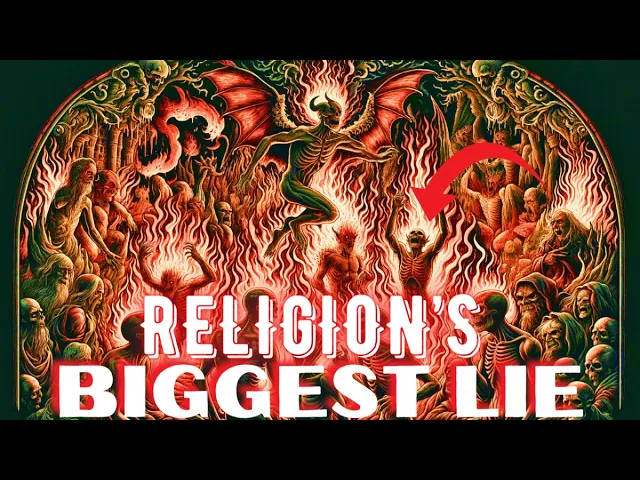
he have you ever wondered why the idea of hell has such a hold on us this terrifying fiery pit where souls are supposedly tormented forever but here's the shocking truth the concept of hell as most people understand it today was likely created and mold by the church yes the church took ancient ideas intensified them and crafted an entire doctrine of Eternal punishment why let's dig in in the original teachings of Jesus there's no evidence that hell was this torturous realm of endless suffering look at his actual words he talks about gehenna a real place outside
Jerusalem where garbage was burned it was a physical location not a mystical underworld so why was gehenna used as a warning because in Jesus's time it was a brutal reminder of what happens when people turn away from compassion and righteousness but this place wasn't described as a realm where Souls were down forever no mention of fire and pitchforks or demons torturing the wicked for eternity those images came much much later in the ancient Jewish tradition the concept of an eternal hell doesn't exist instead you have ideas like shol a shadowy realm where everyone good and
bad just exists in a state of rest or sleep there's no torture no Punishment No fiery pits it's just Stillness even haes in Greek mythology wasn't a place of eternal torment for everyone in fact it had different levels some were dark and Grim but others were more like resting places so how did we go from this neutral idea of an underworld to hell as a horrifying torture chamber here's the kicker it was a tool the church particularly from the 3r century onward realized the powerful grip that fear could have on people by creating a hell
of fire anguish and eternal punishment the church could control the masses imagine the impact of a priest standing before a crowd saying disobey us and you're risking an eternity in Hell fear like that sticks it digs into the mind it makes people obey and once that fear is instilled it's hard to shake think about how much this shaped Society hell wasn't just a spiritual threat it was psychological leverage by the Middle Ages hell was fully weaponized paintings sermons literature everything was tailored to paint this horrendous image of hell that would haunt people and let's be
clear this wasn't about faith this was about power the church's teachings on hell are almost completely missing from the earliest texts of the Bible early Christian communities focused on love forgiveness and the concept of a merciful god but by manipulating the fear of Eternal damnation the church gained incredible influence you control people's beliefs you control their lives let's start with gehenna in the time of Jesus gehenna wasn't some Supernatural underworld it was a real location right outside Jerusalem known as the valley of hinm and it wasn't a place of punishment for the dead it was
a trash dump a site where waste was burned you can imagine the stench the smoke Rising a constant fire devouring what people discarded that's the imagery Jesus invoked when he spoke of gehenna a place where things were destroyed not tortured forever it was a powerful metaphor a way of warning people about moral Decay about ending up thrown out if they rejected compassion and justice but an eternal torture pit not at all then there's shol this is the underworld of the Hebrew Bible but it's not hell in the Hebrew scriptures shol is described as a shadowy
place where everyone goes after death the good the bad everyone it's like a state of rest almost a void without Joy or pain no fire no suffering no torment just silence and Stillness and that's what the ancient Jewish people believed Shel wasn't a threat it was simply a destination a final stop in a life well or poorly lived it wasn't about punishment it was about inevitability now enter haes the Greek underworld which influenced later Christian ideas hates was a place where the souls of the Dead went but it wasn't necessarily a place of suffering it
was more like a divided Kingdom with different realms for different kinds of souls some areas were dark yes but others were more like resting places and in Greek culture haes wasn't even seen as a bad place it was simply where the dead resided but when Christianity spread these ideas eiga Shel Hades star Ed blending together over time as the church's power grew it took these Concepts and Amplified them creating the hell we know today by linking gehenna's burning fires haes are the worldly mystery and sh's association with the unknown afterlife the church constructed a place
of horror to enforce its doctrines these original ideas weren't about torture they were about consequences rest or simply a journey Beyond this life when we talk about as a place of Eternal suffering we're actually talking about a concept shaped by philosophers not by the teachings of Jesus not by the Hebrew Scriptures it was early church thinkers like talian and Augustine who really started to cement this vision of hell as eternal torment they weren't just theologians they were influencers the one setting the spiritual agenda for generations to come talian one of the church's earliest and most
influential writers was a big fan of the idea that punishment was eternal he saw hell not just as a place for the wicked but almost as a stage a theater of suffering talian went as far as to claim that the righteous would actually get to witness the Damned suffering in Hell imagine the psychological impact of that he promoted this idea that Eternal punishment wasn't just a Divine necessity it was something the saved would relish watching this wasn't about Justice it was about creating a disturbing image that struck deep fear and obedience then we have Augustine
of Hippo one of the most celebrated philosophers in Christian history Augustine's ideas on sin guilt and Punishment would end up dominating Western Christianity he's the one who crystallized the notion of hell as a punishment Without End no possibility of parole no hope for Redemption for Augustine the very existence of hell was proof of God's justice a way of balancing the scales for Every Act of sin no matter how small or large and he wasn't pulling these ideas out of thin air Augustine was heavily influenced by Greek philosophy especially the works of Plato he adapted ideas
about the soul Justice and punishment from the Greeks and embedded them into Christian doctrine The Twist none of this came from the words of Jesus or the teachings of early Judaism it was a philosophical project a human endeavor to make sense of divine Justice by any means necessary Augustine was fighting theological battles trying to make Christianity the dominant moral Authority in an Empire that was crumbling under its own weight hell as Eternal torture was a convenient Doctrine it helped solidify his position and in turn the church's influence over the masses if you could scare people
with the idea that every misstep would be paid for with endless suffering you had absolute leverage now let's get to the real Crux of it why did the church push this terrifying image of hell so hard to understand that we need to look at the historical context in medieval Europe the church wasn't just a religious institution it was the most powerful organization in society holding influence over Kings Nations and the entire social order and what better way to keep people in line than with the constant threat of Hellfire for centuries literacy rates were low and
the majority of the population didn't have direct access to the scriptures they relied entire on what the church told them priests Bishops popes they held all the cards they alone decided what the people knew about God Heaven hell and everything in between and with this knowledge they crafted sermons and doctrines that emphasized hell as a place of unimaginable suffering not just as a consequence of evil Deeds but as a punishment for even the smallest deviations from church teachings the church effectively turned hell into a weapon a psychological tool that made made people afraid to question
authority if you were told from birth that Disobedience meant Eternal fire would you risk it of course not the church knew this and they used it to secure obedience loyalty and crucially financial support people were so terrified of hell that they would do almost anything to avoid it they would follow the rules attend Mass pay indulgences sums of money given to the church that were said to reduce one's time in purgatory or in some cases erase sins entirely it was like a spiritual insurance policy pain now avoid the Flames later indulgences became a massive Money
Maker for the church you could pay for the souls of your dead relatives supposedly rescuing them from Hell or shortening their time in purgatory people would spend huge sums of money because they believed their loved ones were suffering in torment the church capitalized on this fear becoming not only a religious Authority but an economic Powerhouse and it wasn't just about money it was about power with hell in their Arsenal the church could crush descent any challenge to their Authority any questioning of their practices could be painted as sinful heretical andp punishable by Eternal damnation the
concept of Hell allowed the church to enforce social order without needing armies or police the threat of hell was enough to keep people submissive to prevent revolts and to ensure that the social hierarchy remain remained intact The Peasants stayed peasants the nobility stayed Noble and the church stayed on top hell as we imagine it today fiery pits demons with pitchforks a hierarchy of suffering didn't just come from church doctrine a major player in shaping this horrifying Vision was Dante aligi and his epic work The Divine Comedy written in the early 14th century this poem was
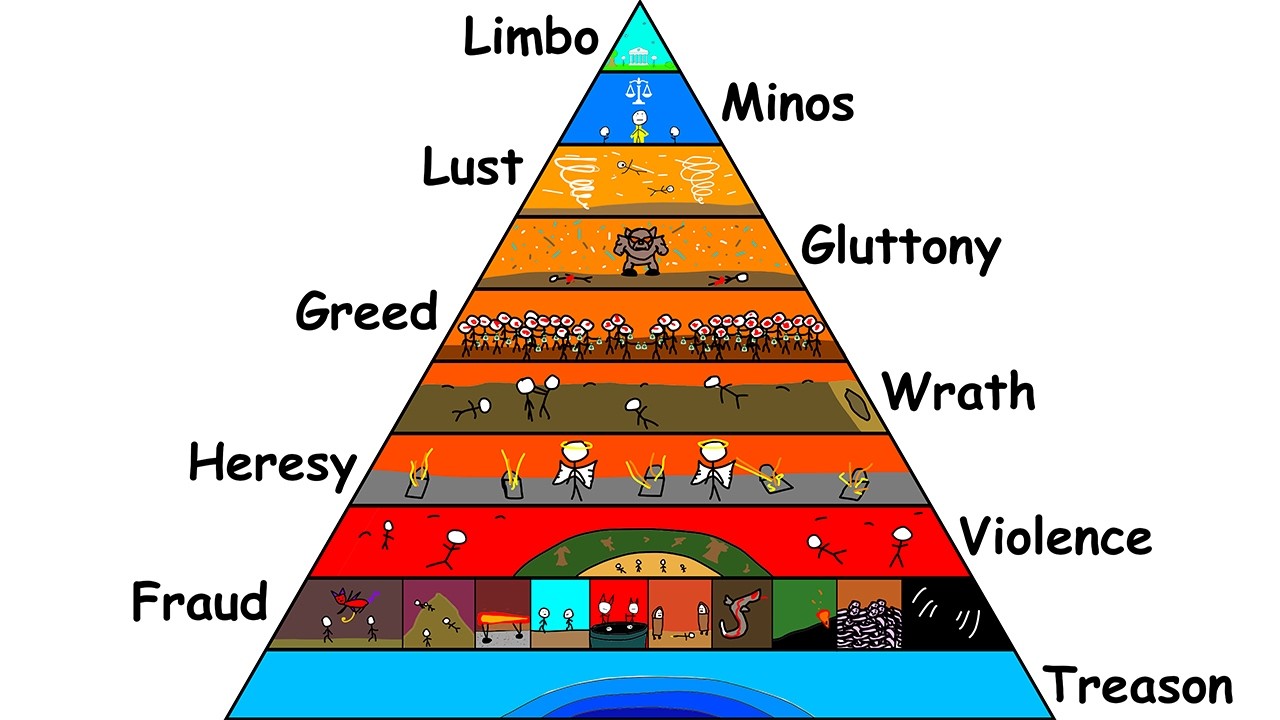
never meant to be a Doctrine it was a work of literature but the impact it had on how people imagined hell unmatched in The Inferno Dante describes hell as a layered realm of suffering with each circle reserved for a specific sin and a specific type of punishment the concept of hell as a structured organized place with customized torments was something the world had never seen before Dante's Vision took the abstract idea of hell and made it terrifyingly tangible he transformed it into a place you could picture in your mind a dark Journey that felt real
the graphic punishments Dante described were horrific yet compelling lustful Souls blown about by violent winds murderers submerged in boiling blood and traitors encased in ice at the very bottom each punishment tailored to fit the crime Dante painted a hell that was deeply imaginative and disturbingly specific the kicker Dante didn't intend for this to be a literal description of Hell his work was an allegory filled with Pol itical commentary on the corruption of his time but once the Divine Comedy gained popularity people started interpreting it as fact priests artists even common folks began to see Dante's
Hell as the real hell and since the church had already cultivated the idea of hell as a place of punishment Dante's work served to fill in the details providing imagery that resonated and lingered the timing couldn't have been better or worse depending on how you look at it Renaissance Europe was a place of high Superstition low literacy and a religious structure that held enormous sway over daily life most people didn't read the Bible themselves they relied on what the church and increasingly the culture around them told them and here was Dante's Vision detailed Unforgettable and
terrifying it didn't take long before his poetic vision of Hell became practically indistinguishable from church teachings on the afterlife and then came the art the Renaissance saw an explosion in religious art and hell was a favorite subject artists like Honus Bosch and Michelangelo picked up where Dante left off creating scenes of hell so vivid that people could practically smell the sulfur Bosch's grotesque visions of Hell filled with strange creatures and nightmarish Landscapes were the stuff of Legends you couldn't look at his paintings and not feel the weight of judgment the horror of Eternal suffering the
church didn't create these images but they were more than happy to to endorse them why because this kind of art reinforced their message follow the rules or face the consequences Michelangelo's last judgment painted on the alter wall of the cinee chapel is another example here was hell vividly rendered in the heart of the church itself a constant reminder to anyone who entered of the Fate that awaited those who strayed Michael Angelo's depiction of the Damned ring and falling with the Archangel Michael judging them was an image so powerful that it echoed across Europe it became
a definitive symbol of Hell reinforcing the terror and the power the church held over its followers this wasn't some hidden image in a Dusty corner it was displayed in one of the holiest sites in christom where popes priests and pilgrims could all see it and this cultural reinforcement didn't end with Dante or Renaissance artists The Divine Comedy was published and reprinted for Centuries by the time the printing press arrived D Dante's work was one of the first major texts to be widely distributed now this vision of Hell spread faster than ever becoming the standard interpretation
even among people who had never read the poem soon Dante's Inferno and the visions of hel inspired were practically Inseparable from the church's teachings the church didn't object to any of this in fact they supported it they saw how these depictions of Hell served their agenda it wasn't just just about terrifying people into submission it was about creating a visual and literary narrative that locked hell into people's minds because if you could picture hell in excruciating detail if you could see it in paintings and read about it in poetry it became real on a level
that sermons alone could never achieve let's dig into the Bible itself what does it actually say about hell the truth might surprise you because the Bible's original languages don't offer the fiery torment narrative that's been hammered into popular beliefs in fact if you look closely there's a real lack of evidence for Eternal torture first off shol appears frequently in the Hebrew Bible the Old Testament shol isn't described as a place of suffering it's essentially the Land of the Dead a shadowy neutral place where Souls reside awaiting the final judgment in the Book of Job for
instance Shel is simply where job expects to go after death a kind of resting place there's no mention of punishment or Eternal flames it's a state of being after life almost like a holding area for the soul then we have haes the term that comes up in the Greek translation of the Old Testament and in the New Testament Hades much like shol is just the realm of the dead it's not a place of active Suffering The Gospel of Luke mentions haes when Jesus tells the parable of Lazarus and the rich man the rich man suffers
in haes but it's more of a temporary State a narrative device rather than a theological statement on eternal torment in fact haes is often seen as a place where Souls reside until the final judgment after which they're either granted eternal life or face the second death this second death concept is crucial The Book of Revelation talks about a final judgment where the wicked are cast into the Lake of Fire this isn't described as hell in the conventional sense rather it's seen as the final destruction of the Soul Annihilation not torture in other words the wicked
are destroyed rather than tormented for eternity so instead of Eternal suffering we see imagery of total obliteration theologians call this conditional immortality the belief that only the saved are granted eternal life while the rest simply cease to exist this idea stands in stark contrast to the hell that's been depicted by Art literature and centuries of church doctrine then there's gehenna we touched on this before but let's clarify gehenna a real Valley outside Jerusalem was a place associated with death and destruction but it was not a pit of endless suffering Jesus used gehenna as a symbol
warning his followers about the consequences of a wasted life when he spoke of gehenna he was tapping into the imagery of garbage being burned and destroyed there not Souls suffering forever the idea was more about finality the end of a life without purpose cast into Oblivion not tortured endlessly the cultural context matters here for his audience gehenna represented loss and waste not a supernatural torture chamber and then we get to the fire Jesus does speak of unquenchable fire in passages like the gospel of Mark but look closer these fires were often symbolic fire in the
Bible frequently represents purification or judgment not torture in passages from the Old Testament fire was used as a symbol for God's cleansing presence purifying rather than punishing the New Testament carries this symbolism too Fire Burns away what's impure in other words the imagery of fire isn't always about torment it's often about purging and refining another term that's key here is colesis in Greek colesis means correction or pruning it's the word Jesus used when describing the punishment for the wicked it implies discipline or reform not endless torment this concept suggests a purifying experience a way to
correct one's path rather than a sentence of suffering this aasis approach views God's judgment as a way of refining the soul rather than casting it into Perpetual Agony the early Christian Movement didn't preach Hellfire they preached resurrection and Redemption look at Paul's letters his focus is always on salvation not damnation Paul doesn't describe a place of torture for the unsaved his writings emphasize the Resurrection The the promise of eternal life for believers this emphasis on life on transformation and renewal contrasts sharply with the Hellfire sermons that came later so where did it all change when
the church grew into a powerful institution the focus shifted leaders saw the potential of hell as a control mechanism and began emphasizing it writings and interpretations that leaned toward fear and Punishment took over while more compassionate views were buried some early Christian writers like origin actually argued for Universal reconciliation the belief that All Souls would ultimately be reconciled with God origin's ideas weren't popular with church authorities who saw more utility in a hell that could scare people into compliance here we are after diving into all these layers of History philosophy literature and art one big
question remains why are there so many versions of hell what does it mean for believers when we realize hell as we know it is the product of centuries of Shifting ideas cultural influences and human decisions first let's think about how this range of interpretations came about hell wasn't originally a monolithic concept the different words and images used in ancient scriptures didn't point to one single agreed upon place of Torment shol gehenna Hades all of these were reflections of different cultural ideas about the afterlife not a cohesive place of Eternal suffering when Christianity spread through the
Roman Empire it encountered numerous beliefs from the Greek underworld to the Egyptian concept of judgment in the afterlife early theologians faced with questions about Justice and the Soul's fate began weaving these ideas into their teachings they took elements from the surrounding cultures and built them into the doctrine and let's not forget about the influence of fear as a tool as Christianity gained power particularly from the 3rd Century onward it became a backed religion with real political clout leaders saw hell's potential to keep people in line to ensure obedience and to prevent dissent it wasn't enough
to Simply encourage people to live righteously hell provided a powerful stick to complement the promise of Heaven by promoting hell as an unending horror show the church gained leverage the idea of Eternal punishment became institutionalized a Hardline that was easier to enforce and to preach this journey didn't just stop a doct over the centuries hell seeped into Western culture taking root in the minds of artists writers and philosophers Dante's Inferno Michelangelo's last judgment Bosch nightmarish Landscapes all of these became visual anchors for hell the art and literature of Hell took on a life of its
own creating something far more terrifying and concrete than the Bible ever described by the Renaissance hell was not just a spiritual warning but a vividly imagined realm of Horror full of demons and grotesque punishments for believers who have grown up with a strict almost unquestioned belief in hell is eternal punishment these Revelations can be unsettling it raises questions about other doctrines we take for granted and challenges us to think critically about our faith if hell isn't exactly what we thought then what is our faith built upon what is the nature of God if not a
God who would consign people to unending suffering this doesn't mean that Faith itself is a fabrication not at all what it does mean is that our understanding of faith and of God might be deeper and more complex than we've been led to believe the version of hell that's been drilled into us for centuries isn't necessarily the original view it was shaped by cultural biases political motives and human interpretations and maybe that opens up a different way of understanding what it means to be judged forgiven and redeemed for some this can be a freeing realization the
god of compassion and mercy described by Jesus feels a lot more in line with the idea of a loving Creator than the Hellfire sermons that followed and when we strip back the layers we find a faith that's not based on fear but on love Grace and transformation in a way discovering the evolution of Hell gives us an opportunity to reconnect with the teachings of Jesus which emphasized love forgiveness and Redemption far more than they emphasized punishment it reminds us that faith can be about seeking truth even if that means questioning long-held beliefs we don't have
to fear hell to live ethically to seek Justice or to find meaning in our spiritual journey in closing I hope this deep dive into the history and evolution of hell has given you something to think about maybe it's opened up new questions or sparked a different perspective on faith and what it means to believe thank you for watching for being open-minded and for exploring this topic with me all the way to the end