Ratings for game one have got to be disappointing for Cat Inglebert in the WNBA front office. There were regular season games this season where Caitlyn Clark drew more than 1. 8 million viewers.
However, I hope Cat Inglebert is ready for disappointment because there's a hell of a lot more of it on the way. This is shocking. Welcome back to the Clark updates.
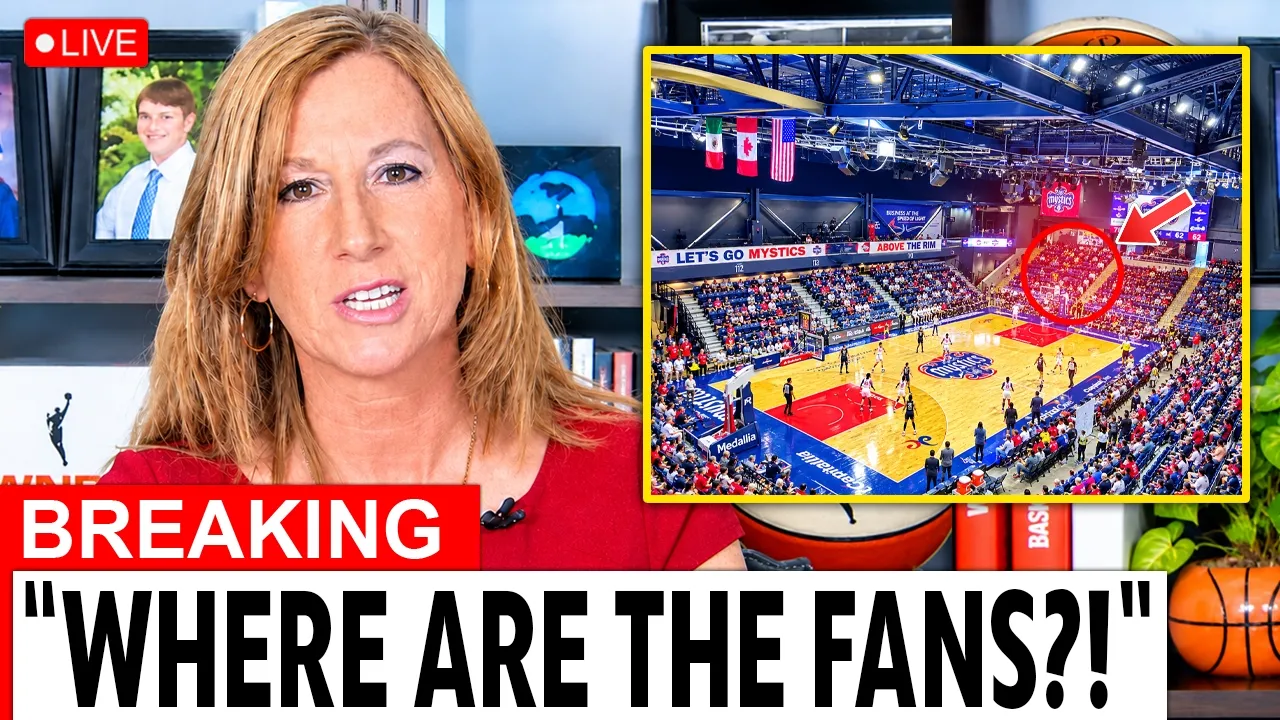
The WNBA is facing major attention after reports of just 200 fans at the Aces versus Valkyy's matchup following Caitlyn Clark's exit. And now the claim that the WNBA commissioner walked out has everyone asking one question. What is really going on?
Stay with us because this story is getting more intense by the minute. Over 50% of WNBA viewers simply disappeared. Furthermore, nobody in the league office can claim they were unaware of this.
On October 1st, the Indiana Fever season came to an end with a 94 to 83game3 loss inside Mitchel Ultra Arena in Las Vegas. A collision occurred between two entirely distinct universes. The Las Vegas Aces were celebrating a firstround series victory on the court.
Executives in television network offices around the nation were staring at a ratings cliff that might jeopardize the postseason's overall financial narrative. The altitude Caitlyn Clark achieved on her way out the door is the first indication of how catastrophic this viewership crash really is. Consider that Thursday night's television atmosphere.
Indiana lost the third game. Unlike ABC or NBC, Vegas was not broadcast on free national broadcast television. ESPN didn't even broadcast it.
The largest elimination game of the first round was moved to cable television on USA Network and CNBC due to the league's new media rights rotation, and it began late on a Thursday night. Even worse, NFL Thursday Night Football and a pivotal major league baseball wildcard matchup between the Boston Red Sox and the New York Yankees were the two largest events on the American fall sports schedule. It is considered a funeral in the television industry to broadcast a women's basketball game on a secondary cable station at precisely the same time as the NFL and a Yankees Red Sox playoff elimination game.
Rather, Caitlyn Clark made it a ratings powerhouse with an average of 2. 25 25 million viewers on USA Network and CNBC and a peak of 2. 7 million at 11:15 p.
m. Eastern time. Compared to Indiana's first round game three from the previous season, Clark's season ending game became the second most watched first round game in WNBA history, only surpassed by her own rookie playoff debut two years prior.
The 93% increase in viewership on Thursday night, was not an anomaly. The first game between the Fever and the Aces on ABC earlier in that same series drew an average of 2. 11 million viewers.
1. 42 million people watched game two despite it being blocked by a streaming payw wall on Amazon Prime Video. For months, a vocal portion of the WNBA media and a number of season voices in the league attempted to persuade the public that the league was no longer dependent on a single Iowa guard.
Regardless of whether number 22 was on the screen, they contended that millions of casual fans had fallen in love with the WNBA product as a whole and that once the playoff started, the crowd would attend every series. That assertion was tested in the first round of the postseason. Additionally, the results for the games played without Caitlyn Clark showed that the sport was entirely different.
Take a look at what transpired on the same networks. There was no involvement with the second Indiana. On USA Network, Clark was drawing 2.
25 million viewers with a peak of 2. 7 million. Just 525,000 people watched the 48 regular season and postseason games on USA Network on average this year.
Over 1. 7 million individuals, or around 77% of the audience, simply don't exist when Clark isn't on that channel. Take a look at Prime Video on Amazon.
1. 42 42 million people watched Clark's game two on the streaming site on Tuesday night. 425,000 people saw the Washington Mystics versus Atlanta Dram without Clark playoff game on Prime Video during the same first round.
From one show to the next on the same platform, 70% of the streaming viewership disappeared. What Clark accomplished on USA Network was unmatched even by ESPN, the unchallenged leader in sports cable television. The second game in the Atlanta Dram versus Washington Mystic Series on ESPN averaged 1.
2 million viewers compared to Clark's Peak of 2. 7 million against the NFL and the Yankees. Additionally, 1.
4 million people watched the Golden State Valkyy's versus Dallas Wings game 2 on ESPN. This indicates that the main ESPN network's prime playoff games lost almost a million viewers. When a large box office attraction loses a close three-game playoff series in nearly any other professional league, a sizable portion of those 2.
7 million viewers stay for the following round. Unlike an Indiana Fever broadcast hidden away on USA Network late on a Thursday night, generally speaking, casual supporters continue to watch the team that removed their favorite star. That viewer carryover is dead on arrival with the WNBA at the moment.
After October 1st, millions of supporters did not simply fade away. The remainder of the bracket was actively boycotted by them. You don't need to break out basketball systems or shooting percentages to understand why the walkout was so abrupt and furious.
You only need to look at the three viral events that millions of people witnessed during the game three elimination in Las Vegas to understand why casual fans left believing that the league would not defend its biggest player. With Indiana ahead 12 to6 early in the first quarter, the first flash point occurred. Brianna Turner, a forward for AC, who was actually on the Fever roster the previous season, walked right into the center of Indiana's huddle to listen in when the five Indiana Fever players were gathered together on the floor discussing between plays.
Turner was pushed out of the circle by Clark as soon as he moved forward. Turner threw back her arms and fell theatrically to the ground. The biggest name in the building was one technical away from being automatically ejected in the first few minutes of a win or go home game when the officiating staff nailed both Turner and Clark with double technical fouls instead of punishing Turner for entering an opponent's huddle.
Outrage replaced frustration by the fourth quarter. Juel Lloyd, the guard for AC, struck Clark squarely in the face during a scramble close to the basket, breaking her lip as Clark approached the closest referee and pointed directly at the blood on her mouth. Cameras panned in.
There was not a single whistle blow. Stephanie White, the head coach of the Fever, had previously received a technical penalty at half court just a quarter prior when officials denied her a coach's challenge during a tumultuous incident. Then there was the news conference after the game, which ignited social media.
Stephanie White, who was seated next to Clark at the stage, read aloud to the audience the ultimate officiating disparity. Indiana made 20 free throws on 19 aces fouls, while Las Vegas was awarded 35 free throws on 27 fever fouls. Clark leaned forward her microphone, arched her eyebrows at the reporters, and spoke two words just as White had finished reading the 35 to 20 free throw differential.
Well, it's interesting. Clark did not conceal her annoyance when a reporter followed up to ask her what explanation the refs offered her after Juel Lloyd left her mouth gushing in the fourth quarter without a foul being called. Your guess would be just as accurate as mine.
No Caitlyn, no watch repeatedly surfaced on X, YouTube, and Tik Tok. After carrying the league's television ratings for the whole summer, millions of people declared they were done watching for the year. The league offic's defenders, however, maintained that the panic was unfounded and that the product would sell itself once the semi-finals began on Sunday with four-time MVP AA Wilson and the reigning champion New York Liberty taking center stage until the reality of a six network ratings monopoly and a 3,500 seat semi-final gym hit the league square in the face.
The storyline of the league's most devoted defenders changed to damage control within hours of Indiana's elimination on Thursday night. They acknowledged that it hurt to lose Caitlyn Clark in the first round, but the WNBA semi-finals were set to begin on Sunday, October 4th. League insiders predicted that the amount of quality in the remaining round will have millions of casual sports fans riveted to their televisions with four-time MVP AA Wilson advancing alongside the reigning champion New York Liberty.
The complete season statistics was then presented by sports media outlets such as Sports Media Watch and Front Office Sports. The notion that the rest of the league attracts even close to the same viewership did not simply collapse when you compare the data from all six of the WNBA's national broadcast partners. It fell apart entirely.
Take a look at the entire scoreboard on television this year. Six major television and streaming platforms, NBC and Peacock, ABC and ESPN, CBS, USA Network, ON and Amazon Prime Video were used to broadcast WNBA games due to the league's extended broadcast schedule. Numerous games between the league's top championship candidates, Olympic gold medalists, and enduring all-stars were broadcast on each of those networks.
Nevertheless, Caitlyn Clark and the Indiana Fever had the highest rated broadcast of the year across all six networks when the final regular season and first round numbers were totaled. Not four of the six, but all of them. A Caitlyn Clark game on NBC and Peacock reached the network's peak viewership of 3.
2 million. At 2. 6 6 million.
Clark's broadcast was the highest on ABC and ESPN. Another Heat game on CBS reached its highest viewership of 2. 6 million.
At 2. 25 million, Thursday night's game three elimination was broadcast on USA Network. It was a fever aired at 1.
6 million on N. Additionally, Indiana's victory over Las Vegas in game 2 was available on Amazon Prime Video at 1. 42 million.
What transpires on the same channels when you segregate the Indiana Fever broadcast from the rest of the WNBA schedule is even more illuminating than the peak records. Let's start with CBS as an example. During the whole season, on average, 1.
82 million people watched Indiana Fever games on CBS. That average fell to 833,000 viewers when CBS broadcast WNBA games involving any other teams in the league without Clark playing. Every time Indiana left the building, over half of the CBS audience vanished.
Take a look at the O TV. Up to 1. 6 million people watched the Fever broadcast on N.
I without Indiana's leaguewide baseline viewership was about 617,000, which is a reduction of almost 1 million people. Take a look at Prime Video on Amazon. The non-fever baseline on Prime was only 437,000 views despite Clark drawing 1.
42 42 million throughout the playoffs. You are not looking at a typical ratings decline when you lose between 55 and 77% of your viewers across all broadcast partners the moment one player departs the screen. A onewoman television monopoly is what you are witnessing.
Additionally, it was heartbreaking to witness in real time the disparity between Caitlyn Clark's economics and the rest of the league when the WNBA semi-finals finally arrived on Sunday, October 4th. Opposing teams treated Clark and the Fevers away games like the Super Bowl during the entire season. Teams rushed to relocate their home games from their usual venues into enormous NBA arenas with 18,000 to 20,000 seats in order to accommodate the influx of spectators paying hundreds of dollars on the secondary ticket market.
The first postclark semi-final round began on Sunday afternoon with Brianna Stewart and Sabrina Ayanu of the reigning champion New York Liberty heading to take on the Atlanta Dram. No one hired out State Farm Arena down the street because Caitlyn Clark was not involved. Instead, the Gateway Center Arena in College Park, Georgia, hosted a WNBA semi-final match between the league's premier big market team.
That building can accommodate 3,500 people. For a league attempting to persuade corporate America that it has emerged as a major league giant, consider the optics of that. 2.
7 million people watched Caitlyn Clark perform on national cable on Thursday night in front of a full house in Las Vegas. 72 hours later, the WNBA semi-finals were getting underway in a suburban gym with 3,500 seats, which can accommodate less spectators than an Indiana high school regional championship. After eliminating Clark from the playoffs, the Las Vegas Aces were expected to carry the star power torch in the opposite semi-final round.
Instead, off-c court animosity and emotional tiredness tainted the entire discussion surrounding Las Vegas victory in the Indiana series. Oza Wilson got into a furious verbal altercation with a fever fan seated courtside during game two in Indianapolis earlier that week. The incident dominated sports talk radio for days.
Wilson admitted at the stage that she had prayed a lot and sobbed a lot over the past 48 hours, telling reporters prior to game three that the criticism and the intensity of playing against the Fever fan base had driven her to the brink emotionally. There was absolutely no energy when the Aces eventually onto the court for the first game of the semifinals on Sunday without Clark across from them. The secondyear expansion Golden State Valkyis defeated Las Vegas 71 to 60 after they gave it their all to survive a six-seated Indiana roster.
The Minnesota Links, the current top overall seed, has already been eliminated completely from the tournament. In just 72 hours, the WNBA went from being a pressure cooker with 2. 7 million viewers to a semi-final Sunday with a 3,500 seat facility, a worn out Las Vegas roster being destroyed by a second-year expansion team, and a sizable portion of the national public outright refusing to watch.
This was more than simply a painful weekend of poor PR for TV executives considering the final two weeks of the postseason schedule. Because this ratings collapse becomes a full-fledged corporate disaster when you consider how the league's brand new $3 billion media right structure is set up for the WNBA championships and the ridiculous $1 million financial decision that led to Caitlyn Clark's elimination in just 5 days. You have to follow the money behind the WNBA's new media structure in order to comprehend why television executives are currently sleepdeprived.
The league's landmark 11-year media deals began this season. NBC, USA Network, and Amazon Prime Video joined ESPN, ABC, and CBS in a deal valued at well over $2. 2 billion.
On the surface, the league office took a victory lap all summer long. They noted that CBS broadcasts increased by 9% to 1. 2 28 million viewers, while ESPN's regular season viewership increased by 17% to an average of 1.
44 million viewers. After October 1st, League Office defenders utilized those seasonl long averages as a shield. They attempted to claim that losing the Indiana Fever in the first round was only a small setback because the overall baseline was higher than in prior years.
However, that argument disintegrates at contact when you examine the WNBA finals actual broadcast schedule. The WNBA finals are no longer solely broadcast on ABC or ESPN due to the new rotational television arrangement. In actuality, just two games of the entire championship series will be shown on NBC's free national broadcast television.
Games one and four. The last five possible WNBA Finals games, game two, game three, game five, game six, and a pivotal game seven will all be shown on USA Network and CNBC. Take a moment to connect the two dots.
USA Network will broadcast five of the seven games in the league's championship showcase. When Caitlyn Clark performed on USA Network on Thursday night, 2. 25 million viewers watched, reaching a peak of 2.
7 million as the complete season data already demonstrated. In 48 other shows this year, USA Network averaged 525,000 viewers without Caitlyn Clark. As a result, NBC Universal and USA Network are facing the possibility of broadcasting up to five WNBA Finals games on a cable channel where in the past 75% of viewers vanish the instant Indiana is off the screen.
Advertising executives are now forced to sell October commercial inventory for matchups involving teams that drew 425,000 viewers in the opening round, which raises the single biggest question of the entire postseason rather than showcasing Caitlyn Clark in a seven-game championship war that could have easily surpassed 4 million viewers on cable. Why in the world did Caitlyn Clark start the first round with just a three-game series? Playoff rounds are designed to last five or seven games in the NBA, NHL, and Major League Baseball Division series.
For a professional sports league, a longer first round series serves two purposes. In terms of competition, it lessens the chance that a top seed like the Minnesota Links or a big draw at the box office like the Indiana Fever can be eliminated from the playoffs due to a poor refereeing weekend. In terms of business, it ensures that television networks will have more prime time programming with their best performers.
A few days prior to the start of the playoffs, Stephanie White, the head coach of the Indiana Fever, publicly criticized the WNBA's three-game first round, calling it a flawed system due to its short turnaround. Why, therefore, did the WNBA decline to change this year's first round from a best of three series to a best of five or best of seven series? Front Office Sports reports that the answer lies in a startlingly tiny pile of money found within the collective bargaining agreement.
Expanding the first round of the playoffs automatically increases player merit bonuses across the bracket in accordance with the league's labor regulations. The championship prize pool per player would have increased from about $60,000 to $76,552 if the threeame system had been abandoned, while first round bonuses would have increased from $5,000 to $6,379 for the entire league. Expanding the playoff format resulted in an additional cost to ownership of almost $1 million.
Give that some thought. Team owners and league executives maintained a three-game first round structure that saved almost $1 million in bonus awards in a league enjoying a multi-billion dollar broadcast windfall. And before the calendar had turned to the second week of October, Caitlyn Clark was eliminated in 5 days as a direct result of her three-game sprint, destroying tens of millions of dollars in television advertising value, secondary ticket income, and national momentum.
That's what it means to step over a $100 bill in order to get a nickel. Additionally, the timing for the league's labor future could not be more favorable because the WNBA Players Association and league ownership are still embroiled in a high-stake showdown over the future of revenue sharing and player salaries. As the fallout from this October ratings meltdown settles, the biggest voices within the players union and traditional media maintained for two years in a row that all 144 players on WNBA rosters shared equally in the financial boom.
The notion that one Iowa guard was carrying the water infuriated them. In an elimination game, umpires swallowed their whistles as veterans bumped her, enter her team huddles, and left her with a bleeding lip. However, Caitlyn Clark is not the one who is truly harmed by Indiana's early withdrawal.
On Thursday night, Clark entered her last postgame press conference in Las Vegas, wiped the blood from her mouth, and seemed utterly unaffected by the commotion. She commended her teammates for overcoming ongoing hardship, and ignoring extraneous distractions during the season. Whether she plays three or 20 playoff games doesn't affect her tens of millions of dollars in private endorsement deals with Nike, Gatorade, and Wilson.
The WNBA headquarters, the television networks that recently paid billions for the product, and the players whose union depends on good postseason ratings to justify a larger share of the pie are the ones who really lose out when over 2 million viewers switch off their televisions. The math in the boardroom gets colder every time a network chart displays a 70% decline on Prime Video, a 54% decline on CBS, or a 1. 7 million viewing gap on USA Network without Indiana on the floor.
You can't declare for the entire summer that no one watches for a single player only to see 75% of the viewers leave the arena the moment she does. The WNBA and commissioner Kathy Ingleberg now have a whole off season to look forward to figures from October 1st and determine the type of business they truly wish to operate. They have two options.
Either they build around the engine powering their billion-dollar television deals, demand major league officiating standards that shield their biggest star from uncalled shots to the face, and fix a broken three-game playoff format, or they continue to act as though the ratings collapse is not occurring while millions of viewers switch channels. Do you believe that the WNBA will eventually be forced to protect Caitlyn Clark and alter its playoff format as a result of the significant decline in playoff ratings, or will the league continue to make the same errors in the upcoming season? Tell us in the comments section below.