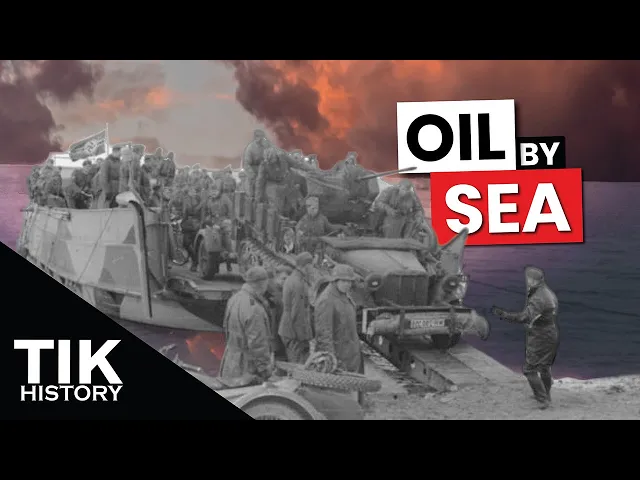
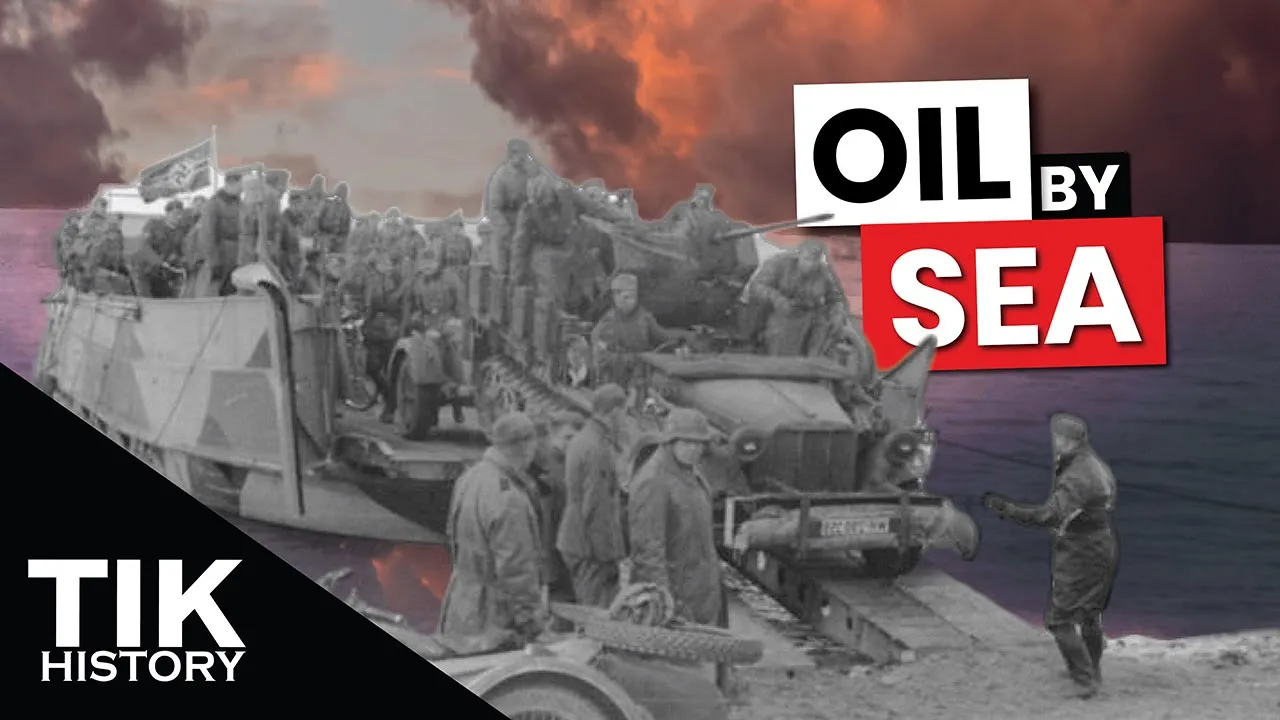
I’m going to answer two Patreon questions today both on the same topic, the Black Sea and the Caucasus in the Second World War. Christopher has said: “Tik, at any time was a naval blockade or even landing possible in the Caucuses? I know that landing craft was involved in the siege of Odessa.
The Italian, Romanian, and German navies along with the combines Air Force managed to defeat the Soviet Black Sea fleet. Seems like it would drastically shorten invasion difficulty in the Caucuses or perhaps trap the Soviets during Fall Blau. ” Bryan Banks also said: “Why Didn't the Germans take Rostov by sea and use it as a supply distribution point?
It seems moving supplies through the Black sea and the sea of Azov would have shorten the supply line to their ultimate goal considerably. ” So let’s just go through the logic here. Germany’s suffering from a major oil crisis in the Second World War (I’ve covered that in numerous videos now) which has led people to try and come up with alternative solutions to the problem.
Some say go through North Africa to the Middle East, or miraculously find the Libyan oil fields. But some think that what Germany could have done was just taken different measures to reach the Caucasus where all the oil was (Mr H’s main goal of the Fall Blau 1942 campaign). They got to the Caucasus mountains, but in order to do this they had to stretch their armies over a huge area, and brought their logistics to breaking point.
We know what happened in the end - the Germans took Maikop but not Grozny or Baku, and the Romanian and German armies were overrun around Stalingrad during Operation Uranus. That forced the Axis (mostly) out of the Caucasus, and the chance of taking the oilfields was lost forever. So Christopher and Bryan asked, why didn’t they use landing craft to take Rostov and/or land in the Caucasus, and then, I guess, supply Axis forces by sea, and thus reduce the strain on their supply chains?
Well, for starters, the Axis did take Rostov in 1942, and Rostov was a major logistics centre. This map actually explains why going to Stalingrad made sense for the Germans, rather than, say, going to the Caspian Sea to cut off the Caucasus that way. Without oil, the Axis were reliant on their trains for supply, and so had to stick to the railways if they were to go anywhere.
That meant, from Rostov, they had to go south into the Caucasus, or north to Stalingrad. I will point out though that this map is incomplete and doesn’t show some of the minor routes, but you get the idea. Both of my Patreons asked then why didn’t the Germans take Rostov by sea, or land in the Caucasus, rather than go all the way around the north.
Surely, sea route supplies are more efficient than rail supplies, right? Or, at least, would reduce their logistical overstretch? Well, I can answer this question with one word: Turkey.
You see, Turkey had been alarmed by Mussolini’s invasion of Albania in early 1939, and had largely sided with the Allies prior to the Munich crisis because they wanted to stop Mussolini and MrH from gaining too much power. The problem was that the Turkish army was reliant on Czech weaponry (along with the Romanians and the other Eastern European powers), and so, when Germany took the Czech territories, Turkey was left reliant on Germany. Britain couldn’t supply any weapons because they needed them for themselves.
So when France fell, Turkey was in trouble. She couldn’t join the Allies, didn’t want to join the Axis, and the Soviets were making moves against her too, as Molotov’s conversation with MrH in November 1940, and Stalin’s subsequent proposals, show. Part of the reason Churchill sent British troops into Greece in 1941 was in the hope that this would persuade Turkey to enter the war on the Allied side.
Unfortunately, Churchill didn’t realize that Turkey was in no position to enter the war on anyone’s side, and so they remained neutral. The point of all this is to say that the Turks remained neutral, and as a result, no Allied, Soviet or Axis warship could use the Dardanelles. Therefore, the only ships that were available in the Black Sea were the ones already in the Black Sea.
In the 1930s, the Soviets had expected trouble from the Axis powers (including Romania, Bulgaria, Turkey and Italy), and so had prepared accordingly. At the start of the war, the Black Sea fleet had one Battleship, 6 cruisers, 16 destroyers, and a bunch of other smaller ships and a load of submarines. I haven’t found a source in English that lists the Romanian fleet numbers, so I’m having to rely on glorious here Wikipedia (the greatest source since tomato).
But according to Thickapedia the Romanian navy consisted of 4 destroyers, a frigate, and some other ships, plus 8 submarines. In other words, they were completely outmatched. Yet, during Barbarossa the Soviets suffered huge losses and fell back, with the port of Odessa falling to the Axis.
Then in early 1942 they also lost their main base in the Black Sea at Sevastopol. And you might ask, how? If the Soviets had battleship and numerical superiority, how did they lose?
And the answer was, as Christopher point out: air power. After the initial days of Barbarossa, the Axis gained total air superiority and beat back the Soviet Black Sea fleet. But that doesn’t mean that the Axis had total naval superiority.
They may have had a small fleet and some transports, enough to conduct small amphibious operations during the Crimean campaign and so on, but nothing on the scale needed to actually land an army in the Caucasus. They did use convoys to transport supplies to Rostov because this is mentioned in the sources. “After the victory at Stalingrad the Black Sea Fleet tried to use their heavier surface vessels to interrupt the German sea supply lines more effectively, but, because of the long distances to cover from the Caucasian ports to the West Coast, they were located early on, and the Germans were able to re-route their convoys.
And when a group of three destroyers attempted to intercept one of the German convoys bringing back light vessels from the evacuation of the Kuban bridgehead, they were attacked by German dive bombers and all three ships… were sunk. This led to Stalin’s order not to use the big ships and destroyers any more in such operations, because they could no longer change the outcome of the war but were instead needed for the training of the crews for the post-war Navy. The tasks at sea could be accomplished by submarines and light vessels and the Air Force.
” Unfortunately, I don’t have much more information to offer because this is such a minor part of the war and it simply wasn’t a viable strategy. The Axis simply didn’t have enough ships in the area to conduct a major amphibious landing or a major supply operation. Even assuming they somehow got Turkey on their side, or they took her out, I don’t think that would have solved the problem.
The Axis oil crisis restricts the amount of ships they can put to sea. They struggled to supply Rommel in North Africa, and he only had one army (with two panzer divisions, an Italian armoured division, and a few motorised and infantry divisions). If they can’t supply Rommel effectively by sea, what chance would they have of supplying an Army Group in the Caucasus by sea at the same time as they’re trying to supply Rommel?
I would say they don’t. Also, Christopher’s idea of blockading the Caucasus doesn’t make much sense because you can’t blockade the Caucasus. Even if the Axis took the Black Sea and marched to the Caspian, the Soviets and British had carved Iran in two.
Supplies could flow through Iran, if not through the Caspian Sea to the Baku area, thus making a blockade impossible. So overall, it’s a nice idea which makes sense in theory (and possibly works in Hearts of Iron 4), but when you consider the practical realities of the situation you realise that it’s next to impossible for the Axis to pull off (outside of Hearts of Iron 4). However, this leads to an interesting question: what could the Axis have done differently in order to get the oil of the Caucasus?
And honestly, I don’t actually know. I’d love to hear your thoughts in the comments - if you were in charge of the Axis, how would you win the war? And speaking of theories, why didn’t Mr H just go through Turkey to get the oil of the Caucasus?
Well, I’ve talked about that in a previous video. Check it out right here. Thanks for watching, bye for now.