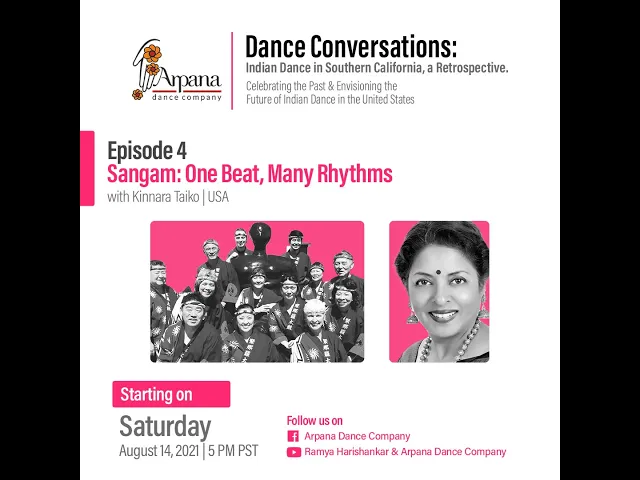
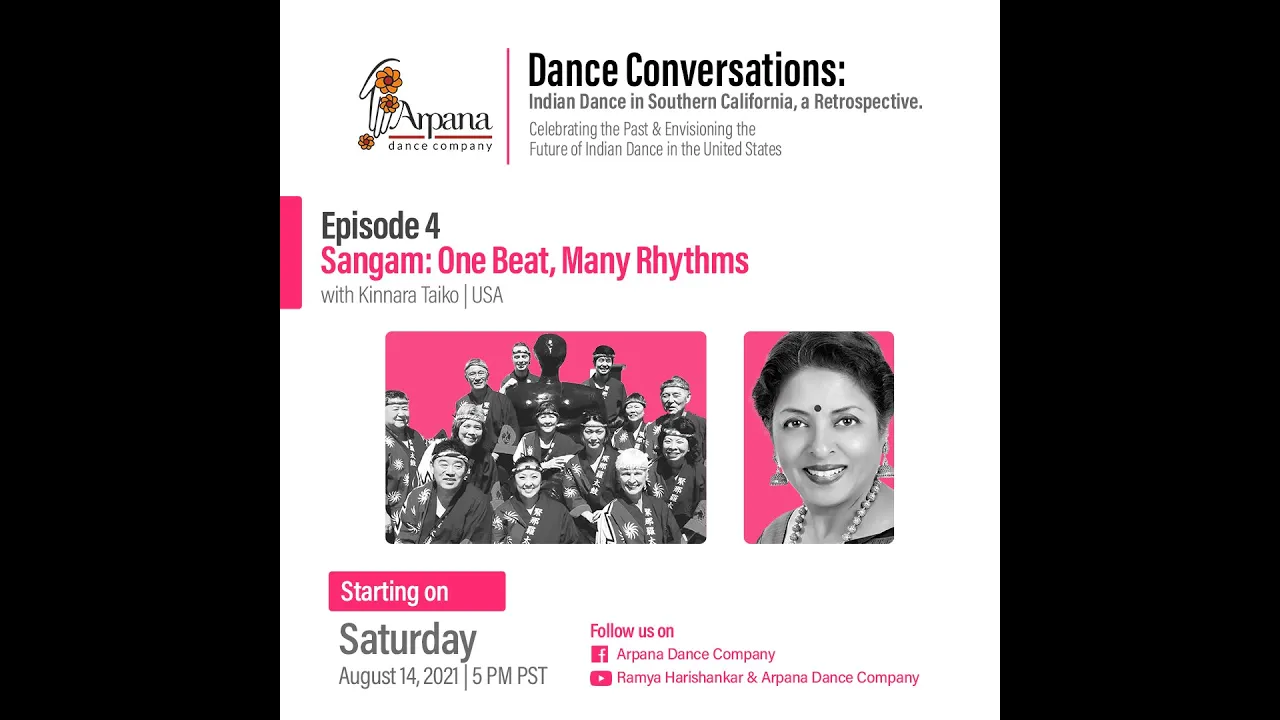
[Music] [Music] thank [Music] namaskaram my name is ramya harishanka and this is dance conversations a retrospective of indian dance in southern california a digital documentation of conversations with colleagues collaborators and mentors in 1992 to commemorate 10 years of teaching in southern california a decade of my school and company arpana i presented a production to benefit a children's charity this then became an annual tradition in 1998 as i was trying to come up with a theme i thought living in one of the most diverse communities in the world how wonderful it would be to collaborate explore
and build communities through the arts and kinera taiko was my first partner in such an endeavor welcome reverend maas johnny and kate thank you so much for being here and sharing and recording our journey so far um our collaboration first was in 1998 in the production called sangam which means coming together and if i remember right dr garfield a professor and a dear mentor of mine i think connected us right um i think he's the one who brought us together but and though i have worked with many other companies with flamenco uh jazz band and
a persian musical ensemble um this is the relationship that has endured for over two decades and i'm really delighted um and delighted to be here with all of you um this today [Music] [Music] go [Music] so [Music] [Music] so [Music] now i've heard that um taiko um was create came into being in the u.s and then travel to japan um is that right trevor moss uh sort of it it starts simultaneously in japan and here around the same time independent of each other so uh the kind of taiko we play is recent it's not traditional
and it also started in hokkaido uh by people who worked at hot springs they needed to provide entertainment for the guests and so some guys in hokkaido hot springs gathered all the tacos they could find and put it together in a large group which is unheard of and then they started creating pieces to play for the entertainment of their guests and so that was the yeah the nuke forum is called mass title yeah 1970s 1960s oh and uh but i came back i didn't know about it in japan when i was in japan but when
i came back to the temple we just for some reason got the same idea and we started here so but it came out of the temple yeah yeah um you know in indian uh music and indian dance particularly classical forms uh there is a structure in rhythmic uh it's very mathematical it and there's a structure but within the structure you can be creative as much as you want um so johnny how is it in taiko is there like a structure or how do you create these rhythmic sequences well to kind of continue reverend moss's explanation
of taiko and actually this instrument has been in japan for like 2 000 years but and people play it on different ways and with different instruments or utensils and stuff like that or but what moss was trying to referring to was what they call kumidaiku which is a group tyco before i used to be played in a group but you know maybe no more than three or four people and it would be played in the village and for some festive uh celebration or something like that and then uh so that was that particular form and
that's throughout the whole japan so to speak and then as moss had mentioned probably in the late 40s and the 50s after the war when people started to congregate again there was this need for some kind of entertainment at the onsens which are the public baths or or baths right so that would be a form of entertainment so taiko was never really part of an entertainment it was part of a of a cultural ritual kind of thing in in respecting the different kind of uh deities that they have or gods that they see the mountain
rocks certain fields and stuff like that i'm sure a lot of other uh countries have that kind of respect for it for nature so to speak yeah so that would be play and that would be part of the ritual and they would do that every year and all of a sudden somebody wanted to make this into an entertainment kind of like a show that would attract people to come and see it but you know be part of the thing so that started the title that we're playing well that didn't really start because we actually started
our own way of playing taiko um yeah and we use it as a way to understand ourselves better in relationship to us performing with other people and how we react to other people are we better than them are we not as good as them our egos get in the way and so it's a combination of a whole bunch of stuff that's kind of like kinada's uh concept in terms of why we play together so to speak yeah but okay in terms of rhythmically getting back to your original question um since it's here in the united
states uh we're fairly used to listening to popular music which is 4 4 count so to speak four beats or something like that and so then using that kind of a format so to speak and river listening to all different kinds of music mainly african music at the time when we began and when he was listening to music was in the 50s and the 60s and so it's really hard to get international kind of music anyway so anyway he had these records and he was listening to him and he shared him with us and it
sounds really really interesting and then all of a sudden he comes in with these patterns and and he just kind of blitz him out and write down the syllables and then he teaches it to us and then the sticking and the technique also comes from here too where normally everything would start at the right hand he would start stuff with the left hand you know so it's kind of like evolved in that kind of situation and so it makes it a lot of fun in one sense and it's totally different than what they have in
japan so when people ask us oh how long has this form of taco been in existence or how long of a history does it have in japan and we kind of look around and go none wait a minute no gotta have this ancestral history in japan i go no we started here united states so it's just the the drug itself and the concept of a drug is from japan but because we couldn't afford one we had to make our own yeah so that's truly a japanese-american instrument and truly japanese american culture that we're trying to
perform and share with everybody very interesting and actually also i was going to ask you about the movements um is it just obviously from what you say right now there is no predetermined structure but it's either something that is choreographed uh to be visually interesting and also navigate the rhythmic structures right right so a lot of times when we compose a piece and and afterwards before or after we set choreography to it so to speak in terms of what looks good if you held a hand up here or if you hold both hands up or
something like that yeah yeah and so people come in with different movements some are natural to to get from one rhythm to another rhythm you have to do this anyway so it is exaggerated before you play so everybody kind of contributes to the arrangement to the structure of the piece that we're trying to play so yeah uh some pieces though i mean people just come in and say hey this is the piece that i wrote and this is how we're going to play it other people bring in a rhythm and then from there we kind
of like everybody kind of uh collectively kind of builds upon it and stuff you know so yeah yeah it could be spontaneous as well as kind of uh a group effort so um i know arpana you know has uh we've participated in the 35th and the 40th anniversary of kinera so if i'm not mistaken so when did its kinera itself form as a group and and i think you kind of explained why because you wanted to create something based on what you had all seen in in japan but when when did kinera as a group
come into being the taiko group yeah oh 69 i think 68 69 1968 69 1969 yeah so it's been i came to the temple in 68 so yeah it's been 50 years [Laughter] 50th anniversary last year now so um so the names of the compositions uh you know have a base in sanskrit like prapancha or samsara and i know that you go on pilgrimage to buddhist sites in india so what is this the branch or strain of buddhism that you practice at the temple it's called the pure land school in japan it's the largest denomination
and that's because uh our founder openly married and broke the monastic tradition so our our school of japanese buddhism is the only school that is not monastic [Music] he rejects monasticism by mary so oh but what is the relationship to india though to india yeah oh it for to the buddha it comes from yeah but not do all buddhists go to india uh oh yeah they do oh it's a holy land for us it is yeah that's why that's why you know we take groups to it yeah yeah i know that yeah yeah so kate
um you obviously are not of japanese origin so what uh how did you get involved with kinera and taiko and all of that so um i well well some time ago i had two very young children and i've been a practicing buddhist for a long time in other schools and traditions and practically impossible to sit on a cushion and meditate with a two and a four year old and a good friend said come to senshin and see see how that feels um so i joined uh 17 wow when was that maybe in 2000 no 1999
uh just before keynote i went on a uh they did a lovely trip in canada and my first uh time sitting in the temple i was listening to reverend moss and halfway through the serum the the salmon some drums started playing on the other side of the courtyard and my heart started beating and i'd actually heard those drums before somewhere but i couldn't quite place it um towards the end of the summer and uh reverend mars started talking about an upcoming trip to india and i thought well that's just you know two great things in
a row so i uh signed up to play drums uh with the uh and i also signed up to travel to india so that was 20 something years ago oh so you were not there when we did the original uh production in 98. i thought you were there for some no i just missed you i came yeah okay i i i knew johnny wasn't there but i thought you were there for some reason so oh okay that's interesting so um i as i mentioned just now johnny um i know you were not in the original
production in 98 um and then i see you were in in some of the pictures in in 2006 when we performed at the getty um so obviously you had uh become part of i mean you probably were part of kinder anyway but you're probably more active later so um you know when we first met you harish and i were in awe because we had already heard uh of hiroshima the band that you were involved with so we you were a celebrity so i was wondering what you did in the band and did you play an
instrument or uh uh yeah i i um it's part of the band hiroshima yeah and uh the time in which i probably which we had the first joint uh performance together i was probably on the road or something like that yeah yeah so that my involvement with them actually started in 1973 in which i personally had friends in the band and they told me to come down and watch them at a club uh close to our uh close ascension actually and so anyway i just took a drum down there we just started messing around and
then there was a performance that they had so the bad hiroshima actually was in existence in 1970 71 and then they broke up and then when they reformed again in 72 then they asked me to join i says uh i have no idea what i'm doing i have no idea no musical kind of a connotation what's happening but i'll come and check it out you know and so then we came up with some patterns there's some pieces for us for me to play along with the band and uh they taught me a lot of musical
things and i at the same time was with kenada and so we start 69 so about 73 four or five years been playing and so still didn't know nothing uh but we kept on playing both groups complain and then for me in 77 um this guy named clive davis came and he signed the band to uh to aristo records and that's where yeah it started so i basically played kaiko in the group i was the percussionist and so basically i just played taiko but mainly just played title percussion also too and not necessarily any uh
latin percussion anything like that so people ask me what do you do in the band and i said i just played taiko yang about the whole situation there was a woman in the group her name was june coramoto and she played this melodic instrument called the koto 13th street instrument sounds like a harp so to speak that's beautiful and now it's the lead of the taiko so i guess i was the the ugly uncle so to speak to this to to the beautiful culture so it kind of worked it why it kind of didn't kind
of work it actually worked to tell you the truth and so i was with the band and signed the contract with the band in 73 we signed a contract in 7 and i then traveled with band all over the world uh probably did 10 seed albums cds and then i left the group in 2004 and i was with you so i remember when we were in hiroshima are you mentioning that they had given the key of the city to your band i guess yeah for uh i guess bringing hiroshima to the forefront or bringing attention
to it yeah they were very very kind and allowed us to use that name and then we heard right before that michael jackson had asked to use the name also too and they asked him what for and he says wow you know he wasn't sure so they get sorry not not not this particular time and so then we went back we were very very very cautious and they said okay and so we got the blessing so to speak you know yeah so um reverend mars when we were in hawaii i remember you mentioning um your
share actually you're sharing the story of how you grew up in hawaii right and also the challenges uh post pearl harbor and i think that's it's very interesting for us being first generation um immigrants uh to hear stories um of you know communities that have been here for several generations uh well i didn't grow up in hawaii that my parents were born in hawaii but i grew up in a place called in los angeles called willowbrook and willowbrook is right next door to watts so i grew up in uh yeah from grammar school the schools
i went to were about 95 percent black and as far as i can remember there were only three asian families that went from grammar school to junior high school to high school and i my family was one of them so i had no contact with very little with the japanese community until much later so yeah but uh my my generation is the last two have been in the camps so that uh when pearl harbor took place uh the following year all japanese americans citizens or non-citizens were sent to the interior to concentration camps and most
of us stayed between three to four years in those camps and had to come back to start all over again because our property was taken with no you know compensation we had to sell everything within two weeks and basically give it away so uh coming back they had to start all all over again from scratch and actually they did a pretty remarkable job they built the temples again they built new temples and new communities and managed to maintain a tradition that that for four three four years died you know that's why your group is so
fun to to talk to because it's the same journey of how do you leave your country and maintain something right yeah and so when you i can't remember how we got in contact with the iranian but i was intimidated because when i went to india i fell in love with india right and the musical tradition of india is overwhelmed i mean we go you people divide that and subdivide that and you know so uh it was very intimidating for me but it proved to be a great relationship uh we're talking about math and indian music
and dance when when i first got ashura from you reverend maas in 1998 just the the rhythmic sequences were mind-boggling and i just focused on understanding the the sequences and the intricacies and literally choreographing it as a rhythmic piece you know and then over the years over the last two decades uh i've you know kind of re-visited it and re-uh thought the process and i thought oh it has it's named ashura so it should have something to do with the concept of ashura or demons and so we've re-uh choreographed it as uh as a battle
between uh with inner and outer demand demons um and so it has seen several incarnations and avatar avatars over the last 20 also there have been several generations of dancers who performed it in the last 20 years the innocence the first group we started so as i was um sharing with you earlier in 1998 when we were rehearsing for um ashura uh we used to come up to l.a to the temple and my son who was two years old would sleep through all the noise the drumming this uh the pounding and the moment it's and
and you know you would ask is it okay it's so loud and he would be absolutely sound asleep and the moment we stopped and it went silent he would get up and look around you know so i think it was the the the noise that was kind of allowing him to sleep you know but anyway you know all that subconscious absorption of music and rhythms has probably influenced his decision to pursue music as a career so he's training to be a musician now all right okay so in 2000 yeah we'll go ahead go ahead in
2007 you know six members of um kenara and uh joined us my company of 14 dancers and um harish my husband and i we were 22 of us that traveled to india and of course kate was with us and there were high uh exciting and low and challenging moments in the trip as it always is in india you know even though i grew up there uh i you know every time i go back now after almost four decades of being away from india it's always an adventure so what do you remember kate from the trip
i think i have so many wonderful wonderful memories of this trip um one of the big ones is uh the just the amount of organization it took for you and harish to put together to a tour for 22 young girls many of them still in their teens i mean a couple of chaperones but a busload of you know young teenage girls uh a few taiko players a lot of luggage because everybody particularly the dancers had two suitcases one for their personal and one for their costumes and then these drums that we had to put on
the top of the bus every day and the the drums got lifted up miraculous onto the top of the bus and we drove to the next place and they came down and they stayed in the lobby of the hotel overnight we never left anything in a theater at all they were always with us and just sometimes we switched the bus and they had to go in the back of the bus but just the logistics still blows my mind i don't know how you did it but uh we had a lot of fun um some challenges
when the electricity failed mid-performance in a theater which meant that all the fact there were no windows in this theater so it meant a bit like a more like an amphitheatre with a roof over and open window frames but no glass and the whole place was it was a humid evening cooled by fans well the electricity went out no lights no fans in the middle of a piece that we call shishimai where the lion is supposed to be dancing and everybody brought out their cell phones to see if they could see what we were doing
and we really tried to hold it together and play in the complete darkness it was extraordinary just lots of i mean yeah lots of love and chance to revisit and you know uh george arby with his mask jumped into the audience in the dark yes and there were people squealing uh as he was moving in the audience and i think it kind of turned into an impromptu interactive performance with the audience yeah it was a little bit of a letdown when the lights came on it was a bit [Laughter] oh and of course add to
all of that you managed to find an itinerary of incredible places for us to visit you know wonderful antiquities and museums and one of my favorite uh um memories i think you have a photograph that johnny sent you of george with his uh yes young ladies well he was really really enjoying that and then of course behind him there's another picture somewhere of him sitting playing his little bamboo flute and the girls striking their poses you know uh yeah behind him as i have that really yeah magical yeah i don't know if you remember kate
but we were in uh charminar uh you know the bengal bazaar the day after performance and we were walking in a group and we had told everybody to it's really a crowded mark a bazaar so we had asked everybody to hold on to their purses and wallets and stay together and there was some lady or or at least somebody who was it seemed like she was nudging you or tapping on your shoulder and and we thought for a moment maybe she was a beggar or then we thought oh somebody just by mistake you know is
bumping into you and then uh she said something and then we found out that she had come to the performance the night before and she was trying to say how much she enjoyed it and she recognized you and she was trying to draw her and draw your in the middle of the bangle market yes no that was yeah a little difficult to understand but it was really lovely of course i stick out like a sore thumb in india so but it was fun lots of fun you know i remember we went to this small town
well small by uh by indian standards in in kerala called cortium and um my one of my students uh family uh hails from there and the mother had organized this performance in the town for the grandmother who was 90 plus and she had said to me like a week before the performance i i really want you to come because my i want my mother-in-law to see her daughter that is nithya dance there may be only three people in the audience my mother-in-law and her two helpers but is it okay i feel really bad but you
know i my mother no can't travel so i said don't worry about it we'll we'll be we're more than happy to come and perform and so we go there and i don't know if you remember kaiten there is a very famous newspaper from that town and half the town is owned by uh you know those people and they have coffee plantations etc so we go there and the theater was packed uh they had 800 people in the performance and we were expecting three you know um so everywhere we went um there were challenges of course
with 22 people as you mentioned and 40 pieces of luggage you know uh but i think uh there was fun in the midst of all of that and i remember the girls being most tickled by the fact that every airport there we would hope they would open a counter just to check us in and also there would be porters waiting at the baggage claim to receive us when we arrived those were the new days of deregulation in india so there were a lot of new airlines and so the uh travel agent who had made all
these bookings took the extra effort to arrange all of these things so that it was a little special you know for us so um you know uh every time i plan something like this i um i just go for it um and i just think of all the fun and all the good times we can have um don't really think about the challenges of course we go through it and then when i when you come back i just think how the heck did we do that you know i don't know and why did i do
that but you know and then every time harish would always say so is this the last time that i would be like yes and that would last for about two months and then i'd be planning the next trip already bit crazy yeah and of course you know we went to japan in 2011 and that was special in many many ways of course traveling with you all is always a pleasure um and then having traveling to japan as you said traveling to a country with people who can who are familiar with the local culture or the
language is extra special and then on top of it you know it was a fundraiser for tsunami victims so it really was a very very special trip and um i remember the lunch the vegetarian lunch you had arranged for us at the temple to familiarize us with what is what we what would be available in japan as vegetarians for us you know um and reverend do you remember in hiroshima this lady who came to the performance and danced with everybody at the very end yes she's an old friend of mine from the time i was
studying in kyoto but she happened to be the daughter of the former head of our entire uh denomination in kyoto our mother temple is in kyoto and she was born and raised in that temple and while i was at the university we got we met and she decided she wanted to go to uh what was that madras to study and so she wanted me to help her fill out the application form is the color kendra i'm not sure so anyway her father is a really prominent religious figure right so it says father's occupation and he
she said just put that priest and so she did not want to have any favors right so she went by herself to madras took the learned sanskrit enough to take the exams and when she came back she taught bharatanatyam in osaka and various universities and she was on her way to india at the time we were in austin hiroshima and i told her about it so she came to see it yeah yeah she loved it she loved it yeah yeah and also of course we can't forget kure you know that was the best that was
the best i think yeah um were you there kate you didn't come with us right dude derek came on that trip yeah so uh when we wouldn't yeah go ahead go ahead in koori we were performing in the temple it was quite cold that evening and the audience it was the courtyard temple courtyard was packed and we had done a run through and everything was fine was working perfect and when the performance began and these girls were all in these one-legged poses of shiva um in front of the temple the door had been closed and
the music would not come on for some reason and i was running back and forth that the music system was a little further away from the space where we were performing and we were running i was running back and forth and i could not figure out we couldn't figure out why the music wasn't playing and these audiences they were literally hardly at our feet you know there was literally two feet away from us and they were feeling sorry for these girls because they were all standing in their there one-legged poses and they were trying to
tell them just put your foot down just put your foot down you know and of course finally these girls figured out when to do it you know kind of elegantly and in unison and then we played the music finally the music came on and they started dancing and then miraculously the door behind opened do you remember that and we were like oh my as they were dancing the door to the temple opened by itself so the order the member said that was a good sign that he wanted to see the dancing too so absolutely that's
how that's what we felt as well people had never ever seen they didn't have a clue what it was but they loved it they absolutely loved it yeah they were screaming at the guy in japanese go find another one and hurry up but it was so i mean it's it's special when you perform to audiences uh who have not seen what you've done right it's um like in in in nara or in hiroshima or so we didn't perform in the main centers like tokyo which probably has a lot of yeah so um and of course
the same thing with hawaii performing for the young students and really uh opening their eyes to the you know the diversity and the cultures that are possible that was extra special as well you know we always have fun uh when we travel with you and we've we've we've got we've worked with what to through almost three generations of your group right and just to see them grow up and leave go on to other things and the next group come in uh it's just like an extended family really yeah when we do travel it's just sheer
fun to do it is yeah there always has been yeah and talking about building communities actually many of them have built relationships and friendships with many members of kinara and they communicate independent of this connection you know with kate or with derrick or others they they have connections outside of arpana and kinara as well so which is really uh which is which is what it's all about you know it's building friendships and connections and um and i'm you know i'm really grateful for bharatanatyam and for dance and for the arts being such a way to
connect people you know so thank you so much absolutely wonderful to have him yeah i appreciate it i think i i think we work with many many groups you know doing collaborations and stuff like that but i think arpana and kinada in terms of just our values and uh are very very similar you know it's it's nothing really out honestly you know high or lavishly too low so to speak you know so it's a combination of the both it is very very i think respect for each other and then within each group that we have
our own you know pride and integrity to be able to maintain you know integrity between ourselves amongst ourselves and then with other groups and i think it's really really helped kenada a lot to tell you the truth and other people uh participating in kinade and how they see our relationship with other groups and especially your group in terms of how you handle uh the girls and how they respect you and the customs uh in terms of greeting you before after uh that particular kind of respect um really really shows our people in terms of another
culture that um is they're they're they're rituals so does people they're customs you know yeah and so it just expands people it makes them understand and appreciate what they have and stuff and where we can go also too uh and stuff like that so we really appreciate and thank you also too for allowing us to to be part of your community also too because um it's opened up our eyes especially my eyes quite a bit to tell you to in terms of uh what we think in terms of international or global music so to speak
but and then uh your guys's history i mean this totally dwarfs everything in the world basically and the rhythms are just so unbelievably uh interesting i wouldn't say necessarily difficult or hard because if you grew up listening to that it's just second nature to you i mean it's just what it is you know so it really really helps us it i it helps us in our in our understanding of music also too and what's the possibilities of it you know you think we're doing something hard you know like ma said you know you break down
the indian rhythms and it's unbelievable you know just totally unbelievable it's you know i mean not to bring throw names out but i had an opportunity to perform with ravi shankar and so he says oh it's very very simple it's seven and a half and i go how do you contact it's really really simple seven and a half well if you can't have try nine and a half and i go what so that kind of opened my eyes up too in terms of the possibilities and the subdivisions of so many different kinds of things so
thank you very much appreciate it so i'm so grateful um not just you know for this conversation but also as you just said for the long and enduring relationship between kinara and arpana and i look forward to many more years of collaboration and many more trips as well reverend mouse [Laughter] thank you [Music] [Music] you