[Music] yo how's it going welcome back to the channel hope you're keeping good in this video we're going to be going through all of the tuning settings explaining what everything actually means how it affects the car and also what happens when you increase or decrease each setting and what happens if you put it at the highest or the lowest amount so hopefully by the end of this you will understand how everything works when tuning a car whether it's for racing drifting or drag and yeah i try to make the guide so it's easy for people
to understand even if you've never tried tuning anything before but also still interesting for pro tuners so no matter what level you are you should still be able to learn a lot from this guide and it's taken quite a few weeks to make this video a lot of research on real life tuning uh reading and watching all the guides from real life pros as well as talking to loads of people on everything from the car x groups to like driftworks forums so yeah hope this helps you out if it does be sure to like the
video and consider subscribing to see more videos like this on the channel right enough waffling on time to get into it so first off you want to make sure that you have the ultimate upgrade or the ultimate mod this basically means all of the tuning is unlocked and in the dyno stand you have access to all of the tuning uh settings and options so make sure you do that first so we start off with spring length so this is basically the length or the travel of the suspension springs and this will also adjust the car's
ride height so increasing it means more suspension length or travel raising the ride height and more progression to the suspension which basically just means the springs are longer so it takes longer to be pressed down a longer progression uh maxing this out means a very high ride height it's going to be like a monster truck you're going to have very long travel springs with a slow progression like the springs will kind of feel light and soft and then if you decrease the setting you're going to be basically giving yourself shorter springs a lower ride height
and quicker progression springs so they'll kind of feel like they're a bit more stiff and if you take it to the minimum it's going to be a very low ride height the car may be like scraping the floor the wheels might hit the arch and the springs are going to kind of feel shorter and stiffer and now we go on to spring stiffness so this is how strong or stiff the springs are this also affects ride height slightly as stiffer springs mean more weight is needed to push them down so say you had your car
like perfect fitment you make the spring stiffer obviously you need more weight to push those springs down now so your car is not going to be at perfect fitment it's going to go up a tiny little bit in ride height right so increasing this is going to mean a stiffer feeling suspension it's going to react quicker and it's going to be more harsh if you max out you're going to have a very stiff ride like the suspension won't be able to compress much and it's going to react really suddenly to bumps in the road and
stuff like that almost like having a solid suspension if you reduce the setting you're going to have softer more kind of spongy and light suspension it's going to be less reactive and it's going to react slower if you set it to the minimum setting it's going to be like the suspension's almost not working properly like the springs won't be strong enough to even resist the car's weight properly so it's going to be like the suspensions sitting really low it's weak and it's bottoming out quite a lot so with all of these settings it's going to
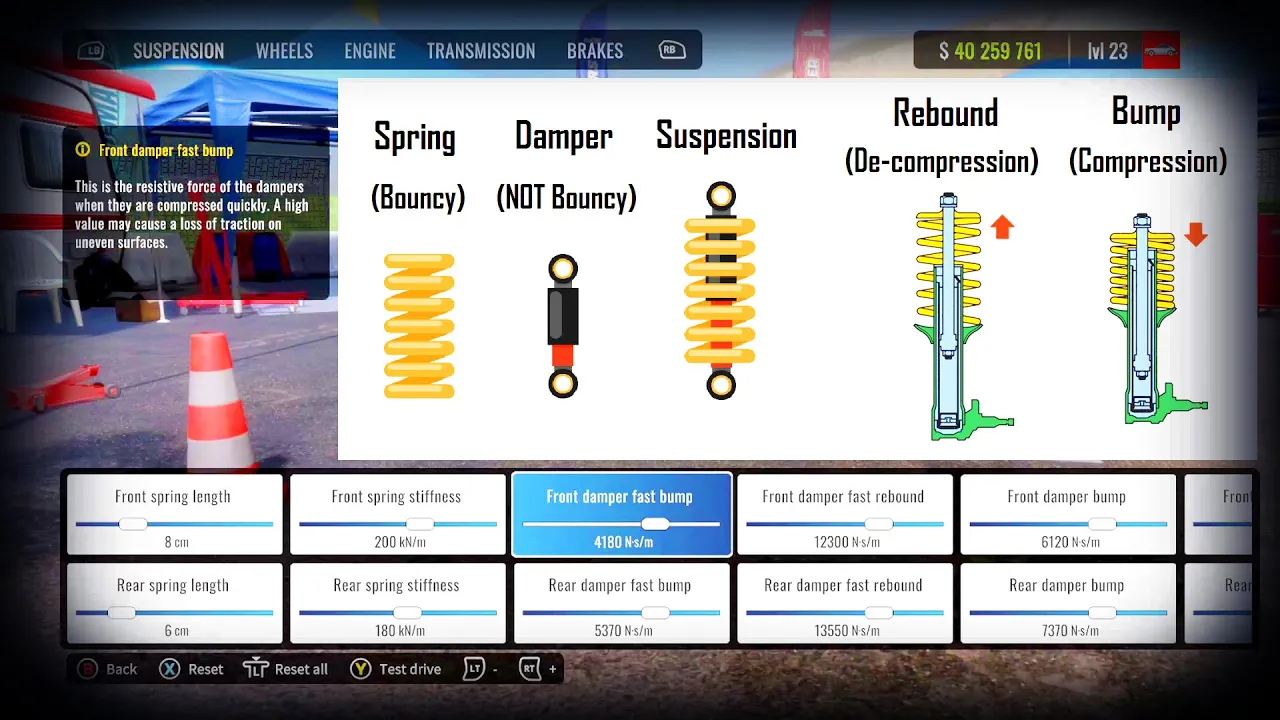
be about finding a nice balance it's just finding what suits uh your car how you're setting that car up and your drifting or driving style so it's all about you know sacrifices and you know things that will get better when you change a setting but some things will get worse so it's like it's all about finding a nice balance now before going on to the shock settings i'm just going to quickly go over what a shock is and how it works with the suspension so the shock absorbers or the dampers or the shocks whatever you
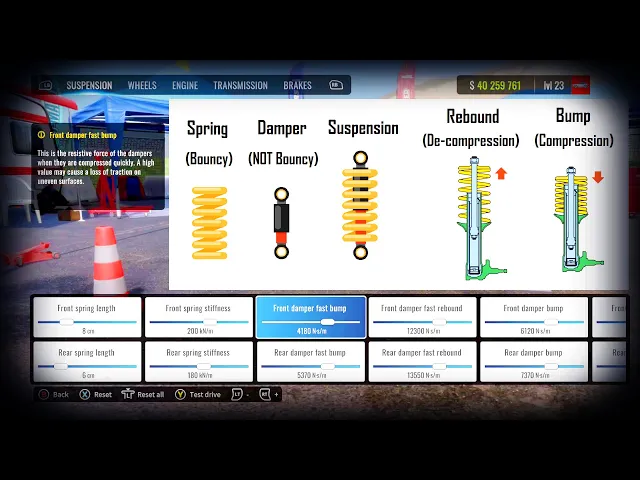
want to call them are fitted inside of your suspension spring and similar to the springs the dampers add resistance you know to kind of soak up forces and bumps from the car on the road so for hitting bumps um jumps and dips and braking accelerating all that sort of stuff but whereas springs are bouncy the shocks or the dampers are the opposite of bouncy like if you only had the springs in the suspension and no shocks then when you hit a bump in the road the car would kind of bounce around and wobble for like
10 seconds like jelly um the shocks basically soak up and resist those kind of forces making the ride more smooth so the shocks not only there to stop the bounciness but it's also to add resistance so it's a huge part of the suspension you know the car suspension is the spring and damper working together to absorb bumps in the road you know impacts from jumps or even just steering and braking and stuff like that so it all makes the ride more smooth it's move balanced and helps maintain grip also to make the next bit a
bit more clear the bump of a damper refers to the compression so when it's pressed down and the rebound is the opposite basically decompression so when the damper pushes back to its original position hope that quickly explains it right now let's get into it okay so damper fast bump so this is like the resistance and therefore the speed of the damper compression in regards to quick impacts so fast bumps so this setting is used to absorb fast bumps like potholes curbs uh bumps in the road and things that give a quick hit to the suspension
more is going to mean stiffer the resistance and the slower that the dampers will compress on a fast bump if you max it out it's going to be too slow and stiff like the suspension won't be able to compress uh quickly enough so you'll feel bumps really hard when driving as the damper won't be able to absorb the shock that quick so it'll feel like a solid damper and you'll feel like a hit or a jolt when hitting bumps and stuff in the road if you reduce the setting it's going to be the opposite so
a faster and weaker resistance of the damper on fast bump compression if you set this to the minimum it's going to be too fast and the dampers are going to be too weak so they're going to compress fully and quickly on fast bumps and almost act like the dampers aren't working so again you'll feel a hit through the car on fast bumps okay hope you're still with me now we go on to the damper fast rebound so this is like the opposite of what we just did it's the rebound or the decompression of the damper
and again this is only in regards to fast movement so a fast decompression so like the damper is being pushed back and decompressed by the springs so basically when you hit a fast bump and the spring in the damper gets pushed down and compressed that's obviously going to push back and give a fast rebound this setting here controls the damping and speed of that fast rebound so the more you uh increase the setting is going to mean slower and more resistance to the fast rebound of the suspension if you max out it's going to mean
the fast rebound damping will be too resistant and slow meaning if you hit a bump the suspension will take a long time to recover and rebound back to its original position if you hit multiple bumps quickly in a row the suspension you know is going to get sort of lower and lower each time and not recover and it could bottom out if you reduce the setting then it means the faster and less resistance there will be to the fast rebound and if you set this to the minimum the damping resistance will be too fast and
too weak for the faster rebound this means that after hitting a fast bump the suspension will instantly fast rebound and make the suspension quite bouncy because the damper won't be resisting or slowing down the fast rebound it will just kind of let the suspension spring back and just do its thing and it will make the car kind of quite bouncy okay hope this is making sense and don't worry the dampers are probably the longest and most kind of awkward thing to explain everything else is much quicker and more simple so make sure you stick around
to the end of the video okay so next we have the damper bump so this should be called the damper slow bump or slow compression just to make it more simple and make sense so this is the resistance and the speed of the dampers in regards to just general or slow compression so call this the slow bump and the slow rebound this setting and the next setting so damper slow compression is going to be caused by like steering acceleration changes in track elevation so going up or down a slope and so this setting is controlling
the resistance and therefore the speed of the dampers for slow suspension compression so the more you add is going to mean the more resistance and the slower the damper is going to work for slow suspension compression if you max this out the dampers are going to be resisting too much making it uh too stiff and slow and not giving it enough time to compress effectively limiting how good the suspension can work if you lower this setting the dampers are going to move faster and have less resistance to the slow suspension compression if you set this
to the minimum then the dampers resistance will be too weak and fast meaning the suspension's slow compression won't have much holding it back other than the spring like the shock will basically feel like it's not working which means the suspension won't be very smooth and also this would cause issue issues for the slow rebound okay so now we have the damper slow rebound again this is the speed and resistance of the dampers but for slow rebound or slow suspension decompression whatever you want to call it um so adding more means more resistance and slower dampers
meaning the suspension takes longer to rebound to a setup position if you max out you're going to have too much resistance and a too slow of an overall rebound so you're going to have a slow slow rebound so for example after steering or changing track elevation something like that the suspension will take too long to go back to a settled position and this is going to make the car unstable if you decrease the setting you're going to have less resistance and faster overall rebound of the suspension and if you set this to the minimum there's
going to be too little resistance and too fast of an overall suspension rebound a slow suspension rebound meaning you're going to have an instant and aggressive rebound that could make the car quite bouncy and wobbly when rebounding from steering or elevation changes and things like that right okay finally we got that long bit out of the way now we move on to toe adjustment so this points the front side of the wheels in or out when looking from above so here's to out here's two in and also here is a neutral or zero toe which
means the wheels are just perfectly straight so increasing this means a positive inward pointing toe this gives you more stability driving straight but it makes it harder to start turning or go side to side if you set this to the max full positive for the front it will make steering very slow to start but lots of straight line stability for the rear full positive would give a very grippy direct acceleration but it would be too much force on the car's drivetrain like the wheels would be pushing in and all that force pushing in would start
to wear away and break parts of the drivetrain not in the game but in real life so i guess it's something you wouldn't do in real life so you probably shouldn't do it in the game either so decreasing the setting making it less than zero is going to mean a negative outward pointing toe it's going to make steering more easy to start off but it's going to make the car more unstable when driving straight if you set it to the minimum full negative toe for the front you're going to have quite snappy steering at the
start of a turn like reduced understeer but it's going to be a bit more unstable on the straight like it won't want to stay driving straight you're going to have to kind of correct it because it's going to be slightly sort of tracking and drifting to the left and right for the rear full negative toe will make your car spin out quite easily when drifting so best to avoid it and also one thing to add is that adjusting the toe in or out for the front or rear is going to slightly increase the tire contact
patch giving you a little bit more grip for drift tuning you probably want the front to be slightly toe out but the rear to be slightly toe in if you want to know why and you want to know more about drift tuning then make sure to subscribe to see the next video which will be a follow-up to this video but we'll be explaining how to drift tune all these settings the best way for different cars uh different setups and different styles of drifting so rather than just saying the basics of what all the settings mean
which is more what this video is talking about the next video is going to be like how to use all this info for drift tuning your car for you know whatever car you want whatever setup whether it's like a street or a pro comp drift uh setup and your specific style of drifting and you know basically how to tune any drift car perfectly to how you want it i didn't want to try and add all that on top of this video because it would just be too much so subscribe to check out that video coming
soon okay so now we move on to a popular one this one is camber so most people know what this is this points the top side of the wheels in or out and it's used to help keep the tires flat when you need it so when you're steering or drifting or cornering hard and it affects stability when driving and cornering so the more you add means positive camber this would give you a bit more straight line stability and make it more stable on uneven surfaces but positive camber is normally used on things like tractors and
farming vehicles they're rarely used on race or drift cars if you were to max this out so max positive camber it would help if you were driving you know a tractor over some mud but it wouldn't be much use on a racing or drifting car if you decrease the setting though it's going to give you negative camber which means more stability in corners and drifting but a little bit less when going straight so with negative camber the wheels are angled when going straight but they almost get pushed flat when turning and drifting uh giving you
more grip and stability if you set it to the minimum means max negative camber it might look cool for you know stance cars and stuff like that but it's not going to be great for drifting it's just going to be too much basically you're going to lose a lot of tire grip the feeling of the car the road and self steering won't work as well as it should do if you're using a steering wheel with force feedback so next we have the anti-roll bars so the anti-roll bars sometimes called the sway bars what they do
is adjust the body roll of the car and it also affects grip and stability so more means stiffer bars meaning less car body roll but when cornering hard it's more likely to become unstable or lose grip if you set it to the max you're going to have very stiff anti-roll bars almost solid and not allowing for flex or body roll this might make the car unstable through corners or it might even make the car go up on three wheels while cornering if you reduce this setting you're going to have softer anti-roll bars more car body
roll and be slightly more stable while cornering but if you set it to the minimum you're going to have very soft anti-roll bars almost like they aren't there or they're not working the car would be a lot more free to roll around and it might be too much though so it might make the car handle in a bit less responsive so next we have the caster angle so this adjusts how far forward or backwards the steering axis is from vertical this causes a dynamic camber angle change as you turn through the steering lock so the
wheel camber will change more and it also affects counter steer and self straightening if you're using a steering wheel more is going to mean more positive camber gain on the lead wheel and more negative camber gain on the trailing wheel as you go up to full steering lock so as you steer through from like zero steering to 100 steering and as you can see here the game shows you what the wheels will look like when they're at full steering lock also more positive caster means stronger self steering self steering means when you're drifting on a
force feedback wheel and the wheel countersteers itself to start a drift or also when itself right steers the car coming out of the drift if you max this setting out you're going to have a lot of dynamic camber change that will mean you'll lose grip at full steering lock as you'll be on a lot of camber and the self steering will be very strong and might cause the steering wheel that you use to wobble left and right at times if you reduce this setting you're going to have less dynamic camber change meaning self steering will
become more weak if you set it to the minimum or zero cast there is going to mean no dynamic camber change as you steer with limited self steering and steering correction from the car now ackermann angle so adjusting this makes the inside wheel turn sharper than the other the more you turn is used to adjust tire drag and tire slip when cornering and drifting the more you have means the more aligned the wheels are when turning or drifting at full steering lock so the more they're pointing the same way this helps with drifting big angles
but also means you get tire drag when steering or drifting low angles if you put this to the max it means when you're at full steering lock both front wheels are straight pointing the same way and aligned so no tyre drag when drifting at full lock but when you're drifting or steering at low angle one of the wheels will be dragging a bit slowing you down if you decrease the setting of the opposite basically so the more the wheels are aligned when starting to turn but the less they are aligned at full steering lock if
you set it to the minimum then when at full steering lock the wheels won't be aligned and point in the same way and when drifting one wheel's going to drag and slow you down a bit and kind of bring you out of a drift but when you're drifting or steering at low steering angle the wheels won't have much drag so the next one's quite easy it's steering angle so it's just the maximum steering angle that the car will go up to so more means you can steer more and hold a bigger drift angle without spinning
out max sets it to the highest max steering angle best for drifting as you can hold more angle without spinning less obviously you know limits the maximum steering you can have if you set to the minimum obviously it's going to be the least amount of max steering angle that the game lets you set but for this just always put it to max steering angle it's best for drifting and there's no real reason not to so next we have the rims diameter so basically wheel size wheel diameter more means a bigger sized wheel and this will
slightly affect the feel of the overall gearing of the car not very much but it will make a little bit of a difference so basically bigger wheels mean it takes longer to get to max speed and max speed is higher but you know it kind of slows you down so it will feel like a lower and longer overall gearing or you know final drive gear ratio if you set it to the max you know obviously you're gonna have like huge crazy dunk wheels uh you're also going to have a slow car with low torque and
power but it will also have a high top speed so again it's going to feel like the final drive gear the overall gearing is longer and slower with bigger wheels if you decrease this so smaller sized wheels it's just the opposite so it slightly affects the feel of overall gearing again but the opposite way so it'll make the car accelerate a bit faster but have a lower top speed so with smaller wheels it will feel like shortening the final drive gear ratio the overall gearing if you set it to the minimum obviously you're going to
have ridiculous like toy car wheels and the gear ratio will feel really short uh the wheels are also going to spin up too easily meaning you don't have much grip and next we have tire width so this changes the width of the tire and the wheel more means a wider tire and wheel giving you more grip max is going to mean like you know crazy wide tires the sort of thing you'd use for a drag car uh way too much grip for drifting um if you make this less obviously thinner tires and wheels less grip
if you set it to the minimum you're going to have you know really thin tires a very little grip almost like driving on like a spare wheel then we have tire pressure so this is how much air pressure is in the tires how much they're filled with air basically so more means more air pressure means harder tires less grip max is going to mean very hard tires with low grip so less is going to mean less air pressure and more grip and you're going to get a little bit more feeling out of the tire like
a feeling from the road setting it to the minimum means you're going to have very low tire pressure giving you like saggy and soft tires that grip well while driving slow but aren't very good at high speed so wheel adhesion is basically what type of tires you're going to be using and the game actually shows you the different type of tires so 90 adhesion as you can see is like worn tires so tires that have already been used and worn down and have low grip 100 is like your standard street tire that most cars would
use and drift on 110 is similar to 100 it's the same style of tire you know same amount of tread but it's just a more grippy rubber and 120 is as you could see like a racing semi semi-slick tyre hasn't got much tread and very grippy so what most people drift on in real life is 100 your normal street tires most people wouldn't be able to afford to buy performance tires basically 110s and nobody really drifts on 120s in real life which is you know racing semi-slicks in real life so yeah but obviously use whatever
feels best for you so next we have wheel track sometimes called track width so wheel track is how wide or far out your wheels are from the car so more is going to add more stability to the car's handling but if you max out you're going to make the car go from almost like a long wheelbase car to a square wheelbase car because you're pushing the wheel so far out and it's going to make the car spin out easier if you do that less is going to mean the wheels move closer into the car it's
not really going to provide much benefit and if you set it to the minimum like your wheels are going to be like inside of the car they're going to be it's going to like glitch out basically so you don't want to do that and next up we've got tire profile so this is basically how thick the tires are so more means a thicker tire you're going to get a little bit more feedback from the road but if you max it out you're going to have very thick tires almost like drag tires the feedback from the
road is going to be kind of very spongy and soft less is going to mean a thinner tire giving you more quick and harsh feedback from the road and minimum is going to mean very thin tires and it will almost give the car a kind of stiff and harsh ride almost like a race car so next up we have engine tuning engine tune up so this basically just upgrades the whole engine so more power top speed and acceleration more obviously increases this is going to give you more overall power just a better engine overall max
is going to upgrade it to the max less is going to be you know less power a less you know better engine and minimum is the lowest engine you know performance you can set it to so max torque this is basically how much force or power the engine has at any moment so more means the engine has more power and strength to build up speed faster if you max out you know you're going to have the most engine force available to power the car forward at any time if you lower this then you have less
engine force or strength and if you set it to the minimum you're going to have you know the least amount of engine force and strength that you can have so it might take a while to build up speed even with a high horsepower car because the engine is lacking in you know the kind of force next you have the rev limiter so this is how many revolutions the engine makes at its fastest so basically how fast the engine can be running at more means a faster spinning engine giving the car more power and you can
also spin the wheels more easily max is obviously going to be setting this all the way to the top means the engine is able to spin up to its maximum you know engine speed less is a limit on the revs or the speed of the engine and the minimum obviously is the minimum setting that you can put to um you know limit the max revs that the engine can go to next you've got turbo charger and this is pretty simple do you want a turbo charger on the car or not yes we'll give you a
boost to the engine power and also the car will have a turbo sound no means obviously you're not going to get a power boost that the turbo gives you and the car also won't have that turbo sound when you're driving it next you have turbo air pressure this is basically how powerful the turbo is so obviously only matters if you've got a turbo installed more is going to mean a more powerful turbo giving more boost to the engine max is going to mean the max power you can set the turbo to which is going to
give the engine a big power boost less is going to be less power of the turbo and less of a boost to the engine minimum is going to be the lowest setting of power for the turbo not giving much added boost to the engine and now onto the transmission you have the diff locking ratio so the differential locking ratio so this setting is how much difference is allowed in the rear wheels spinning more means the rear wheels will try to rotate at the same time it makes the car more drifty and less grippy max is
what you call a locked differential or a welded differential it means the wheels will always move with each other and spin at the same time and there will be no slippage or difference less is going to mean the wheels are more free to rotate and spin independently of each other and the minimum means the wheels are completely free to rotate independently from each other and it will make the car more grippy and less drifty so the final drive sometimes called the overall gearing of the car is basically a setting that changes all of the gears
at once and it makes them all kind of shorter or all longer so if you increase this setting you're going to make the gearing of the car more towards acceleration and short gearing so if you max it out the car is going to accelerate really fast and go for all the gears quickly but you're going to have a low top speed if you do less so decrease the setting is the opposite so you're going to make it more speed gearing or a lower and longer gearing setting it to the minimum means you're going to have
a very high top speed but it's going to take a long time to sort of accelerate and get through the gears and get up to that top speed and then next up you have all of the individual gears as well so this works the same as the final drive ratio but instead of tuning all gears at once you tune each gear individually so you can make each gear shorter or longer and you can also make all the gears closer together or more far apart and now we're finally on to the last section and we start
off with break torque so this is adjusting the strength or the force of the brakes so increasing it means braking force will be stronger and faster but less controllable if you max out the brakes will be too strong and they might lock up the wheels easily when you're braking causing you to crash or lose control if you lower this then you're reducing the braking force making it weaker and the brake will work more slowly but the braking will also be a lot more controllable and smooth if you set this all the way down then the
brakes are just going to be like too weak and almost like they're not working so you won't be able to slow down in time now we move on to the brake bias so this is going to adjust how the brake force is applied between the front and the rear wheels so setting it to 50 means all wheels break with the same force but if you increase it from 50 it shifts the braking force more towards the front wheels and helps to get more drift angle when braking but if you set to the max it means
only the front wheels brakes will work so your braking won't be very good and it's also more likely to make you spin out easier if you lower this then you're making the braking force go more towards the rear of the car and it's going to straighten the car up a bit more when braking like if you're drifting it straight up setting it to the minimum means only the rear brakes will work and so your braking will be really bad and you won't be able to slow down properly next you have abs abs stands for anti-lock
braking system you can set this on or off on means that the brakes won't lock the wheels out when braking and braking will be better and more efficient off means the anti-lock braking assist is off so if you brake hard you'll be able to lock the wheels up most drifters have this set as off as you can use brake locking to help with drifting and then finally you have launch control which is basically a speed boost that you get when you start off driving but it only works when you're doing an xds tandem challenge online
doesn't work on anything else and most people just set it to off and that's it hope that's helped you if you've got anything to add to this or even if you have any questions uh make sure to drop it in the comments and we'll get back to you and try and help you out and make sure to check out the next video which is going to be how to drift tune any car for any setup like a street drift car or a pro drift car and for any style of drifting so this video was just
an understanding of how everything works for tuning for not just this game but this will work on forza you know any game and also in real life and um but yeah check out the next video which is going to be how to apply all of this knowledge to make any type of drift car for any style of drifting thanks for watching if you've made it to the end really appreciate if you could like and maybe subscribe to the channel and we'll see you in the next one keep it steady peace