now let me start with some fresh insights last week we received results from a survey we sent out to our portfolio companies about how they perceive nature risk 48% of the responding companies now consider nature risk to be financially material that means it could impact the operations or results and while survey responses as you know they're not hard science this validates our decisions to look further into this risk and combine our climate and nature disclosures into one single document uh in 2024 but let me be honest while it conceptually makes sense to you know treat
these topics together the complexity really became appearent when we wrote These disclosures we are dealing with different yet interconnected risks and the portfolio of over 8,000 companies but that's why we organized this event here today to share insights Foster dialogue and collectively build knowledge about nature and climate risks and I'm fortunate to be joined by my colleagues you can see here Mia Christopher and Julia over the next 25 minutes we will cover how the fund is exposed to climate nature risks what our portfolio companies are doing how they addressing these risks and our future priorities
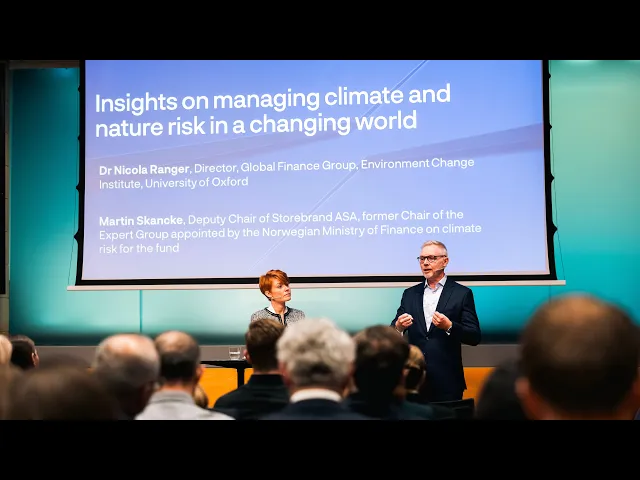
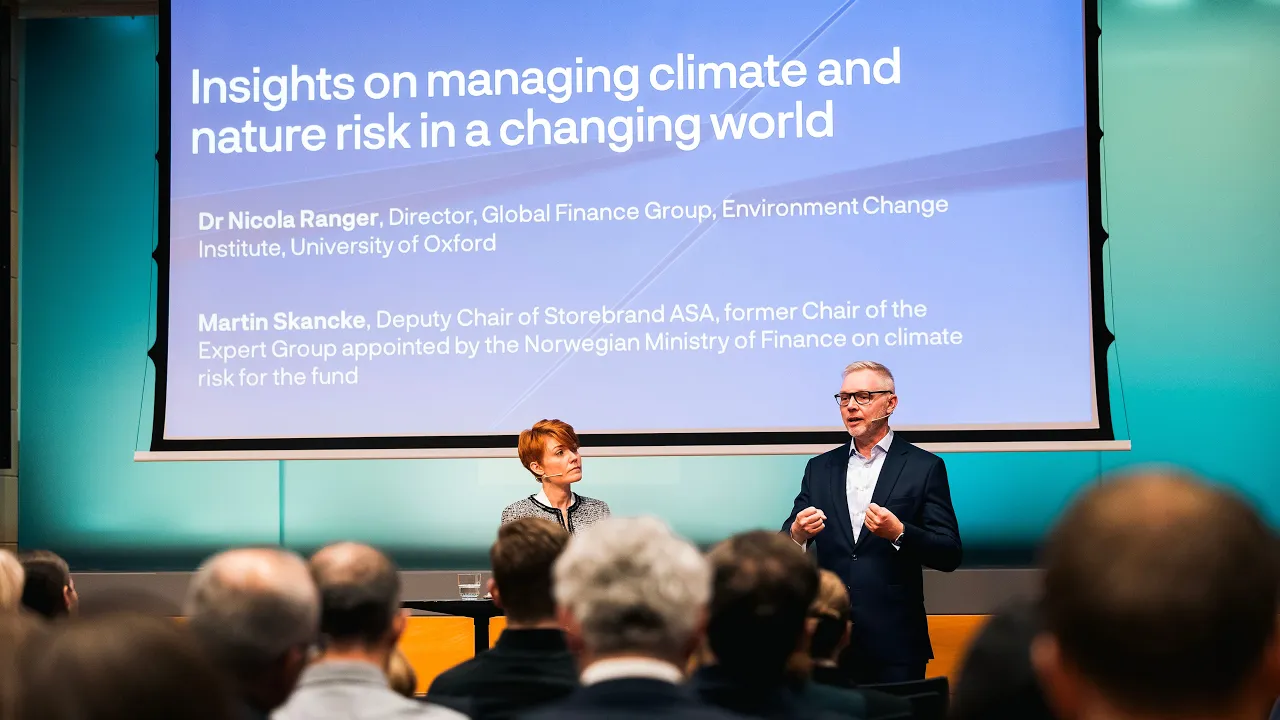
and after our presentation very excited to welcome Dr Nicola Ranger from Oxford University and Martin skunker the former chair of the expert group on climate risk and the fund and very looking forward to hearing your perspectives and your questions at the end now turning to you Mia let's come back to our my initial point about combining our climate nature disclosures could you explain why does that integration make sense from a science perspective I can I can so climate systems and ecosystems exist in a delicate balance so we know that climate change threatens biodiversity but we
also know that healthy and adaptive ecosystems help us be more resilient and mitigate climate change now scientists have acknowledged these interconnections for decades however among investors we haven't really Quantified these interconnections and that is something we are actively working on now this is important to us because nature provide critical resources that fuel our economy right so think by direct resources such as food fuel or medicines or more regulatory services such as carbon sequestration and flood control now these natural Services underpin economic development but they are rarely valued in financial markets but for investors it's about
understanding the future risk reward of our current Investments and also potential investment opportunities traditional climate scenario models don't really account for the economic impacts it has on natural systems and the future availability of Natural Resources for example I'll give you one um example from the from the Fisheries on how climate change have an impact on species and that then how the species have an impact on an Industries as for example Fisheries so as the ocean temperature is changing Studies have found that fish docks move following the preferred temperatures so when climate change lead leads to
changes in species distribution the fishermen also need to follow addressing these in interconnections between climate and species leads to better measurement of future risk and this is what we are working on in the fund so now Christopher is going to talk about how we measure this currently on the portfolio thank you uh Mia so there's actually a very interesting story about uh emissions uh in the fund the big picture as we know is that Global emissions are continuing to go up and this uh means a warmer World a more volatile world and this is a
big risk uh to the fund in the long term so this worries us if you look at the Blue Line uh on this chart it shows the emissions associated with listed markets globally and they have gone up as I said now the funds Benchmark makes some adjustments to this index particularly we remove ethical exclusions related to coal and the removal of these companies contribute to lowering the emissions of The Benchmark relative to the index and that is done at the ministry level the fund does not have a separate decarbonization Target this was one of the
recommendations that Martin made three years ago when he put forward his report with recommendations on how climate risk should be should be uh managed in the fund and this recommendation was accepted by by parliaments we don't have a separate decarbonization goal but emissions in our portfolio have marginally declined over this period and that's interesting one of the reasons for that is that we have divested from companies with high emissions I'll get back to that uh next yeah so risk-based Investments these are decisions financial decisions to sell companies that we believe have unsustainable business models they
add long-term risk to the fund and we can sell them they are not ethical exclusions so they're different from the work of the Council on ethics they remain in the fund's Benchmark and so they contribute to the relative risk of the fund and they're financially motivated in uh last year we did 49 divestments 10 of these were associated with climate and nature related risks when companies improve we can bring them back in we can reverse previous decisions many of the divestments we've made were made 10 years ago uh or more and so last year we
started reviewing many of those decisions and and we decided to reverse 16 of them eight of these were related to climate and nature uh related risks I mentioned that risk-based divestments are financial decisions so like all our investment decisions we track Returns on a daily basis this picture is quite positive and interesting what we've seen is the cumulative effect of these decisions has increase the uh returns of the fund by 64 basis points or more than 16 billion croner climate related divestments have made the biggest contribution in part because they account for the largest share
of divestments nature related uh divestments have also contributed positively so there's a story here if we sell risky companies with unsustainable business models and reinvest in the broader Market we can generate a positive return that's at least the the the experience from the last 10 years but as we can see these returns are volatile so we don't know if they will continue to be positive uh in the future now we measure climate risk using different methods this is stated in our mandate but it's also prudent we don't believe a single metric tells the whole story
we need to look at a menu of different metrics to understand risk in the fund scenario analysis is a tool for understanding how different climate scenarios might impact the fund over time so this is an important part of our toolkit um we have used a bottom up approach for the last four years this is where we started with this work it basically means you you estimate the net losses of climate change at company level and then you aggregate that up to portfolio level we've looked at a range of climate scenarios including scenarios with very high
levels of warming the results show estimated portfolio losses between 2 and 10% it's quite modest if you think about these these include scenarios with very high warming so we have identified a number of weaknesses with the bottomup approach that we talk about extensively in the report to to further develop this work we've developed some internal top- down approaches the first one looks and this is the starting point here is the macroeconomy so it doesn't start with companies it starts with the macroeconomy and the GDP effects of climate this exercise yielded 19% loss for us equities
under a current policy scenario so it's a fairly moderate warming so if we look at a more extreme warming scenario we might have even higher losses in addition we started looking at how nature risk could be included in these scenario models as Mia said currently this is a very nent field uh under development so we looked we worked with a set of academics at the University of Minnesota and looked at what the effect of Glo on global GDP would be if three ecosystem Services collapsed there are three out of total 18 ecosystem Services it doesn't
capture all of nature risk but it's a portion of it and the result was roughly 2% GDP loss so what can we learn from all of this well we can see that the the um results across these different models vary and we know why because they measure different things they have different assumptions different inputs different scenarios we also know that they're in their early stages they're continuously develop and and this is good but it does mean that you cannot compare results over time they also don't say much about the pricing of climate risk in the
market and this is critical information for making investment decisions so for that reason we're not using them the results directly to make decisions but more as a way to understand broader portfolio risk and how to use different models to better account for that right Alexis maybe you can talk us through how we work with these issues as an active owner thank you Christopher um companies are really the core of our approach how we manage climate risk because in our climate action plan 2025 that lays out our strategy to address climate risks we State basically that
em engaging with the highest emitters in our portfolio in is the core of our strategy and since our portfolio broadly represents the market our climate risk exposure mirrors market-wide risks channeled through these companies so ultimately how these companies address and manage the risks determines our portfolio risk exposure in 2024 we engaged 519 companies on climate and nature issues we conducted 141 Net Zero dialogues these are in-depth often multi-year long dialogues about companies climate targets transition plans and emission reductions and we set 753 specific objectives for these dialogues based on company's plans and progress versus peers
and as you can imagine doing this effectively requires robust quantitative and analytical foundations to determine which companies should we engage with which issues to prioritize and how do we measure progress over time and the starting point for our work our public expectation documents on how we want our portfolio companies to manage sustainability risks they are financially motivated this is about ensuring that risks are well managed and businesses create value over time what's new in 24 we took the important step to quantify all our expectations in quantifiable score SC creating a powerful tool for us to
measure to what extent companies actually fulfill our expectations and these scores behind them lies a sophisticated methodology we combine multiple data sources we use AI to extract further data points and we apply machine learning techniques to fill data gaps we will continue to seek ways to improve these scores further how are companies performing in 2024 these numbers tell an interesting story climate scores average 56% meaning the average company in our portfolio meets over half of our expectations and we are seeing constant improvement over the last years biodiversity lags behind standing at 32% but with a
faster growth rate than on climate suggesting companies are waking to Nature risks the biodiversity Gap you could say is most pronounced in risk management and Target setting aspects few companies have actually concrete biodiversity goals and for climate the blind spot really remains a lack of transparency by companies on how they engage with regulators and policy makers and Julia will explore this issue towards the end of the presentation now we talk a lot about management practices and disclosures but the question is how does that actually affect corporate performance we don't have good sustainab sustainability performance indicators
for many top Nicks but we have a good starting point when it comes to climate companies scope one into two emissions and the graph you can see here shows you actually how the companies do on our Focus list that's the list where the highest emitters are on um we have in our portfolio and here we cluster them by that 23 scoring on our climate expectation scores so the black line here shows you the companies meeting at least 75 5% of our expectations they had declining emissions since the Paris agreement since 2015 and now the compan
is scoring wors on our climate score you can see that actually emissions went up since um our starting point here we have in 2015 that's reassuring we're capturing something meaningful these correlations give us some confidence actually that when we address company management and disclosure practices that that likely affects corporate performance over time key indicator when it comes to companies management of climate risks are whether they have robust Net Zero Targets this graph here shows you the development how many how much of our finance emissions are covered by Net Zero targets and we reached 74% last
year so theoretically these emissions they're all managed addressed by the companies and should go decline to Net Zero by 2050 while encouraging you may have seen in the news over the last month there are companies pushing out targets or cancelling that zero targets so whether you know the future progress is more uncertain than this positive trajectory have seen over the last years scrutiny of targets is also increasing last year the science-based targets initiative that's the main body in a way to evaluate and approve corporate n zero targets removed at least 87 companies because they didn't
submit the Net Zero Targets in time that gives us actually good setting to analyze how do these targets how are they value by financial markets so here with this research piece we're looking at the stock market reaction to these companies not or being chucked out by spti and we can see in develop Market we see a statistically significant negative um share price reaction of over 2% when companies around the event when companies lost their Target in Emerging Markets that's not uh statistically significant and obviously we need to remember this is an event study right we
have a small sample um but still I think it suggests that in developed countries really financial markets take that into account and react to a company losing approval of its Target and that could be either because the market is concerned about the company's management of climate issues or it can be seen more broadly as an indicator of poor corporate management quality if you kind of suggest and commit but then you can't follow through and set and get a Target approved now this completes uh the chain I wanted to lay out from management quality to sustainability
performance year emissions to to actually how financial markets react to changes in management indicators it's peac mail but I think that's how we need to break down the problem of how sustainability factors affect asset prices we also believe that supporting academic research is very important specifically now that the financial implications of climate and and nature risk become more apparent this is really not the time to say we know enough and we have recently funded three new projects with a National Bureau of economic research with NYU and with Imperial College in London and we have entered
a research collaboration with the University of surich on this survey I mentioned in my introductory remarks and I want to share a few more insights from this survey conducted with Professor s and Vagner and my colleague snada here at the fund we sent out the survey in February so the data is brand new we had over 300 companies responding on their perceptions of nature risk and I want to share few key figures from this survey with you already today 44% of the responding companies believe physical nature risks has a financially material effect on their companies
while 28% believe the same is true as for transition risk and just to remind ourselves physical risk here refers to the direct impacts of nature degradation um whereas transition risk is more about regulatory changes policy changes and shifts in consumer preferences as we move to more sustainable economies for context there was a survey carried out in 2019 on investor preferences actually um perceptions of climate risk and it showed nearly the opposite results where 55% of the investors actually felt that um transition risk was already material whereas only 34% said the same about physical risk these
findings they suggest two key observations and again acknowledging we are comparing surveys from different points in time and different respondence group first physical risks appear more material relative to transition risks when it comes to Nature while the opposite holds true for climate second that's probably important finding the level of risk awareness for nature seems comparable where we were when it came to risk Awareness on climate 6 years ago Julia we're seeing rapid evolution of our assessment and knowledge uh and awareness of of these risks what are the key areas we still need to understand better
yes thank you while we have made progress with our combined disclosures we still have a lot to learn about nature risk all sectors in our portfolio depend on healthy ecosystems and Water Resources we have identified several sectors that could potentially have very high impact on nature including basic materials food producers and energy in total companies comprising 20% of net asset value could potentially have very high impact on nature this assessment provides a useful overview but it does not allow us to assess individual companies risk exposures and guide our engagement with companies therefore a more granular
analysis is needed our goal will be to better understand which natural resources our companies rely on and how companies can impact this complex system as Mia already mentioned we also need to gain a better understanding of the links and trade-offs between nature and climate to fully understand the funds risk exposures this year we have taken a first step to understand location specific nature risk this map shows asset locations of our tech companies in our portfolio and their exposure to water stress areas you might notice though that these assets are clustered in certain regions and one
of the missing pieces here we believe is value chain data um and we need to understand not only how nature risk affects direct operations but entire Supply chains and our next step will be to utilize open- Source geospatial data to understand these location specific risk better and to use AI to access already publicly available data for climate we will focus on three key areas climate performance corporate policy engagement and scenario analysis it is key for us to understand company's actual results versus their stated goals and this leads us to another very important question on company's
actions do companies with Net Zero targets Lobby against climate policies we recently published a view on responsible corporate policy engagement but we have actually raised this topic for nearly 20 years and given our long-term interest and Diversified Investments we now want to understand this better we are utilizing an AI driven approach again to uncover misalignments between public commitments and actual lobbying activities as Christopher mentioned we also will continue developing our scenario analysis for climate and nature and we believe that this is crucial for understanding how physical risk will impact the fund in the future so
now I'm really looking forward to hearing perspectives from our panel on how to manage nature and climate risk going forward please yeah so we're really really pleased to be joined by uh nicoa Ranger and Martin skunka to eminent panelists with a wealth of knowledge on this topic uh so let me start with you uh Martin you authored a seminal report on climate risk and the fund not me alone not you alone with a commission but you were the face of it and uh and it was highly anticipated it made a number of recommendations and most
of them were accepted uh by Parliament this was 3 years ago so now we feel like it's a very different time so I want to start with you what do you think has changed and both in in the world around us uh relevant to climate risk and how this should be managed uh by a financial investor uh yes thank thank you for for having me um a lot has changed actually I went back to look at the report and fall about you would what would have done differently now uh and it's striking how much has
changed in just three years I think um on uh physical risk I think uh the publication also of the sixth assessment report from the ipcc that came I think March 2023 gave us I think a richer Fuller picture of physical risks uh and we might come back to this but I think there are some structural sort of methodological issues that have to do with how we've modeled this that has led us to significantly underestimate uh physcal risks and I just looked at you the survey you did 2019 I think it's fair to say that uh
when we did this report I think we also had sort of not maybe explicitly but implicitly there was an assumption that uh what matters in the very sort of near term medium term is transition risk physical risks are really important but they're sort of further out on the future I think if I were to write this report today I would have stressed that physical risks are actually very material and important also in the short and medium term so I think we actually underestimated the near-term effects of fiscal risk so that's number one on transition risks
um I think the uh the mindset then was that uh and I think uh inspired a lot by the ngfs the network network for Greening of the financial system and their work categorizing uh you know physical transition risk and uh orderly disorderly uh transitions um so as a former consultant I love 2 by two matrices so I was for very uh inspired by that I still think that framework or that way of categorizing makes sense but in 2020 2021 I think we thought that there were several viable orderly Pathways to Net Zero um I don't
think they exist anymore um and it's a little like uh you know the famous opening line of Anna coren says all uh happy families are the same and unhappy families are all different because there's only one way to be happy and you check all the boxes and there are many many ways of being unhappy and I think um in terms of transition risks um I think we're at a point where um there aren't really many orderly Pathways to n zero maybe none but there are many many different ways a disorderly transition could play out and
I think what we don't understand is what are the relevant dimensions of disorderly uh and I think investors need to think about what could disorderly look like and I'm hoping and I know that you norus bank is involved in work with updating the ngfs scenarios I think uh and now working in the partly in the private sector and and chairing the risk Committee of a of a large investor uh I think we would be hoping for some more guidance on how we can think systematically about the different ways in which a transition can be disorderly
and I would have focused more on that I think if I were to write a report today so Nicola let me bring you in so Martin mentioned the the underestimation of physical risk in the near term and so and I also mentioned in my my uh remarks that the models that we use and see tend to underestimate this risk you've worked extensively with uh with climate modeling nature modeling and also with a variety of uh of uh participants in the financial industry insurers Banks central banks so what is your uh current kind of assessment of
the state of these models and and how are they used um in the financial industry thank you very much and firstly thank you for inviting me to be here and also huge congratulations for this um brilliant work that you've been doing and really really welcome it um so so to answer the question I well firstly I would say the mo most of the scenarios that we use or financial institutions are using are not representing the risk so they're not representing what say the ipcc tells us are the key physical risks and they're definitely not representing
the link between climate and nature risks and so what what we see so when uh We've interviewed financial institutions for example particularly Banks and insurers that I mainly work with um we find actually they know this as well so they're looking at the scenarios and they're asking exactly the same questions that the scientists are asking and and knowing that there's something hugely missing in these scenarios and you for example you we did a survey after the bank of England's stress test so the bank of England did its first climate stress test about two years ago
where they provided financial institutions a set of scenarios and asked them to run them and report back on the findings and we did a big survey with the bank of England afterwards of of all the participating firms and all of them said they did not believe these scenarios actually represented the risk and these scenarios were based on the ngfs scenarios with a sort of tweak to represent the UK on top of that so we know that they they're underestimating the risk but some specific areas and I would say on transition risk as well I totally
agree with you and they're not picking up the the disorderly transition scenarios that we see out of the window now um and they're also I think not picking up the fact that in reality it's not going to be that we see transition risk or physical risk we're now in a world where we're going to see these two things together and actually impacting many of the same sectors at the same time um but come coming on to sort of specific things on on the um physical side that that we see sort of in in the research
that we're doing so I focus on a a number of different aspects of it so one one is around extreme events um I also particularly focus on things like cascading and compounding risk so how these different things play out how they transmit across different countries and some of the things that we can see is that for example the the scenarios that are being used are not even really thinking about extreme events so until actually the latest version of the version five of the um ngfs scenarios they were not capturing really any extreme events um now
they're doing a bit better but they're still not capturing the types of events that we see again from looking out of the window and I used to work in the insurance industry that the insurance industry is very aware of um these are not captured in the the types of scenarios that are being used um by investors and banks at the moment they they're also not capturing said these cascading risks and what do I mean by that so what what we can see whenever so when when a disaster hits what are the big things that really
affect the economy so it's yes there is the reconstruction of buildings and that sort of thing and that and we pretty much are able to capture that now but what we know is really causing the r of things like power networks going down Interruption to um uh water supplies U people not being able to get to work all of these these what we call these sort of network risks and not captured at the moment and we know that actually a lot of the risk is coming from uh these types of things so a lot of
the work we do is to try to capture these added risks and we know that this is going to at least double if not more the the size of the r risks coming on to the the nature side again I really appreciate um the work that you're doing really really great and I I know s of in the we were just commenting the other day in the social media field that this is everyone's picking up on this work and and really applauding it and I certainly do as well um I think on on the nature
side so I think this is the it's the elephant in the room and we wrote this paper with the ngfs called the green scorpion which was our version of this isn't the elephant in the room it's the great green scorpion in the room that's going to sort of hit us um these risks are not taken into account and they interplay it's very very difficult to separate climate and nature risk because they're fully interconnected I'll give you a couple actually from some work that I'm doing with the World Bank at the moment um so I just
picked out a few that I know are linked to um your portfolio or or your your geographical portfolio at least so Brazil for example some of the biggest risks in Brazil right now are how um land conversion so we all know about the Amazon but the other areas like the the Sado for example land conversion in the Sado which is very much linked to mining is putting huge impacts on aquifers and impacting on on water availability across the whole country and this is an enormous potential limit to growth so it's that interplay between these nature
related factors but also the climate so the increased pressure from um changes in weather conditions but also what's happening in terms of Economic Development and these things are coming together and they're amplifying each other the other one I mentioned is is Morocco is a really interesting one as well so Morocco as well big water constraint issue so they have huge potential in terms of Renewables um but they can't exploit that at the moment because they don't have the water to do it so this is putting a constraint on their growth and is also impacting on
the agricultural system so this interplay between water energy land nature is all coming together and amplifying and again we're not taking account of that at the moment I think on the the nature side one of the big things that that I've been particularly sort of pushing on is we often associate nature when we think about nature risk we think about the birds and bees and butterflies that's not where the big risks are going to come from yeah everyone everyone loves birds and bees and butterflies I do but that's not what's going to get the economy
and it's not what's going to hit investors and you know I the the 2% number you you uh quoted you that's based on Fisheries Timber and pollinators again like Fisheries Timber and pollin pollinat are important but for a small part of the food system um Timber Fisheries again really important in terms of local livelihoods but for the whole macroeconomy not big so that's why you're seeing such this tiny 2% number if you took into account these big water supply issues big soil quality issues impacting on our food system you can very easily get into um
10 20% uh potential losses to GDP so I think there's a lot of things I think we we're making a lot of progress I don't want to sound too negative but there's a lot of things that we need just need to be aware that are missing at the moment so so it sounds like from your your summary is that we we actually know quite a bit of this risk and we also know that the models don't capture all of it so what is the state of kind of pricing this risk in the market which I
said was a critical point like what do you think Martin is uh to what extent are I think investors factoring this in so I think some of these risks are at least understood I think the transition risk on climate is relatively easy to model because you can model it essentially at least the Direct effects as sort of increasing the price of CO2 emissions and see how it affects corporate profitability and I think most companies are doing this so that's not I think capturing some of the indirect effects are more that's more challenging um just to
take an example from Norway so you increase the price of CO2 emissions that creates a lot of demand from oil companies for electricity to decarbonize their uh operations but that increases the energy prices for other companies including companies that have already Electrify their production processes and have zero emissions so even thinking about you had this graph about you financed emissions or emissions from the portfolio it doesn't necessarily say a lot about risk because it could be lots of transition risks even for companies with zero emissions because we're I think uh to use uh sort of
Economist speak we're thinking too much of this as a partial equilibrium problem but it is a general equilibrium problem and we have market failure in very many markets that are a necessary integrated part of the transition and so in terms of policy prescriptions I think we have thought too much in terms of finding optimal policies when we're faced with this enormous uncertainty we should be thinking more about finding robust policies no regret moves and thinking more systematically about how can we make decisions that will minimize the expected regret in the future um so for climate
policy you know very very simplified you can make two mistakes right one is you have a very strict climate policy and it turns out oh the climate issue wasn't so important after all so that's one policy mistake or you could have a very LAX unambitious climate policy and it turns out that oh this was a really important big problem which C which policy mistake do you think you'll regret the most well clearly you'll regret most having triggered irreversible climate change the regret of having a too ambitious climate policy will be pretty small because it simply
means that you would have been speeding up maybe too fast a transition to local carbon technologies that have many other advantages anyway and so I think this whole modeling you know an economists love their models uh and I think one of the problems of of these models particularly the so-called integrated assessment models the models that combine sort of a climate model with a macroeconomic model is that they are by their nature uh equilibrium models they are uh they always uh search for an equilibrium but an equilibrium model is not really a good way of understanding
risk because you're not interested in what happen happens at the equilibrium point you're interested in what happens in the tail end of a probability distribution sorry and that's not captured at all so I think we need to move away from thinking about this in terms of optimizing policy and thinking more about robustness and that goes even at the Cor level thinking about how robust are your corporate strategies across a range of different scenarios and minimizing regression I think that robustness way of thinking that you know thinking about robustness is a much better way of dealing
with deep uncertainty that we have in this space would like to S thank first of all um you too thanks a lot for your insights and uh and thank you for coming and uh for further you know info you would like to have I can just you know encourage you all to check our disclosure have a read yeah thank you thank you