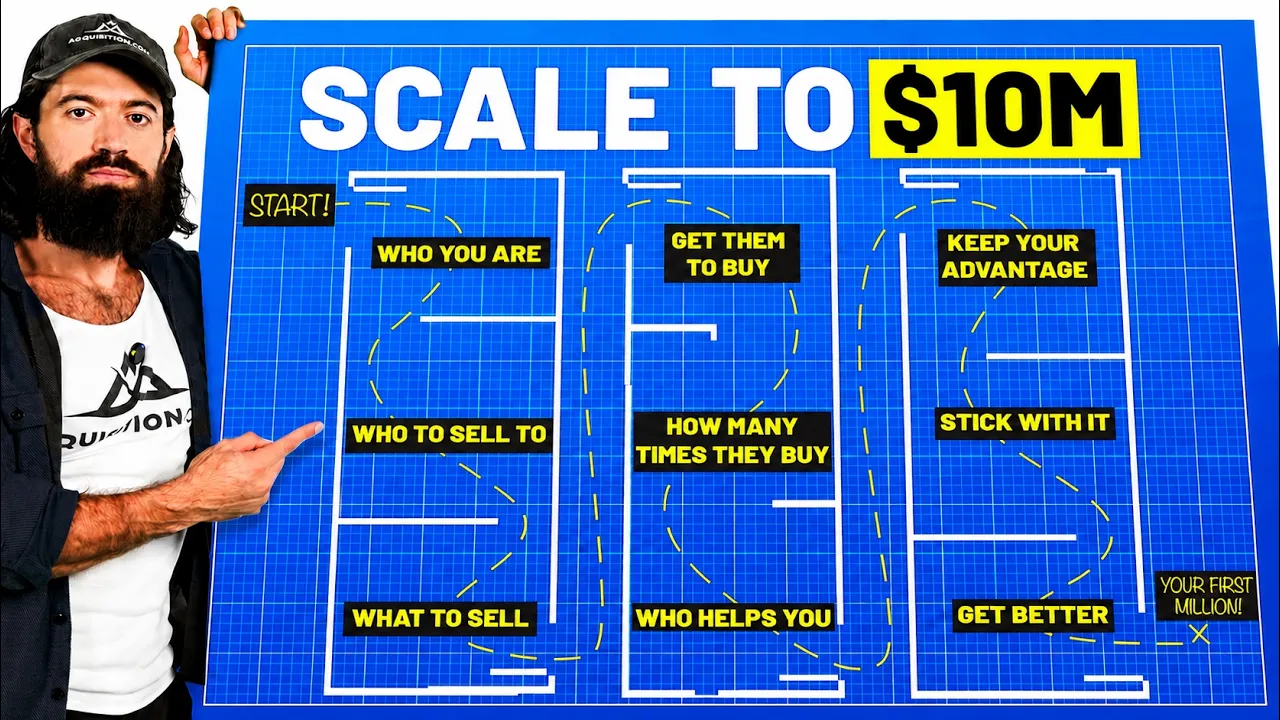
This is my how to go from $1 million to $10 million scaling road map and how I scaled 10 businesses to $10 million plus and three to hund00 million plus using the exact same road map. Do you guys want to hear something completely insane? Okay, so when I was 22, I started making $50,000 a year. This is when I was very fancy making the most money. Uh so I had a very expensive suit cuz that's what that means. And so what Was interesting about that is that everyone everyone was very proud of me. Uh but
I was using basically no leverage in my way of making money. And so I was making four figures a month as a management consultant. But then at age 22, I made one change and went from four figures a month to five figures a month. And so that's when I went from being an employee to being self-employed, right? So I didn't have anyone helping me, but it was just me and I had a lease to a Place and I got to over $10,000 a month. At age 26, I made another change and went from five figures
a month to six figures a month. Okay, a little bit more interesting. What happened? I got a little bit of help. So I started becoming a true service business owner. I had other people started helping me out. There's going to be a common theme you're going to see here in a second. At age 27, I made another change. went from six figures a month to seven figures a Month, right? And you can see the the little image there of few people to lots of people. Uh and then I went from being a service business owner
to a media business owner. Age 32, I made another change and I went from seven figures a month to eight figures a month. And so that's when we started to include capital into our way of making money. As in we used money to make money and we use me to make money. At age 34, I made another change and went from eight Figures a month to nine figures a month. And I'm still on this journey today. We have done nine figures in a month. Um, but I want to have done that on a consistent basis.
And so hopefully this will show the documentation of that process. And so to put a little bit of kind of logos and reality on this so you can do your own research. Uh, we widen is a chain of brick and mortars uh that we took over a million dollar a month. Uh, well oiled is a B2B services Business $1.2 million a month. Appointment trader is a BTOC marketplace software platform a million a month. Gym Launch was $2.4 million a month. Prestige we got to $1.7 million a month. Uh, we got to $1.6 million a month.
Chain of Fairies was a uh we got to $1.1 million a month and we sold our interest in that. We sold our interest in Allen and we had uh we exited Gym Launch and Prestige Latch to America Pacific Group for $46.2 million and we invested all of That money again doubled down um and scaled our holding company of Acquisition.com to $20 million plus per month. And so acquisition.com itself we scaled to $20 million plus per month which was our first $100 million business. We did $100 million separately on the media side in under 72 hours
which is technically physical products. Um, and then school itself does over a billion dollars in GMV and has over 30 million users. So that means that we Scaled not one or two but three different businesses to $100 million plus. And so the problem is this. Most advice that on scaling comes from someone who made $8 million or made $10 million um, and didn't really know how to go further. And so they teach you to build a house, but you're probably trying to build a skyscraper. And knowing what you're trying to build matters a lot when
you're digging the foundation. And just to show you how Rare this is, so you have realistic expectations around this. One in 10 people start a business. All right, of those 1 in 10, one in 250 get to $10 million plus. So that's one in 2500, which is two and a half times this image. This is a,000, two and a half. It would just be too too small. So achieving $10 million a year, just $10 million a year, is very rare, despite what social media will tell you. And of Those 250 people at $10 million plus
per year, only one of them will get to $100 million plus per year, which looks like that. And so until you get advice from someone who has actually been there, you can get stuck for a long while. And I know this firsthand because I've had this happen. And so 10 years ago, I was stuck. This was my trailing few years of revenue. Um, and you can see what being stuck actually looks like from a business Perspective. Some of you guys are in this exact spot. Um, add or remove zeros as desired. But functionally, it looks
like this. You're like, I kind of go up, I'm kind of going down. What's happening here? Right? And so, again, add or remove zeros as desired. What I want to show you, I think what's most important about today is what happened here and what happened here, right? I would be interested in that at least. And so, what I actually did was or what broke me Through this was advice that I got from a mentor. Um, and this is the first person that I ever met doing a billion dollars a year, which you could take that
same hundred million dollars and then do, okay, what's one in a hundred of them and it probably works out to the same thing. Um, because it's very rare. And so I got very rare advice from somebody who'd live who'd breathe very rare air. Um, and it helped me get this breakthrough. That's what I'm going to Share with you. He said, "The fastest way to 1 million isn't the fastest way to 10 million. And the fastest way to 10 million isn't the fastest way to 100 million." And so if you think about it like this, if
you were going to build a 10-story building, you can make it millions, you can make it stories, it doesn't really matter. You wouldn't start with a one-story or threetory foundation, right? It wouldn't make sense. And this is the big problem with Well-intentioned, I want to be very clear, well-intentioned advice from people who've only been to 1 million or 10 million or maybe 20 or 30 million on how to get there because they don't actually know what happens next. And so what happens is you'll scare very fast to a specific point and then run head-on into
a structural wall. Meaning the way that the business itself has been designed has made it incredibly difficult to scale past a certain point. And so if you ever had like fast growth and then you're like boom, I can't seem to grow my revenue past this point, you were dealing typically with a strategic problem with how the business was founded and structured to begin with. And so what ends up having to happen, and this is what we walk through a lot of companies because we scale a lot of businesses, is sometimes you have to redesign portions
or the entirety of the business to get it around or rebuild the Foundation in some ways almost like let's hold the top stories up while we redig the trenches and put the plumbing in so that we can actually have a 10tory or 100 story building in order to actually break through. And so that's actually what I had to do at both of these points that led to these breakthroughs. And you can see that the the staggering difference uh in very short periods of time. And now, while that's amazing for me, you're like, "Okay, great, Alex.
I love this for you. What's in it for you?" All right. And so, it's the answer to this one question. What changed from here at four figures a month to here at nine figures a month? And so, that's what I'm going to show you in this short presentation. How to get from where you are using some of the lessons that I learned the hard way and a few stories to make them stick to building the infrastructure capable of getting to a million dollars a month Plus and beyond. But I want to warn you again to
be very clear. This is not a promise that you're going to become fabulous rich or fabulously rich or get any other result. Uh everyone is different. Scaling your business like everything else in life worth doing uh involves risk. And most people do nothing at all as you saw from the stats I gave earlier. Uh and so your results obviously vary. All right? But that's why I make this type of content Every day is to help you scale as good as I possibly can. And so here's the problem. So getting to $100,000 is three things. You
got to have one person you sell to. You got to have one product you sell. You got to use one channel. That's it. That's all you got to do. So, you got to sell one thing to a specific type of customer one way without convincing yourself it's more complicated. That's all. Which in some ways is just don't listen to everyone that says it's Somehow harder than this. Getting to a million dollars a year, you add one thing to that equation, which is you sell one product to one uh avatar on one channel consistently. Rather than
being hot and cold, hot and cold, hot and cold, I made enough money. I'm just going to stop. I made enough money. I'm going to stop. You actually keep consistently doing it. And you essentially do more of what worked. Now, what happens once you cross that $1 To $3 million barrier is that you actually can't work anymore, any harder because there are only so many hours in the day. And typically, you don't have enough margin to make big bets. And this is why so many businesses, it's almost like a bolus of businesses get stuck in
this 1 to3 million area. And so, let's just take a hypothetical here. So, let's imagine that you're 2 million bucks a year. You're running a 20% margin. So that means you have $400,000 of profit Left over, which means that you could bet most of your profit on one or two maybe key hires to relieve you or narrow your focus on one type of customer because you might be selling to multiple different types of customers that makes you the most money. But in so doing, you risk the fact that you're turning down other customers that might
mean you lose margin, right? Or you decide to raise your prices, but then you might lose some of the sales that you're getting. Or you change your offer altogether and then you could risk the entire business, but you could also make the entire business. But the problem is this is that you have no margin of error. This is why at this stage it's so difficult because you can't work any more hours but you don't have that big of a margin of error. Which is why so many people stay stuck, right? Because the size bet that
is required to get to the next level is one that actually requires more Risk not less. And this is why it's very counterintuitive and for that reason a lot of people stay stuck here. And so said differently, it takes more risk to get out of the 1 to$3 million range than it does to get into it. Because getting into it as you start the business, you work as hard as you can. But getting out of it, you have to start change. You have to change how you work and how you how you assess risk and
take risk within a business. And so you have to approach It differently. So let me explain. So if someone achieves success faster than you, they simply are better allocators of a single resource, time. And so time allocation is the only thing that matters. And if you master time, you will master material success. Not saying happiness, I'm saying material success. All right? And more specifically, traversing the swamp or crossing this $1 to $3 million barrier is among some of the hardest transitions in business. Going from a million dollars a year to a million dollars a month
and beyond. And so what appears to be speed from the outside when you see these rapid scaling companies is not actually lots of activity. Like the founders can only work a certain amount of hours per day. They're not literally moving faster, right? It is making the correct strategic decisions and making fewer mistakes. And so if you think about it like a video game, if you play a video Game the first time, it kind of looks like the the image on the on the left there. It's like you go up, you you battle somebody, you lose,
you don't you have to figure it out, and eventually you you you break through. But once you break through, if you play that same game again and you know where the the secret sword is hidden and where you get the power power up gem and how to hit the boss from the specific angle that makes you win, you just kind of zoom Through it. But your character can't play any faster than it did when you played the first time. You're just not making mistakes. And that's why your character again, your character moves the same. So
the point here is that you know exactly what to do. And knowing exactly what to do is what creates speed. And so your progress slows when you encounter a new boss or a new level that you haven't been to before. And so anyone here who's watching this, um, who here's had more than one business before? Okay. Now, for those of you who said yes, who here's second business grew faster than your first business, right? Why? Because you'd already done it before. And so you blew right past the old levels, but then you got stuck at
the same levels you were at uh with the first business because the game doesn't change even if you have Different businesses. And so well, let me I kind of give the answer away there because you already know what to do, right? You kept moving until you hit a point of incompetence and then once again it becomes trial and error over and over again, which is the slowest way of all ways to progress. And so what I want to do is give you some of the cheat codes, aka the solutions without the trial and error to
get to million dollar a month and beyond. All Right. Again, not a promise or guarantee, just the infrastructure of how I understand it. And this way, you can get it right the first time or at least with less wasted time. And this is why this is so important. If money is a denomination of time, denomination of time, then every transaction that we make is for some percentage of our lives. And so, our wealth is a measure of how little of our lives we must trade for the things that we want. And so, Money is an
IOU from society for future goods and services, which translates roughly as other people's time. And so one person might buy a Ferrari and it cost them one week of their life. For somebody else it might cost 520 weeks of their lives. And that might be the median, you know, earning wage in the United States versus somebody who's a top.1 center. But it's just how much life did they have to trade in order to get this thing? And so when we translate Back from money into time, it actually becomes far more useful for us in terms
of thinking about what do we actually do to make the money? We have to get the time. And so the big multiplier on this is leverage. And this is the core concept of this entire presentation. And so what is leverage? The difference between what you put in and what you get out. And so if you put a lot in and get a little bit out, you have very low leverage. If you put a little bit in and Get a lot out, you have very high leverage. And when you put a tiny amount in and get
a lot out in a business, you scale. And so scaling is when you get more out for the same amount in. And so for example, if I work 40 hours a week and my business used to make a million dollar serving a 100 customers uh and now it makes $10 million serving a thousand customers per year, it means that I have scaled. And so when you Employ higher leverage, scaling occurs. So saying like scaling is my goal. Scaling is what happens when you do the right stuff. It happens as a consequence rather than an aim.
And so each of those income jumps where I added a zero to my my income in revenue over my career happened because of a jump in leverage. Like I couldn't work 10 times the hours. I had to get 10 times more for every hour I worked. Which is why I feel very confident I can Walk you through the steps that luck alone did not contribute to because I have now gone to this million dollar plus per month range 10 plus times. And statistically, if that was one in 200 two 2500 people have it, and I've
done it 10 times in a row, that's a very small likelihood that it would be done by luck alone. And so there's a lot of different ways to get leverage and use them together, which is very key to get even more Leverage because they are multiplicative. And so, for example, you can spend an hour working with one client or an hour working with 10 clients. If you did that, you have 10 times the leverage. This doesn't need to be very complicated, but it is very much real that if you make that tiny change, you could
have you have 10x the earning potential with the same number of hours. You could spend an hour making a presentation, have 100 people see it Live, or if we record this, right, we could have millions of people see it for the same amount of time. Uh, you can spend time making all the money you need to grow a business or you can borrow other people's money to grow your business so that you don't have to make all the money required to then buy the warehouse. You could say maybe I'm going to take somebody else's 10
years, get the warehouse up front, and move five years forward and make sure the Arbitrage or what I sold of the business versus what it what I get in money is worth it for both of us. You can spend 10 hours working client one-on-one or you can spend a 100 hours having AI code of software that serves 10,000 clients. You can work with 10 clients one-on-one or you can spend hours working Sorry, you can spend 10, you can pay 10 people to work with 40 clients. And so the list of things that create Leverage is
endless. However, what's missing when you scale, especially going from 1 million to 10 million and beyond, is three specific forms of leverage. And so you were able to get your first million or, you know, 2 $3 million uh working more even with low leverage. But to get to 10 million or hundred million, you need more significantly more. And so you can't 100x your effort. There's only so much time and energy in the day. You have to 100x your leverage. And so with that being established, I would like to introduce to you the three leverage frameworks
that I use to scale businesses from 1 million to 10 million plus and beyond. Okay. So here's my promise. Uh you are not able to scale your business because you are underleveraged. Period. So you can't work any more than you are to get to where you want to go. You have to work differently. You have to change how your business functions. And so if we see our Input of time on the left and money as our output on the right and this is the throughput of the business, the first place that we need increased leverage
is we need to create leveraged demand. So in a sentence, you've got to get more of the right people to find out about your stuff consistently without using more of your time or your time limiting you. Second, you've got to get more of the right people to buy your stuff consistently without more of your time Limiting you. You need leverage conversion. And then third, if you have leverage demand, we have more people finding out, leverage conversion, more people buying, then the next thing we need is more people able to deliver this stuff consistently without our
time limiting us. And so if you're not growing as fast as we want, you're stuck where you're stuck as a single bottleneck in your business, aka you feel like you can't do anymore, I made this for you and partially for me because I really like this. And so let's start with uh with creating leverage demand. All right. So, you've got to get more of the right people to find out about your stuff consistently without your time limiting you. And so, you don't have as many customers as you want because you don't have enough demand. You
can't afford to increase it. You don't have the time to increase it. What you have Is inconsistent. It's not high enough quality or it's the wrong people. And so, you're not getting enough for what you're putting in, aka you don't have enough leverage. And so, if this is your problem, there are three shifts that have happened in demand that you may have missed or that you haven't capitalized on. And so, number one is the shift from interest media to social media. Number two is the merger of ads and content. And number three is Andromeda. So
let's start with number one. So social media back in the day worked like an email. You got a lot of followers, you'd grind really hard and then once people followed you, you'd make posts and then they'd see it. Doesn't work that way anymore. All right? And what happens as a result is that with the new algorithm um people are making content for views rather than for getting customers. All right? And so because of this shift in the algorithm Where it's all based on what people are interested in, not who made the content, your follower count
matters zero now. It is 100% about the content, which is incredibly encouraging for a variety of reasons that I'll share. But the biggest one is that the content is the targeting now. And so if you're like, man, I I I need to get more consistent customers, then it's like, well, it would make sense to make stuff that only your customers want to see. And right now, You're trying to do memes of your relationship when you're a plumber, and that's probably not getting you people who have uh leaky faucets. And the reason this is amazing for
us is that every piece of content proves its own merits. Whether you have 10 million followers or zero followers, you have the exact same advantage. It's all anyone tomorrow can create a the most viral piece of content that exists. And this was not a reality. And so if There's ever been a moment to say, you know what, uh, I want to start today, you actually have no disadvantage, which in some ways like a counter advantage to the people who did start that the only thing that they have on you is that they have skill. But
all the grind that they had has basically amounted to nothing besides the skills they have with their hands which to be fair is material but if you learn quickly which will be the point of this uh you can catch up Quickly. Now the next piece here and why this is amazing is that you can now just make content only for your specific type of customer and the algorithm will show it to only the people interested in that stuff which is only the people you want to buy which is great. And so this means that you
can make lots of money from very small audiences and only have to talk about the stuff that you want to talk about rather than talk about dances or memes or any of that stuff. And so This is the big leverage insight here from number one which is that which means being good has a lot more leverage and you have no disadvantage for starting today compared to me. It is now entirely based on the quality of the content. And so this is um a wonderful uh uh two different businesses. one that focuses purely on helping uh
registered dietitians get more reimbursement for insurance. Talk about a niche of a Niche. Uh she has I guess 8,100 followers. The first time I saw her I think she had under 5,000 and she's making a million plus dollars a year and look at the number of likes that she gets on her posts here. This is not like a brand new two seconds in. This was like like you could look at her page now. Um, and I say this to say that Amy does a really good job of monetizing her audience because she only makes content
like who's consuming content for Medicare credentiing is just like Blue Cross Blue. Like no one is consuming that except for registered dietitians who really want to improve their reimbursements. So in a world before they'd be like, "Oh, this content is not going to convert." It's absolutely converting for the 5,000 people who watch this thing and they're like, "Oh my god, this is exactly for me." Now, next totally different space. Temple of Gains, Yanni, he uh he started this Company, I think, three years ago. Um pacing, he didn't want me to say how much, but I'll
say many millions. All right. Per year. Hold on. Many millions per year. What's his following? 5,000 followers. What's all of his content about? Uh people using his gym equipment. Uh, and so the people who buy gym equipment look at people who use gym equipment. I only know that. I don't know why I know that. Anyways, um, and so, and so that is the shift that's Happened from social media to interest media, which allows us now to get more leverage in our demand even though we're starting at zero. So, we get more for what we put
in because now there's a way higher throughput between the effort we put into content and what we get back as customers. Here's number two, which is the merger of content and ads. And so we used to have two different departments and we had this for a very long time. We had a paid side and we had an organic Side. Somebody who makes content, people who run ads, very different different skills, different people etc. Over time, and this happened in the last 12 months, we realized that when organic videos popped, we all of a sudden get
these big big pops of sales that would come with it. And it was like, huh, wait, so organic can create sales. Now, this may seem obvious to you guys, but most of the time we think about organic as like we build the brand and then some people Are interested and it's fine. But when you have these pops with kind of viral videos that are the correct type of viral videos, you see huge spikes in sales. And so we were like, huh, I wonder if we could put money behind these organic ones that do well and
see if that creates even more sales. And it did. And so the monster machine has now shifted because now we can just make content and then when the content pops, we take that And then we run it as ads. And so instead of having two different kind of disperate workflows that have to exist, these are now merged into one place, which gives us more for what we put in, more leverage, more demand. And so I'll make this final point, which is just that um all of the content we can now use acts as a free
test. And so we post it, we get free reach from the platforms. Amazing. We get some customers for free. YOLO. And then when They do crush, we put money behind it and we make even more. So, we first get paid. We get paid to get paid. It's not a bad gig. And so, this is probably why you might have seen ads for me that look like this. And if you're like, "Wow, those ads look just like content." It's because they're content. And we saw that those made sales. So, we were like, "What if we had
more people see them?" And so, I actually put Le through this Process. Um, he's a customer of ours. He said, "What changed when we tightened our avatar and turn organic into ads?" So over the last year we were heavy on organic and barely touch paid. Our lead flow is you know very hit or miss because sometimes you have them hit and an organic video pops but then you're very reliant on this like I got to make another hit. I got to make another hit. Especially if you scale infrastructure is very hard because you're like well
I Got to pay people even though I don't have a hit right this is what balance this is where the marriage between the marriage and the merger between organic and paid really it becomes kind of a sweet spot. And so um he says some you know pain points etc. In 2026 uh we run four five so far and this is where things started to change. So two main changes tighten the avatar. We stop speaking to everyone got specific and we started using retargeting ads built from Our very best organic content. Now every webinar gets warm
retargeting ads to people already in our world using best performing rules and posters creative. Shout out to Alex for your best free content can make your best ads idea. Notice what I'm talking about right now. Uh when we tried organic only for one webinar we had zero applications, zero calls booked and it was the same content, right? And it just flatlined. With the last two webinars alone, we Fixed the avatar and backed it with the warm ads and we have about 60,000 revenue in 30 days. Again, not a promise that that's going to happen for
you, but you can see how crazy of a difference that happens just by the the shift in perspective of, oh, I don't need to make these things separate. They can be the same and I can test for free and get paid to test and then take the winners and then scale them. And so, here's the leverage insight, which means that when You make this content that even if you started at zero, you don't have to do any extra work to make the ads. Your content are are your ads. And so, that means you get even
more for the same. It also means you should probably make your content for the people that you want to buy stuff from. So that then leads to number three. So we have our shift from social media interest media. We got that changes what we make. The merger of content and ads means that when those Things work, we can put money behind it and scale it even harder. And then number three, how does that how does that actually interact on the paid side? So think about this from the the most organic side to the most paid
side. And so Andromeda's uh Meta's new kind of like AI engine for targeting. All right. So if you're running ads, and if you're not running ads, the first two will apply. If you are, then listen up. And so the new alg a new algorithm um makes Advertising significantly more specific in who it's targeting but requires you to make far more creative. And so the shift that I think about or I describe this is it's the shift from advertising to an ocean to advertising to a 100 ponds. Instead of saying hey you know business owners it's
more how do I have plumbers and chiropractors and uh make an ad for electricians and make an ad for marketing agencies. And to the same degree, if I'm in weight loss, it's not Just like, "Hey ladies," it's, "Hey, vegan powerlifting moms. Hey vegan powerlifting dads." Or well, I guess in that one, not not the dads, but you get the idea is that it's all about how can we be as specific as humanly possible because the targeting now is so good that if if on your newsfeed there's something that generically includes you and one that specifically
includes you, the specific inclusion is always going to have a higher conversion rate. And so If we think about that, it's far more oneofone ads. So, we might have to create a thousand ads in the same campaign, but our return per ad will go up. And that's the big shift that happened with Andromeda. And you're like, well, that sounds like a lot of work, and it is. If only there were a solution. And so, I'll get to it in a second. So, this is Abram. We actually walked through our ad process that I'll show you,
which is Andromeda native, Right? And so, he follows the rule of 100, which is from my uh my leads book. He said, um, we wrote and launched 20 new ads in five ad sets with 10 10inch variations. So, 100 new ads launched today. Uh, so way over 100 minutes in in marketing. We have UGC cranking. Um, just feeling behind like I'm not doing it enough. Welcome to the world. Um, only able to spend 40 4,000 on ads and cash collected is at 299,000. So 6.68. It just requires so much more creative Than you think. And
so again, this is a reminder. I'm not saying that this is going to happen for you. That's not the point. But what I do want to show is that it is in order to to increase your returns, which is why he was taking this challenge on for his his his business. You have to make a lot more. So it's like, okay, social to interest. Got it. Merg of content and ads. Got it. I need to make way more. Got it. Okay. And for those of you who here actually has run Um who here is organic
only? Get a couple hands. Anyone? Handful of you. Okay. Um for those of you raise your hands. If you're not using paid in your businesses yet, if you have a gigantic opportunity for scaling, that's like a six-inch pot for you. And I'll show you why. So, let's say you have 100,000 followers. Let's say that that purple ring represents your 100,000 followers. When you make a post, a very small percentage Of those people see your post just because of the nature of the algorithm. That's how it works. Okay, let's say, you know, 5% of people see
your post. Fantastic. So, very small. Now, if you make a post that has a CTA in it, we're like, "Hey, go buy my thing." It's now like a fraction of a fraction of a percent, which is that itty bitty dot in the middle there. But here's where this is very interesting. This is the amount of people who are Interested in your stuff. Why? Because of the first point. It has shifted from social media to interest media. There are far more people who have seen your stuff than have hit subscribe or follow. Or people who saw
your stuff, hit subscribe, and then they lost interest for a period. They don't hate you. They just aren't interested in bodybuilding anymore. Now they're interested in cooking. Who knows? Doesn't mean that they don't know who you are. And maybe If you reminded them with an offer, they might be interested yet again. So right now, if you are making money only off of your organic, you're only monetizing that. When you add ads to your organic, you can monetize all that much bigger. And so you're missing out. Believe it or not, on the vast majority of the
sales you could be making, and this is probably one of the easier three to five X's that I see in a lot of businesses that are organic is just Actually making the merger happen between content and paid. And so all that you're like, okay, I get these three shifts. What do I actually do to scale? Well, leverage frame number one is that you shift from manufacturer to capture, right? Because we're like, how do I have all this content that I have to make all these ads for? What I actually have to do? And so I
call this a self-licking ice cream cone. And so fundamentally what you want is that Within your business you build processes so that when a customer comes in, you have a way that that customer creates media or multiple forms of media for you that then you can take that content and post it and when the good ones happen, put money behind it and when those really scale, those get you more customers who then make you more content that you then go back and then around and around you go. And so these are all examples of us
just doing business and Capturing it, which is the vast majority or almost entirely what all my content is comprised of now. And this is business. You're like, "Oh, but that only works for business." Well, I'll give you an example in a second, but [laughter] um but we do this across all the brands. And this has obviously resulted in pretty significant growth. And we've got 1.2 billion impressions now. Uh which generates roughly hund00 million a year In B2B ad impressions. If we were to simply monetize those impressions at $20 per CPM, which is pretty wild and
for us, like does that actually translate into leads? Yeah, translates into leads, right? Thousands and thousands and thousands of leads. And so the suffic cone creates leverage demand for any business. And so, does this work for strength? Yeah, it does. That's totally different than business. But what is he doing? He's showing himself, teaching His athletes what he does. And here's the cool part. He is almost entirely online as a business, but he just uses inerson components to have to feed the machine, to feed the selfing ice cream cone. The next one here, this is a
surgeon. He does facial surgeries. And so he shows his before and afters of customers or patients as they're walking in the door. Every business that services customers has customers in the business every day that you do stuff With. And so we just need to capture that and then show and post it. Wild, I know. And so again, note here is that, well, what if I what if I don't have an inerson business? He doesn't have an inerson business. Here's a hair coach. She coaches people on how to do hair. She doesn't have an inerson business.
She just has a physical product and she is online primarily. She just has a tiny little Studio that she does the stuff in. And it's very easy for her to get people to come because it's unscalable with scale. She does the unscalable things so she can create scalable content to create the licking ice cream cone. And so every single business because the everyone that's in person it's very obvious how to build but for these these are online u every business can build a self-licking ice cream cone. And the beauty of it is that it solves
all five Core issues. You don't have enough demand. Well when you post way more stuff with your customers you'll get more demand. Uh if you can't afford to increase it well good thing you're already doing it. So there's no added cost to already servicing your customers. Um you don't have time to increase it. Well there's no added time because you're literally already servicing your customers. Well what you have is inconsistent. Well, you service Your customers consistently. So then you can match that with consistency in terms of your media because you're just taking what you're doing
every day and advertising every day now. And then finally, you're like, "Oh, my stuff isn't actually bringing in the right people." Well, what is better than literally advertising your customers to get the right customers? Which means that when you use a self-looking ice cream cone style of making content, it Also makes your ads, but it also gives you endless variety for Andromeda and satisfies the five problem with one action. So one solution, five problems also leverage. And so Will implemented a fraction of this leverage demand process in his law firm. Yes, a law firm, literally
any business can do this. He said, "One of our uh business law firms pulled a $45,000 referral from a past client that essentially just reactivated with this Process." All right? And so again, I'm not promising that this is going to happen for you. I'm just saying that like you can see changes in a business very quickly. And it doesn't matter whether it's high ticket, like this was a $45,000 referral, or it's for a high volume uh low ticket transaction business. It works the same way. And with AI, the post editing or the post-p production can
be done by one person for an entire business. So you're Like, I'm going to have to hire all these people. It's not true. We have uh we launched something called the Morozi channel, which is a highlights channel. And this is just to show you these are this was posting five mids per day plus I think 15 shorts per day. How many people do you think this is taking? I'm probably kind of gave it away, but think it's more than five. No, not more than five. Think it's less than five. Okay, less than five. How about
How about Three? Do I have some threes? Couple threes, twos, but one. Tiffany's right. It's a one. [laughter] I've got one cracked out teenager. Um, and so all this to say is that this again, leverage is multiplicative. And so we now have this big machine that we can build into the business, but we don't actually have to use a lot of machinery to build it. And so what used to take you a Department of 10 or 20 people to create, one person can do now. And so my advantage shrinks and yours expands because the barrier
to you copying literally what I'm saying is one person and that person could be you. And so Devon installed this leverage demand process and turned up his ads like a lot. He forexed his spend because of the creative volume and he was able to hold his rorowaz. All right. And so uh I tried to take out how much money he made Because it was impressive. Um in 60 days with ads with proof. Um but if if you go through this he was able to go from you know 300,000 to 1.1. I guess I guess just
said it. I'm not saying it's going to happen for you, but he switched from a augment um so from basically normal ad creation to AI ad creation. So significantly more leverage in the creative and that was the main thing, the main takeaway. As a result, we produced 3.3 4x more creative variance. That was the big change. How did he 4x the revenue? He 4xed the creative volume. How did you do that? Leverage. If you have no leverage, you're going to st stay stuck at the same level. And so that's you can increase demand at scale
with no extra time. And this is one of the frameworks that is required to get to the next level. If you're if you're stuck in in demand, this is it. This is the problem. So that's how you can increase demand at scale with no extra Time. But once you have enough of the right kind of demand, you not might you might not be converting all of them, which then creates number two, creating leverage conversion. And so the problem for most businesses is your sales take too many conversations. The calls run long, aka people don't feel
ready to buy. They compare to competitors based on pricing. uh even if they are ready there and there is trust. You're the person who closes way more than your top Salesperson can. Your sales team is inconsistent. Um and it takes too long to ramp up sales people from how much they have to learn or they have to be too advanced which means they can cost a lot. And that is mostly because leads come from different different sources. They come at different levels of readiness to buy or at different qualification levels. And so a salesperson has
to plug a lot of holes in a prospect's beliefs and educate them In order to get them over the line to buy. And as a result, they have to wear too many hats. They have to be a consultant, a teacher, a therapist, a cheerleader, a coach, a product expert. It's too many things to teach someone. And so it becomes very hard because there's too many skills required, right? And so the skills required for the role too high. Uh which means it's more expensive. It's harder to find and replace. They take longer to train and They're
harder to manage, which sucks, right? This is all low leverage. And this just makes this problem even harder as you scale. So what do you actually do? So you have three options. You can scale an advanced sales team. You can sell one to many like pitching. Uh or you can create order takers. My approach is I try and do highest combination of two of these things. Sell one to many and combine that with order takers. And so this is how it kind of works. The Idea is to give your salespeople six-inch putts. And so think
about it like this. If you had to teach a brand new person off the street how to drive, how to use irons, woods, chip shots, wedges, long putts, that would be hard. Now compare that to putting a ball six inches away from the hole and teaching someone just to make that shot off the street. You're like, it's six inches away. I just need you to do this. Can you do this all day? Much easier to find someone who can do that. Takes less time for you to train them. There's lower variability between their shots doing
this to this. And how long does it take to train that person up? Nothing, right? And so you just basically have to teach them how to not mess it up. And that takes way less time. Aka, it's higher leverage. So what does this have to do with leverage conversion? Well, instead of the number of times you hit the ball, like the Drives and the wedges and the irons, um, replace that with the number of conversations you have to have or how long the conversations go in order to get somebody to buy. Aka, think how much
how much information do I need to give this prospect in order to get them ready to buy? And so I call this the conviction continuum. And so on the left, you've got people who are right at the T- box and they have to like you have to drive it all the way down, Meaning they need a lot of information in order to buy or somebody's on the putting green who just needs a little tip in, right? Right. And so the idea is how do I move them along there before I need the salesperson tip in?
How can I just drop the ball and move it from the T- box all the way next to the hole? That's the process I want to walk through. And so all of this just explains is how much information someone needs in order to buy. And so let me Give you some examples. So if you're selling $10 sunglasses, someone doesn't need a lot of information to buy. They can buy that pretty quickly. Lot very low information. They just look at it, put on their face, they say, "Cool." On the other hand, if you're selling $100,000 time
shares, someone's going to need a lot more information to make that purchasing decision. All right? And so, the goal is to frontload as much information as possible before they talk To a salesperson. Now, to be clear, this has nothing to do with price. Price is a component of it. But, for example, a $100,000 time share, you might have to lock somebody in a room uh on a Carnival cruise for 3 days to get them to buy it. On the other hand, if your if your uh basement gets destroyed, uh it is flooded and you need
restoration work done, it might still cost $100,000, but you don't need to get locked into a room for three days in order to make that Decision. You probably make it pretty quickly, right? Why is that? Because different sales require different amounts of friction. All right, but the goal for every single sales process is still the same. We want to frontload as much friction as humanly possible so that makes it the whole conversation as easy as we can. This applies even if your price is expensive and kind of like my point which does especially if your
price is expensive. So what do you Actually do? We move them along the continuum by giving them more information. And so you with that information you warm them up but the trade-off is few of them get through. And so this is the trade that we make. If I say somebody has to watch a 60-minute video before they talk to me then fewer people are going to be do that. But the people who do do that do do are to be more willing to buy, right? And that's the idea is Like how can we move the
ball down the field and we move the ball down the field with information. All right? And so you want to break that into the minimum number of chunks to get them the most information. Now, how we do this doesn't really matter. These are just examples. You could do presentations, case studies, uh applications, number of conversations you have, setting. There's a lot of different things you can do. You add proof throughout the entire Process. All of that is just information someone needs in order to buy. And we have to find the sweet spot for that. All
right. And this is what we're looking for, the sweet spot on friction. And to be very clear here, you could have too little friction and sell the same amount of sales on the left side or too much friction and sell this many. And so this is a zone. And you're never going to be perfect on this. But the idea is that if you're talking to people And they're not ready to buy, you probably take some friction away and get them and get them and get more people to have that conversation with. And so I'm not
going to get into these variables of of what create friction, but it's all about all of these chunk up together. Two, and you can screenshot it if you want. It's just how much risk is someone going to be taking on in order to make this decision, right? That's basically it. Is this incredibly risky and very Irreversible and will take forever and it's very expensive for me? There's going to need more information. If this is not a big deal for me financially, it's going to be immediate. Someone else is going to do it. I've bought from
this person before. low risk, so not as much information. All right? And of course, different places that you can do these sales processes. Not going to get into the details of that, but by and large, if you're going in an entirely remote Environment, they're going to need more information. An entirely inerson environment, less information. And so, for example, if we had a $500 weight loss challenge that we're selling, the process that we would run, pretty simple. We generate a lead, we call them up, get them to show up, we sell them 500 bucks. That's it.
There's there's nothing, no, no consumption. We just set the appointment, have them show up. If I want to sell $5,000 weight loss package, I would have them become a lead. I'd give them a video. If they watch the video and they like the thing, they could apply. After they apply, I'd set the appointment, have them a show, and then I'd sell them a $5,000 thing. Now, what's crazy between these two examples is that the leads are the same. All we're doing is adding a little bit of friction to warm them up so they're more likely
to buy. And we can add a zero to our price tag. And so, if a business can Serve the same number of customers, but make 10 times the money, we have created leverage. And this is a leverage conversion process. And here's the really crazy part that no one will tell you. The sales conversation itself, which one do you think is harder, the first or the second? The first, because they're colder. Which one do you think takes longer? The first, because they're colder. And so you can have faster sales that are easier to have because they're
6-in putts. And that's what we're lining up here. Now, this is a different one. So, it doesn't have to be for, you know, fitness. Obviously, this is solar, right? A traditional solar sales process. somebody knocks somebody and somebody finds interest. They say, "Hey, I'm going to set an appointment for a closer closer comes later and then closes the deal." Very straightforward. That is what most solar companies do. But to have a more leverage sales Process, this is what a $200 million solar company would do. Somebody knocks, they set the appointment. Before the closer shows up,
they say, "Hey, watch this video." Aha. They're compressing information. They're warming the prospect up. They're giving proof. They're giving data. They're giving statistics, giving analogies. Then the closer shows up, does a little razledazzle and he says, "Hey, before we get to the the the nitty-gritty, watch This video." Gives more information, more proof, more statistics, right? More stories, more anecdotes. So then when he asks, now they're ready to buy. And so the actual amount of time that is required from the salespeople in situation one and situation two is less in situation two. And they close at
higher percentages, at higher prices. And so it's very likely right now that the part of the reason that you're not scaling as much as you want is because Conversion takes too long. too many conversations, people were too cold, and you're talking to tires when you could warm them up one to many at scale and then six inch put them all in. That is by how how and why you add leverage to a sales process. And to be clear, this happens all the way up. We had the largest non-fiction book launch of all time. We did
$15 million in a weekend, sold 117,000 people in B2B, right? And that presentation created Leverage, sold thousands at once who otherwise would not have bought. And so if I just emailed people saying, "Hey, grab a $6,000 book package," people probably not want to do that. But I had to make a 90-minute presentation that turned into a three-day event that after enough people had enough information, they were like, "This actually makes sense." And so they did. They bought it. And so if people are too cold in your sales process, this is this is the t Tactics,
right? What do you do if people are too cold, they take too many conversations, they're not ready to buy, they price compare, add some friction, add a VSL, add an application, add a deposit, add some friction. So this was uh Chandler. He actually did exactly this and this is an important note. He took his CAC his cost of getting a customer from $5,000 to 1500 by adding friction. So even if your cost per lead goes up, your cost to get a Customer can still go down, right? And so CAC went from 5K to 1500 with
our VSL funnel and I'm going to walk you through a few big levers that we pulled last four months. We've been trying to crack cold call traffic with it. Now we did it. So I figured we share this because it was a win. It allows us to scale our ad spend in business. Harrah. And then PS for qualitative data, not quantitative. The call quality is much higher. Prospects are warmer. They are More open. And they have more money to spend. Big secret. It's the same prospects. It didn't change his creative versus targeting. They were just
more willing to spend, not that they had more money. News flash, one in nine people in the United States has a million dollars worth of stuff. Crazy. They just lie. They weren't ready to give it to you because they do not trust you because they didn't consume enough information because you did not make it easy to buy. You're trying to sell harder rather than make it easier to buy. That is the shift. And so almost everyone I've spoken to after making these changes spends at least $20,000 a month more than marketing, which normally people would
spend5$10,000 and occasionally have a higher spender. It's the same people. They've just been better positioned. They're 6-in pots now. Same thing that Alec did. He actually added friction. Same idea. He uh he Added friction to his uh his his his solar offer and got 37 to1. Really absurd uh by adding this friction in. All right. I wanted to give an update our newest 14-day test run update offer landing page. uh the freestman, right? Um and so that addition of friction um increased lead quality and obviously had really good returns. Now to be clear, I'm not
promising it's gonna happen for you. Every business is different. You're a special snowflake. You get the deal. Uh your results are not, you know, will vary. No, no promises. But in general, too cold, add friction. But on the other hand, if people are ready to buy, but there are too few of them, you don't have enough opportunities to sell, what do we do? pull it back, we remove some friction, right? And the biggest companies in the world do this. So, how can Tesla get all these extra sales by removing friction? Everyone already knows about the
product. They already have viral videos. They have one of the most prolific, you know, owners of all time. Like him or not, doesn't matter. You probably know who he is, right? And so, as a result, people have a lot of information in order to buy. And so, they took their clicks to buy a Tesla and all these custom versions of this down from like a hundred clicks to five. They modeled buying a pizza. And so, it's as hard to Buy a pizza as it is to buy a Tesla. They removed friction and saw a gigantic
increase in sales. And to be clear here, the reason I'm making this point is that if people have enough information to make a purchasing decision, they can buy a $40,000 car online. You probably are not giving your prospects enough information because you're afraid of not having the opportunity. But instead, you're losing opportunities because you're not giving enough information. And when you do this, you hit the sweet spot and close more sales from the same leads. Right? I walked Adam Jacob through this process to remove friction and uh this is what happened. So he validated and
he added he had a 13.3x ROI right just through the optimization of friction in the process. said differently. Jimmy did the same thing. He 2xed his conversion. So he removed friction, right? And scheduled sales calls were 40% before and then they went To 88%. Just removing friction. And this is the big insight, which means that you get more sales from the same leads. You make it easier to find, train, and manage salespeople that you have and turn them into order takers making 6-in putts all day. And that is the goal is that instead of having
the advanced sales team, we can sell one to many and have order takers and have significantly more scale and leverage in our conversion process. And so once you have A leveraged sales process, ding ding ding, what happens? You get bottlenecked in delivery, right? The next issue you run to on your way to a million a month is creating leverage delivery. And so there's three ways that we can create leverage delivery. So number one is product delivery. So let's just start here. So, I'm going to hit these really fast, but just to show you how quickly
you can change a business. You can go from one-on-one like some of the Examples I showed earlier to one to one on 10 or one on one to many. You can go, hey, instead of just me doing everything, we can do it done with you or I you can do it yourself. There's versions of this that we can tweak and get the same price point but have significant leverage in the delivery. Uh we can have instead of you having problems in calling me because you have my cell phone uh we could do it via email,
we could do it via chat or we Could do it in a community different levels of leverage that we can have and the number of people who are going to buy at that price point will be just about the same but huge difference in scalability. We could do some amount that's in person some amount that's remote. I had a lady yesterday, she did she was doing like six or seven calls to onboard medical practices into her her business. It was taking, you know, seven remote calls and every time it was hard Because there's a lot
of emails back and forth and I said, "Why don't you just tell the practices to fly out their three main people who are techie and lock them in a room for a day and then just knock the whole thing out. It actually takes way less time to do that." Great. Let's do that. Right? Playing between how we're actually delivering it. Reactive versus proactive. Um, are we going to schedule all of our calls or is it just whenever You want one? And by the way, when you do that, sometimes they don't want one at all, which
is zero drag. Uh, is it going to be live versus recorded? I had a different agency who did onboarding for uh people who have bigger brands, and he would do uh three days once a quarter where you'd fly out and do all the recording with them. But like of the three days, a lot of it was prep for the one day. And I said, "Why don't we just make that those first two days virtual Or recorded and then have one day in person?" He did that and he 3xed his his leverage like that. Uh async
versus insync as in do we need to have meetings or can just every week I send you recording what's going on, right? We can do this not on the same exact time. It makes it easier. It can fill in the cracks of your day with that stuff. Um custom versus templated. Uh is everything bespoke? Is every customer different versus okay, I Actually have a specific type of customer which means I can walk them through the exact same process so I don't have to rederive the wheel every time. Um, on demand versus scheduled. Uh, that one's
pretty self-explanatory. Um, expertled versus pod. Do I need to have 10 experts or can I have two experts with five helpers each? That gives me significantly more leverage and better margins. Am I allow am I having people pay once and then I'm allowing Them to ask for more stuff? This happens more in construction services uh, where you build especially done for you stuff. You start to have scope creep or time creep. It's like we need to have fixed limits and then clear uh off-ramps where costs go up if they change what they want and then
are we are we able to and this is where having things that are sent to you asynchronously becomes especially valuable is that we can start batching work. We can say, "Okay, well, I got seven asynchronous things I have to review, and I can review this all in one morning." Rather than having seven disparate meetings that take three times as long because there's questions, there's, "Hey, how's it going? The weather, blah, blah, blah." All of that gets wasted. And so, all of these are different ways. These are just 12. There's a hundred more ways that you
can create leverage with your delivery, right? And these are just a handful to Get to 1 to 10. And like a lot of these, you can just 10x leverage just with one of them. When you stack them together, which is what I like to do, you can create so much leverage and allow yourself to go back to the beginning, which I'll show you in a second. So, I actually walked Danny through one of these live. This is what I was just referencing. He went from doing three days, uh, I ran the play, Alex said, and
we got them all done in one day. Great. I got two days of my life back per customer per month, right? So, it was a combination of three different things is what we did with him, right? And so the insight is this is that if you can service more customers for the same cost, less cost or less work, you've created more leverage in your delivery. And so the key to doing this well is finding as many lowcost alternatives to the things that your customers don't care about and keeping only that which Truly matters to them,
which is often far less than you think. Even trading three low touch for one high touch can create net savings and increase perceived value. So the lady I was talking about um that I talked to yesterday um she had seven remote meetings which cost more time for her in coordination and in between plus the time versus one in person. What do you think is valued more? One in person, no question. And which one's faster? One in Person? No question. So it's faster. It's perceived as higher value and it takes less cost for her. It 5x
her delivery throughput. So that's how you can change with the product delivery. The next is obviously technology. So I'm not going to hit this too hard, but I'm going to just shift one perspective for you. And so most business owners right now are still thinking the old way of doing business, which is very orchard driven. So there's Circles and dots and people who report to people. You have to shift in the age of AI into workflow based thinking. So workflow based thinking looks like this. So let's say you have an editor is one role and
there's 10 behaviors that they have to do which creates a workflow. Okay. Now that is not actually a job. There are 10 behaviors that sync into different flows. that that editor is responsible for. Now, when we break up the actual Behaviors, the actions that the editor does, all the ones that are black, we can automate with AI and the ones that are white require more judgment from a human. And so, that is what stays human. But if all of a sudden the job of the editor, we can take eight of those behaviors away and focus
on the two, the leverage that the editor gets is significantly greater. And so this is kind of like a before and after in terms of how much more work um can can happen As a result. So you can five to 10x the output which is why I could have a cracked out teenager putting five mids and 15 15 shorts per day on a channel because of this. And so if your team can use AI to accomplish five times more your service you can service that many more customers for the exact same inputs or costs. And
so this is Mike. He said boring moneymaking ACI help process build process to do high value internal moves. So after being told the Bottleneck and all things I wrote a check. Uh so write out a checklist of all the the steps to do an internal employee move and load it as a prompt. ACQAI walking through using the process/justic doc uh log sheet and instance doc to have a workable and archival process. After identifying one important sales calendar was actually at capacity. We had our recruiter own and run the process without me saying a word. The
result two high-v value sales Moves happening this week without involvement. My involvement or any instruction from me. So boring but so epic. I'm happy to learn that runnable processes can so easily solve this party, right? And so then he he attached all those things. And so like as much as like or flows and and org chart and workflow processes, what that really means is that works without you. And that is much sexier. And so that's what happens when you have the tech Enhancement. So one is we change our agreements. The second is we use the
technology to enhance what we can do. And the third is okay, if we do have to uh employ people in the business, which obviously that's a part of it. Um how do we do that? So one of the big shifts is shifting from the thinking process of like okay I know how to get customers but how do I get talent right is that many businesses on some level understand this is how you get customers I got to Generate leads I got to work the leads I got to sell I got to do some sort of
customer success we ascend them and then we sell them in the future that makes us more money that's the process everyone's kind of everyone okay with that one that doesn't sound crazy okay but when I when I show the mirror of this everybody loses their minds um and so the question is do you have an identical process for talent acquisition. So instead of lead genened you've got Application generation. Instead of lead nurture you've got application nurture. Instead of sales you have interviewing. Instead of uh you know customer success you have onboarding and training. Instead of
ascension you have ascension but within your team. And reselling means just retention. We just retain them. Just like we retain a customer we train we retain a team right through management. And so the what this really looks like is that humans go through Identical processes to do stuff. That's all that means. But people who are experts in marketing suck at acquiring talent. And people who are amazing at acquiring talent suck at marketing. It's the same thing, different words. This is why I think labels matter so much. But like what's the ad of getting a job
prospect? A job ad, right? What's the script you have when you have the conversation to get them to buy, aka they decide to work for you? It's a Sale. Of course, it's a sale, right? Right? And so if these things are not scripted or approached to the same level of rigor, how is it surprising that you're struggling to find your technicians or your reps or your or your dentists or whatever. And so you want to create leverage in the delivery so you can get more good people for the same work. And so one is on
the demand side and then the other is on the supply side. So once we do have them, how do we Get more out of them? Which is where training and tech gets us even more in the backside. And so this is the big insight which is that between all three of these things, product, tech, and people, changing the terms of delivery, the nature of the work, and the quality of your people allowed you to service far more customers for the same or less. And that is what gives you the leverage to get from 1 million
to 10 million plus. And so this is Patrick. Hiring was One of his big constraints. And so we walked him through this process. Uh he actually applied all of the marketing stuff, right, uh to this. And so Patrick had two roles he was struggling to fill. And then it took a funnel approach to acquiring talent and with within days got a a lot of applications for a role that he was otherwise struggling to get. And this is within days. And this is why the shift in thinking is so powerful is that if you just take
the marketing mind Of getting a customer and apply it to getting teammate like do you think you have a VSSL in the process if you have too many leads? Uhhuh. Works the same way. And so once you scale delivery boom boom boom you make more dollars. But zoomed out, you have to go back to the beginning and create even more leverage demand again. And so now we cover the first way of creating leverage demand. And this is one of the common ways of Getting someone from, you know, a million to uh a million a month,
right? Which is self-licking ice cream, installing this process in the business. But there's a lot of other ways that we need to create leverage demand, right? We can create a UC army. We can create AI ads. We can create AI creators. We can have programmatic ad buying. There's different things that you can do to get more from what you have um on the demand side. And these are all important as you Scale on the con conversion side, right? We talked about the conversion continuum, the six-inch putts, great, but we didn't talk about sales recruiting. We
didn't talk about sales onboarding and training, management, and comp AI sales reps, right? Um, and then programmatic buying, but on the advertising side for getting the reps. And then once we have that, we talked a little bit about delivery, which we talked about some of the frameworks for Product, tech, and people. Tada. But there's different levers on LTV. There's ascension motions that need to get put in. Um there's front-end loss leaders which are massive ways to create uh leverage in delivery. Um there's avatar fractals which is basically how do we pick the customers that going
to make us the most money and how do we basically run different paths for them so we can maximize how much we make and how much margin we have. And one of my most, you Know, one of my favorite frameworks, which is basically the lifetime gross profit per employee to cost acquiring talent maximization process, which is just like we if we can spend $5,000 to make uh $100,000 on a customer, that sounds amazing. But is there an equal and just as powerful on the talent side where if I spend $5,000 to get somebody who's going
to make me $250,000 a year, why don't I have the same level of rigor on that side? And I'll show you that Process. And so there's a lot of things that it takes to scale. I showed you three of the big ones. Um and so the question is what do you do from here? So instead of saying you know there's this one magic method right uh the reality of business is that the puck moves right and you need new solutions at each level because you'll have new problems and but the good news is you'll have
more resources to solve them with right and this is my My forever problem solution cycle like problems create solutions solutions create problems and around and around we go and so your business will always have a constraint and how you solve it depends on where you're at whether that's creating leverage demand you could service more customers but you can't so you just need to create more from what you have or it's creating leverage conversion. You have enough people knocking the door, but your sales People suck. They're inconsistent. Too many calls are taking too long. Talking to
people underqualified or it's leverage delivery. You've got enough not got enough demand on the front end, but you just can't expand because you're worried about your quality dropping. You don't know how to find technicians. Um, and a lot of that comes down to what are the agreements that we can change about delivery, what technology we can use to get more from what we have, and if we Can't solve it with the first two, how do we get better people faster? And you start all over again. And so that is fundamentally how you scale and that
is the framework that we used to scale 10 different companies to 10 million plus and three to 100 million plus. And so I'll uh I'll read this because I think it's it's pretty cool. Um from bleeding 20,000 to targeting 5 million in under three years. We went from hemorrhaging cash to closing 2025 With roughly $20,000 in profit after eight months of losses. Total revenue for the year was about 1.34 million. Small number big turning point. Then came my VIP session which is value acceleration method. This is what we talk about. Um, my first one forced
me to completely tear down to rebuild my offer from the ground up. Notice that step that I mentioned at the beginning. Wait, we have to rebuild this whole thing because it was built on the wrong Foundation because he got stuck at the same point. Um, it was uncomfortable. It was necessary and the results showed it fast with another jump in business almost immediately after implementation. Fast forward to today. We just into year three this month. We're currently on pace to do approximately 3.5 million this year growing rapid roughly 18% month over month. Our target is
5 million. I'm no longer scrambling. I'm building and and now having communities Like Vantage as another layer of support and accountability only adds more fuel to the fire. That shift did not come from one tact. It came from following the system, using ACQI, listening to team guidance, following critical tasks, which is what CTS are. Avoiding the woman in the red dress, always avoid her. Uh doing the work. This has changed my life. It changed my employees lives that continues to push my business to levels I genuinely did not think were Possible when I started. I'm
sharing this for one reason. If you're in this community and you're still on the fence about going all in on feedback, stop hesitating. The frameworks work. The guidance works, but only if you execute. And so I bring this up to say like we have done this before. We know what it takes to do it. If you are struggling to scale, what I just walked through is you have to figure out where you need to employ leverage. You are simply not Employing enough of it in your business. And doing more work is not going to get
you there. And on some level, you probably already know that because you're like, I can't work anymore than I am right now. And so you have to shift how you work. You have to think differently. You have to work differently. You have to risk differently. And so that means we have to change how we do leverage demand. We have to change how we convert. and we Have to change how we deliver. And sometimes it's a couple tweaks and depending how how screwed up the business foundation is, sometimes it's a lot of tweaks, but the end
result is still the same is building the infrastructure that can get to a million a month and beyond. Hey, real quick. If you are a million dollar business owner and you're dealing with some of the issues that I talked about in the video and you're trying to get to a million Dollars plus per month, um, I'd love to potentially work together. And so if you want to see more details about that, click the link below and uh maybe I'll see you on the other