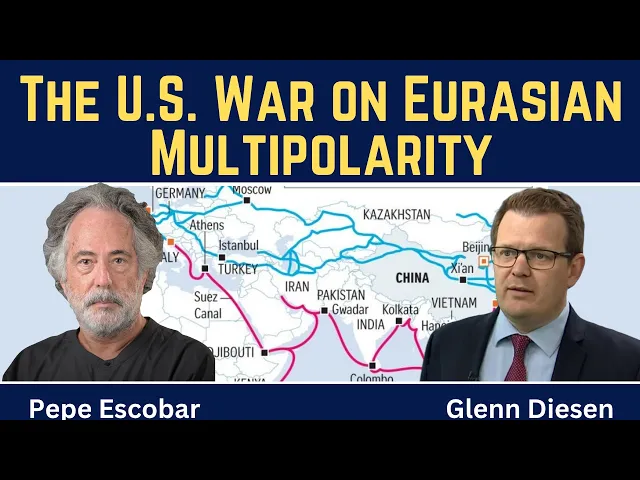
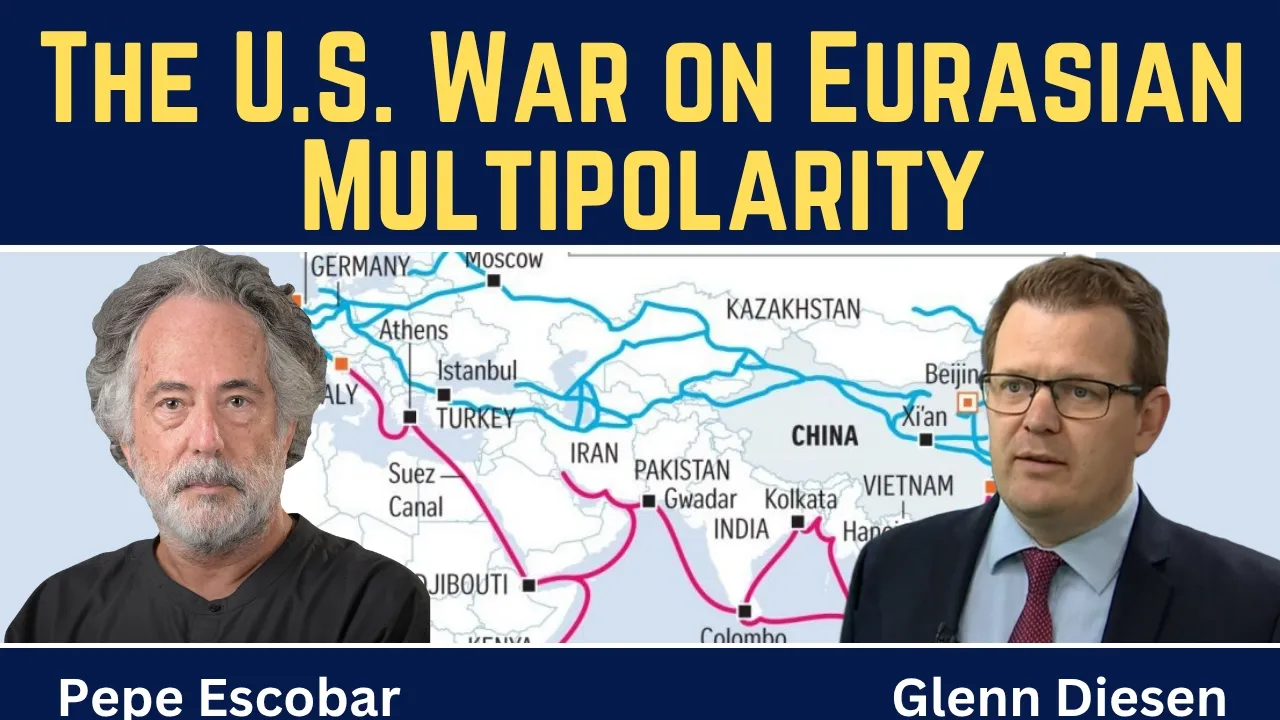
Welcome back. We are joined today by Pepe Escobar, our journalist and an author. Uh, thank you for coming back on.
It's um, it's good to see you again. >> Always a pleasure, Glenn. And greetings from Buddhist peaceful Southeast Asia.
>> Well, uh, I think the first time we met in person was in Moscow. I was working there >> years ago. >> Very Yeah, it feels like ages ago now.
But I also thinking there for a department focusing on uh the greater Eurasia initiative that is for Russia to integrate its economy you know through industries physical corridors financial instruments from China to India Iran and you as a journalist have been working on this as well. Uh so um yeah that's been a while uh but but this whole initiative is seen as an effort to essentially yeah reorganize the international economic [snorts] architecture and um of course Russia and China tends to form the core but India Iran many others have an interest in this multipolar uh economic architecture. Uh I thought a good place to start today would be yeah to ask you how do you see Iran's role in this whole thing in this construct?
Well, uh, stepping a little bit away, but not so much from the war, Glenn. This is, uh, one of my latest columns this week. I I sent you a copy, which is, uh, an update on the what I called years ago, the war of connectivity corridors.
So, basically, we have all those connectivity corridors part of the new silk roads, the belt road initiative. There are at least six of them, maybe seven in fact, including the maritime silk road. Uh, east to west.
Then there's the north to south, the north south international transportation corridor. Three bricks, Russia, Iran, and India, which is something that I had the privilege in fact to follow last year in Iran when we were in Iran at the same time. And I remember they were very busy talking to them all the time.
And on my side I was working on this documentary which is uh the first one uh in the world in English about the corridor and we we were very privileged because we had full access. We had all the permits. So we could go from the Caspian Sea to Bandarabas, Persian Gulf and then Chabahar Sea of Oman and see everything and especially what's lacking uh and the problems of course and the challenges and the problems and I talked to some absolutely first rate uh traders and uh geopolitical analysts in Iran about it.
So that is one of the key new corridors of the future. North to south across Eurasia uh bypassing Swiss, bypassing sanctions, bypassing Swift. And then there are uh two more corridors that are I would not even say in progress, but for the moment they are more like pipe dreams.
One of them is IMAC and the denomination is it's a misnomer because it's not only India, Middle East corridor. Most of all it is Israel, Saudi Arabia, the Emirates, Europe and India corridor. And the idea is to place the port of Hifa as a key trading port connecting with the Arab world, connecting to Europe and connecting to India.
Uh as it stands, we can say that this is dead. And in fact, even Saudi Arabia is practically saying by not saying that this is dead. And then there are the Turks.
And as you know very well, Glenn, they are always hedging. So they are even resuscitating a wow a longgone idea from the late 2000s early 2010s a pipeline from Qatar uh across the Arab world to Turkey and then they can sell uh Qatar gas to Europe for the moment also is just a pipe dream. So in this column I try to analyze the pros and cons of these uh four corridors but the logic is the same.
Uh the 21st century is going to be a war of connectivity corridors at the core of the Eurasia development and Eurasia integration. Well yes some would suggest that much of the past at least 200 years have been organized around uh wars over connectivity. I mean in the early 19th century we know when the the Russians were expanding out from the center towards the periphery this put them in a clash with the British India.
So this is uh what's yeah the the machiner theory that is that you have land land powers connecting versus the sea power and then of course in the 20th century we had the uh yeah discontinuing and it's fascinating because if you look through the strategic documents it always for the US Britain they always formulated you know their claim to world power is controlling the seas that's how they connect the world and then the land powers Russia worst case in the you know connected with Germany or even worse connected with China would then begin to rival the maritime powers. This has always been a key focus of geopolitics and uh it does appear we're still into this. I mean if you look in >> with the k with the BTC pipeline for example I remember in the 2000s that was a very big thing the baklissi kan and then uh this was a way of skirting for the Europeans to go under Russia and above Iran.
>> Exactly. even getting Ukraine connected into the NATO orbit. This is a way of getting the energy transit country to ally with the energy consumers against energy producer Russia.
So we we already seem to be very deep in this connectivity war. But uh what do you see being the wider consequence of uh what's playing out now in this war with Iran? Well, I would say that the number one thing would be what's going to happen with the international north south transportation court.
Russia is deeply involved. Uh they are helping to finance uh railways inside Iran. They could even finance a railway skirting the Caspian Sea to the left of the Caspian Sea because the Russian sink is going to be much much uh faster than uh trying to upgrade the Iranian port structure in the Caspian.
And they're right, Glenn. I went to the port of Bandar Anzali in the Caspian and it stuck in the 70s. There's a lot of work to do.
So they start getting for instance big cargo ships from Astrakhan. I saw some uh Astraan ships in the port but small ones not big cargos. So this is essential.
And what's India going to do? We're all asking the same question. What about the relationship between Iran and India when two days before the decapitation strike in February 28th Modi was being received in Israel and they came up with that motherland and fatherland stickick and it's a huge problem because India is a huge investor in chabahar when I was in Chabahar was fascinating I was talking to the port authorities they said you see those cranes over there they were brought by brought bought and paid for by India.
They are investing. It's a bit of a low at the moment. This was last year.
Uh but they promised that uh uh in a few months uh they're going to you know help us uh develop other parts of the port. The port is expanding very very fast. It's very impressive.
It reminds me uh uh like when what Shenzen 30 something years ago to give an idea, you know. So uh so what's what's going to happen? The Chinese of course they look at Chabahar they say look we can go there and in 10 minutes [laughter] you have everything you need and and they told me look the Chinese we always have Chinese cargos coming here in fact I saw two while I was there most of them go to bandabas but some of them go to Chabahar uh if they are uh for instance uh stuff that is going to be sold in eastern Iran or could be sold pulled in Iran or uh in Afghanistan.
There's a very good road that recently finished from Chabahar to the Afghan uh Iranian border. So the Chinese there's a strong possibility the Chinese will end up taking over Chabahar is going to be one more extra uh connection in their string of pearls of ports and not far from Guadada which is crazy. you know the distance from Chambahar to Guad is 80 kilometers across the border there they are practically sister ports so China could use both easily they already using water of course so this this is the the big big if is what's going to happen to the north south corridor and we didn't even talk about the Russian connectivity corridor which is a taloscratic corridor which is the northern sea route out that the Chinese call the Arctic Silk Road.
This is a corridor that the Northeast Asia specifically, they are immensely interested, especially South Korea. It's something that we see in in in those discussions in Russia during uh the Vladivosto forum and some St. Petersburg.
We're going to have the same discussion St. Petersburg, you know, about two months from now. In fact, le less than two months from now and of course the Southeast Asians are also interested in using it because Southeast Asia can connect to Vladivosto.
Then you take the North and Sea route and you arrive in Mul Musk and you are almost in Europe. So these are the it was not part of this column of course but these are the two key new connectivity corridors the north south and the north and sea route. Um and of course the Chinese they keep adding to what they have.
For instance, uh something that is in the column as well. They finally finished the China Iran railway only a few months ago. And guess what the Americans did?
They bombed a stretch of this railway inside Iran two weeks, two or three weeks ago. Very important because this is from Sing Jang. Of course, everything starts in Singh Jan, but then he goes everywhere.
He goes through the Siberia. He goes through Kazakhstan middle corridor. And this one is particularly interesting because it's Shinjang, Kazakhstan, Kygystan, Turkmanistan, and then it crosses the border in Turkmanistan, enters Iran, and from Iran it can go to Turkey, and from Turkey can go to Europe.
And for the Chinese, this is a key corridor. uh this uh road this this railway sorry the Iranian stretch it's part of what they call the east west corridor and it's where the most important corridors of the new roads of brie there you go it's all there and and everybody is interconnected and the central Asians are connected with all these corridors as well so it's important for them as well because they also receive uh Chinese merchandise that stays in their countries and the rest keeps going. >> Well, given that um well, you mentioned the the attacks on the on the Chinese um connectivity.
>> I know Iran railway. Yes. Yes.
>> Yeah. This is quite important and I also think the yeah the connection with Pakistan is important. I mean if you follow this China Pakistan connectivity with rail and road and then cutting down to the ports of Guadar which Pakistani port which operated by the Chinese is quite an impressive infrastructure where you see essentially this new silk road uh recreating the world as it was before you know European maritime powers took over the world 500 years 500 years ago.
But uh as you mentioned, I also noticed that the US and Israeli bombing of Iran, not only did it target Chinese um uh um infrastructure, but it it also targeted part of the railroads which would connect the international north south transportation corridor, the Russia, Iran, India. So So there seems to be a war on multiparity here. That is obviously this seems to be a key target.
Do you think China stands out uniquely in terms of um a country the US would like to weaken as a result of attacking Iran? Uh Glenn, in fact, this is a war against uh multipolarity. There's no question.
The number one target of course is China. But this is a war against Iran, against China, against the interconnection, against Eurasia integration and interconnection against Russia on another level because this is the the the other war up there which seems to be a neverending as well and a war against bricks. No question about that.
And but this has been announced since the start of Trump 2. 0. zero uh when he's he start first blabbering about bricks which he still has no idea what bricks is about it doesn't matter because the only thing that register in his um fouryear-old psyche ah they want to uh bypass the US dollar that's the only thing that register so war against everybody it's the empire of chaos lie plunder piracy and we bomb everybody that we don't like this this is the American foreign policy now Right.
So obviously the Chinese know it's extremely complicated because it's still not clear especially for us foreigners even if we have access to China. We talk to people in China. I'm going back to China next months again.
I was postponing it because of the war. But one of my first questions to anybody is okay what is more important for you bricks or BRRI or the C roads and how do they interconnect? And the second question is are you fully aware that this is a war against especially against you?
If you follow I would say relatively independent media like our friends in uh Guancha in Shanghai when you read some of their best um contributors scholars scholarly contributors they don't get into detail but this is more or less they they understand that this is a war against China of course and this is a war to try to prevent sources of energy reaching China which is something that they are seeing in front of them nowadays with the American blockade and there's already the blah blah blah about the Strait of Mala which is inevitable but they have been prepared for a potential blockade of the Strait of Mala for at least 20 years and that's why they diversify their sources of energy so you have multiple sources of energy you have oil from Kazakhstan, you have a gas pipeline from Turkmanistan, you have gas pipeline from Myamar, uh you have power of Siberia which is full capacity now and soon power of Siberia too. And of course all the effort that they made to diversify internally. And when you travel in Sing Jang, it's it's mindboggling because you see miles on end.
Everything is electrified. you see forests of uh solar panels, wind turbines, uh those solar farms where you have that pole, you know, irradiating energy hundreds of kilometers around and uh something that I learned from our Ruigur context, Singh has so much energy that they sell energy to the rest of China. So that explains why China nowadays is I would say 80 84 to 86% they don't need to import oil and gas.
So their import of oil and gas is about 13 14%. It's not much compared to the their uh um national needs but they know that ma Malaka continues to be a very very tricky um situation. And now it gets even more uh tricky.
I would say this uh uh deal that the minister of defense of uh Indonesia made with the secretary of war in Washington signed in Washington while Praau the president was going to Russia and spent five hours talking to Russia. This is Indonesia hedging all the time, but they cannot hedge. There's there's there's a limit to their hedging because the other bricks, especially China, are going to say, "What the hell are you doing?
Are you considering giving overflight rights to the the Americans in Indones in our Indonesian territory? " And at the same time, they're saying, "Look, maybe we should monetize Mala. " So now there that there there's the idea in Jakarta.
Okay, they looked at what happened in Hormuz. Malaka is very very strict territorial waters once again divided between Somatra in Indonesia and Malaysia. So both of them can charge a right of passage.
Why not? So I'm sure this is going to happen sooner rather than later. So, so every everything of course is changing but this is going to be particularly um important and of course who doesn't like that Singapore but Singapore is not in the street of Malaa the street of Malaa is to the north Singapore is on the tip south of of of the Malaysian Peninsula.
It has nothing to do with Mala. Malika is a Malaysia Indonesia affair. So all these things are uh they are advancing in parallel.
So it's dizzingly complex but it's a completely different system and we still don't know where it's going but the Malaka angle for China is crucial and I'm sure they will exert a lot of pressure on Jakarta about this uh defense agreement with the Americans. So when the US develops uh naval strategies for for putting this uh well limit the reliable access for the Russians to seas on the west on the western borders of Russia they have three seas which uh can be cut off. There's a Black Sea, Baltic Sea and the Arctic.
You see that the US is going after all three. That was part of the purpose of um you know toppling the government in Ukraine, shutting down the Black Sea fleet of the Russians. Essentially, I would make the Black Sea a NATO lake.
You know, you have NATO now speaking very openly about making the Baltic Sea a NATO lake by challenging Russia and Khalining, of course, getting Sweden and Finland into NATO. Um, I think the yeah, the former NATO secretary general Rasmus said we couldn't put a blockade now on St. Petersburg if you would want to.
I mean, it's kind of aggressive language while an American general said we can invade Khalinrad and there's nothing Russia can do. And as as well you see the militarization of Scandinavia and the US ambitions on cutting off the Russians in the Arctic. Um yes overall I think this is also a goal of taking Greenland.
So they you know they're going after the Russians but when you go want to go after the Chinese you have the dual island chain which is important but there in all American documents which you know since the 19 well for a long time but also the Chinese documents is always special place for the straight of Mala where they see this is where the Americans would come to try to cut out the or shut down the the yeah the Chinese uh connection with the world. So as you said closing off between Indonesia and uh Malaysia I think at the narrow area it's just like 2. 8 kilometers something very narrow.
>> So this is easy to shut down but >> do do you how do you see us moving towards that though the the war in Mala over Mala? Do you think this is a possible actual war or do you think uh I mean do you see a link between Iran to Mala essentially? There is already a gland.
Did you see that? They boarded an Iranian ship not very far from the straight of Malaka. So you know this is probably a message we can in this is an Indoakcom operation.
And I was joking with uh with some people saying that basically uh this uh American task force or invincible armada cowards now because they are not in the in the Gulf of Oman. They are in the Arabian Sea or in the southern Indian Ocean. They are very very far from the Persian Gulf or the the Sea of Oman.
I was joking that this is already a nindopakcom operation much more than Sencom. And then when you see that they apprehended a ship. already in the Indopaccom area.
That's the beginning. This this is just the the beginning. So the Chinese, I'm sure they are horrified about that.
I couldn't read any deeper analysis so far. Uh maybe they are in Chinese um military channels only in Chinese on Waybo or in on WeChat whatever it's possible. So this is something I'm trying to do in the next few days.
But obviously they are horrified because this is exactly what they have been thinking since the early 2000s when they started their d very very uh well coordinated diversification but they still every sing uh all the oil that they import from the Persian Gulf has to go through Mala. They they cannot get rid of that. You know the for instance they were thinking about Guada because Guadada they could build which is something that they could but it's going to cost a lot of money take a long long time a pipeline from Guadada to sing across Baluchistan and then parallel to the Karakuram highway would be a mega engineering feat.
Yes, they could do it, but it's very costly and would take a lot of time. But it's still it's there. The the idea is still there.
Then they would completely by uh bypass Mala. That's one possibility. But of course uh it all depends of uh because we are in the I would say it's what 3 weeks ahead the meeting between she and uh put uh sorry and and Trump in Beijing.
It's going to be on the 14th. So obviously Trump is positioning himself to arrive in Beijing with strong cards in his hand including uh extortion cards, intimidation cards. Uh typical Trump administration.
Uh the Chinese of course as we know they are cool, calm, collected. Uh they play go this means they surround the adversary and it's they see long term. uh they don't play this stupid uh poker that the Americans do.
But of course they are worried. And of course they are worried be even though they have this gigantic res 1. 3 billion barrels of oil in reserves.
This is something we cannot even imagine. But they have it. They accumulated this.
They they were ready for something similar to what's happening now. not Malika but Hormus as Malika in fact because at as it stands um not much oil is uh flowing through Ormus because of course of the second blockade the first non blockade the Iranian blockade it was free for all in terms of Chinese uh cargo now with the second one is more complicated but we still have not arrived at a real cliffhanger. Will this invincible Armada have the balls to actually board a Chinese tanker in international waters?
I don't think they they they will take that risk. And the Chinese are betting on it as well. But of course, the quantities they are receiving are not enough compared to the to the past.
Was 1. 3 million 1. 4 million a day from Iran.
plus the others then plus the oil from uh Saudi and UAE as you said the Chinese they they know what's going on this they see what's happening and uh there's this incrementalism in which we're moving towards it first we see this you know partial blockade on Venezuela and uh again the Chinese see they're part of the target uh you know the American weren't subtle about this either they've made it very clear it's not just it's not that they have to open up to the US it's that they have to shut down the trade with the Iranians. And then of course we now know we have the blockade on Cuba. Uh we have the hijacking of Iranian ships.
We have the piracy and hijacking of the Russian ships. And so you see this uh again connectivity wars if you will. Uh so and given that the Chinese see themselves as being well they're the peer rival of the United States.
They are the ultimate target. Uh what what do you think the how do you think the Chinese are going to react to this? Because they do have a calm demeanor, you know.
>> Exactly. I'm waiting for I'm very curious now to go to China because uh I decided to go because I think maybe there is this an an interval before Trump arrives. It will be the best time to go uh and then start asking questions there.
And while Trump is there, it's the perfect morning to a perfect moment to talk to uh of course as you know talking on the record with Chinese officials in China is immensely complicated for for us foreign journalists and analysts. But of course we have our connections uh in my case scholarly collections uh former PLA officials now retired and even if we talk off the record many many of them they talk but they say look it has to be off the record no problem we always get nuggets of information that you won't find in Sinhoa in global times in China daily etc but uh for the moment they are not even It's typical Chinese. They are reflecting upon it.
So, it's too early to talk about it. But obviously, this strikes a nerve. Malaka for them is a taboo subject.
And now it's getting very very close to home with this first uh seizing relatively peaceful. There was no uh gunfire involved apparently, but it's it was obviously a nindopakon message to the PLA Navy especially and that's why this is so dangerous. Let me ask you something if you allow me.
Yeah, lamb. Considering your fabulous experience in Russia, how do you see the North and Sea route being implemented for good within the next few years? They they say when you go to those round tables in uh Vladivosto for instance, they say okay there are lots of challenges but uh it can be operational by 2028 2029.
Do you think that's realistic? Well, I've been to those eastern economic forums in Vlad as well and yeah, on those panels and and uh well, the timeline, I'm not sure if if they're able to get it up and running by then. But again, it's um on one hand, it's a very competitive advantage because the Arctic corridor of Russia, I mean, this is yeah, connecting Europe with Asia through the Arctic, it's a it's it's it saves a [clears throat] lot of time and money.
So it's a very competitive international maritime route and it will be pretty much the only one in the world which is not uh dominated by the United States Navy. So it's uh it has a lot of benefits and even if the US would try to well force its way if you will you need the search search and rescue ports all you know all these things across the uh Russian Arctic um coastline. So there's no way to really circumvent the Russians there.
So, so the the Russians have great leverage there and also because of the you know the relationship with China get you know everyone gets impression sometimes that the the Russians can get a bit antsy because the the you know they will be more dependent on China than Chinese on Russia. You know the Russians overcome this by having a certain degree of strategic autonomy and also diversifying their partnerships as we've seen in the Arctic. They make sure not just to invite the Chinese, they also invite the Indians and >> Korean angels.
Yes. Yeah. >> Yeah.
Exactly. But uh but also because the ports and all are sovereign Russian territory, it's it creates more balance in the relationship with with the Chinese. So kind of has all the perfect uh recipe for for being a a good project.
But this being said, it has limits as well. I mean the Arctic is it can't become the main corridor. is simply one of many which uh which allows countries to diversify and again so I think often people see it as a you know uh it gives the potential of a Russian strangle hold but I think this is exaggerated because it won't it won't reach that degree of traffic.
It's I think if anything having more corridors it it prevents other countries from using corridors uh as a weapon because then people lose trust in it. And so the Russians have an interest in keeping it open to have trust in it. But it can never be so powerful in terms of the amount of traffic that it would uh pose any threat or you know give the Russians too much power.
So overall it seems like a yeah quite a reasonable project. uh but nonetheless uh the US its uh hegemonic strategies uh builds on and has always done so on maritime supremacy and that means two things all the oceans have to be under US control and also you have to deliver reduce the physical connectivity on on the land so you want to make sure that Germany's cut off from Russia you know bombing Nordstream all of this is achieved you want to make sure that Chinese are cut off from the Russians Russians are cut off from the Indians. Turkey is cut off from Russia.
So you it's yeah essentially the the divide and rule. I think this is how the maritime powers >> and if you go to the Russian um you know conservative scholars Seavitzk and others in the 1920s they made it clear this is they this is why they consider the maritime powers to be naturally imperialistic because they they they can only dominate if they divide and they had a vision that the Eurasian land powers they can only become competitive if they cooperate because yes China's more powerful but China's objectives can't be achieved without cooperation with India Russia Iran. So there's a natural incentive to cooperate.
So this is why they kind of frame the land powers as being more cooperative while the maritime powers are inherently um yeah more imperialistic. I think I drifted a we bit away from your question. But I I I I do think it has a lot of potential.
The Russians have all the ice breakers. They have uh they're building the infrastructure new technology especially drones make a lot of the infrastructure required for search and rescue much cheaper and reasonable especially in areas which have not that you populated which aren't that heavily populated. So I tend to be optimistic about the Arctic RTO but uh >> but the problem is in the past it was just a frozen desert.
there's not that much competitive strategic interest. But now with maritime corridor, all of this natural resources becoming available, it just it's it's lined up for being, you know, taking the center of a zero sum geopolitical standoff. Again, that's why the American wants Greenland.
So, >> exactly. And wow. And Putin is uh personally implicated.
It's what he tells us in Vladivosto every year. This is a federal project uh and they are investing a lot of money in archangels in Murmansk in the ports. Uh so and they take this as a matter of national security.
So it's extremely serious and at the same time the interest the Chinese because one of their corridors for instance they cannot use for the moment the Trans Siberian. They cannot use the Trans Siberian anymore because of sanctions. So that's why they are investing so much in these middle corridors, east, west corridor, etc.
going south, going through the north, it's impossible, but going to the deep deep north uh um in the Arctic is perfect and uh relatively fast and yeah well that's why it's funny that Vladivasto on the Pacific coast of Russia is connected also now with India. So India will also partake in the in the Arctic project. People don't consider India to be an Arctic country.
But but this is kind of the weird stuff because once Sweden Finland becomes became part not become became part of NATO, you essentially have all the Arctic states you have all the Arctic states are NATO members except for Russia which is half of the Arctic. And in the past the Russians because they wanted to integrate with the Europeans and to have a you know common European home as Gorbachov framed it uh they essentially airmarked all Arctic cooperation with uh the western countries but now that uh it's become obvious that there will be no common European home will only have block politics. The Russians are looking towards the east.
So now the Arctic is becoming this roof of Eurasia in which they're inviting Eurasian powers instead of the west. So I think in the future we're going to kick oursel for what what we've done that is the Europeans because uh you know all this Arctic gas which was supposed to fuel our industries cheap gas for the past next 30 years this has now been signed over to the Chinese instead because we are obsessed with defeating the Russians instead of finding a political settlement. though it's just I think historians will look back at this period here as one of the most ridiculous and uh yeah full of self-inflicted >> question yes and you you saw the latest 90 billion uh and they think they actually think in Brussels that this is going to be paid by Russian reparations.
>> Yeah. all that but that but that's why they call it a loan 90 billion >> to Ukraine how is it a loan they can't pay it back and then they explain oh well after we defeat Russia they will pay in reparation so essentially the Europeans can't afford peace anymore because peace has you know they have to defeat Russia otherwise they don't get their money back either >> otherwise they're not going to get their money back >> I always ask though what exactly is this plan if you see Russia considers this to be an existential threat. How do you defeat the world's largest nuclear power which considers it to be in a fight for its survival?
Exactly. To what extent do you want to be successful? I mean, this is a horrible war on so many levels.
the humanitarian strategic. I mean, anyways, I wanted to just get back to uh the the Iranian Chinese aspect of this though because the from what I hear now, the Iranians have began to outline the rules of his new toll system that is everyone has to pay toll. If I'm not mistaken, those who participate in attack on Iran or sanctions Iran, they get a little bit of extra bonus on top in terms of what they have to pay.
Also, they don't want dollars. So, >> only Yes. probably but obviously they will accept UA but not they won't advertise it the back the backup currency will be UN so so is it how do you see this impacting then I mean this is why countries want control over international uh corridors maritime corridors so then you can uh you know extract political concession and economic ones and this would effectively strip the US of much power though is this why the Americans can't leave or or you know even though they more or less lost the war against Iran is this why Trump can't go home of course not because if he uh gets this off ramp wherever that is this is admitting your strategic defeat the strategic defeat is already there for the whole planet to see the thing is the degree of this strategic defeat is going to be extremely humiliating or there's going to be some a saving in built.
We still don't know. But he has to take an off ramp and he's begging for an an off-ramp. That's that's a completely different story.
The Iranians can sit on the current situation for months even though they are paying a horrible price. They already pay a horrible price in terms of the infrastructure that is destructed. There are numbers floating around reaching as much as $270 billion dollars to rebuild what was destroyed during the war.
So obviously they they badly need a toll booth in Ormoose. This is going to help. Uh they cannot expect the Americans paying reparations because this will never happen.
or they will have to force uh the Gulfies especially um Emirates which are for all practical purpose at war with Iran now not Saudi Arabia but but the Emirates to pay reparations so what are they going to do attack the Emirates again? Yes, they can they can immobilize the Emirates in a matter of hours. Very very easy.
And in fact, if the Americans attack again, the number one target apart from Israel is going to be the UAE and not the Emirates. Uh Abu Dhabi specifically, Dubai, the business model of Dubai is already dead and it's not coming back. Dubai, >> how so?
The business model is >> exactly because uh I would say the conceptual brain of aligning with the US and Israel in a war against Iran is MBZ Muhammad bin Zed. He's a very very dangerous gangster. In fact, did you see that he sent his son to Beijing was received by Ciinping and he was lecturing Siginping in Beijing about the Iran Russia relationship.
It's it's it's absolutely mind-boggling. These people are self-ent they are gangsters and self-entitled. That's even even worse.
And they made their bet a long time ago. those uh famous 1. 4 for uh trillion I think is a little bit too much but it's probably much less than that that they committed to invest in the American economy and the Americans can build all the data centers that they want uh in the Emirates and of course the direct connection with Israel which is part of the IMAC as well assuming the iMac one day would happen probably not the the link between Hifa and the UAE is essential for the cor and they still have to build it.
They have to build these rails don't exist. Uh if you sum it all up, uh I think it's over 1,000 kilometers of rails that still have to be built linking Israel with the UAE. So they made their bet even before the war and obviously they provided their own territory for US attacks against Iran.
The Iranians won't forget that ever. There will be payback. It has already started, but it can get much much more hardcore uh later on.
And if the Americans try something funny in the next few days once again, rumor me, but we have to deal with the rumor mill as well. There could be something happening within the weekend. Well, the Iranians already said uh what's going to happen.
It's very very simple. We attack Fuja, we attack Yamboo, and we close the Babal Mandeb. That's it.
Can you recover from that? No. Nobody can.
>> Yeah. When um Yemen closes down the Red Sea, I think this is >> then it's game over. >> That's game over.
That's game over. And everybody knows that, Glenn. Every everybody doing, you know, models or whatever.
Everybody knows that. And that's why nothing happened with the bubble amb so far because this is the ultimate joker. Then it's total collapse.
The global economy is already collapsing even more because of this absolutely ridiculous blockade which is not blockading anything. Ships continue to to go through. And it's fascinating because [laughter] if you if you if you navigate in the Iranian territorial waters, uh Pakistani territorial waters and Indian territorial waters very close to the coastline.
That's it. You go from Car to Mumbai. [laughter] Very simple, you know.
And I'm sure a lot of cargos now are doing that. Tankers are doing that now. you you why do you need to uh navigate in the middle of the Arabian Sea?
You know that the Americans are there or at least they tell us there. We we we we still don't know where exactly they are placed. There's no uh visual uh identification of where these uh destroyers are placed.
Somewhere between the Arabian Sea and the Southern Indian Ocean. that's very very far away from uh the coastline of uh Iran and Pakistan. >> Given that they're so far away, the the region gets so stretched out as well, which means you need a a lot of ships.
So, >> of course, >> from the Yeah. the amount of manpower the ships being used, I mean, they're really exhausting the resources. Making matters worse, at some point, you know, where do you dock, where do you do the maintenance?
A lot of these are going to make them very vulnerable. So, uh, it's, uh, it's a dangerous strategy they're playing. If we're going to back into full out war, um, the US could be in very bad shape.
So, >> yes. >> No, >> if we go back to war, these ships are going to be attacked by missiles and drones, swarms of missiles and drones. There's no question.
The the Iranians are just waiting. This will be part of the war 2. 0.
One of the first things, okay, let's attack the uh the US Navy, whatever they are. As the Chinese would say, interesting time. So, uh thank you very much for taking the time.
Any final thoughts? >> My pleasure, Glenn. Well, hope to see you in in Russia soon.
[laughter] >> Yeah. Yeah, I'm going soon. So, thank you.
>> Cheers. Take care. Bye-bye.