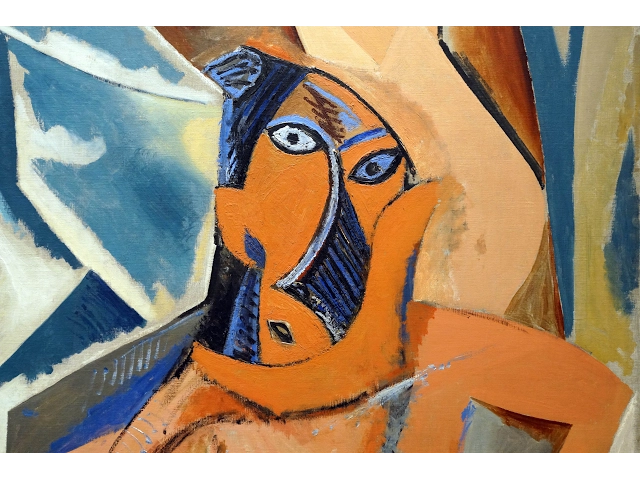
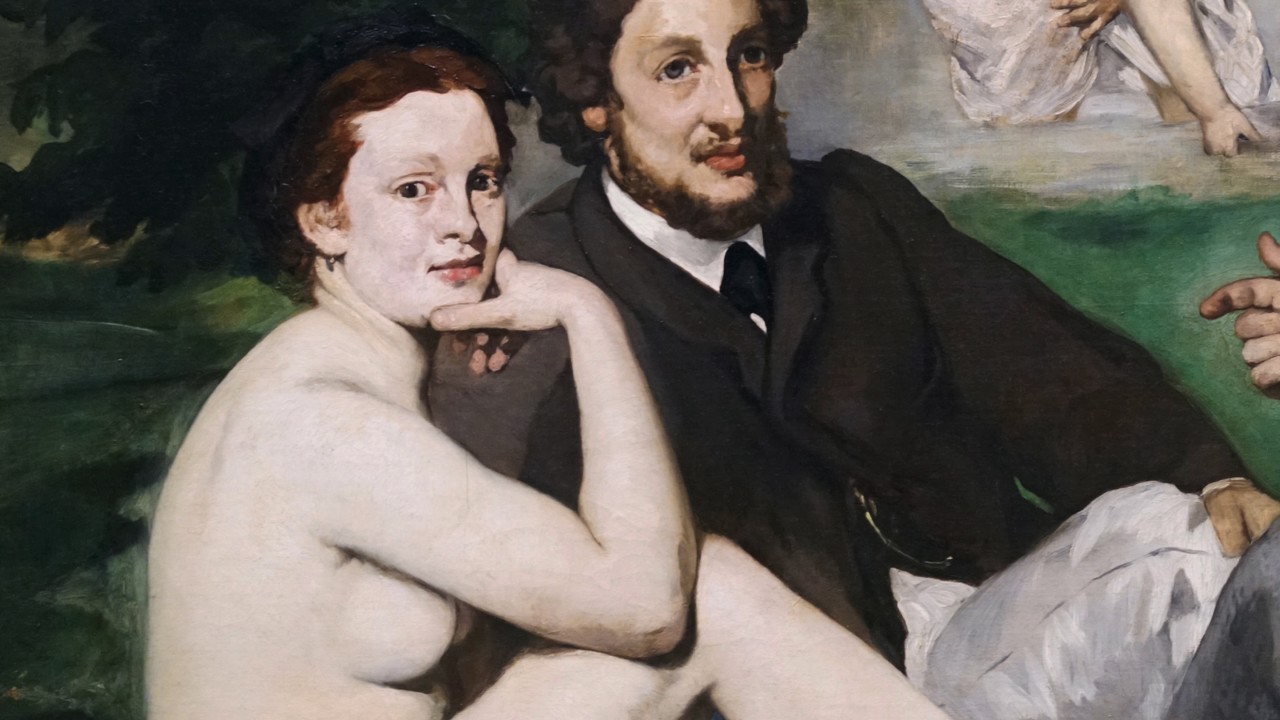
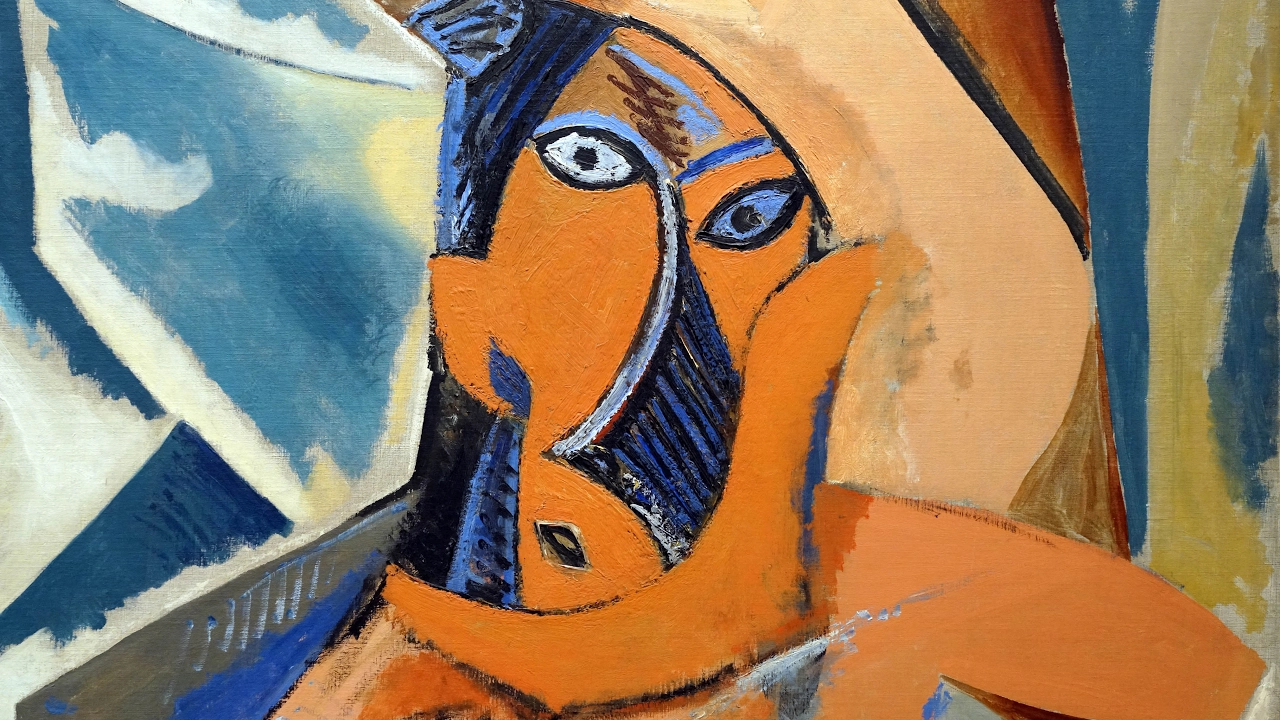
[Music] we're on the fifth floor of the Museum of Modern Art looking at demoiselle Devon by Pablo Picasso Picasso is a Spanish artist but he's in Paris when he paints this the title translates to young ladies of aen which refers to a street that's not in France but is in Barcelona and associated with prostitution what we're looking at is a brothel the idea of rendering a woman who is available to the male viewer but within a context that goes back to dega but it also goes back to man if you think about his painting Olympia
and you could go even further back to the Venetian Renaissance and look at paintings by tishan for many art historians this painting is seen as a break with the 500 years of European painting that begins with the Renaissance and many art historians see this as the foundation on which cubism is built so it's this radical break that points to the Future and it's a radical break with these conventions of representation that had for so long been accepted in the west about how you make a body in space how you create a space all of that
is upended by Le demo deol gone is linear perspective gone is curus skuro that modulation of light and Shadow that creates the illusion that Picasso by the way was in love with the magic of Illusion but here he's shattering it he found the formal means to convey the IDE ideas I think that were behind Le moel Deo ideas about sexuality about the female nude about sexually transmitted diseases this is a confrontational painting in the original sketches the women were focusing on a male that was included a sailor there was also a medical student but he
takes those men out and the women then turn their gaze outward like mayonnaise Olympia to engage us the viewer directly those two male figures give us a clue to some of the ideas behind the pain a sailor someone who's in a brothel as a customer who was seated at a table originally and then the medical student takes on a more analytical view who looks at the women from a more scientific perspective but also maybe from a more artistic perspective artists have a history of dissecting human bodies of understanding the bone structure the musculature of looking
at the body analytically but let's not forget that that medical student carried at least in some sketches a skull and of course it makes sense that a medical student studying Anatomy might be carrying something related to his profession to tell us who he is on the other hand the skull in art history is a reminder of death it's a momento Mori and so there seems to be some tension here between the sensuality that the Sailor is indulging in and a moralizing reminder that the pleasures of life are short indicated by the skull carried by the
medical student the faces of the women on the right are often seen as represent ations of African masks that we know Picasso was then looking at the figure on the left is an archaic figure going back to ancient Spain going back to Iberian art before The Classical period that's one of the problems of this painting we look at Art and we expect stylistic coherence but here we have this AG glomeration of styles it's a kind of invention Picasso is allowing his laboratory to be exposed to us there is a physical confrontation there is danger here
the figures are really close to us space has become this palpable three-dimensional fractured planes the curtains that seem to thread in between the figures are pressed right up against those figures there is no space behind or between there is still some sense of Illusion there's still some Shadow there's still some highlighting but picazo has only created an illusion that goes back into space a few inches it's a little bit difficult to look at this painting without the hindsight of understanding where cubism is going to go but knowing that cubism is this deconstruction of three-dimensional form
shattering that form and then placing those fragments back on a two-dimensional surface has led some AR historians to look at the central figure as one that we're both looking across at but also looking down at as if we're standing over her while she lies on a bed these were not ideas that Picasso came up with independently matis had been exploring these ideas and before him Saison had done this you can see why artists who saw this painting and pi Caso Studio soon after it was painted were horrified even deat when he represented un idealized women
in a brothel never came close to the rawness the ugliness Picasso is a product of his culture he's a product of this moment the fact that he's looking at African masks in order to represent danger is an expression of France's colonialism those objects those masks were coming to France because France had large Colonial possessions in Africa and P at this time knew very little about the cultures that these came from he was interested in them for their formal qualities for their formal inventiveness also because they represented otherness this idea of needing to go outside the
Western tradition in order to express what the early 20th century in the late 19th century felt like is important this tendency toward expressing the flatness of the picture plane not denying it by creating this false illusion this is a very important thing in the late 19th and early 20th century it speaks to the oppressiveness with which post Renaissance culture mannerism the Baro neoclassicism theems of the 19th century all weighed on contemporary artists who are seeking a new visual language to represent modern culture [Music]