I've spent a great deal of time going over lies and falsehoods. Breaking down the Protestant Reformation was an important task, and as the rest of that history that follows gets put together, it is important that we continue to speak about important truths. We have spoken a great deal about what we should not do, but we also need to spend more time on what we should do.
If you now recognize that the foundation that you have learned about the Most High has been off and tainted, it's important that you come to Him in truth and understanding and serve Him. One thing that you will notice when you read His word is that He has always pleaded with His children to come back to His laws, His statutes, and commandments and serve Him. The reason for Israel's chastisement was because of their rebellion and disobedience; they ignored Yahweh's ways, followed the other nations, forsook Him and His ways, rejected Him and His covenant, and tried to be like the other nations.
They lived lawlessly and paid a heavy price for this. Today, as we review our modern world and modern religion, unfortunately, it's sad to say that Christianity is a religion that teaches those who follow it to be exactly like what Israel was chastised for. In Christianity, people are taught a lawless faith, that they can be saved while living exactly how they want to live.
But if you read His word, He has never said such a thing. He has always pleaded with Israel to come back to Him, for them to turn back to His Torah, and to serve Him. In fact, our Messiah has stated, "If you love Me, you will keep My commandments.
" So, it's found to be true that His Torah needs more understanding. In Christianity, we are just taught to abhor His law, to disregard it. We are told that we can't keep it, so don't focus on it; we are told that it's a burden.
I mean, we're told many different things about it, but it should be understood that this doctrine comes from Satan because the last thing he wants are for people to align themselves with Yahweh's law and His ways. Satan promotes a lawless faith. Let's be clear that there has never been anyone who has been rejected or chastised by our Father for just following His Torah.
The Pharisees were not rejected by Yah because they followed His Torah; they were rejected by Yah because they served themselves and did not know Yah. Their hearts were not circumcised; they followed the law in order to show how righteous they were. It had nothing to do with following the law in truth.
The more you understand Yahweh's law, the more you understand Him and His love for us. For instance, when I speak about clean versus unclean foods, people love to debate about the fact that they can eat whatever they want. But what is missing from this is not just about the allowance of liberty; it's more about why He has given us these laws and commands in the first place.
Because while yes, you can eat what you want, it doesn't mean that all food is good for you. In fact, by following Yah's law, you protect yourself, you live more healthily, and you preserve yourself for longer periods of time. It's crazy that the same people who speak against Yahweh's dietary law and say they can eat whatever they want are the same people with major health issues, but they don't see the correlation.
It's important that we review our hearts when we understand His Torah. Most of us have learned about it in a way that seems like restrictions, and because we have been taught to be rebellious, we don't desire to be under rules. But when we truly understand Yahweh and why He has given us His Torah and why He has said certain things, you can better understand why following Him is better for our lives.
Now, please be clear about this: Following His law does not bring salvation, but following His law does keep you out of sin and away from danger. This video, I know, will come against a lot of negative feedback, and people will call me legalist or judaizer or whatever. But the purpose of this video is not to put anyone under the law in order to justify your faith; it is so that you understand more about Yahweh and why He has commanded His children in certain ways so that you can understand Him more and understand how to better align to His will.
There is nothing wrong with His law, and in a time where lawlessness and evil abound, His law is probably the safest thing to abide in as we transact with His world. So, we will discuss more about the Torah and why we should regard it in love. Let's begin.
Okay, so the Hallelujah Scriptures has a great resource book that they use that speaks about the Torah. Because how they started the book is so well written and explained, I'm going to use their introduction to start this discussion with a few minor changes in the way. Let's start talking about it.
Somehow, a Jewish tradition has been passed down through history that leads many to believe there are 613 Mitzvah or laws in the Torah that are written and need to be kept. This number is used by some to attempt to prove that we cannot keep all the laws and thus highlight the need for forgiveness through Messiah. While some even claim that these laws are a burden, and if you have ever had a conversation with these kinds of people, you'll find that this is so true.
I mean, I know this as I respond to people in the comments who take offense when. . .
I bring up this topic about the law. The first thing many people want to do is ask if I keep the 613 laws. For anyone that has ever come across that, please know that the people who use this statement, for the most part, have not actually read these laws themselves; they definitely, with assurance, have not studied them or understood them.
They are using lines that they have been taught—indoctrinated lies that keep them lawless without understanding. For those who actually call Yah's law a burden, they absolutely need a heart check. I would never say that all these statements come from a misunderstanding, and that's why I want to get this clarified.
So let's continue on. While it is most definitely true that we do need redemption through Yahusha, as we have all fallen short of the perfection of Yah, as Romans 3:23 reminds us, "For all have sinned and fall short of the glory of Elohim," the simple truth is that even Yahusha did not keep all these so-called 613 laws. That might sound crazy to you.
Why do I say that? Because the commands given in the Torah are specified to whom they pertain. A large portion of the laws are for the priest, some just for men, some for women, some for animals, or the owners of animals, etc.
To give a visual perspective of the 613 laws, this is a pie chart illustrating the application of the commands and to whom they pertain. So, based on this chart, you can clearly see that when people ask you, "Do you keep all the 613 laws? " it's because they themselves don't truly understand the law.
Understanding should always come before people refute and/or reject. Anyways, as you can see, according to the chart, approximately 30% of the laws are specifically for the Cohen, the priest. After that, there's another almost 30% divided into percentages for men, women, Cohen haGadol, judges, sovereigns, servants, etc.
The remaining 41% actually apply to everyone who considers themselves part of Yasharel, regardless of position or condition. The supposed 613 total is a number the modern Jewish scribes arrived at when examining the list of laws in the Scriptures. There is no single definitive list that spells out the 613 commandments.
It's important that you know where your doctrine comes from when you say certain things. This numbering and giving of 613 laws is not from Yahweh; it is from modern Judaism. For instance, let's use a Mitzvah.
Mitzvah, meaning "commandment," let's use Mitzvah 420: it commands to read the Shema morning and evening. It is a commandment to read the verse, "Listen, Israel! Yahweh is your God, Yahweh is one.
" It actually is, "Hear, O Yasharel! Yahweh, your Elohim, Yahweh is one. You shall love Yahweh, your Elohim, with all your heart, with all your soul, and with all your strength" (Deuteronomy 6:4-5).
Remember, they don't say His wonderful name, so they use Hashem. This goes back to the ineffable name doctrine I brought up last month. What I was saying is that, according to the 613 Mitzvah, number 420 commands them to read the Shema twice daily, but there are no Scriptures that actually say such a thing.
You will not find one command in the Scripture like this; they made up their own laws. There are many examples like this that could be given, but the focus of this video is not to go over their falsehoods, but to go over which laws Yahweh intended for all mankind for His blessings. While bearing in mind that Yahusha said, "Do not think that I came to destroy the law or the prophets.
I did not come to destroy but to fulfill. For assuredly, I say to you, till heaven and earth pass away, one jot or one tittle will by no means pass from the law till all is fulfilled" (Matthew 5:17-18). His law has not gone away yet.
But also, we need to add to this understanding. As you come to the realization that the Torah and the commands were never done away with, you also need to consider how the early believers dealt with the new Greek converts. We'll read about this in Acts chapter 15: "And certain men came down from Judea and taught the brethren, 'Unless you are circumcised according to the custom of Moses, you cannot be saved.
' Therefore, when Paul and Barnabas had no small dissension and dispute with them, they determined that Paul and Barnabas, and certain others of them, should go up to Jerusalem to the apostles and elders about this question. So, being sent on their way by the church, they passed through Phoenicia and Samaria, describing the conversion of the Gentiles, and they caused great joy to all the brethren. And when they had come to Jerusalem, they were received by the church and the apostles and the elders, and they reported all things that Elohim had done with them.
But some of the sect of the Pharisees who believed rose up, saying, 'It is necessary to circumcise them and to command them to keep the law of Moses. ' Now the apostles and elders came together to consider this matter. And when there had been much dispute, Peter rose up and said to them, 'Men and brethren, you know that a good while ago Elohim chose among us that by my mouth the Gentiles should hear the word of the gospel and believe.
And Elohim, who knows the heart, acknowledged them by giving them the Holy Spirit, just as he did to us, and made no distinction between us and them, purifying their hearts by faith. Now therefore, why do you test Elohim by putting a yoke on the neck of the disciples, which neither our fathers nor we were able to bear? But we believe that through the grace of our Adon Yahusha, the Messiah, we.
. . " Shall be saved in the same manner as they.
Then all the multitude kept silent and listened to Barnabas and Paul declaring how many miracles and wonders Elohim had worked through them among the Gentiles. After they had become silent, James answered, saying, "Men and brethren, listen to me: Simon has declared how Elohim at the first visited the Gentiles to take out of them a people for His name, just as it is written: 'After this I will return and will rebuild the Tabernacle of David, which has fallen down; I will rebuild its ruins, and I will set it up, so that the rest of mankind may seek Yahweh, even all the Gentiles who are called by My name,' says Yahweh, who does all these things. Known to Elohim are all His works from the beginning of the world.
Therefore, I judge that we should not trouble those from among the Gentiles who are turning to Elohim, but that we write to them to abstain from things polluted by idols, from sexual immorality, from things strangled, and from blood; for Moses has had throughout many generations those who preached him in every city, being read in the synagogues every Sabbath. " Then it pleased the apostles and elders, with the whole church, to send chosen men of their company to Antioch with Paul and Barnabas, namely Judas, who was also named Barabbas, and Silas, leading men among the brethren. They wrote this letter by them, the apostles, the elders, and the brethren, to the brethren who are of the Gentiles in Antioch, Syria, and Sicilia: greetings.
"Since we have heard that some of you went out from us and have troubled you with words unsettling your souls, saying, 'You must be circumcised and keep the law,' to whom we gave no such commandment, it seemed good to us, being assembled with one accord, to send chosen men to you with our beloved Barnabas and Paul, men who have risked their lives for the name of our Lord Yahusha the Messiah. We have therefore sent Judas and Silas, who also report the same things by word of mouth. For it seemed good to the Holy Spirit and to us to lay upon you no greater burden than these necessary things: that you abstain from things offered to idols, from blood, from things strangled, and from sexual immorality.
If you keep yourselves from these, you will do well. Farewell. " So when they were sent off, they came to Antioch, and when they had gathered the multitude together, they delivered the letter.
When they had read it, they rejoiced over its encouragement. (That's Acts 15:1-31. ) So I made sure to bring this understanding in first so that it is understood that this understanding that the apostles had is still understood in this ministry.
If you are a Gentile, I do not seek to trouble those of you who are turning to Yahweh, but just as the apostles committed, I concur that you must abstain from things polluted by idols, from sexual immorality, from things strangled, and from blood. This video is not about placing burdens upon you, but to help you understand Yahweh better and understand why He has commanded Yasharel in certain ways. So we will start with the laws that will be most important in our times today, such as restoring the Sabbath and festivals, working toward a biblically clean diet, then progressing through the laws that pertain to you personally.
Notice in Acts chapter 15 that the council addressed the four most prevalent laws that existed in the Greek culture at that time and directed believers to then heed the law of Moses; for Moses had had throughout many generations those who preached him in every city, being read in the synagogues every Sabbath. (That's Acts 15:21. ) The Torah was given to Yasharel for the people living in the land Yahweh had promised to Abraham, Isaac, and Jacob.
And although many laws are prefaced by the words "when you come into the land," they are no less important to us in our society in the lands that we dwell in today, although a small handful clearly pertain to the actual land of Yasharel. As we go through this, it's important to remember above all that the commandments are given in love to be a blessing. "Now it shall come to pass, if you diligently obey the voice of Yahweh your Elohim, to observe carefully all His commandments which I command you today, that Yahweh will set you high above all nations of the earth.
And all these blessings shall come upon you and overtake you, because you obey the voice of Yahweh your Elohim. " (That's found in Deuteronomy 28:1-2. ) So please, as you review this, please adjust your view of Him and His Torah.
Our perception of His law has been tainted because we have been taught a false version of our faith that rejects Him. His laws are not a burden, as John himself writes: "By this we know that we love the children of Elohim when we love Yahweh and keep His commandments. For this is the love for Yahweh, that we keep His commandments, and His commandments are not burdensome.
" (That's 1 John 5:2-3. ) Proverbs 28:9 says, "One who turns away his ear from hearing the Torah, even his prayer is an abomination. " So it's important that you have a strong understanding of His law and His ways and go back to Him in truth.
It is important to understand the difference in mindset. I am in no way speaking about justifying yourself to Yahweh through your keeping of the law. We know how everyone likes to compare keeping the law to what the Pharisees did.
Yes, the Pharisees were all about keeping the Torah, but that was not their problem. The problem was they never gave their heart to Yahweh, and therefore, they never understood what. .
. Yahweh truly desired for them through His law, so this is not about how to justify yourself with Yahweh through the law—absolutely not. We know what James says: if you really fulfill the royal law according to the Scripture, "You shall love your neighbor as yourself," you do well.
But if you show partiality, you commit sin and are convicted by the law as transgressors. For whoever shall keep the whole law and yet stumble in one point, he is guilty of all. For He who said, "Do not commit adultery," also said, "Do not murder.
" Now if you do not commit adultery, but you do murder, you have become a transgressor of the law. So speak and so do as those who will be judged by the law of liberty; for judgment is without mercy to the one who has shown no mercy. Mercy triumphs over judgment.
That's James 2:8-13. It is true that, yes, we are judged by the law of liberty, but this does not mean that we can live however we want and do whatever we want. This is just not right or true.
And so, if you want to understand Yahweh, there is no better place than through His word and by His Torah. Understand why and how Yahweh has set Yasharel apart. Yahusha Himself has warned us, "For I say to you that unless your righteousness exceeds the righteousness of the scribes and Pharisees, you will by no means enter the Kingdom of Heaven.
" That's Matthew 5:20. So we cannot just do completely opposite the scribes and Pharisees and live lawlessly. We must be better and exceed the righteousness of the scribes and Pharisees, and this comes by understanding Yahweh and circumcising our hearts.
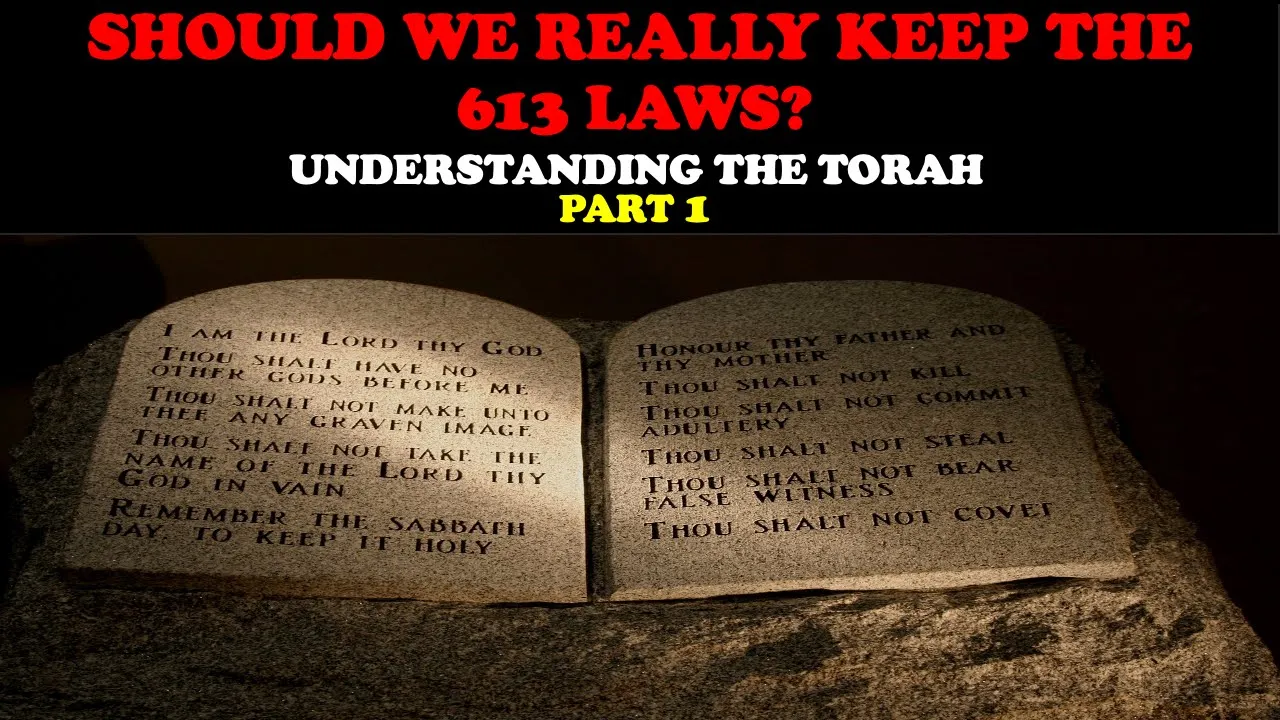
So it's important to understand Yahweh and His Torah, so as you live your life, you can understand what He condones and what He despises. How will you ever understand Him if you don't understand what He loves and what He hates? So the first thing we must deal with, and must be the very foundation of this whole topic, is to deal with the Ten Commandments.
Then we will close this video out and then pick it back up in the next part because I do not want to overwhelm. I've covered this before, but we need to go more in-depth. So this part is an introduction to this.
The Ten Commandments are huge by themselves and they must be the foundation; they must be understood so we will understand what Yahweh has commanded. You can read it all at once in Exodus 20:1-17, but for time’s sake, I'm just going to go over each commandment: Number one: You shall have no other gods before Me (Exodus 20:3). This is a huge commandment in which most people break today.
This was a sin that caused Yasharel to be driven into captivity; they served other gods. You should know that Yahweh does not play around with this commandment, and this commandment is something that Satan attacks aggressively in many different ways because he is introducing himself as the god of this world. So the first way that people break this commandment is placing themselves as a god; it's the worship of themselves, committing idolatry.
Kanye West recently, in an interview, explained just that—that that's what he does; he made himself a god. This is a topic by itself. Most people break this commandment because they put themselves over Yahweh; they place their needs, their desires, their wants, their goals—they put everything in priority over Him and therefore make these other things god over their life, which is exactly a doctrine of Satanism.
For those that think that you are not under the law, do you think it's okay to put other gods before Yahweh? If you know the answer is no, then rethink your position on not following the law because the Apostles of the New Testament abided in this law too. Number two: You shall not make for yourself a carved image, any likeness of anything that is in heaven above, or that is in the earth beneath, or that is in the water under the earth.
You shall not bow down to them nor serve them (Exodus 20:4-5). You know how many people accept this practice? My grandmother has all these carved images in our home; it's just a thing that their generation accepted, I guess, because it's considered African art.
This is a common practice. The Roman Catholic Church is probably the biggest breaker of this commandment with all their carved statues that they worship and bow down to, with all the images that they made during the Renaissance. But this is also prevalent in the Protestant churches with all the Christmas worship people do every year.
I mean, back in the day, they used to have us all wearing Jesus pieces around our neck—literally with the head of the Messiah around our necks. You'll see the practice of breaking this commandment continue today and it just goes on without thought or care; it's not even thought of. This again was a practice that Yasharel was chastised severely for.
For those that think that you are not under the law, do you think it's okay to make carved images, bow down to them, or serve them? If your answer is no, then rethink your position on not following the law because the Apostles of the New Testament abided in this law too. Number three: You shall not take the name of Yahweh your Elohim in vain, for Yahweh will not hold him guiltless who takes His name in vain (Exodus 20:7).
I've spoken about this in many videos. To take His name in vain is to make it meaningless; to bring it to nothing. What could be more meaningless than to not even say it or acknowledge it?
To bring it down to. . .
merely a title, but yet this is what the majority does: we take His name in vain, and He said He will not hold him guiltless who takes His name in vain. A majority of the world who calls themselves Christians break this command, many out of ignorance, but others, even after being presented with the truth, fight over it. For those that think you are not under the law, do you think it is okay to take Yahweh's name in vain?
If you know the answer is no, then rethink your position on not following the law, because the Apostles of the New Testament abided by this law too. Number four: Remember the Sabbath day to keep it holy. Six days you shall labor and do all your work, but the seventh day is a Sabbath of Yahweh your Elohim; in it you shall do no work.
(Exodus 20:8-9). This is a huge commandment that has been spoken of many times throughout the Old Testament. If you read the Old Testament, you see just how important this command has always been to Yah.
But this is another commandment that is broken by Christians as a majority. Most don't actually recognize that they do worship on the Sabbath on the first day and not the seventh day because Rome changed a time observance a long time ago. This is why people go to church on Sundays and they don't work on this day; this unknowingly is their Sabbath.
Now there are many that do not understand that they follow the Sabbath on the first day, and their reasons for not honoring the Sabbath are different. Growing up under the Christian Church, what was taught to me is that the reason I don't honor the Sabbath is because I rest in Jesus. But what does that even mean?
I rest in Yahusha; absolutely I rest in Him because I trust in Him. I believe in Him; He is my shield; He is my counselor. Of course, I rest in Him, and He is Master.
But the practice of resting on the seventh day is quite different than that. We work for seven days and rest on the seventh; a day of rest, as He commands, is not a burden; it's actually a blessing. Just as Yahweh rested on the seventh day after He made creation, we rest on the seventh day as we rest from all of our labor.
Yahusha Himself did this, so we follow Him. But again, this is a command that most people feel is not even necessary to consider any longer. This was a sign of people that are under a covenant with Yahweh.
Why would we, who believe in Him, do any different today? For those that think you are not under the law, do you think it's okay to forget the Sabbath day? Well, in this one thing I know: many of you do.
But if you know the answer is no, then rethink your position on not following the law, because the Apostles of the New Testament abided in this law too. Number five: Honor your father and your mother that your days may be long upon the land which Yahweh your Elohim is giving you. (Exodus 20:12).
This is an important commandment, and if it was held correctly, the world would be better, because we would follow and honor our parents, who coincidentally would honor their parents. By doing this, if they were all in line with Yahweh and His ways, this would continue down through the culture. But because people break this commandment today, anything goes for each generation, and the generations get worse and worse.
Now, Yahusha does provide clarity on this, because we are not to follow our parents into rebellion and sin, and we cannot honor them more than we honor Him and follow them into rebellion and idolatry. This was something I personally struggled with for a long period of time because I always wanted to stay in line with my parents, but they did not desire Yah in the same way. And so, I had to make a decision to follow after Yahusha more than I follow their ways, because I was not going to be led into sin and rebellion because of them.
For those who follow Yah and are led by Him and are in covenant with Him, honoring our parents should be an easy command to follow. How can you say you love Yah as your Father, and you can't even honor your own parents? For those that think you are not under the law, do you think it's okay to dishonor your father and your mother?
But if you know the answer is no, then rethink your position on not following the law, because the Apostles of the New Testament abided in this law too. Number six: You shall not murder. (Exodus 20:13).
This should be a simple one: don't go around killing people. People often confuse this because of what the Israelites had to do as they were commanded to go into their promised land. This was a commandment amongst them as a people.
If they were living amongst each other in peace, if they were able to kill someone because of offense, then problems would never get handled. This still holds to this day; we cannot go around killing people because they wronged us. This should be an easy commandment to keep and understand why.
Now, Israel had their own way of dealing with people that broke the Torah and were rebellious, and that is a different discussion altogether. But they had a law and ways of command that were fully understood and explained in the times that we are in. None of that is justified because we are not a people living under Yah's covenant, so we do not kill those who wrong us.
We pray for and try to minister to them, but we know in the. . .
End vengeance is Yah's, and He will avenge us. So we do not commit murder. For those that think you are not under the law, do you think it is okay to murder?
If you know the answer is no, then rethink your position on not following the law because the apostles of the New Testament abided in this law too. Number seven: You shall not commit adultery (Exodus 20:14). Another one that's self-explanatory.
When we marry, we take vows before Yahweh, joining our partner and becoming one flesh. Just as we are not to break our vow before Yah and worship other gods, we should not break our vow with our spouse and commit adultery. An adulterous person was looked upon very badly in the culture of Yasharel.
Today, in this lawless generation, adultery and divorce are common. People make vows before Yah that they didn't really believe in. If you can make promises to Yah and not keep them, it does not only say something about your relationship with your spouse but also about your relationship with our Creator.
We cannot commit adultery. For those that think you are not under the law, do you think it is okay to commit adultery? If your answer is no, then rethink your position on not following the law because the apostles of the New Testament abided in this law too.
Number eight: You shall not steal (Exodus 20:15). Lawlessness—these last few commands are just pure examples of how we are to conduct ourselves today. It is clear why we should not murder or steal, but you must understand that during those days, they had no rules or laws; they did as they felt they should.
When Yahweh took Yasha to Himself, He gave them order. We should not take things that do not belong to us. I do not need to dwell on this because this is one thing that most people understand.
The only question is: do they understand this because they follow the rules of Yah or because they are following the rules of the land? Either way, we do not steal. For those that think you are not under the law, do you think it's okay to steal?
If you know the answer is no, then rethink your position on not following the law because the apostles of the New Testament abided in this law too. Number nine: You shall not bear false witness against your neighbor (Exodus 20:16). This is another commandment that people break without question.
People will tell a lie or an untruth about someone for many different reasons, and many people do not feel a way about it. People lie under oath; they lie to get their own selves out of trouble; they lie to protect others; they lie to elevate themselves over another. This is a common commandment that people break today—bearing false witness against their neighbor.
But if we are following Yah, it should be easy to see why we should not engage in this type of behavior. By lying about someone else, you could bring judgment upon them or bring things against them that they do not deserve, and that is just not right to do. For those that think you are not under the law, do you think it's okay to bear false witness against your neighbor?
If you know the answer is no, then rethink your position on not following the law because the apostles of the New Testament abided in this law too. Lastly, number ten: You shall not covet your neighbor's house. You shall not covet your neighbor's wife, nor his male servant, nor his female servant, nor his ox, nor his donkey, nor anything that is your neighbor's (Exodus 20:17).
To covet is to yearn to possess or have something that is not yours. This is a huge commandment that is broken today because of the wine of fornication spread from Mystery Babylon. We live in this way completely because the culture of society markets to us coveting, teaching us to want what others have.
Now, don't get me wrong; there's nothing wrong with liking something and saying, "You know what? I'm going to work hard to obtain this. " But there are different depths to this.
When you make it your mission in life to obtain those things, you walk away from what Yah wants you to do because you've made it your own goal or purpose. When you look at what others have and say you're going to have this for yourself, it walks you into a multitude of sin. Looking at your neighbor's spouse and saying you want him or her for yourself is walking you into sin.
Looking at their house or their cars and saying, "I'm going to figure out how I can take this from them," is walking you into sin. If it's not yours, then don't dwell on it. If Yah desires to bless you with it, then He will.
When you make it your life's purpose, you will not be blessed. Many people do not realize that the reason why they are not blessed with certain things is that they're covetous, and Yah does not want to bless them because He knows this will drive them deeper into sin, like idolatry. This is a commandment that is broken more often than it's not, but people don't recognize it because it is our way today.
We cannot be this way, but unfortunately, people live in this projection of this command far too much. For those that think you are not under the law, do you think it is okay to covet what belongs to your brother or sister? If you know the answer is no, then rethink your position on not following the law because the apostles of the New Testament abided in this law too.
You see, these are Yah's commandments, and these things should not be a burden for. . .
us to live under or follow. But, for some reason, people speak against this as if those who desire to adhere to these commands are being legalistic. When they say the only law they are to follow is love, they misuse what Yahusha has said about the law, and they use his words as a reason to live in disobedience to him.
So, before we end this part of the discussion, let's discover this, because I think if we clarify it, this will help us all with understanding how we place a law in our lives. We will find this in Matthew 22:34-40. But when the Pharisees heard that he had silenced the Sadducees, they gathered together.
Then one of them, a lawyer, asked him a question, testing him and saying, "Teacher, which is the great commandment in the law? " Yahusha said to him, "You shall love Yahweh your Elohim with all your heart, with all your soul, and with all your mind. This is the first and great commandment.
And the second is like it: You shall love your neighbor as yourself. On these two commandments hang all the law and the prophets. " Yahusha said the first and greatest commandment is to love Yahweh our El with all our heart, with all our soul, and with all our mind.
Then he said to love our neighbor as ourselves; on these two commandments hang all the law and the prophets. But do you know what he did there? He broke up the Ten Commandments and broke them down into the most simplistic understanding.
To love Yahweh our Elohim with all our heart, all our soul, and all our minds is to follow the first commandment: to not put other gods before him; to follow the second commandment: to not make any carved images and bow down to them, as lawless pagan nations do to their gods; to follow the third commandment: to not take his name in vain and make it meaningless; to honor the fourth commandment: to remember the Sabbath day; to honor the fifth commandment: to honor our mother and father; and the second, which is like it, is to love our neighbor as ourselves; to honor the sixth commandment, which is to not murder; to follow the seventh commandment and not commit adultery; to follow the eighth commandment and not steal from our neighbor; to follow the ninth commandment and not bear false witness against our neighbor; and lastly, to follow the tenth commandment and not covet what belongs to our neighbor. Yahusha very simply and plainly summed up the commandments into two: loving Yahweh with all our heart, mind, and soul, and then loving our neighbors as well as we love ourselves. This is the summation of it all.
If we live in the commands as Yahweh has commanded us, we live in love of him and our neighbor, and thus we live as he commands us. This is pure obedience to the will of Yah. If you understand this, you understand the beauty of the law.
So, imagine the hypocrisy of trying to justify disobedience to the law after Yahusha summed it up beautifully. It comes down to love, and the word shows us how we can do this properly. Understanding the commands of Yahweh is not difficult or a burden; we do them because we love Yahweh and seek to live as he desires.
When we live in objection to his ways and therefore desire to live how we want to, we are actually satanists and are driven away from our creator. Following the law does not bring us salvation, but we follow his law and commands because we love him with all our heart, minds, and soul. This is pure obedience to the will of Yah, and if you understand this, you understand the beauty of the law.
So, if you can imagine how many of us who have been led by false doctrines of men have spoken in direct opposition to living in obedience to our creator, it should all drive us towards repentance. If you have ever lived with the false mindset that you do not honor those commands, repent from that mindset and turn back to him at once, in the ways he has guided and commanded us. His ways are not a burden; they are a blessing.
We have a Messiah who provides forgiveness for our mistakes and our sins—not so that we can abuse this grace and live lawlessly, but so that we can live in the forgiveness Yahweh grants us, and continue to strive to live the way he desires until his kingdom comes. So, this is the beginning of law and the most important parts. After we understand this, we must go deeper into understanding more of his Torah, understanding his festivals, dietary laws, sexual defilement laws, and laws for men and women regarding marriage.
I want you to understand his Torah so you can at least understand what he stands for and what he is about. Whether you choose to follow him or abide in him is completely your choice, but if you follow him and your heart is circumcised, living a blessed life becomes much simpler. It's hard to live in liberty when you don’t really know the speed limit.
You need to at least understand the rules and what he stands for so that you do not move so far away from him. I pray that this brings clarity, and through these next videos, a stronger understanding of Yahweh is had. We keep his commandments because we love him, and so this will assist you in walking more in alignment and in love for our creator.
Follow him and his commands. Be blessed. Hallelujah!
Praise Yah! Okay, thanks again for watching. If this has blessed you, please make sure to like it and share this video with others.
If you. . .
Haven't done so already, please make sure you subscribe to this channel. Y'all, I upload every Friday. Also, please don't forget to follow this ministry on Facebook and Instagram, as well as on this website: truthunedited.
com. If, for any reason, you do not see this channel any longer, you can always find this ministry on my website. Make sure you subscribe to the email list to always stay connected.
Also, please continue to pray for this ministry; your prayers and your support are sincerely appreciated. As always, I want to thank those who have donated to this ministry; your contribution is a huge blessing to the ministry and helps continue on with this assignment. Your support is a blessing; I'm always humbled by your support and I'm very thankful for you.
Be blessed! Okay, thanks everyone for watching. I love you all!





![✝️The Life of Jesus (📜Gospel of John) Full Movie [4K ULTRA HD]](https://img.youtube.com/vi/_7VREHqasrc/maxresdefault.jpg)

![Fall Asleep Listening to Genesis: Bedtime Scripture for Deep Sleep [Holy Bible Audio]](https://img.youtube.com/vi/46IfXNk8YI8/maxresdefault.jpg)