Geoff: Despite having access to more information than ever before, Americans trust in the news media has been declining in recent years. Nearly three quarters of Americans say the news media is making political polarization worse. Judy woodruff investigates as part of her ongoing series, America at a crossroads.
Judy: -- >> I listen to fox News. I listen to Newsmax. I will go to CNN, to see what they are saying.
Judy: Jeri Levasseur is a Republican committeewoman in haverhill, Massachusetts. >> Do we want to do heavy traffic time like 4:00 to 7:00 again? Okay.
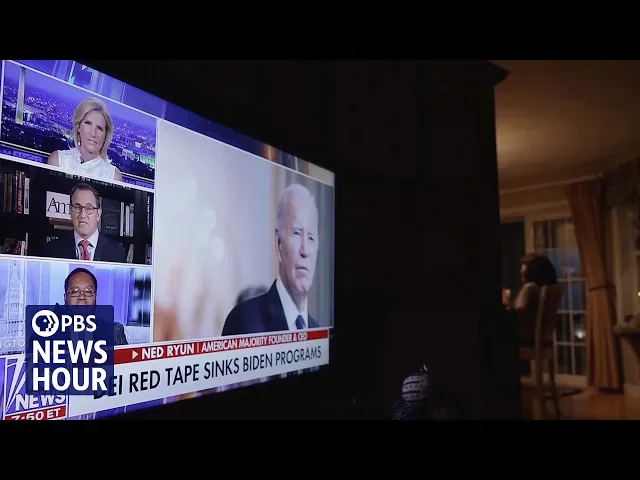
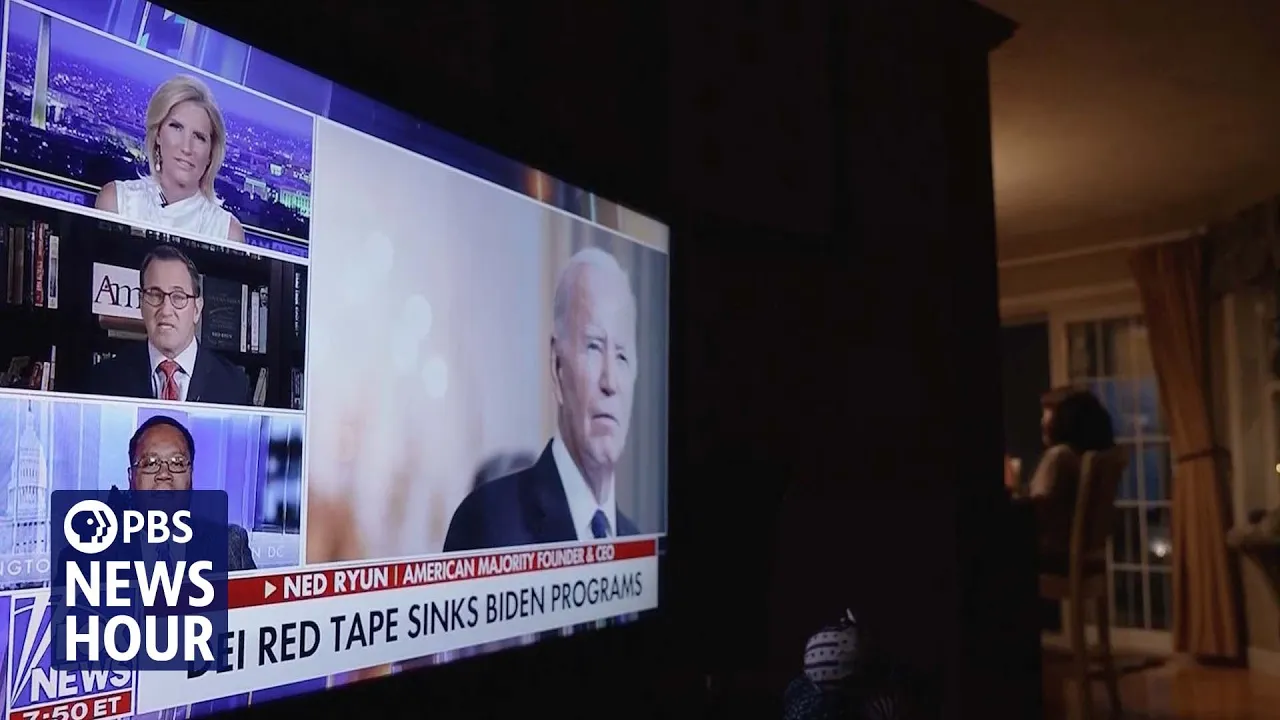
Judy: On a hot evening this July, she and a handful of fellow Republicans were working on their plans to show support for former president trump, while Fox News played in the background. >> -- -- Attempt to enforce their vision for America but it is not based off meritocracy. It's based off racism, and it's based off neo-marxism.
Judy: -- >> I think that president trump gets a -- not that fox is pro-trump -- but I think he gets a better interpretation of his values and what he stands for from fox. MSNBC is much more likely to insult Republicans as opposed to insulting a Democrat. >> The supreme court is a clear and present danger to their entire political agenda.
Judy: Across town, demet haksever who immigrated to the United States from Turkey in 1975, is watching MSNBC. >> In the morning, I start watching MSNBC. Morning Joe.
CNN sometimes, pbs, other sources, bbc. And at night, I tune in to MSNBC. Judy: Haksever is a retired economist who's now involved with indivisible, a grassroots political group dedicated to opposing the Republican party.
And why do you prefer MSNBC, you say? >> Well, I like that they're focused on the issues that are important to me. Judy: What about fox?
>> No, I gave up on fox a long time ago. Judy: Haksever and Levasseur are not unique. A 2023 survey by the associated press found that 26% of Democrats and 60% of Republicans have little to no trust in the news media.
And research by yougov in 2024 showed Democrats were more likely to trust a wider range of sources than Republicans, who were far more inclined, like Levasseur, to primarily trust fox and Newsmax. >> The national news is more polarized certainly on broadcast and cable and it is much less reportage and much more opinion. Judy: Martha minow is a professor and former Dean of Harvard law school, whose book "Saving the news" looks at how the news media has been transformed under declining government regulation and increasing economic and political pressure.
>> Political parties funded newspapers in the 1840s, 50s, 60s. The journalism that developed in the 1880s into the golden age of the 1960s was the first time that objectivity was elevated as an ideal. That really recognized we need multiple sources.
We need to be transparent. We need to actually document. We need to have a counterpoint.
>> Here is a bulletin from CBS news. Judy: That also just happened to be good business. To advertise to the most people -- which paid for publication -- newspapers and broadcasters had an incentive to aim for objectivity.
>> This picture has just been transmitted by wire. Judy: In the 1950's, 60's and 70's, television news reporting was primarily limited to the three major networks: CBS, ABC, and NBC. With only a handful of channels available for broadcast, the government issued licenses to the networks and also put regulations in place to ensure fair treatment in their coverage.
Like the fairness doctrine, enacted in 1949. >> The fairness doctrine was part of the entrance of the federal government in the regulation of access to the airwaves for television, radio. You have to have balance.
If there is, presentation on one point of view, you have to have a contrary point of view. If a public official were attacked, they had a right to reply. >> Good evening, I'm David walker.
>> And I'm Lois hart. Now, here's the news. Judy: But as cable TV grew in popularity and dozens of new channels came on air, all viewers had to do to get a contrary point of view was -- -- contrary point of view was change the channel, in theory.
So, the fairness doctrine was phased out by president Ronald Reagan's FCC in 1987, setting the stage for a radical transformation in the way Americans got their news. >> I think a lot of people now turn to the media to be reinforced in what they believe, rather than to learn something new. Judy: Minow says cable networks like MSNBC, Fox News and others now pursue smaller audiences on the left or the right -- sometimes called narrow-casting -- by leaning into opinion coverage that those viewers will agree with.
Hannity: Kamala Harris has a horrific track record, even worse public persona. Psaki: She has different superpowers, and different areas she'll need to work on than president Biden. >> Opinion media is more successful than news media, than journalism.
I think it's related to this lack of curiosity. People looking to be reinforced. Also, it's more expensive to actually interview people, to look at documents, to, actually explore without knowing ahead of time.
What is your story? Being able to convert, a story into something that's very simple, digestible, and maybe even outraging, is more successful. It attracts attention.
It's what people talk about. >> Breaking just now, an illegal immigrant from Ecuador arrested, apprehended, under arrest, suspected of sexually assaulting as you said a teenage girl in a New York City park. >> Recently, there was a 13 year old girl, little girl in new York that's been raped by an illegal that's crossed into this country.
He tied up the little boy that was with her, gagged them, and nothing comes out of the white house about how horrible this is. >> According to new analysis from NBC news, quote, "Despite several horrifying high-profile incidents, there is no evidence of a migrant-driven crime wave in the United States. " In fact -- United States.
>> They are just cherry picking a couple of terrible crimes by immigrants, which, of course, -- but they don't mention, ever, the positive contributions of the immigrants to communities, to this country. Judy: But is partisan news media in fact creating more division in the country, or are partisan viewers now finding their way to more friendly outlets? >> I've been focused on polarization almost my whole career.
Judy: Professor Matt levendusky is a political scientist at the university of Pennsylvania. His research shows that watching certain channels does have an impact on viewer's political opinions. >> We showed people the fox coverage, the MSNBC coverage, or the mainstream news coverage, and what we found was that people tended to move in the direction of the source, right?
Especially if it was a source that was congenial to them. Judy: How do you see the role of the news media and any bias or slant in the news media in affecting the way most people think about issues? Matt levendusky: Well, there's certainly an effect.
I think people who are actively involved in politics tend to be quite polarized, but the country as a whole still has room to come together and find common ground. But the factor working against that is that politicians often have an incentive to divide people. Judy: Levendusky says both the news media and political leaders -- who are often recruited from the political extremes during primaries -- have played a role in deepening our divisions.
Mr Trump: Venezuela is releasing thousands of people. Criminals, gang members, drug dealers, the worst. >> They are trying to control women's bodies quite explicitly .
>> If you look at studies about the kinds of people that run for congress, they're increasingly being drawn from people who are more on the extremes rather than the middle, because the people who are in the middle sort of look out at congress and they say, where am I going to fit in in? So it's pushing people and kind of stretching them out a little bit more towards the extremes. >> Well, the thing is, early voting starts in September.
Judy: Jeri Levasseur has felt the impact of this growing polarization in her own community and even her own family. >> Well, I do have a brother who is very liberal. So we just don't talk politics at all.
Ever. Judy: And what about where they get their news? >> They would never watch fox or Newsmax.
It's MSNBC. >> Right, this is how we make it in Turkey. Judy: But 10 minutes down the road, demet haksever sees an even greater threat in the coverage coming from fox, especially its promotion of conspiracy theories about the 2020 presidential election: .
>> The disinformation, they spread it about the validity of the election results 2020. It poses a great risk to our democracy. I come from Turkey and we lost our democracy because of the same divisions.
Judy: What happens to a democracy in a situation like that? >> Well, democracy dies in that case. Judy: Harvard's Martha minow says there is no easy solution to this problem more nonprofit media, funding local journalism, and fighting disinformation could all help.
But she remains deeply concerned about how these divisions are affecting our communities. >> The lack of a shared reality is a crisis in America right now. And you can see this depending on what your preferences are, you flip channels or whatever, you see different topics, and when it's the same topic, there's no relationship!
And if you don't share a reality, and indeed you think the people next to you are out to get you. It's not just democracy that's at risk. It's peaceful coexistence.
Judy: In an upcoming installment of America at a crossroads, we'll look at how the internet and social media have only accelerated this concerning trend. For the pbs newshour, I'm Judy woodruff in haverhill, Massachusetts.