[Music] hello everyone and welcome back to mike and his whiteboard today we're going to talk about getting filled and when we're talking about getting filled it's basically taking your order and putting it through an exchange and then actually getting filled on that order so there's a few different factors that go into actually getting filled and it's a common question we get on the support line so i thought it'd be a great topic to discuss here so let's talk about order type first so when we're talking about order type there's two different order types that we
can route in general so we can route a market order or we can route a limit order so here it takes usually route limit orders we pretty much never route market orders and that's for one reason so if we look at the actual definition of a market order it's basically a trade that's filled at the best price available in the market so what's important to know about this is that you don't really know where the order is going to get filled so it could be right around the price you want to get filled or it
could be totally off the price you want to get filled so for that reason we always route limit orders and a limit order is basically a trade that's filled at the limit price or better so if i'm looking to sell an option and i want to sell it for 50 cents i won't be able to sell that option and it won't get filled for anything less than 50 cents sometimes i'll get filled for a better price like 51 cents or 52 cents which is always great but it will never go below 50 cents so it
won't fill at 49 48 47 etc however with the market order if i route something for 50 cents i'm at the mercy of the market so if i want to sell it at 50 cents and there's an open order for 30 cents it'll get filled just like that for 30 cents so that's one reason why we don't choose market orders and we always usually choose limit orders so we can have control over the orders that we're placing so if we go to the next slide here we'll talk about getting filled a little bit further so
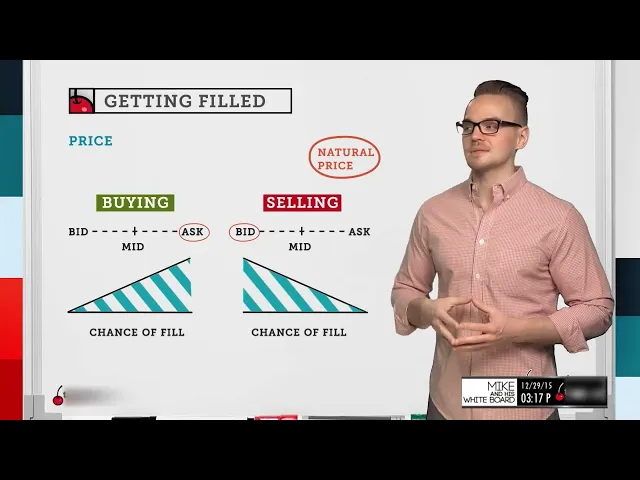
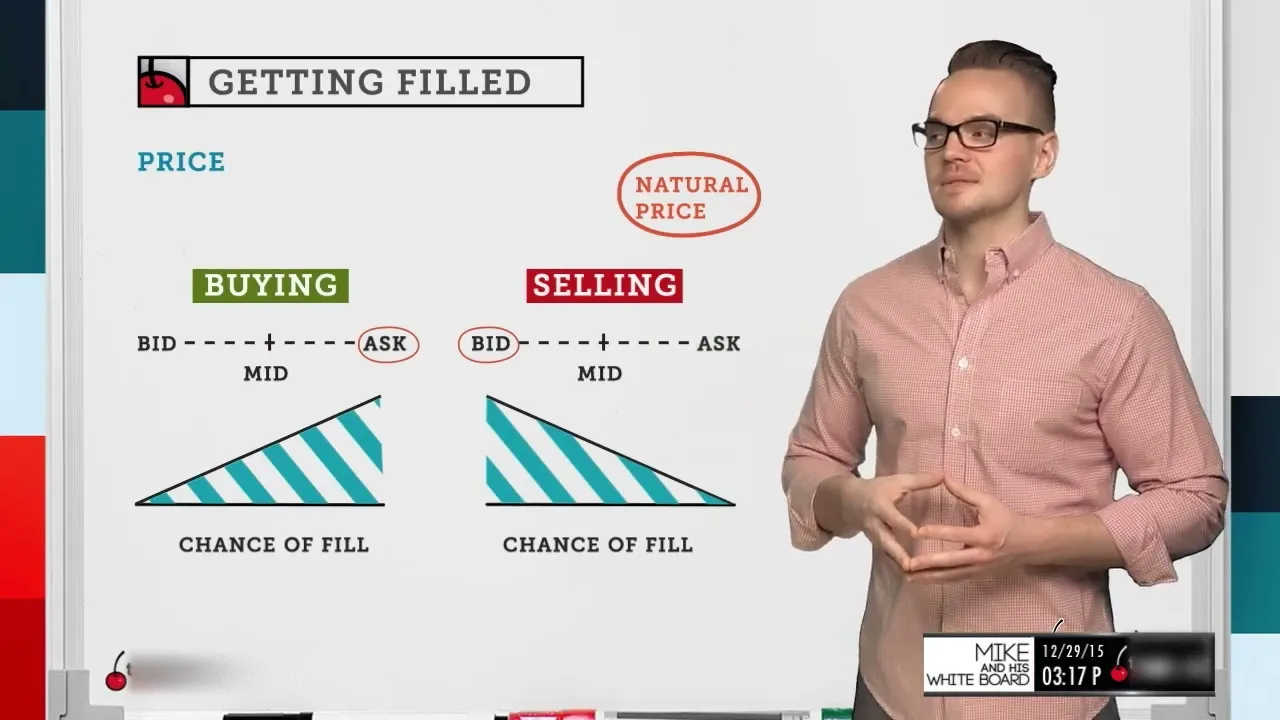
there's a difference between buying options and selling options so really what we need to understand is the bid ask spread so a bid ask spread is basically the spread of an option where we're looking at who's willing to purchase an option at a certain price and who's willing to sell an option at a certain price so if i'm looking at buying an option and notice the natural price in the upper right corner so the ask on buying an option is circled because that's the natural price if i'm buying an option i'm going to have a
higher chance of getting filled the closer i get to that ask price because it's going to be higher than the mid price and higher than the bid price so when i'm looking at buying an option the closer and closer i get to the ask or the natural price the higher chance i have of getting filled inversely if i'm looking at selling options the bid is where it's going to be the natural price and i'm going to have a higher and higher chance of getting filled the closer and closer i get to a bid price so
let for example let's say i'm selling an option and let's say the mid price is 50 cents the bid price is 45 cents and the ask is 55 cents so i've got a 10 cent wide bid ask spread and let's say i try routing it at the mid price of 50 cents and it doesn't go through the more and more i get closer to the bid price of 45 cents which is going to give me a lower profit because if i sell something for 45 cents as opposed to 50 cents it's going to be a
lower profit overall but the closer and closer i get to that natural price the higher chance i have of getting filled so there's another thing to consider even if i'm at that natural price and still not getting filled and we're going to talk about that on the next slide here so one thing to consider is that there's different exchanges when we're routing orders so normally when we're looking at the platform the platform is taking different orders from different exchanges and showing us the average of the price so let's say i route something for 50 cents
and i want to sell a put at 50 cents and i route it as a limit order so i won't accept anything less than 50 cents what's important to know is that there might be multiple exchanges that would accept that order and it takes the average so if i've got an order exchange that's at 55 cents or 52 cents and then i've got one that's lower if i route it for 50 cents and it goes to an exchange that doesn't match that price specifically then there might be an issue with getting filled temporarily i might
get filled in a minute or two but it might not get filled right away so that's important to note another thing to note is that the more legs i have on a trade the harder it is going to be to get filled and that's because if i'm routing a spread so if i'm selling a put spread instead of instead of selling that naked option the more legs i have so in this case i would have two legs i have to be filled on each of those legs before the total order can be filled so if
i'm routing a spread or an iron condor which has four legs it's going to be harder to get filled altogether which is why we always stick to the most liquid underlyings so that we don't have to deal with that issue another thing to consider is liquidity so again we usually rout our orders with the highest liquid underlyings so that we don't have to deal with this but if there is a liquidity issue we can look at the out of the money options to see if there's a zero bid so if i'm looking at an out
of the money option and i'm trying to sell that out of the money option and there's a zero bid and a number for an ask so let's say there's zero bid and a ten cent ask that's a pretty good indicator that there's low liquidity because no one is willing to buy that option in the marketplace so it's really crucial to check for zero bids when we're looking at liquidity and it's also good to look at different expirations so generally when we're looking at expirations in the option market the regular expirations tend to be more liquid
so there's more players in the regular standard expiration cycles then when you compare that to a weekly option cycle sometimes there's an exception for that when it comes to earnings so if a big stock like apple has earnings and the closest expiration is a weekly option or a weekly expiration cycle to that earnings announcement you might see a lot of liquidity in that specific expiration when compared to the regular expiration but in general regular expirations or standard expirations are usually the ones that have the most liquidity another thing to consider is legging so if i
have a spread and i sold an option and i bought another one to create a spread if i can only get filled on one of those sides i might consider that but usually when we route an order together we'll try and take it off together but if i'm in a situation where i sold a put spread or sold a call spread and it's reaching almost max profit what i might consider doing is just closing that short option which would take the risk off the table if i can't seem to sell that long option out of
the spread so that's one thing we would consider maybe with legging but usually when we route an order together we want to take it off together to make everything flush so let's go to the next slide and we'll talk about the takeaways of getting filled so the first thing to consider is that it's not instantaneous it's a two-sided market and there's prices that have to be matched so whether it's different exchanges or different pricing or different liquidities on each leg there's a lot of different factors that go into it so it's important to know that
it's not going to be instantaneous most of the time another thing to consider is the order type so when we're talking about limit orders versus a market order if there's an an order in the market and we route a market order it's usually filled instantaneously but we never really know what the pricing will be and for that reason to avoid that we like to route limit orders because it gives us the ability to route it for that price or better so when we're selling options it could be for that price or higher and when we're
buying options it could be for that price or lower and lastly different factors can be hurt or help getting uh getting filled so when we're looking at different factors such as high liquidity or low liquidity or different exchanges having a wide array array of pricing there's different things that can help or hurt us but having a better understanding in general will help us understand why we're getting filled or why we're not getting filled so this has been an overview of getting filled thanks so much for tuning in my name is mike if you've got any
questions at all shoot me an email at dough.com or support or you can shoot me a tweet at doterra for a great night what's up everyone thanks for watching our video click below to watch more videos subscribe to our channel and visit our website at [Music] you