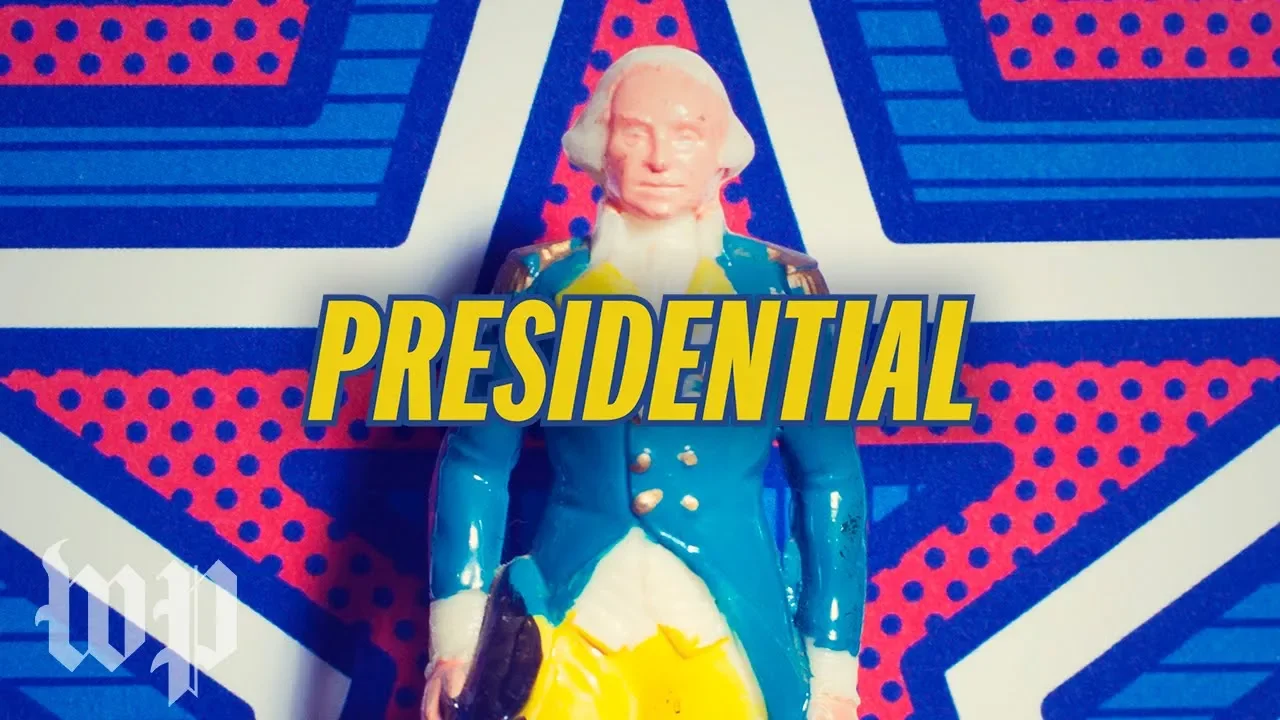
It's a pitch-black winter night, and I'm walking outside along the gravel paths at Mount Vernon, George Washington's old home in Virginia. There's a candlelight tour going on here, so everything's dark except for a few fire pits and lanterns that are popping and crackling. There are re-enactors and visitors who are standing around them singing.
There's also just this beautiful icy white moon in the sky that's lighting up the Potomac River below. I actually work only about 15 miles from here in a very different environment: the newsroom of The Washington Post. I'm Lillian Cunningham, and I’m the editor of a section here called "On Leadership.
" I mostly interview current leaders in business and government, but I had the idea that, especially in this election year, it would be really fascinating to study up more on presidential leadership in particular—like the skills and the circumstances that have made certain presidents effective or ineffective—and whether the type of leadership traits required to do the job well have changed significantly over the years. That's when I started confronting the fact that there are a lot of presidents I really know nothing about, even the big-name presidents I thought I knew something about. Well, on closer look, most of what I knew were just their very major successes or failures.
I'm talking about sound bites that have become famous, like the Civil Rights Act of 1964. I won’t just cite the funny little myths that have somehow been lodged in our collective memory, like Taft getting stuck in a bathtub. The Washington Post's former publisher, Phil Graham, popularized the phrase that journalism is the first rough draft of history.
I started thinking about that and decided, wouldn’t it be really great to dig into each of the American presidencies by talking to the journalists around me at The Washington Post? These are some of the people who have often been first on the ground to record and assess a president's decisions and actions. Then I thought, wouldn’t it be really great if I took that and combined it with talking to historians, professors, and biographers who spend their time studying those histories years, or decades, or in some cases, centuries later?
So that’s what brought me to George Washington's home on a really cold winter night. For the next 44 weeks, I'm going to go one by one through each of the American presidents. I'm going to try to better understand who all of them really were, how they came to hold the nation's highest office, how they confronted tough decisions, and which traits really helped or hurt their success on the job.
I'm also really interested in the strange ways in which their legacies have shifted or cemented over the years. Were the presidents I never learned anything about really so lackluster and forgettable? Did the iconic ones really have some superhuman leadership capacity that the others didn’t, or have there been some other forces at play that, for one reason or another, have made us remember or forget the presidents that we have?
I'm starting at the beginning, so this episode is going to explore the character of George Washington. Not every episode is going to focus so exclusively on the personality and the demeanor of the president, but since George Washington gave us our very first example of what an American president should be like, it seemed fitting to kick off the series by looking a lot more closely at who he was as a person and how he came to define the role. [Music] For this, I'm going to talk to Jill Achenbach, a reporter at The Post who's written a book about George Washington; Julie Miller, who's a historian at the Library of Congress and is basically the keeper of George Washington's papers; and then Bob Woodward, the legendary Washington Post reporter who broke the Watergate scandal and has authored a number of books on the American presidency.
This is the very first episode of "Presidential Leadership. " [Music] "Resign the presidency effective at noon tomorrow. What your country can do for you.
" [Applause] [Music] Normally, I'll dive straight into discussing the president at hand, but since this is the first episode of the series, I want to take just a little time to zoom out and think through why and how we're going to approach this podcast. This is where Bob Woodward comes in. Since investigating the Watergate scandal that led to President Nixon's resignation, Bob Woodward has been immersed in uncovering the inner workings and decision-making of American presidents, including Clinton, Bush, and Obama.
So I asked for his help in guiding the aim of this podcast. His first piece of advice to me was, “If you give a plain vanilla Wikipedia version of the presidents, you haven't kind of captured the deep controversy that runs through American history. ” “Good evening.
This is the 37th time I have spoken to you from this office. ” Here's more of our conversation. “I would start with the definition of the term ‘president.
’ I have done so to discuss with you some matter that I believe. . .
What is it? From working on eight presidents, my conclusion is that the president needs to establish what the next stage of good is for a majority of people in the country—not a party, not an interest group, but a real majority. Then develop a plan, a strategic plan, to get there and then execute it systematically.
In obvious cases, the next stage of good is winning the war, getting out of the depression, ending the Cold War. I urged the Soviet leader, Mr Gorbachev, to send a new signal of openness to the world by tearing down that wall, perhaps giving health care to everyone, raising taxes—sometimes as the next stage of good. Cutting taxes often is the next stage of good too.
” With Congress fighting Congress, fighting the Supreme Court, getting the Supreme Court to validate what you’re doing, this president— and then one of the things to ask about each of these presidents: Did they do that? Did they plan it? Did they look into it?
Or was it handed to them? Pearl Harbor was given to President Roosevelt, yes, and he had no choice. 9/11, the terrorist attacks in New York and Washington, so it is a matter of ascertaining what the will of the president is.
What does the president really want to do? And then, to what extent do they succeed or fail at working their will? Do you have the sense that then the sort of skills that are needed to execute on that are, you know, different every time and for every president?
Or have you found that there are actually some sort of key leadership traits, sort of skills that you've seen? This is the great question—are there universal leadership skills or talents that apply in each case? The answer, when you look at this, is no.
Sometimes a president needs to be really tough, and other times the president needs to be a great listener. Presidents also need to be creatures of instinct because they’re in politics. Gerald Ford, when he pardoned Nixon, I always thought it was the ultimate corruption of Watergate.
Nixon goes free, all these people go to jail, and then when you look at it—as I did, look at the record and interview Ford for hours and hours—why’d you do this? Turns out Ford was really interested in getting Nixon off the front page because he was going to be investigated, certainly indicted, probably tried, maybe jailed. This presence would have meant two or three more years of Watergate, and Ford said, “I needed my own presidency.
I had to dispose of Nixon. ” So, what looked like, in 1974, the ultimate corruption turns out to be actually an act of courage in the national interest because Ford paid an immense political price for the pardon because of the suspicions there was a deal. I mean, that’s one of the things I find really fascinating too, is the way that legacy shifts over time and when it’s kind of fair to start assessing whether a vision someone had has actually— the answer is it’s always fair to make an assessment, even in the moment, because that’s the way democracy functions—an open debate, dialogue, aggressive practice of the First Amendment.
But I remember interviewing President George W. Bush about the Iraq War, and we spent hours on the question of why’d you do it? What happened?
What were the decision points, step by step? And then at the end, I asked him, “How do you think history will judge your Iraq War? ” He was standing in the Oval Office, hands in his pockets, and then took his hands out, kind of—his hands flew in the air, very aggressively—and he said, “History?
We won’t know! We’ll all be dead! ” Well, he’s ducking the question, but he’s right.
We don’t know—we’re going to be dead when the final assessments come in. And of course, as we’ve learned, there’s never a final assessment. [Music] All right, so here we are, finally ready to start talking about the subject of the episode—George Washington.
He was unanimously elected in 1789 to be the first President of the United States. Joel Achenbach, a fellow reporter at The Post, wrote a book about George Washington called "The Grand Idea: George Washington's Potomac and the Race to the West. " So I asked Joel what he thinks tends to get overlooked or forgotten today about who George Washington really was.
You know, Washington was so much more interesting than we realize because over time he’s become the man on the dollar bill. You think of him in that Gilbert Stuart portrait as a kind of stiff figure, you know, gray-haired and a somewhat unknown famous person. And so, he turns into a statue.
He turns into someone who it’s hard to picture as actually animated and alive. In fact, he was kind of like an action hero for much of his life—not just in the Revolutionary War, where obviously he was the commander of the army and a hero who spent eight and a half years fighting for our independence—but even before then, when he was in his early 20s, he kept getting into these misadventures. You know, the Jumonville ambush, where he and his allies ambushed a French officer, that helps trigger the Seven Years' War, known here as the French and Indian War.
Soon after, he has a fiasco at Fort Necessity, where he has to surrender and gets parole, but he easily could have been executed, potentially, and was already one of the most famous Americans at the age of roughly 22 because of his exploits. He had a few personality traits, though, that benefited him. Number one was that he had no fear to an astonishing degree; he just simply never in his life seemed to experience the emotion.
He just had a way of instigating a lot of trouble and somehow escaping it. During the Braddock massacre in 1755, he had bullets flying around him—I think four bullets went through his cloak. He had a couple of horses shot out from under him, and somehow he survived.
It was kind of like James Bond in the movies; he never actually gets shot for some reason. He had many skirmishes where he could have died and misadventures in the backcountry, but he was not fearful. He was ambitious; he continued to have sort of champagne tastes in a sense.
Which is peculiar because he was also this frontiersman at times. I mean, he was like Daniel Boone. He was someone who slept out in the open in the backwoods, hundreds of miles from the nearest city, and was sort of indestructible in that way.
Even as president, he had some rough moments where he would be caught in a thunderstorm in a boat, and so on. He did not live an easy life, but he certainly did like the finer things in life. So how do you think those exploits shaped his leadership style and his approach to being president?
He must have felt that he had a providential personal destiny by the fact that he kept getting in these scrapes, and he kept surviving. He had a sense that he was a great man doing something historic. He certainly felt that about the country; he thought that America had, was gifted by Providence.
You know, essentially, it was our destiny to become a great country. Part of his personality was that he did instill in people a great deal of obedience and reverence. He was the kind of leader who, in a pinch, in a battle, would be upfront.
He was not someone who would be sitting back, you know, two hills over, watching his men in a skirmish; he'd be right up there at great personal risk. As president, he had to deal with the rise of partisanship, something he had no interest in. So he was always sort of caught in the middle, but he was the only person who could have kept the country together, I think, in those first really stormy years.
He commanded respect from all directions politically; everyone respected Washington. That was a really handy thing to have for a young country, to have a president who was not divisive. We don't have that today, obviously, and you can kind of wonder how often in American history we have ever had that— not very often.
But for a young country to have someone like Washington, who was clearly the person you needed to have as a leader and who was willing to do that job and to serve in the best interest of the country, was a really lucky break for us. He had a vision for this young country somehow growing into a powerful nation, and that was at a time when it was not obvious at all that that could happen or would happen. With the United States, when it was first formed, it had a smattering of former colonies—now states—that were essentially their own countries.
When Thomas Jefferson referred to "my country," he meant Virginia. It was Washington who figured out how we could take these different states and actually cohere them into a true nation. This part of his life—being the woodsman, the canal builder, the explorer, the person who kept lighting out for the wilderness and going over the mountains and down the Ohio River at a time when landowners just didn't do that—his sort of appreciation and feeling for the country at the level of the landscape, the rivers, the mountains, and what passed for roads then, was someone who probably knew the country physically better than anyone else of his time.
He knew, in his head, that if he wanted to keep the country together, he had to create what he called the "cement of interest" among people or between people, so that people in the West would feel connected to the people in the East and would not feel connected just to whoever was down the Ohio or Mississippi River in New Orleans. Washington, more than anyone else of his day—except for maybe Benjamin Franklin—had the big picture about American destiny and the future of the country. Of course, that vision turned out very badly for the Native Americans.
It was also a vision that never, during the colonial era and during the Revolutionary era, resolved the great tragic stain of slavery. Washington was not a perfect man by any stretch of the imagination, and you could easily impose some of our current values upon him and his time and find him not meeting what we would expect. The most obvious example is that he was a slave owner who did not free slaves in his own lifetime—only in his will, and then stipulating that they be free only after his wife died.
At the same time, when you look at him in the context of his time, he did something that, for example, Thomas Jefferson didn't do. Jefferson didn't free his slaves in his will, except for just a few of them. Washington knew that slavery was wrong and took steps to make clear that this was not something that met the values of the country.
There is no one else in American history as important as George Washington, and with all due respect to Abraham Lincoln, for example, I think even Lincoln would acknowledge that. Lincoln saved the country, but Washington made the country—he made it in part through sheer force of will and yes, through optimism, through vision, through wanting to do something big. One of the big things a lot of people know about George Washington is how, possibly, his greatest act was giving up power and relinquishing the presidency after two terms.
That's what really solidified America's democracy. I want to look a little bit more closely, though, at what exactly he was wrestling with when he took on. .
. The role of president, to begin with, even during his time in office, he was still sorting through what it meant to be a president rather than a king. I figured the best way to get inside his thoughts was to turn to his papers, and that meant turning to the Library of Congress.
The Library of Congress is possibly my favorite building in Washington. It's this just gorgeous space, and it sits near the Supreme Court and the Capitol Building, and it houses the original papers of just about every American president. From the Washington Post building, it's actually only about a 10-minute metro ride.
So, I packed up my recorder and my notebook, and I headed over there to meet with Julie Miller. Julie Miller is a historian at the Library of Congress who specializes in early American history, and she's basically the main keeper of George Washington's papers. She brought out these big, heavy archive books that contain Washington's delicate and yellowed letters with his perfect cursive handwriting.
"What's your sense of what you know most people overlook about him? " I asked. "Well, my feeling about who he is, and my sense is that most people don't really know who Washington was at all, and they think of him as being a symbol or an icon.
To some extent, he contributed to that himself. Even in his lifetime, he was very concerned about his own image while at the same time being rather modest. But I think one of the things that libraries like this one do is we collect papers of these presidents so that every generation of historians can go back and look at them again and bring new questions to them.
So that we're not reliant on this very remote image of somebody like Washington that has to do with myth-making, I think, to a great extent. Because we have his papers that document all kinds of very interesting aspects of his personal life, for example, we really can develop a sense of what he was like. One of the most important aspects of that is that he was very much a man of the 18th century, and one of the things that contributed to his image and to his power is that he was considered an exemplary eighteenth-century gentleman.
So, what does that mean? That's something that we write over. You know, we don't meet a lot of exemplary eighteenth-century gentlemen walking around the States, but in the 18th century, obviously, this was something that everyone immediately identified.
Some of it was external; it had to do with how he carried himself and how he appeared and his social graces. He was a good horseman; he was a good dancer, that sort of thing. People paid attention to that sort of thing.
He was very popular with women. "But he was good-looking, yes? " "Yeah, he was!
He was considered handsome. If I were being set up on a blind date with George Washington, well, he was married, but I just—how would you describe him? Well, I mean, if you were going on a blind date with him, right?
Like, say, it's like, you know, 1757. Okay, just pretend you're going on a blind date with George Washington. First of all, you'd be very impressed because he was really good-looking, right?
Yes. You know, he had just finished a leadership role in the French and Indian War. You would have found that he was extremely charming.
If you went to a dance or something, he was a really good dancer, beautifully dressed. At that period of his life, he was ordering lots of really fashionable clothing from England. You know, he really liked that sort of thing.
He would have looked really good, George Washington. "But one thing you would have wanted to be aware of is that he was not a particularly rich person, and he was anxious to expand his holdings. If you were a rich widow, as Martha Custis was, he would definitely be interested in your money.
I mean, you didn't marry Martha Washington just for her money, but he married her for her money, so you know he was calculating, I think, to that extent. The other thing is that he had a great deal of self-control, but one of the reasons he had to have so much self-control was because he had quite a lot of emotion. A lot of that emotion, you know, we've seen he was susceptible to feeling in ways that we might find attractive, but he was also pretty angry sometimes.
So, we have, for example, letters that he wrote, particularly to people who owed him money—very angry letters. So, you wouldn't want to get on the wrong side of him. "It does seem that, for the most part, a lot of that sort of mythology and the iconic imagery of him seems pretty true to who he was, though, right?
I mean. . .
" "Well, I think he—you know, the cherry tree myth business and—" "Yeah, well, what that's about is there was someone called Mason Weems who wrote a biography of Washington. Did he make that stuff all up? It's actually a little unclear; he might not have made it all up.
There may have been some roots of truth in some of that. It doesn't have too much to do with Washington. What it really tells us is that Washington was a person who attracted myth-making.
In other words, people wanted to tell stories about Washington, and to some extent, he himself was behind that. " A little bit because he was so self-controlled and so concerned about his image and so concerned about appearance—not entirely, you know. Some of it was insecurity, and I think about his education, for example, but some of it was out of, I think, a sense of responsibility toward his role as the first President of the United States.
You know, he wanted to make a good presentation. But he was very, very charismatic. In other words, people looked at him and they really saw him as being the most, you know, ideal person that they had ever seen, and he gave that impression throughout his life.
So, and that was how people perceived him, and to some extent he supported it. For example, when he was president, he went on a couple of tours of the country to sort of introduce himself to people. When he was on one of these tours, they were, you know, riding in a wagon, in a carriage, and when he would approach a town, he’d get out, they would stop, he’d get out, get on his white horse, ride through the town on the white horse.
Some people would see him injured on a white horse because he knew that's what they wanted to see, uh-huh. And then when he passed through, he’d get off the white horse, get back in. But Washington embodied self-control, self-abnegation, and modesty.
In the 18th century, when political figures wrote things, they wrote them anonymously; they took pseudonyms when they wrote. The idea was that if you were writing something, some political essay, for example, it didn't have to do with you; it really just had to do with the ideas that you were writing about. So you would use a pseudonym of some kind.
Did he have a standard pseudonym? Washington did not do a lot of analytical writing; no, he was not like Jefferson or Adams or Hamilton in that respect. In fact, one of the interesting things about Washington is that he had a very limited education, and he, you know, he was aware of it.
I think it is a testament to his self-confidence that he had no trouble surrounding himself with people who had a better education and received their guidance when he needed it. One of the examples of things that I've gathered up to talk about has to do with the many, many times that Washington said things like "I am not competent to be president" or "I am not competent to be the commander of the Continental Army," and it's really interesting. He often said it in a very sort of emotional way.
Do you want to hear some examples, or should I give you some examples of what I mean by that? So for example, do you think he meant it? No idea?
Coincidentally, no. I think he meant it genuinely, and I think he felt that when he expressed his self-doubt, people would not see it as a weakness, but that they would see it as a strength. In other words, that they would understand his ability to be in touch with his emotions and to express his humility and modesty—these were positive qualities.
In other words, the culture that people lived in at the time when George Washington was alive was very different from the culture that we live in now in certain respects, and that's one of them. Modesty was something that people really valued. In other words, you know, we're in the middle of a presidential election now.
I don't think any of the candidates, for example, would say, "I am not qualified to do this job. " Washington said that publicly over and over. Washington was pressed to be president; in other words, people felt that he was the most natural leader, and he didn't really want to do it.
So let me just show you here—I have a whole stream of examples where Washington expressed self-doubt about his ability to be president and an unwillingness to be president. For example, in his diary, he wrote as he was setting off from Mount Vernon to New York. He came to New York to serve as president, and he wrote in his diary, "At about ten o'clock, I bade adieu to Mount Vernon, to private life, to domestic felicity, and with a mind oppressed with more anxious and painful sensations than I have words to express, set out for New York.
" This is his diary, so this is private, right? He said the same thing publicly. He wrote to Charles Thompson, who was the guy who was sent to get him, and he wrote, "I am so much affected by this fresh proof of my country's esteem and confidence that silence can best explain my gratitude.
While I realize the arduous nature of the task which is conferred on me and feel my inability to perform it, I wish there may not be reason for regretting the choice. All I can promise is only that which can be accomplished by an honest zeal. " In other words, "I'll do my best, but no, no.
. . " And then he wrote, someone wrote to congratulate him, and he replied, "I feel for those members of the new Congress who hitherto have given an unavailing attendance at the theater.
This is about myself, though a little of that, my movements to the chair. " Okay, so he's on his way, right? He wrote about "my movements to the chair of government," in other words, "my trip from Virginia to New York will be accompanied with feelings not unlike those of a culprit who is going to the place of his execution, because so unwilling am.
. . " I, in the evening of a life nearly consumed in public cares, to quit a peaceful abode for an ocean of difficulties without that competency of political skill, abilities, and inclination which is necessary to manage the hell.
So that's his—he's admitting; he's saying, "I'm really not very well prepared to do this. " Now, no one else believed that. Everyone else felt that he was very well prepared to do it right—led an army and so on.
So he's being modest, but people admired this in him. In other words, they didn't feel that this was a problem. I felt that this was, according to their understanding of what a leader should be, a desirable leader should be somebody who's modest, self-abnegating, emotional, and yet willing to control himself.
In other words, even if he feels emotional, he’s supposed to do what he gets on his horse to do. So, to what extent do you think that's him just being smart about the time he lives in and what he has to say to appeal to the people to be in that role? I mean, is it genuine?
That's a good question. First, it said, "This is what you say to sound like a leader. " That's what I did to sound like him.
I think it was genuine. I do not believe he was making any of this up. This is what he felt, and this is what he said, but he was very, very conscious of appearances all his life—before he was president and while he was president.
I have something really, really interesting about that, Skip. Should I carry my piles and piles of stuff? One of the really interesting things that we have in the George Washington papers is we have all kinds of records of Washington's personal financial life.
So one of the things we have is a little book that was kept by a secretary, who was actually George Martha Washington's nephew, Tommy Dandridge. It was a little record of daily expenses of the household when they lived in Philadelphia, when Washington was president. So there’s tons of this stuff about table ornaments, curtains, wine coolers, and he goes on and on.
The reason for this is because the house where they lived was not only a private home but it was the president's house; it was the place where there would be public receptions and dinners, and he really, really learned about appearances. He says so in one of these letters. So what kind of image is he trying to craft?
What does he want? One of the things he was really worried about, and at one point he reached out to John Adams, Alexander Hamilton, and a few others, was making sure that foreign powers understood that the United States was a legitimate country. He himself had never been to a foreign country other than, I guess, Barbados in his youth.
But some of the people he knew had. For example, John Adams and Thomas Jefferson had both served as diplomats abroad. Jefferson spent a long time in France, and Adams spent quite a bit of time in England, and they knew how things were done in foreign courts while Washington did not.
So he asked them for advice, and they sort of impressed upon him—Adams in particular and Hamilton—impressed upon him that, you know, if you want to be taken seriously, you have to think about what diplomats from these countries are going to expect based upon what they have seen at home. In other words, they’ve seen people dressed up in special suits and stuff like that. Washington, who grew up not poor but not rich in rural Virginia, which was really a colonial backwater (I can say that at the time that he was growing up), understood that this was worldly.
He did not know the world of foreign ministers and so on and so forth. So he was really concerned that, you know, the house really looked like a center of government. He’s going on and on about it.
He’s concerned, for example, about wine coolers because he says when he passed the bottles around, one bottle moves and another stops, and all are in confusion. This is really disturbing to him. He thinks that if you’re going to have a state dinner, you don’t want the bottles in confusion; it’s not a good thing.
So he has a really good idea, and the idea is that he’s going to have a wine cooler with room for several bottles with casters on it, so you could just roll it. He usually invented this idea. So he asked Tobias Lear, his secretary, to find out what it would cost to get something like that made out of silver.
Then he goes on, and he says, "Oh, he’s here," he’s going on and on about table adornments. Again, you can't imagine there’s so much. What he’s saying is he’s the first president, and he’s got this house in Philadelphia.
Members of foreign legations are going to come; we’re going to have state dinners, and it’s got to look to these people the way they’re used to such places looking. You know, it should look like what they’re used to seeing in France, what they’re used to seeing at the European court. So he’s worried about that.
I mean, what do you feel like were some of the really key things he did or the attributes he had that sort of set the course for us to think of the presidency a certain way that if it had been someone else who. . .
Was president first, you know? Well, he—I mean, I think Washington kind of carried the presidency on the strength of his character and his personality, and I think that's why people wanted him. But he didn't—you know, that's the thing.
You could see he himself was brilliant and secure, even though other people thought this about him. One of the things he did, as I was saying before, was how he asked for advice periodically. One of the things he did was he asked for advice about etiquette, and we'll see that Jefferson did the same.
But Jefferson was much more, shall I say, devious and did it with a slightly different tone. So Washington, in an effort to kind of set up his presidency—in other words, to establish how things would be done—was really worried about etiquette. In other words, who should the president meet?
When should he meet him? You know, and how could he sort of control access to himself so that he had enough time to get his work done? He didn't want to seem too royal, you know?
There was a debate about, for example, what's called “the president. " He was really conscious of the fact that he wasn't a king; he didn't want to be a king, but he didn't want to be too much of the people either. He needed to establish himself—you know, in other words, people had expectations of liberty and equality, and it was a republic, after all, not a monarchy.
But they also expected to have a leader, and he was the one who had to figure out, at the outset, how to use his time and how to use his persona in order to establish just how kingly or not kingly the president was to be. Because there were no precedents; people had no experience of having a president. They had experience of having a king—I've heard of remote kings.
Americans I've met, obviously. But still, you know, so, you know, again, should they call him “Your Highness”? What should they do?
You know, I mean, Congress meant to discuss this, and they debated it, actually quite hotly. So then, do you think he nailed it? I don't.
Well, I think he tried really, really hard. So, for example, he wrote this sort of formulation to a bunch of people—Adams and Hamilton among them—and he concluded by saying, “Many things which appear of little importance themselves and at the beginning may have great and durable consequences from their having been established at the commencement of a new government. It will be much easier to commence the administration upon a well-adjusted system built on tenable grounds than to correct errors or alter inconveniences after they shall have been confirmed by habit.
” In other words, he wanted to be sure that things started off right and that he was responsible for doing that because he was the first. So he had this whole list of questions: “Well, what if I want to go have tea at my friend's house while other people get jealous because I haven't given them, you know, the same amount of time? How do I distinguish between just me and me, the president?
” You know, he was really worried. So he wrote these questions, and we have a couple of replies from Hamilton and from Adams. They wrote different things, and what Adams—who had this European experience—basically said was, “You know, there's nothing like the president, so it's really, you know, hard to figure out—I'm paraphrasing, obviously—what to do because we really haven't had exactly this office before.
” But then he sort of warned him and he said, basically, that “these foreign ministers are going to come from abroad expecting,” and these are his words, “a splendor and majesty in some degree. ” So, in other words, we have to have some ceremony; otherwise people really won't take us seriously, especially, you know, for people who come from countries where people dress in crowns and adornments and scepters—all the stuff we don't have. We don't want any of that, but nonetheless, you have to have something.
So that's what all the fussing over the table ornaments is about because Washington is really worried. You know, he's thinking about just how ceremonial and exclusive he should be, or, you know, there's a fine line. He had to balance between that and being open and available.
So that balance Washington was trying to strike—between coming off as open and democratic, yet at the same time powerful and important—well, that same tension plagued the design of the Washington Monument, and actually a lot of our other presidential memorials up through the present day. In fact, early on, there was a real reluctance to have any big monuments at all to U. S.
presidents; it just seemed too royal. In our next episode, we'll take a look at how we did end up with some very big monuments in D. C.
and how they've played a significant role in shaping presidential legacy and which presidents we think are most significant for that. I'll be talking with Phillip Kennicott, the Post's Pulitzer Prize-winning art and architecture critic. You might be thinking, “Is this Episode two about John Adams?
” Yes, it is, and the amazing writer and historian David McCullough, who also won a Pulitzer Prize. We'll be talking all about John Adams next week, but the reason we'll also be talking about monuments is that there's an interesting backstory about how Adams doesn't have a monument in D. C.
even though for more than a decade there's been an effort underway to get him one. Special thanks. Week to our featured guests: Bob Woodward, Joel Achenbach, and Julie Miller, and a big THANK YOU to the staff at the Library of Congress, who have all been so helpful, and to my many colleagues at The Post who helped get this thing launched.
Music for the podcast is by Dave Westnur, and finally, my biggest thanks really goes to all of you for listening to our first episode and getting really excited about the series. I already know there are a ton of you out there who have deep, deep interest and knowledge about many of the upcoming presidents, and some great ideas for the stories and the questions you'd like us to tackle, so I would love to hear from you. You can find us on Twitter and Instagram at presidential_underscore_WP.
I'll also be using Twitter and Instagram to share fun historical images, quotes, and things like that from the president that we're featuring each week. So, if you haven't had enough of George Washington, you should check out presidential_underscore_WP on those platforms to get your fix. And finally, if you're not listening to this podcast on iTunes, you should think about going there to iTunes.
com/presidential. You can subscribe for free, and that way you get all our episodes as soon as they come out every Sunday. [Music] Thanks again for listening, and we'll be back next week to talk John Evans.