Welcome to the first class on Christian ethics. I'm really glad you're here today and my name is Mark Kraton and we'll be walking with you through this class. We want you to know or I want you to know that I think we're going to have a great time.
There's a lot to learn and I know that I'm also going to be learning as we go along. So, um let's let's get started. Why does Christian ethics matter?
I mean, what's the big deal? But before we talk about ethical decisions, rules, or difficult moral questions, we need to slow down and ask a more basic question for us Christians. What kind of people did God create us to be?
That's an interesting question. What were you created to be? Now, many of you will say, "I'm a dad or I'm a mom or I'm a pastor or I'm a this or I'm that.
" No, that's what you do. But what did God create you to be? And if we don't answer that question, we'll never get ethical [clears throat] decisions right, especially Christian ethical decisions.
Now many students will come into the class on ethics assuming that the subject is mainly about decisionmaking and that's just not true. Students will come in and and they'll imagine future situations where they will need to choose between right and wrong and they want to avoid serious mistakes. That concern makes sense.
But that doesn't go deep enough. That's not deep enough for a Christian. That's not deep enough for a follower of Jesus Christ.
In scripture, ethics is not primar primarily about an isolated decision. It's about formation over time. Ethics, in other words, is about how you are being developed over time.
And the Bible assumes that long before a difficult decision appears, a person already being shaped by habits, being shaped by loyalties, being shaped by beliefs, and being shaped by relationships will then be able to make the right decision. And so, ethics has to do with the heart. Now, one of the key verses that you're going to keep in mind is Proverbs 4:23.
Keep your heart with all vigilance, for from it flow the springs of life. We don't take that very seriously, but there are three things that I need you to think about and think through. Number one, ethics begins in the heart because the heart shapes the direction of a person's life.
In other words, if you're a hero and you do heroic things, you will have decided in your heart long before the time comes to do heroic things. You will have decided in your heart that that's what you're going to do. That's the kind of person that you're going to be like.
So, you keep your heart with all vigilance. Second, if the heart is formed well, actions will follow in the right direction over time. In other words, if we in Christ begin to form our hearts and we allow the Holy Spirit to form our life, then direct the right things to do, the right things to say will come to you naturally that you'll just do them over time.
And then guarding the heart is something that is an ethical responsibility, not just a personal concern. In other words, you are in covenant with God. When you came to know Jesus as your Lord and Savior, God bound himself to you and you are bound to God.
And you are bound. In other words, it is your responsibility to guard your heart. And that means to guard what you look at, what you think about, what you say, the friends you have, what you're putting in your heart.
And I want you to know that if we miss this, if we miss this whole part of ethics, then life will just become stressful. And ethics will become stressful. Students will feel like they're being tested constantly instead of just living life inside the world that God has made and living by the work of the Holy Spirit.
And so what will happen is if you don't keep your heart with vigilance, if you don't begin to let God shape your heart, if you don't get your heart wellformed, then what's going to happen is you will have this incredible fear of failure instead of learning faithfulness. And again, that's what ethics and covenant is about, learning faithfulness. See, Christian ethics is meant to shape your life, not trap your life.
It asks how people learn to live faithfully before God, not how they avoid punishment. So, this course begins with an assumption. And if you're taking notes, I want you to write this down.
Ethics begins long before any decision. It begins with you and who you belong to. Ethics begins long before any decision.
And it begins with you and who you belong to. Now, if you don't understand that sentence, this course is just going to not make any sense. It won't feel like you're learning anything.
It'll just be this heavy sense of rules and regulations and it'll just be heavy from the start. But if you begin to understand that it begins long before any decision making, ethics becomes a joy. You see what Christian ethics is not is this.
Before we define anything else, we need to clear away some misunderstandings. And there's going to be misunderstandings as we go into this. Many people use the word ethics to mean different things.
Christian ethics does not begin with philosophy. Philosophy usually starts with human reasoning and asks what produces the best outcome or the highest good. The Bible scripture starts somewhere else.
It starts with God and God revealing himself forming a covenant and calling a people to live in his presence. So let me say that again. God reveals himself.
He forms a covenant. He binds himself to us and he calls us to live in his presence in his world. And Christian ethics flow from revelation, from finding out from God the things that he wants, not from speculation, not from some kind of weird some and listen, not from some kind of weird psychology.
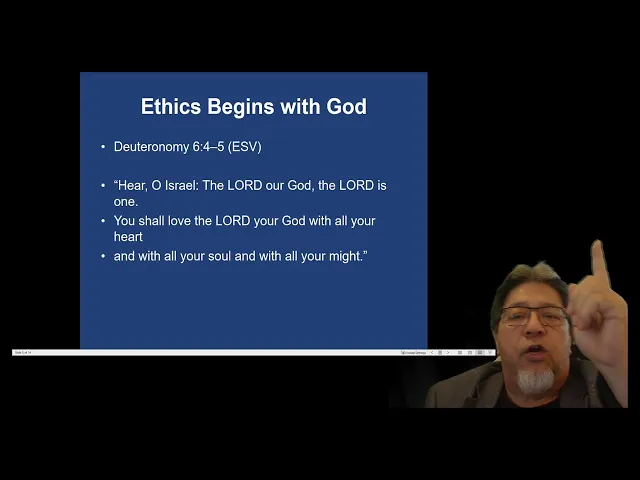
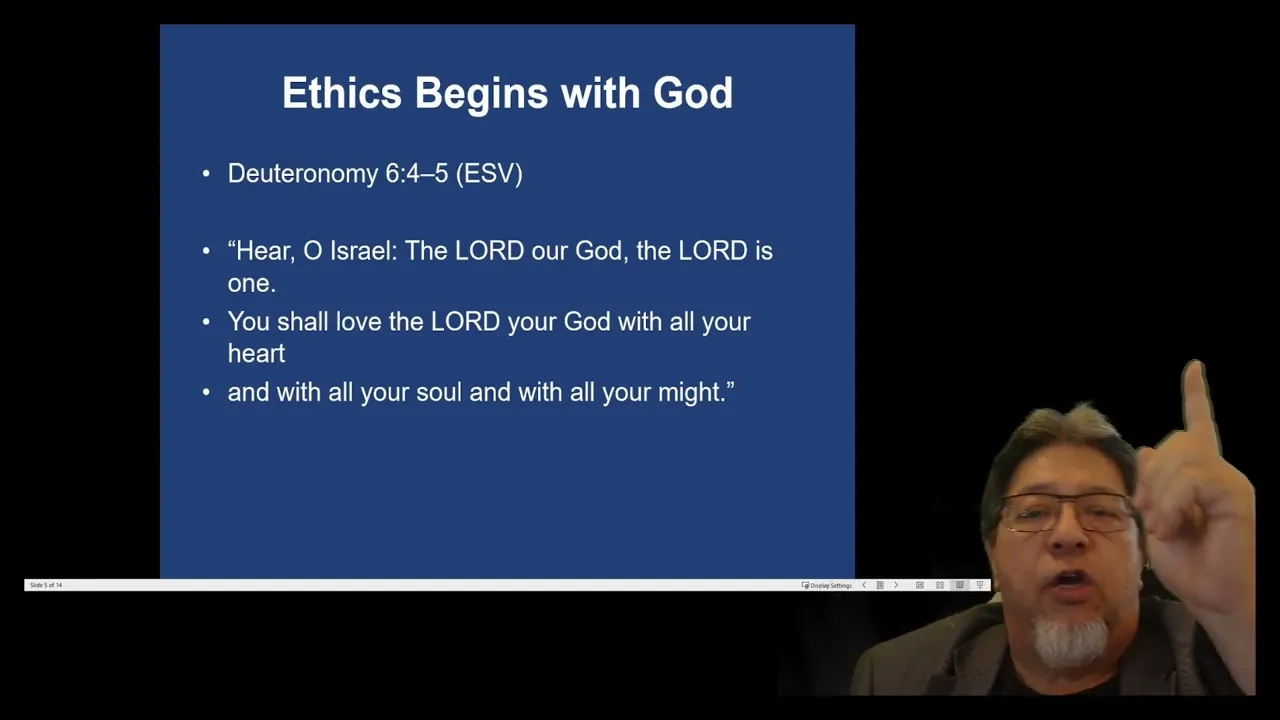
Now the Bible says this in Deuteronomy here, O Israel, the Lord your God, the Lord is one. You shall love the Lord your God with all your heart, with all your soul, with all your might. Let's stop for a moment and talk about love and ethics.
The word here in the Hebrew is aav Deuteronomy 6 4-6. That's translated love. It's from the root.
is from the root of in the verse it appears and you shall love which means in context this is not sentimental this isn't an emotional word in Hebrew usage aav is covenantal and actionoriented it carries the idea of chosen loyalty devoted attachment faithful commitment expressed in action Let me say it three things. Okay, you must get these. If you're writing this down, this is what this word means.
Chosen loyalty, devoted attachment, faithful commitment expressed in action. That's why Deuteronomy 6 does not define love as a feeling, but it ties it to something much more solid. It ties it to our hearts, our soul.
It It ties it to inner loyalty. Love is ti is ti is is in your heart. It's inner loyalty.
Love is the soul, the life, the whole being. Love is you shall love God with all your strength, with your energy, with your resources, with your actions. We often don't love God with all our heart, soul, mind, strength.
We don't do that. We don't love God with our energy. Our energy goes into almost everything else except loving God.
Our energy goes into resources or actions. In other words, you need to bind yourself in faithful allegiance in covenant to God. And this is why Deuteronomy says to Israel, love God.
[clears throat] And that love is shown through a number of things. Obedience, remembrance, teaching, daily practice. Now, let's let's just stop for a minute.
Obedience. Obedience. Loving God through obedience.
Do we obey God? I know all of us fall short. We've all sinned and come short of the glory of God.
But is it our heart's desire to be obedient, to remember? Is it our heart's desire to think and teach the precepts of God? If you're a mom or a dad, to your children, if you're aunt or your uncle, to your nephews and nieces, to your friends, to your family, and are you being obedient and remembering God and teaching God not on Sunday, but every day?
Now, Jesus keeps the same meaning attack intact when when he he quotes the sha she doesn't reinterpret love emotionally. He keeps it covenantally. Remember covenant binding to his people.
So when Deuteronomy says you shall love the Lord your God, it's saying you're going to give him your loyalty and you're going to live out that allegiance to him. Now write this down. Obedience flowing from covenantal belonging is not emotional intensity.
I want think about it. I want you to write it again. Obedience flowing from covenant belonging is not just emotional intensity.
It's not just I do it when I feel like it or when we've heard songs. You know, one of the songs that I I know that many people love is, you know, that God is is a a promisekeeper and and he he works miracles. That song moves our emotions, but that song shouldn't move us to obedience.
It's our covenantal tie to God that moves us to obedience. Now, there's another word in in the Hebrew for love. It's describes how God loves with inside the covenant.
Hed describes how God loves with inside the covenant. It's not simply kindness or mercy. It's steadfast loyal love through the whole world through the whole time of our lives.
It persists over time. Even when the other party falls apart, even when we fall apart, even when things go wrong, it and we go wrong, it answers a different question. And it answers a very different question.
Will you stay faithful when the relationship is strained? Had is most most often used of God not commanded of humans in the same way a hab is [snorts] God keeps his covenant [clears throat] has said love. He remains loyal.
He's full of has said he remains loyal to Israel and unfaithful people. He remains loyal to you and I spiritual Israel. How often are we also unfaithful continues to act for the good of his people?
That's what God does. He acts for the good of of his people even when his people are unfaithful. When scripture says God is abounding in hed full of hessed, it means God does not walk away when the covenant is broken.
That's why marriages are found on this covenant. We don't walk away no matter what. No matter who breaks the covenant, we stay.
God's love is durable. So, how do how do these two words function in scripture? Well, the key distinction, and you'll want to grasp this, Ahav describes covenant allegiances.
Who you choose and how you live in response. Let me say that again. Who you choose and how you live in response.
H said describes covenant loyalty, God's faithful commitment over time. Israel and you or I are commanded to Ahav. God promised to show has said to Israel and to us and that order matters.
That particular order matters. Israel love Israel's love is a response. Our love is a response to the hasset.
God's steadfast love is the ground that makes response possible. And that's why Exodus 34 pairs them this way. God is abounding in steadfast love.
He's faithful and met. He is loyal and reliable. Israel is called to love and obey.
And that love and obedience flows out of that prior faithfulness. Why this matters ethically? Why does this matter in Christian ethics?
This keeps us from turning love into some kind of sentimental mush. In other words, it keeps us from making love a love song. Oh, I love her.
Oh, the birds. Oh, the bees. Oh, the flowers.
Oh, the trees. Oh, to love. Loving God have means living in loyal obedience to God.
Trusting God's love means resting in his faithfulness when we fail. Ethics is not about generating feelings towards God. It's about living faithfully within a relationship God has already committed himself to.
Let me say that again. Please write this down. Ethics is not about generating feelings towards God.
We should have feelings towards God, but that's not what it is. We we live our lives in this feeling box. But God wants us to live our life in the obedience box, and feelings will follow obedience.
Obedience will never follow feelings. See, again, it's about living faithfully within a relationship God has already committed himself to. So, one of the things that we really need to consider as we move through this is ethics begins with God.
Deuteronomy 6:4-5 says, "Here, O Israel, the Lord our God, the Lord one. You shall love the Lord your God with all your heart, with all your soul, and all your might, with all your being. Everything that's in you is to love God.
" And so, we have this idea that ethics is also about moral improvement, but it's not. It's not about moral improvement. Though it's very important that we have moral improvement in our life, ethics is not about moral improvement.
Many modern systems of ethic focus on becoming a better version of yourself. You can't become a better version of yourself, not by yourself. You can only become a better version of what God wants you to be.
Frankly, we're not that good or we're not that good as people and we need to give our lives to the living God and allow him to make the changes in our lives. So, we love God. Of course, we don't even understand what that means to love God.
We have that mixed up with some kind of emotional feelings. And yes, there is emotional feelings towards God. But love, especially in a Seemetic sense and and a Greek sense, is far more than just having a feeling towards God.
And and the Bible is not interested in self-optimization. God is not interested in self-optimization. God is interested in faithfulness.
God is interested in obedience. And that only happens inside of a relationship to Jesus Christ. It's not a personal improvement project.
It's a improve my faithfulness project. And that's what we have to understand. Obedience comes with relationship.
John 14:15 says, "If you love me, you will keep my commandments. " You see, in the Bible, in God's eyes, obedience is an expression of love, not a way to earn it. Here's what I mean.
You are already loved by God. You are already desired by God. God wanted a family.
He loves you. You don't have to earn God's love. But once we learn about God and we have him as Lord of our life and we understand what that means, we begin to have expressions of love.
And those expressions of love, just like there's an expression of love for your wife, you buy her gifts, you take her out to eat, you buy your children gifts because you love them. Jesus said, "If as an expression of your love, keep my commandments. " You see, Jesus places relationship before commands.
Jesus shows that faithfulness flows from belonging to Jesus. Once we understand, remember we talked about God puts relationship first before anything else. Once we understand our relationship, then we'll begin to love God.
And our ethics will begin to change. And ethics don't change overnight. See, Christian ethics is not grounded in feeling or personal preference.
Now, feelings matter, but feelings are not moral authority. Here's the issue. We have to be rooted in loyalty in Christ, not rulekeeping for its own sake.
We we have this idea that if we keep the rules, if we do what God wants, he'll like us and he'll bless us more. But that's not true. God says that we have been given every blessing in the heavenlies in Ephesians.
God has already blessed us fully. Now, we have these things called personal preferences and we have these things called feelings, but they're not moral authority. The moral authority that we have is God.
Scripture assumes that desires themselves need formation. Our desires need to be formed. And ethics in the Bible does not follow emotions.
It trains the heart over time. Did you get that? It trains the heart over time.
You see there there there has to be a formation of the heart. In Jeremiah 17:9 it says the heart is deceitful above all things and and is desperately wicked. Do you see that?
Desperately wicked over there. Desperately wicked. Sick.
Who can understand it? Isn't that amazing? I have a friend Jonathan and Jonathan was a multi-millionaire.
He's passed away, gone to be with the Lord. But the first time I met Jonathan, I walked into the room and he said to me, he goes, "You know, Mark, I know something about you. " I said, "What is that?
" He said, "Your heart is deceitful above all things and desperately sick. " Well, thank you, Jonathan. He said, "And you don't even understand your own heart.
" And I said, "Thank you, Jonathan. " Of course, at that point, I'm going, "What kind of guy is this? " But here's the reality.
[clears throat] He was right. You see, the Bible reminds us that the heart cannot be trusted to guide itself. I'm not trustworthy.
Look, I, as you can see, I'm trying. I'm I'm I'm I'm a little chunky. I want to lose some weight.
And if I trust my heart, I'm going to eat all day long. I have to trust discipline and and the science that comes behind if you want to lose weight, you got to eat less. And scripture reminds us that the heart cannot be trusted to guide itself because the heart is bent.
It's sick. It hasn't been ethically formed. And that ethical formation comes from God's instruction, not our personal instinct.
Our personal instinct is always self-s survival. If there's a train coming, my first in instinct is if I'm on the tracks, for me to get out of the way, I have to think to push you out of the way. Christian ethics is therefore dependent.
Get this, write it down. Christian ethics is dependent on shaping the heart over time within the covenant relationship with God. That heart is deceitful.
And we have to understand that. Now, as we move through this a little bit, as we get our as we begin to get our feet grounded, what we one of the things that we begin to see in ethics is ethics is communal. In other words, we always think that Christians and Christianity is this individualistic.
It's all about my relationship to God. Yes, but you live in a community. You live in relationship in community.
You live in covenant in community. You were in covenant with your friends, with your wife, with your uncles, with your church family. You were in covenant.
And the Bible never says that we make ethical choices in isolation. God's commands assume families. They assume neighbors.
They assume communities. They assume responsibility towards others. Ethical life in God's word always affects more than one Christian.
Never forget that if one member suffers, all members suffers. 1 Corinthians 12:26 says, "If one, it says, if one member suffers, all suffer together. If one member is honored, all rejoice together.
" Covenant ethics recognizes that we belong to one another. not as individuals but as a shared body. We belong to one another.
And so when you see that person in church maybe maybe that you don't particularly care for or that other Christian that rubs you the wrong way and and this is hard for me but I have to look at them and go we belong to one another. We're one body brothers and sisters. And because of that shared belonging, [clears throat] the suffering or honor of one member affects the whole community.
In other words, if you suffer, the whole community suffers. If you're honored, the whole community is honored. And if you are ethically lacking, the whole community hurts from that.
We can we don't do things in isolation. Our world is not about being isolated. Our world is about community and faithfulness is shown by entering one another's pain and joy, not by standing at a distance from one another.
And if you don't understand that's a intricral part of Christian ethics, you're going to miss it. You see, covenant is the foundation. Covenant has foundation.
Christian ethics grow out of covenant. That's what Christian ethics is. It's about covenant.
It's covenantal. It grows out of belonging to God. God speaks to people he already calls his own.
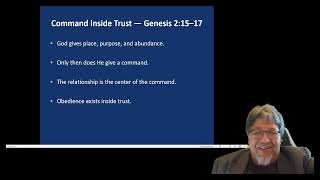
And get this, write it down. Instruction follows relationship. In Exodus 20 2 and 3, God said, "I am the Lord your God who brought you out of the land of Egypt, out of the house of slavery.
You shall have no other gods before me. I am the Lord your God. Christian ethics is communal.
Obedience is learned and practiced together. Faithfulness develops inside shared life, not isolation. We can't isolate from one another.
In other words, God didn't expect you to be a Christian alone. Now, Christian ethics is obviously biblical because scripture tells us that God's character and priorities are laid out for us in this book called the Bible. Ethical wisdom grows as people learn God's story.
Christian ethics is theological. Get that? Christian ethics is theological.
What we believe about God shapes how we live. Ethics is theology of God's word. It is God's word lived out in everyday life.
Whether it's life in your wife or your work or if you're a pastor in your church or if you're an elder in your church or in your family. Ethics is disciplehip lived out in real life. Instruction follows relationship.
Ethics is disciplehip lived out in real life. Now I want to talk about covenant for a minute because what we have to understand is identity comes before obedience and covenant is one of the most important listen don't miss this. Covenant is one of the most important ideas in scripture and one of the most misunderstood.
Covenant is not a contract between two equals. Biblical covenant, it's a relationship established by God on God's terms with real responsibilities. It's the sovereignty of God.
We as believers who are know Christ, we live on God's terms with real responsibilities. In scripture, God always acts first. He rescues before he commands.
He claims a people before he teaches them how to live. Deuteronomy 32, he talks about giving the nations to other gods to rule. And then he said, "But Jacob I keep for myself.
" And then he teach Jacob. He teaches Jacob. And this order really, really matters.
And you can't miss it. Ethics does not create identity. Identity explains ethics.
Levit Leviticus 26:12 says, "And I will walk among you and you will and I and be your God and you shall be my people. " I will walk among you. I God wants to walk God wants to live with his family.
When we come to know Jesus, we have the Holy Spirit living in us and we become this thing called sacred space because God can only commune in sacred space. And so he gives us the righteousness of Jesus Christ. He gives he adopts us into the family of God and we begin to have a relationship and walk and live with him in everyday life.
And God establishes our identity before he gives instructions. When I was born, I was brought into my f or I was adopted. I was brought into my family before they gave me the rules.
They saw me. They loved me. They brought me into the family.
And then they taught me the family rules. They taught me how to think as a Kraton. how what it means to be to carry the nameraton because God walks among his people.
Ethical living flows out of relationship. Are you getting the the the the thread? Ethical living flows out of relationship, not distance.
When I came into my family, my father lived with me and I had a relationship and he taught me by me watching him, by him talking to me and by him correcting me. I walked in the Kraton family. God walks with us and we are in his family and we have to live with God walking with us.
And he said, "I will be your God. " Now, that's a huge statement. And we could spend a whole amount.
You could do a whole dissertation on what that means. And will be your God. There's no other idol.
I idolatry is is where sin comes. Adam and Eve were were guilty of idolatry and and they raised up something before God. Christian ethics begins with who we are.
to God before it addresses what we what we do what we are called to do. Now if you have students reverse this order obedience will always be I'm under pressure. God didn't mean for you to live your life under pressure.
He said, Jesus said, "Come unto me all you who are weary and heavy laden. I will give you rest. Come and learn of me, for I am what?
Meek and gentle of heart. " And my burden is light. God didn't mean us to live under pressure.
Obedience wasn't meant to be lived under pressure. Obedience was meant to be lived in a context of joy, joyful obedience. So if you don't understand this correctly then obedience becomes just a very heavy burden.
But if we understand what it means that God walks amongst us, what it means that God empowers us, what it means that God loves us and will actually give us the power to do the things that we could never do ourselves. If we understand that then obedience becomes joyful and the burden is light. You see we are in covenant and that does mean responsibility.
Being a believer being in Christian ethics or being one who carries Christian ethics means that you carry responsibility. You see belonging to God is not only comforting it's demanding. You understand God is demanding.
But that's okay because in the demand he gives the strength. It's not something that we do in our own strength. That's why Jesus came.
We looked at the ten commandments and we go, "Oh, there is God's holiness. I can't live up to that. " But when we come to know Jesus and we understand Christian ethics, we understand that God's people are expected to reflect his character in the world.
Ethics is not optional for those who belong to God. Can I say that again? Let let that land.
Ethics is not optional for those who belong to God. Now let's get this community as as context right. In Levitic Leviticus 195 and6 the Bible [clears throat] says you shall be my treasured possession a kingdom priests and a holy nation.
192 he says speak to all the congregation of the people of Israel. Say to them you shall be holy for I for I the Lord your God am holy. Wow.
Let that settle in a little bit. God calls you and I to be holy. That holiness is grounded in his character, not human comparison.
Let me say that again. Holiness is grounded in God's character. It's what God is.
And again, we I don't think we totally understand God's holiness. We can describe it from the Bible. We can take Greek or Hebrew and we can see what that means.
But I don't I'm not sure this side of glory whether we can really understand the holiness of God. At least I don't I want to and I want to be holy. And that's the whole thing about Christian ethics.
I want to I want to move in that direction because Israel belonged to a holy God. Their way of life is meant to reflect him. We are to reflect the glory of God.
Our job is to go into the world and reflect the glory of God into the world. That's your job. Now, that's a very broad brushstroke.
And that's why you go to to seminary. That's why you go to university to begin to narrow that down and understand that. But that's the concept that you have to understand.
You're reflecting the glory of God into the world. And so, Christian ethics is therefore about becoming a distinct people by God's presence. In other words, it's never private.
You're to be distinct. You're to be the light on the hill, the salt of the the earth. God makes covenant with a people.
Ethical commands assume a shared life and that. So there are some words that we have to get into our vocabulary and into our minds. Honesty, justice, faithfulness, mercy.
See, all of these words assume relationship. And if you don't have covenant, if you don't understand covenant, ethics feels random. Without covenant, there's no direction.
But when you're in covenant with God and you begin to look at the Bible and you begin to understand that that binding that God is bound to us in his love, remember that has said and our ethics has direction. This again comes from recognizing and returning to the covenant again and again and again and again because every ethical question depends on understanding your covenant with God. So here's something.
Think about it. Think about it. Christian ethics grow out of covenant belonging, not moral pressure.
Let me say it again. Christian ethics grows out of longing for covenant or belonging in covenant, not moral pressure. Let that settle for a minute because it's a wonderful thing.
I belong to Jesus. He belongs to me. Now the Bible obviously assumes community from beginning to end.
Israel was formed as a nation. The church is described as a body. Ethics in scripture is never designed to isolate individuals.
is designed to enhance the community of Christ and bring the message of God's redeeming glory that God wants to redeem his creation. God wants to his family. God wants to reestablish the identic the uh the edenic order again.
Exodus 195-6. Let me read that. Now therefore, if you will indeed obey my voice and keep my covenant, you shall be my treasured possession among all nations, and you shall be a kingdom of priests and a holy nation.
I think I put that up wrong. So, I'll I'll I'll uh fix that, but [clears throat] that's what Exodus 195-6 says. Ethical commands are relational.
Love assumes neighbors. Forgiveness assumes harm. Justice assumes power and vulnerability.
Scripture does not imagine morality private. Bear one another's burdens. The Bible says Galatians 6:2, "Bear one another's burdens and so fulfill the law of Christ.
" You see, Christian ethics is lived out through shared responsibility, not isolated morality. Bearing one another's burdens reflects the pattern of Christ self-giving love. Faithfulness to Christ shown is how we carry one another through weakness and need.
That's ethics. So if you want to look at ethics and you have one verse, Galatians 6:2, maybe write that down. Galatians 6:2.
Remember that. Get that in your head because we bear one another's burdens. That's Christian ethics.
It It isn't sitting in this classroom hearing me paver all over the place. It's really getting into the nitty-gritty of God's word and living out God's word through the power of the Holy Spirit. This your sin, my sin is never purely personal.
Sin affects families. Sin affects communities. Sin affects covenant life.
It's this is why ethics matters beyond our individual choice. You see, if we understand this, we'll see why ethical decisions matter even when no one is watching. When no one's watching and you make the wrong decision, it doesn't affect nobody.
Number one, God sees. Number two, it affects your family, your community. You don't sin in a vacuum.
And so actions shape communities, not just individuals. Actions shape communities. And if you're not thinking through on community about your church, your family, your extended family, your neighbors, then you're not living the life that God has called you to live.
You're his ambassador to reflect his glory and to take the saving knowledge of Jesus Christ into the world so God can redeem his creation and reestablish Eden. And that's what's going to happen. So why does the course matter?
Let's look at the framework just for a moment. Everything in this course is built on covenant, community, and scripture. So week one establishes the framework.
We we we're just laying down the framework now. Next week we'll focus on the image of God and human dignity. And then later on as we continue on uh in later weeks we'll begin to apply ethics to real life questions.
But without this foundation, applied ethics just becomes confusion. Words hard. And I know maybe some of you are confused right now.
But ethical reasoning will become coherent as we move along and we begin to understand. But we have to lay down the framework. In other words, we have to put a basement or a foundation in first.
So let me give you an assignment. This week, I want you to reflect on your moral framework and its influences. I want you to identify your ethical assumptions.
Where did they come from? Where did your ethics come from? Who shaped them?
Was it your mom? Was it your dad? Was it an uncle?
Was it the bad experiences of life? Was it the good experiences of life? what for you is normal or right?
And this there's going to be quizzes and after week two there'll be quizzes every week. But there's no right or wrong in this. I just want you to think through a little bit and be aware.
The purpose is awareness. I'm not here to judge what you're going to write. It's just awareness.
See, before the Bible can reshape ethics, you as students need to recognize what's already been shaped in you. So before we reshape your ethical framework, we need to understand the one you walked with before you got here to the class. And so that's your assignment.
Reflect. write a page, two pages on your moral framework and its influences. Again, it's not going to be not going to be graded.
It's just what's right, what's wrong in your eyes, what's normal. Now the next class we're going to study something really really interesting and uh we're going to look at the image of God m and we'll explore a little bit about human dignity and why every person matters in Christian ethics and this will begin to prepare you to think carefully about some words like justice life moral responsibility ility. So, think through a little bit this week about what we thought.
You can relook at the um at the video here, but make sure that you bring this before God because if you don't get this right, there's going to be fractures in your future ministry in your homes. You have to get this right. It's much more important than we can ever imagine.
God bless you. We're going to grow in grace together. We're going to learn together.
I'm looking forward uh to walking with you through this course. God bless you.