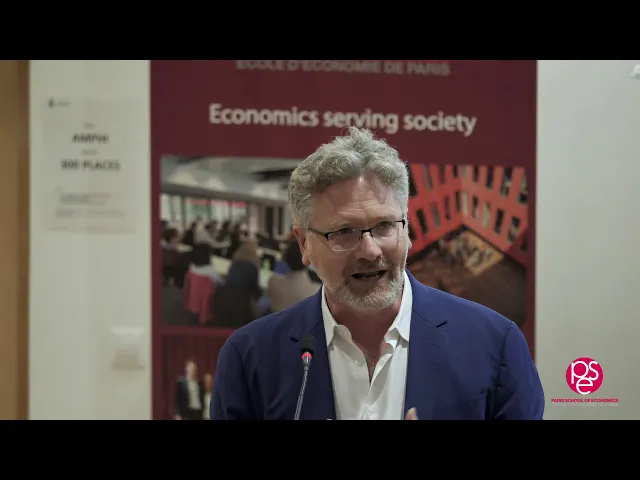
good evening hello to all of you thank you for for being here it's a true pleasure to welcome Adam Jews who will present his er his new book I mean he was really published after in September actually so a few months ago on the on the recent financial crisis for economic historians Adam has been well known for his book on his first books is to first book on the history of Germany in the interwar and then the third rash so German and the statistic and German state and then the wages of destructions which are too
long mark books on the history of statistics and then the history of Nazi Germany then the world's deluge which was a masterful history of of the interwar period and the change in the balance of power after the war after war one and it is with this perspective of the historian that he's looked at the recent crisis analyzes both as he has done in his previous work both to geopolitical issues and the particular issues and balances of power as well as other economic issues so either his new book has already received a lot of attention translated
in many language could reviewed in in the in the press but especially in the financial and economic price so without further ado I will let Adam present the main main argument of the book and then Anna's been a secure a and Thomas Piketty is well professors here and we need no introduction we'll discuss the main main intact of the book and then the discussion will continue with with you in a in session of our of comments and questions thank you thank you Eric for that kind introduction it's a true true pleasure to be here I
and it's funny to hear the book described as recent it feels like an eternity ago since it came out and for today what I thought I would try and do is respond to the pleasure of being here at the Paris school and to try and relate the arguments of my book to some of the agenda some of the themes which Thomas Piketty in particular is associated with in thinking about inequality and its effects particularly on American society so there are many themes in the book including a long discussion of the eurozone crisis which I won't
be talking to talking about at all in my setup but I'd be very happy to talk about that in Q&A afterwards but what I didn't want to miss was the opportunity to try and figure out the relationship between my project and the project which Paris is associated more than with any other place in in the world there let's see hmm let's see whether we can make PowerPoint work yes okay so there are three I think basic ways of thinking about the history the economic history of the crisis of 2008 three basic models one is the
perspective of international macroeconomics the second is to think of 2008 is fundamentally a banking crisis and the third is to think about the 2008 crisis as reflective of profound socio-economic imbalances in American society one might extend this diagnosis to the eurozone as well which reflected in debt and the real estate boom and in most of the discussions are crashed and in the way in which the book is set up in fact the conversation is basically between number one and number two the International macro side of the story is familiar to many of you I'm sure
from from just frankly newspaper discussion of the global economy before 2008 focused on the gigantic imbalances between the current account surplus and current account deficit countries it was associated with a clear diagnosis of the instability of the American economy in a particular vision of how a crisis would unfold as foreign creditors to the United States lost patience bailed out the dollar plunged interest rates would rise not actually a scenario that unfolded in 2008 but nevertheless a powerful diagnosis of imbalances in the world economy the third position focuses I think fundamentally on this remarkable graph which
is Schiller's account of deflated real estate prices in the United States and focuses on the extraordinary anomaly that we see at the end of the 20th century in the beginning of the 21st century when for the first time a huge surge in real real real estate prices is visible in the American data a real anomaly if you like in the development of the US economy and that anomaly is then linked to a culture of credit a sociology a politics of the expansion of credit which is summarized as well as anything could be by this extraordinary
irresponsible advertisement for Citigroup one of the most irresponsible banks in the pre crisis open a cravings account satisfy your needs with credit provided by our bank this diagnosis of the crisis is in I think inseparable from an anguish inward turned American conversation about what has become of the American Dream where the hopes and aspirations of middle-income Americans can and cannot be realized those are the two alternative narratives to the ones in which on which I focused in crashed and the basic starting point and the argument of crashed was that number one the International macroeconomics scenario
was a compelling drama it was a compelling vision of how a crisis might happen but that isn't actually the crisis that did occur and number three this drama of an over expansion of credit to exposed parts of the American population and the unraveling of that boom would explain a recession it would explain a bout of the economic flu it would be like on a mass scale what happened in the dot-com bubble bursting of the early 2000s in fact the losses from the two busts in the first round are in fact quite comparable but that doesn't
explain what it is we're most interested in in 2008 that doesn't explain why are so beside that a person has been Bernanke in the fall of September of fall of 2008 could be found telling Congress if we don't do this in other words if we don't take emergency action we may not have an economy on Monday it doesn't explain why Ben Bernanke referred to 2008 as the worst economic crisis in history neither of the two stories of the backery a global economic imbalance in the macroeconomic balances nor the story of a boom to bust in
real estate will do that work for that you need to understand the sudden dramatic drama of the collapse of the American and they're not just the American but the global banking industry between 2007 and 2008 Bernanke is not exaggerating when he says that this was the worst the most dangerous crisis the world economy has ever faced never before in history have so many large financial institutions been in jeopardy at the same time with the same Pete pace and on the same scale as we saw in 2008 at no point in the late 1920s or the
1930s was there anything like this kind of threat so what I did in crash was to follow the diagnosis of the two leading agencies an economic analysis at a global level from which was on the one hand the folks associated with the macro finance school at the BIS people that you'll be familiar with Tobias Adrian hyung sungchung borio dis yeah that who focused on the dynamics of the banking crisis at a national and international level and then in the footsteps also of Tannenberg you me at the IMF who provided a very similar analysis of the
transatlantic meltdown of the banking system in 2007 8 what all of us are focused on is this rather counterintuitive vision of global financial globalization which dominates the scene in 2007 8 this is the map from bis data of cross-border claims by banks in the period before 2007 and what it points you to is the counter to intuitive idea that the central axis of financial globalization as opposed to trade globalization is not the Pacific it's not the signer American the Chinese American relationship it's the old core of North Atlantic transatlantic finance which is at stake the
gigantic intersecting cross-cutting intellect balance sheets of financial actors on both sides of the Atlantic and what we see in this sphere is an implosion in cross-border finance of gross capital flows across these borders which is truly catastrophic in scale and is what makes 2008 the disaster that it was it may have been triggered by factors to do with the real estate bust but it's the implosion of the banks which makes this unlike the dot-com bubble bursting or other previous moments of southern market adjustment now this was a technical argument and I'll flesh out in in
a minute by we by means of some work which Ben Bernanke has recently published the technical claim to the priority of the banking crisis but he was also a conceptual argument because what was at stake in shifting the perspective from international macroeconomics to the banking sector as such were a series of deeper questions essentially about the nature of globalization in the late 20th and early 21st century a series of questions about the relationship between the real and the monetary economy did was the crisis led by imbalances on current account or imbalances on capital account on
the relationship between national and transnational one should really say on the relationship between macro developments 2008 2009 is one of the severus shots that the macro economy has suffered and the micro economics of bank balance sheets it's out of that that was spawned to the new genre of so-called macro finance which choose together intellectual provinces which don't really fit together financial economics and macroeconomics on the other hand a series of questions about the geography of globalization that I've already pointed to a story about globalization that was North Atlantic not Pacific and a set of questions
which we may come back to in discussion about where power lies in a global monetary system in which money is created through private credit by a profit-seeking oligopoly whose currency of operation however is the national currency of the United States and so when things get rough when the going gets serious in the end the entire global financial system comes to depend on the financial on the Federal Reserve of the United States for me going back to the earliest work which Eric Monet referred to in his introduction for me what were at stake were a series
of questions about the national economy as such the difference between the world of the Philips machine of the 1940s and 50s where the national economy was thought of as an organism or literally a hydraulic mechanism of interconnected flows a history of the shift between that world and what hóng hóng shin refers to as a world of the matrix a private balance sheets how we move in our understanding of the global economy from what he refers to as an island vision of the international economy a series of national economies trading and transacting with each other to
a vision of globalization which was what we have all along said it is namely the interaction the intersection of track of the match of the balance sheets of transnational corporations that was in a sense one of the central messages of the book that national economic macroeconomics international macro in its classic sense the brand of macroeconomics which emerged in the interwar period and became hegemonic after 1940 and 1950 which was centered on the account of the relationship between GDP and the current account balance have been rendered obsolete by financial globalization and that's the story that I
attempted to tell in the book there is however another way of challenging the preeminence of the national economy and its coherence as an object of politics and economic analysis and that takes us that the to the terrain of the inequality debate this graph first put out by the EPI in the United States has now become an icon of the early 21st century this too is another way of thinking about the increasing irrelevance and incoherence of the national economy it can be the national economy subverted by this global matrix of transnational balance sheets it can also
be subverted by the glaring discrepancy between national economic growth as measured by productivity and the average and median earnings of American workers for me thomas piketty's intervention was part of my problem I had embarked on writing crashed already in 2012-2013 and then I had to digest the historic impact of his book as it appeared in the United States in 2014 and it was indeed a historic wave a tsunami of debate about this question which rolled over the United States with the basic framework of my analysis set in this argument between macro finance international economics and
the banking crisis I wasn't exactly going to start rewriting my book so in a kind of sleight of hand the way in which I deal with the pickety phenomena in the book is to Historic Site it you appear in the book as part of the political drama of 2014 but I don't really entirely in terms of the problem of inequality and I kind of want to use today this evenings discussion to sketch a way in which the two things might be related and I think it's obvious how you can do that but it's an open
door which I want to go through it was an open door that other analysts had already gone through so Rajan's early book on fault lines and mian and Sufis brilliant account of the balance sheet crisis of American households in the course of the build-up of the real estate boom and then the bust really point the way and they starting from the bottom if you like of American society unanimously argue that in the face of static real wages and earnings for American households the responses to take up to take up credit and so we have a
story of the genesis of the krytus out of the frustration of the inability of American families to make good on the promise of the American Dream that I think is a relatively uncontroversial element of the story of 2008 far more controversial amongst analysts of 2008 is the question I pointed out at the beginning of my talk and come back to here namely the question of whether once the crisis was started the main driver of the subsequent recession in the United States was the impact on balance sheets of households and corporations of the shift the revaluation
of real estate or whether the main effect on the real economy was coming through the panic sweeping through the credit system through the banking system in other words is it the underlying imbalance in the household sector which is driving an increase in saving deleveraging and a reduction in consumption or is it the panic in the banking sector which is causing causing the recession the stakes in this apparently technical argument are extremely high in political terms because if people like me and and Sufi are right in arguing that it is the shock to the balance sheets
of American households that was actually the driving force in the recession of 2008 2009 onwards then the crisis fighting measures of the Bernanke's the Paulson's the Geithner's and so on which were focused on stabilizing the banking system were misplaced because they were targeting an epiphenomenon a symptom not the fundamental driver of the recession which was the malaise in American households the shock to American households and the story that spins on from there is the story one or other version take your pick of the populism story this story that the elites bailed out the banks and
did not bailout ordinary American mortgage holders and that sets the ground for the disintegration of the American political system it's a more plausible account frankly of the Sanders bid against Clinton than it is of Trump but it certainly helps to explain the rancorous politics of the election of 2016 so this issue of what it was that was a driver in 2008 really matters and it's for that reason that Ben Bernanke on the 10-year anniversary of the crisis in the fall of 2018 returns to this issue the one thing that Bernanke wanted to tell us ten
years on from the crisis was that he wanted to vindicate the focus of his economic policy on rescuing the banking system and to do that he had to defuse the argument that the problem was actually in American households he ran a piece of econometrics he ran two versions of the model one version in which priority is given to the household effect the other in which the priority is given to the confidence the impact on confidence through the banking panic and he matches those to the actual course of key variables in the US economy over this
period the blue line is the mean and sufi household model the red line is the Ben Bernanke banking panic model and you can see why Ben Bernanke feels that this is a decisive test of the correct focus of the policies of 2008 9:00 in rescuing the banking system across all of the key variables the fit is far better from the banking crisis model in other words it's likely that this was the main mechanism driving the recession in employment in the contraction of the economy this is a vindication if you like of Ben Bernanke's politics it
is also from my point of view good news because it's a vindication of the argument and the focus of crashed as well which is resolutely on the banking crisis dimension but what I want to do today is to dig and to dig away at that self-confidence insistence that the banking crisis stands alone as the key driver of the crisis of oho nine because what the Bernanke framing of the question presupposes is that we can in fact separate the crisis in the banking system and it's logic has a technical problem of finance from the underlying shifts
in the American social structure which are much better captured in the balance sheets of American households now at the level of the explanation of the debt build-up that seems to me a plausible argument in other words the stagnation of median incomes in the United States is a good explanation of the demand for credit what we need to do is test the question of whether or not inequality dynamics might actually have something to do with the technical working of the American financial system and to do that what I would suggest is that we need to look
not at the bottom of the income distribution not even at the 50 percent mark or the 80 percent mark what we need to do is look at dynamics at the very top of the income distribution in the 1% and the fraction of 1% level because it's at that level that we see a direct interaction between the development of the American financial system and the development of inequality in the United States from the 1970s onwards so what I want to do in the rest of today's talk is to open this black box of the American financial
system and expose if you like some of the social dynamics the dynamics of inequality which we can see operating within that system both produced by it and working back on it to shape the way in which it functions and to make it more vulnerable now in a sense what this means to do is simply to continue the project which Hyman Minsky began in the 1970s when he noticed a fundamental shift in the American financial system driven by the behavior of the increasingly affluent top twenty to thirty percent of Americans who were taking their money out
of regular bank deposits and putting it into various types of mutual fund that were invested in equity thereby enabling them to buy into the accelerated growth that you can gain from investment in equities the money market mutual funds which are money near money are substitutes for bank deposits are the key driver of this its assisted by underlying dynamics of inequality it's assisted by the increasing privatization of American pensions in the form of 401ks and it has the effect of dramatically shifting the balance between the flow of funds into the financial system by way of conventional
insured bank deposits to a mode based on mutual funds wholesale money markets which is a much more unstable form of financing for the American banking system and this is one of the undeniably one of the key elements in the story it's the Sultan pose our cash pools type logic are beginning to pick away at the stability of the bread and butter vanilla boring banking model which had dominated America in the aftermath of the New Deal but money market mutual funds and mutual funds in general are investment vehicles for the top 30% of the American income
distribution they are not investment vehicles for the truly affluent for the folks not just in the top one percent but in the top zero point one zero zero point one and zero zero zero point one percent all of which are relevant to our story here as we know from the work by Piketty sires and and colleagues for them the world of alternative investment mechanisms is what opens up from the 1970s onwards and the three key elements of this are hedge fund private equity and various types of real estate trust and venture capital these are high-end
investment vehicles for the most exclusive set and what we see from the late 1990s onwards is a veritable explosion in the hedge fund industry our catering to this group whose incomes as we know are exploding away from those of the rest of American society in this period these funds are in their very investment logic expressions of massive inequality the minimum investment in a hedge fund is a quarter of a million dollars these are things that a retail investor can buy their investment strategies are conditioned on having investors with very long time horizons and with the
ability to absorb large losses in the short term but they promise above-average market returns in other words they are rocket fuel for the eat in an inequality cycle and they express it very directly in the bid and the offer that they make to investors the scale of the money that we're talking about here is extremely large this a very remarkable compilation of security holdings at the global level distinguishing between pension funds mutual funds insurance companies down the left-hand side there and high net worth individuals at the bottom you can see that individual fortunes high net
worth fortunes are macroscopically relevant to the global security system and you can see by 2006 3.7 trillion of those are secured in the alternative investment hedge fund end of the market now in relation to aggregate security holdings 3.7 trillion may not look like a lot in relation to what we need to explain namely the boom in subprime mortgages it's easily adequate to capture a large part of that dynamic in ways that I'll show you in just a second but what I want to point to is an increasing segmentation within the United States financial system from
the 1990s onwards between two rather different zones on the left-hand side you have the zone which preoccupies most of us in the analysis of the financial crisis this is what we mean by Wall Street and shadow banking in its absolute core the high street on the left hand side mediated with the investment banks in Wall Street by way of specialist mortgage lenders commercial banks pension funds and providers of money market mutual funds and then large asset management like Blackrock ore PIMCO and the universal banks like JP Morgan which combine both deposit business and investment banking
activity off on the right hand side roughly a third if you like of the total we see the truly wealth high-net-worth family office centered model family offices being the specialized investment offices that manage the estates of the super wealthy in the United States and the alternative investment vehicles hedge funds private equity and venture capital which are the privileged sources of investments for them what I want to briefly do is look at the dynamics of inequality within this group because in a minute you'll see why this segmentation into two tiers makes some kind of sense in
the conventional story of the crisis of 2008 the center of the drama are investment banks and the dynamics of inequality within those banks and they are zones of massive inequality so if the average American is taking home maybe fifty thousand dollars a year this is the hierarchy of salaries that you see within a typical investment bank in the pre-crisis period for the vast majority of Wall Street careers the top is something at the level of the senior vice-president level between 500,000 and a million making a stick which is earning a million dollars in paying a
year is a crucial rite of passage in a successful Wall Street career the people in the managing director level we think there's between six and ten thousand of them in total these are the people whose salaries head into the truly astronomic levels of the tens of millions a year and the absolutely top dog in this world for the last decade so has been Jamie Dimon of JPMorgan and these are his annual salary earnings which are widely known in Wall Street and a benchmark for any aspiring investment banker and we know that part of the dynamic
of the crisis is that his salary are greatly exceeded that of any of his European counterparts so if you've got Citigroup and Goldman Sachs with equivalent kind of salary levels at the top there you can see Perry bar and Deutsche Bank trailing miserably behind and it's not an implausible story to say that basically a large part of the European banking system was driven by a lustful Chace to try and realize the kind of salaries that top investment bankers in the United States were pulling down but the thing to take in is that in the world
of big money top investment bankers are the bottom of the hierarchy the bottom of the hierarchy because the people who really make money in what we loosely call Wall Street in this period are the people who cater to that other bubble the high-end bubble the ultra high-net-worth individuals these I kid you not are the salaries annual salary and annual compensation of the top hedge fund managers in 2007 those are millions of dollars those are thousands of millions of dollars there are four people there earning more than a billion dollars a year before 2007 with john
paulson at the top of 3.7 billion dollars in compensation in the pre 2007 period it's estimated that in 2007 the top five hedge fund managers earned more in compensation than the entire leadership of the S&P 500 in the united states five guys more than the entire leadership class of American Finance the truth the bitter truth and you have to understand this I think to get inside the heads of these people and it wasn't until these numbers that I really it really clicked the bitter truth is it's virtually impossible to become a billionaire working for a
bank it's a horrible reality that dominates the world of investment bankers there are as far as I know only two career bankers that have made it into the billionaire set Jamie Dimon and Lloyd Bank fine there may be others that you know but it's a very exclusive group because if all quote-unquote you're earning is twenty million dollars a year we know from the logic of inequality you can't get to a billion there's no way that you can actually get there unless you get lucky with an equity stake the world of the top investment bank managers
is the world of big bureau bureaucracies they run huge banks they have to deal with lawyers and they have to deal with regulators it is why I think Jamie Dimon could exclaim when confronted with dodd-frank I'm going to need a lawyer and a psychiatrist to cope that to most normal human beings like an obscenity but if you are comparing yourself with a hedge fund manager who lives and works in Connecticut and is no smarter than you but he's earning literally hundreds times more than what you're earning this is the shocking reality that you have to
deal with there aren't going to be many people in Europe you haven't heard of Blackrock the major asset manager of our era six trillion dollars 15,000 employees headed by Larry Fink one of the great mouthpieces another one of the lucky managerial elite who's made it into the billion-dollar league annual compensation however sorry that shouldn't be thirty billion that should be thirty million he's a Starbucks drinking Democrat not to be confused with Blackstone which is what Blackrock was spawned out of and Blackstone is in the other bubble what Blackstone does is private equity so you already
can know the story it's much smaller four hundred and seventy two billion but only two thousand four hundred staff and it's boss Steve Schwarzman has a net worth of thirteen billion and he's annual compensation is six hundred million so 20 times what his former colleague is earning this is a totally obscene graph I'm about to show you but I think it really matters for the understanding of the dynamics of inequality within the American financial system the gap between a Wall Street managing director on ten million and an average American on 50 thousand is the same
in proportional terms as that between a top Wall Street investment banker and a hedge fund superstar it's two hundred to one in both cases this is a to understand I think the reality of the internal life of investment bankers why they're so hungry you have to feel the force of this because it's very difficult to become a billionaire working in a bank it's not difficult to become a billionaire if you're a top hedge fund guy how does this logic work how on earth did the hedge fund people get this rich and why does it matter
systemically because the standard hedge fund deal cultivated from the 1980s onwards is almost believably generous to the managers of the money it's the two-and-twenty cut which basically means you get 2% of all of the money entrusted to your care to manage it plus 20% of whatever profit you're able to make on that money so if you're managing a modest hedge fund of 10 billion dollars on the basis of this your earnings are going to be something like 200 million dollars which makes you ten times the salary of the top investment banker of your generation managing
a moderately successful hedge fund the question of course is how on earth do the managers of hedge funds like this justify these kinds of premiums two-and-twenty the answer is they have to get outsized returns because they're taking a huge tax of the money entrusted to them and that means they have to take outside risk and this is why hedge funds in the late 1990s and the early 2000s had a terrible reputation and the one that broke was LT a long-term capital management over a set of trades that it put on in relation to Russia which
exploded with the Russian financial crisis of the late 1990s but the really puzzling thing and this is really the nub of my argument and the link I think between the logic of the financial crisis and the story of massive inequality which is so aptly summarized by this internal group is how absent the hedge funds are from the bad list from the list of villains in the crisis of 2008 in fact in 2008 2009 at least in American discourse not only are the hedge funds not guilty of having caused the crisis they are in fact the
heroes of the crisis because it was hedge fund bets that were the naira that formed the narrative of Michael Lewis's definitive story the master narrative for most Americans perception of the crisis the big short the big short are is the play a small number of daring hedge fund activists one of them Steve Iseman here put on the likelihood of the real estate market imploding that's a hedge fund the typical hedge fund bet it required leverage it required risk-taking and it paid off on a spectacular gaile with John Paulson already mentioned earlier on becoming the hero
of the American finance industry earning fifteen billion dollars for his fund four billion dollars for himself personally by shorting the housing market as the New York Times coverage as the New York Times remarked coverage of Paulson is tinged with wonder at this Saban who had the wit to spot what was going to happen the gall to defy conventional wisdom by betting on it and the determination to carry on betting until his prediction materialized he became in other words the living embodiment of Friedman's promise that speculation was rational and stabilizing and Paulson becomes in a sense
oddly the ideological alibi for the American the American system furthermore even when they lost hedge funds were not the bad guys because unlike banks hedge funds were not bailed out hedge funds and banks both lost but no hedge fund came pleading to the feds say give me liquidity give me capital injections this in the narrative of the crisis this is the honest money which took its hits and walked away this is so-called outside money this is not a too-big-to-fail kind of an argument LT and LTZ M in fact the time a too-big-to-fail argument in the
politics of the crisis of our own eye the hedge funds have gone massively underwater what I want to end by doing is calling that into question and the place to look is the market for CDOs cerio's are the second-order product of the securitization process when you pull and trashed mortgages this doesn't require any great elaboration here you end up with a bunch of securities which are triple-a rated according to the math of independent probabilities and you end up with a bunch which are much higher risk and what they then did in the CDOs was to
repackage those and to produce another trash of triple-a rated securities and more increasingly risky paper at the bottom and what is really striking if you look inside the market for these this securitization process is who the buyers were you can tell a story of the securitisation processes of storing a supply-side innovation but we need to put the demand side back in and if you put the demand side back in what you see is the extraordinarily prominent role played by hedge funds in buying these assets so the role the hedge funds play is not just out
of the intelligent investor but they are one of the great absorbing forces which creates the potential for financial innovation in America at this point and why is that happening because the hedge funds themselves are being transformed it seems to me if we're looking for evidence of envy if we're looking for evidence of this extraordinary inequality within the financial system spilling over into behavior the table on the right hand side is as good as any as we're going to get in the early 2000s given the success of the hedge funds in the 1990s everyone wants in
to the hedge fund business the hedge funds become institutionalized the line between the two financial systems the rich end and the classic Wall Street ends begins to break down and it is not by accident that is precisely at that intersection in hedge funds managed by investment banks with a large amount of investment from pension funds invested in securitized assets that the crisis truly begins in the summer of 2007 before paribus famous announcement in August we see in the summer of 2007 bear stearns declaring it's the non-viability of a - of its funds this to me
the canary in the gold mine the moment at which if you like the story of inequality enhancing investment patterns intersects with the story of the financial crisis at its in its technical workings where the the narratives can really be brought together so this would be my summary sure at the bottom end of the American income distribution the stagnation of median incomes is a driver of the demand for cheap credit but what we have to focus on as well is the massive the distorting dynamiting and destabilizing effect of inequality at the upper end of the income
distribution as well it creates a high-risk deliberately high-risk type of investment strategy suitable for the very most affluent who are catered for by the alternative investment market its segments Wall Street and sets up a dynamic of competition and emulation with in Wall Street itself asset managers chase yields by attempting to emulate hedge funds and the huge demand from that increasingly large volume of investors creates the market for the private financial engineering that blew up in 2008 and in this way I think we can genuinely extend the the combination if you like of a Piketty Minsky
kind of approach and insists that an increasingly unequal Society does indeed provide a favorable environment also for in increasingly unstable financial system thank you very much for your attention and I look forward very much [Applause]