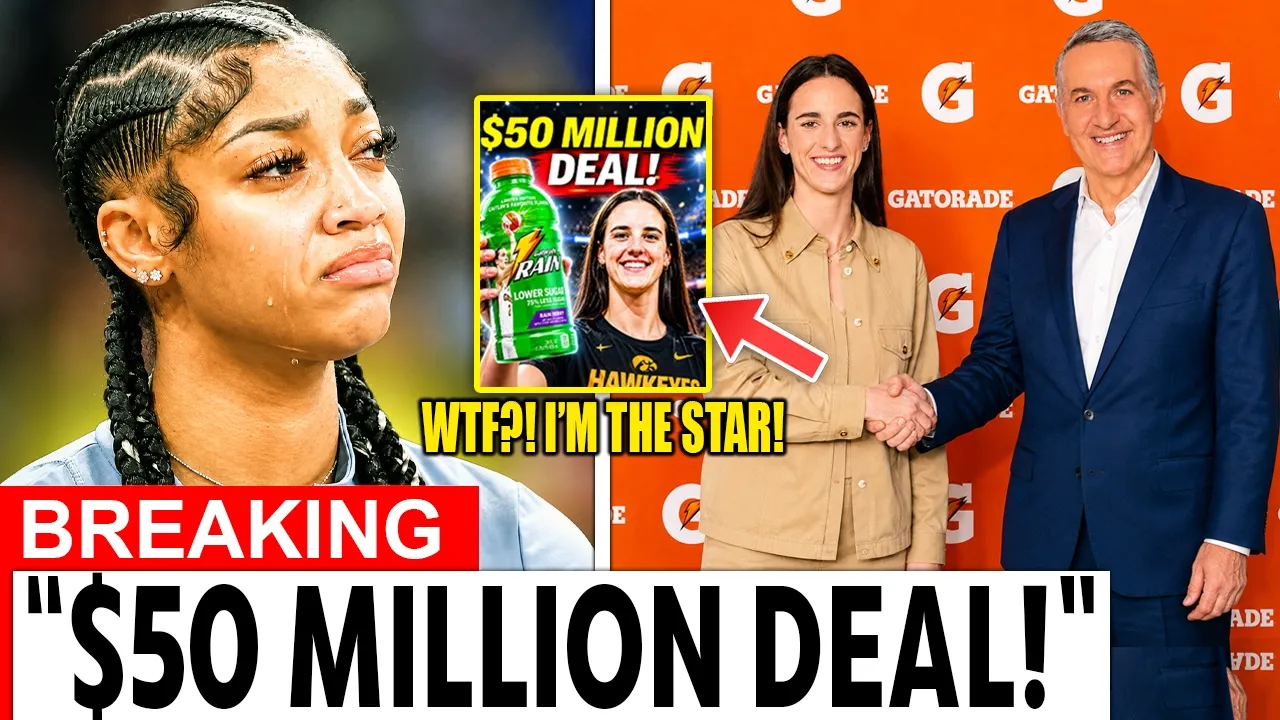
So today, uh, Caitlyn Clark released a water bottle. And yes, I mean this, a Gatorade water bottle. I think it's going to be impossible to get because this is a water bottle.
Not only did it sell out, it was obviously going to sell out. The damn site crashed. The website crashed.
Welcome to the Clark update. I'm back with another exciting and interesting video. Today we've got a story that's getting everyone talking.
Caitlyn Clark, Angel Reese, and a shocking $50 million Gatorade deal. So stay tuned as we break down all the latest updates, reactions, and everything you need to know. Let's get right into it.
Caitlyn Clark has the largest Nike contract of any WNBA player in history for a reason. A $50 million Gatorade partnership with a flavor that went viral and a Wilson signature line that hadn't been done since Michael Jordan. That was not an accident.
Angel Reese's sneakers are in the discount bin for an equally obvious reason. [music] Major sponsors are allegedly reconsidering and Reebok has said nothing at all about promoting them. I promise you that Reese's response to everything is hilarious and exactly what you would anticipate.
Are you on team Re or team Caitlyn? Tell me in the comments section below. For many years, Gatorade has been involved in athlete partnerships.
It was consumed by Michael Jordan. It was consumed by LeBron James. It was consumed by Serena Williams.
If you appreciate this content, consider giving this video a like and subscribing to the channel. Believe it or not, more than 73% of viewers haven't subscribed yet. It's free and only takes a second, but it means the world to us.
So, did you subscribe already? Great. Thank you so much for your support.
Now, back to the video. Not a single product launch ever caused their website to crash during the entire period of time. Gatorade servers were unable to keep up when Caitlyn Clark dropped Rainberry.
Let's discuss the specifics of this arrangement. According to reports, the arrangement is worth about $50 million, making it one of the biggest endorsement deals ever given to a female athlete in any sport, not just basketball. Just that figure would tell a tale.
However, in this case, the deal structure is crucial. Gatorade did more than simply add Clark's name to an already existing product. They brought back a flavor that Caitlyn cherished as a child, gave it a special twist, and made it uniquely her own, her own taste.
That level of dedication is really different. This is the actual appearance of the Rainberry launch. The bottles had a clear connection to Clark's personal brand.
Everything revolved around her, including the packaging, color, [music] and name. Rainberry wasn't a sticker covered generic product. From the moment it went live, it was a cultural moment and customers responded right away.
Gatorade's website was overloaded within minutes of its introduction. Error page screenshots were being shared by fans. Before the majority of users could even load the page, the product was gone.
Now consider the real danger that Gatorade was taking. Their list of athletes is well established. They didn't have to take this action.
They have choices. However, after considering their whole selection, they concluded that Clark should receive a distinctive flavor rather than a co-branded campaign, a limited colorway, or a bottle with their emblem. A permanent stocking unit is called a flavor.
Stores all around the nation have it on their shelves. Depending on how quickly it sells, stores reorder it. It either has legs or it doesn't.
[music] Rainberry sold out so quickly that on the first day, it didn't matter if it had legs. Here's what that sellout really reveals. Gatorade observes more than just social media.
They monitor retail velocity at thousands of locations around the country. The data indicates something extremely specific. When a flavor moves as quickly as Rainberry did outside of the main fan base, there is demand.
At the register, folks who don't watch the WNBA, have never purchased a Clark jersey or follow her on Instagram picking up that bottle. That is the most quantifiable sort of crossover appeal. Additionally, none of this was unexpected.
Every big company had a real world case study of Clark's impact on a product's awareness during her first season with the Indiana Fever. TV ratings surged, games sold out, merchandise moved, and Gatorade observed all of that. They monitored the data and took action once they were sufficiently certain of what they were witnessing.
Additionally, they achieved $50 million with a distinctive flavor. Everyone is talking about the website crash right now. In all honesty, it is only a minor portion of what this agreement represents, but it certainly merits the attention it is receiving.
A single launch day is not the focal point of a $50 million collaboration. [music] It is organized according to a brand's estimate of an athletes commercial ceiling for the ensuing years. Furthermore, Gatorade's wager on Caitlyn Clark's ceiling is far lower than what was predicted for her two years ago.
In 2026, a large corporation's website crashing due to a product introduction is a market verdict. Before the servers could even handle the demand, Clark responded to Gatorade's wager on their distinctive flavor line. Even if the Gatorade contract is enormous, it is only the latest development in a marketing narrative that has been changing the rules for female athletes ever before Clark entered the league.
Prior to Caitlyn Clark, only one name in Wilson Sporting Goods history had a signature line. one [music] and you are already aware of its identity. Jordan, Michael, that's the list.
Jordan and now Clark. Take a moment to consider that. Let's now present the complete image of Clark's endorsement portfolio.
Folio seems as of right now she holds the biggest endorsement contract in WNBA history with Nike. She is the first female athlete in State Farms history to sign a contract with the company. She currently has a $50 million Gatorade contract with her own flavor in addition to the Wilson trademark brand.
On its own, any one of those transactions would make headlines. When all four of them arrive within about 2 years, it creates something that is unmatched in women's sports history. People overlooked the Wilson transaction when it was revealed.
Therefore, it merits its own place here. Wilson doesn't provide catchphrases. They don't work like that.
They are among the most well-known athletic goods firms in the world and they are very picky about which athletes have their names permanently associated with the product line. Michael Jordan was the last one to do it prior to Clark. [music] Not a celebrity from the past 10 years, nor a recent star.
The player Michael Jordan is credited for literally redefining what it takes to be a sports brand. Clark falls into that group presently. Wilson made the same choice for her, which is why people are drawing comparisons between her and Jordan.
This is the point at which people must comprehend the true meaning of a signature line. [music] It's not a restricted run. The advertising is not seasonal.
[music] Wilson continues to produce, market, and distribute goods under Clark's brand. In their business, [music] that is an ongoing line item. Unless they have faith in the athletes long-term commercial potential, brands don't do it.
When you examine the State Farm agreement closely, it has the same weight. State Farm has a long history of engaging in sports marketing. They have worked with male athletes in basketball, baseball, and football.
Before Clark, they had never once brought in a female athlete. They didn't fill the void at random. State Farm can determine which relationships are most beneficial to their business thanks to decades of consumer data.
After reviewing all of that information, they concluded it was worthwhile to target Clark's audience. That is a big choice from a company that doesn't take big decisions lightly. And there's Nike.
According to reports, the transaction will cost $28 million over 8 years. This is the largest endorsement amount that a WNBA player has ever obtained from a shoe company. The next detail, however, is more crucial.
It is anticipated that Clark's first signature shoe will be released in 2026. Nike's trademark shoes have been the foundation of entire business empires. The Jordan [music] brand, which began as a single shoe line, now makes more than $1 billion a year.
Analysts predict that Clark's shoe will sell out in a matter of minutes before it has even been released. Wilson, Gatorade, State Farm, and Nike. These aren't tiny businesses following a fad on social media.
These four are among the most well-known commercial brands in American society. In the same little period of time, each of them committed to Clark on a long-term basis. Brands of that size are not responding to a hot moment when they move so quickly in the same way.
They are preparing for the upcoming 10 years. Clark has a strong sponsorship team and is more than just a basketball player. Right now, she is a commercial infrastructure.
Forbes took note. The rest of the sports world is forced to pay attention when Forbes puts a figure on your influence. Forbes does not rank people according to how noisy they are on social media.
They consider sponsorship value, audience reach, leaguewide economic impact, and the actual conversion rate of an athlete. Therefore, it was not appraised when Forbes declared Caitlyn Clark to be the world's most powerful female athlete. That was a discovery.
According to the whole rating, Clark is the fourth most powerful woman in sports overall. Amy How, Amy Montaigne, and Gail Benson are the three executives listed above her. They are in charge of organizations.
Clark is the only active athlete at the top. That is the crucial figure and the information supporting it is particular. In her inaugural season alone, she earned 11.
1 million offc court. That was the highest number ever posted by a firstear WNBA player. Not even near.
In addition to measuring sponsorship value, Forbes also considers the quality of social engagement. That is how much an athletes fans truly react and convert when a brand gets involved rather than just how many followers they have. They consider an athletes ability to draw spectators from outside of their primary sport or cross-industry reach.
Additionally, they consider the economic impact on the entire league, i. e. whether the player is improving the surrounding ecology.
The receipts are public records and Clark checks each and every one of those boxes. This is the portion that caused a stir. Angel Ree was not on the Forbes list, not lower on the list, not in a minor category, not even an honorable mention, just absent, despite spending the better part of two years making it very evident that she saw herself as Clark's business equal, if not her rival.
Look, Re has been out there. She has been covered by the media. She has a contract with Reebok.
[music] Most athletes would be envious of her social media statistics. However, visibility and worth are not the same thing. Value is also measured by Forbes.
Reese's public stance over the previous two years has a rather obvious trend. She frequently made announcements about brand partnerships near Clark's announcements. Her remarks on social media kept coming back to Clark.
Republicly posted about playing golf during Clark's crossover work with the LPGA, which seemed more like a territorial response than a sincere pastime. It's a coincidence once. A steady pattern over a two-year period is a strategy, but it doesn't seem to have had enough of an impact on the market to get Forb's attention.
This was further complicated by Sportico. Clark was voted the WNBA's highest paid player. Remember that Clark's contract is still on a rookie scale.
She is not at the top of the list because of her oncourt compensation. Regardless of the size of their contracts, her off-court earnings are so high that they surpass those of every other player in the league. That is an exceptional market indicator.
This indicates that Clark's base wage is almost meaningless in the grand scheme of things because sponsors are paying her at such a high level. The Sportico data and the Forbes rating are both just figures. They don't need to be interpreted or twisted.
However, comparing them side by side reveals that the difference between Reese's and Clark's commercial trajectories is not just large, but also expanding. For months, the market has been subtly conveying this through audience analytics, brand choices, and retail statistics. Sportico and Forbes simply made it impossible to ignore.
It's not a moment to be named the world's most powerful female athlete and to be the highest paid player in the WNBA. It is an evaluation of the market. Furthermore, it is not a coincidence that neither list included her most outspoken opponent.
It is a piece of information because the Reebok shoe, which was meant to be Angel Reese's big commercial moment, was experiencing something quite different as Clark was gathering rankings. A signature shoe is meant to make an impression. Angel Reese's trademark Reebok shoe has been available for purchase for several months.
It's the point at which a company raises its flag and declares, "This athlete is our bet. " Major retailers have it in their sales sections, and Reebok hasn't done anything to promote it. That isn't a strategy for a soft roll out.
There isn't a good way to approach that issue. Reebok made a big statement when they signed Ry. The roll out was clearly noticeable.
The timing, which came immediately after Clark signed a contract with Nike, seemed purposeful. It was Reebok's way of announcing that they had their own star in the women's game. The collaboration was presented as a significant turning point in Reebok's comeback to prominence in women's sports.
They received the attention they desired. However, the sales statistics revealed a very different picture once the shoe finally hit the shops. The shoe hasn't sold out after several months.
There are no lists of weights. People are not motivated to find it by any consumer urgency. Rather, big box stores have begun to provide discounts.
And in the shoe industry, that's about the most obvious indication that demand fell short of expectations. A popular product is not discounted by retailers. Inventory that needs to be moved is discounted.
Put that next to Clark's yet to be released Nike sneaker. Within minutes after the release, analysts are already predicting a sellout. Nike is busily constructing marketing infrastructure for a sneaker that has not yet been released.
A shoe that has been sitting on shelves is being discreetly marked down by Reebok. There is little need to explain that contrast. But this is where Reese's situation becomes more challenging.
Long-term athlete collaborations are more than just sales figures for brands. They are monitoring sentiment. They are calculating the risk of an association.
In other words, what does the general public associate with this athlete? And does that relationship improve or worsen the brand's reputation among its core clientele? Major sponsors have reportedly become less interested in Reed during the past year.
According to several sources, the persistent impression of hostility toward Clark is the issue that keeps coming up. That view has been consistently driven by certain behaviors. Comments on social media kept coming back to Clark.
Announcements of brand deals decreased around Clark's announcements in a trend that seemed more reactionary than natural. Although public remarks caused controversy, they did not foster goodwill among those engaged. All of this is noticed by brands, they have teams whose sole responsibility is to keep an eye on precisely this kind of stuff.
And it seems that what they've been witnessing with Ry has made them hesitate. [music] The most obvious indication of the current situation is Reebok's marketing retreat. It's not a scheduling problem when a company signs an athlete to a signature shoe deal and then stops advertising it.
The athlete on the other end of the deal will not benefit from that [music] internal re-evaluation. The sneaker has already been marked down. The advertising has stopped.
A successful partnership doesn't experience either of those things. Whether Reese's commercial momentum has slowed is not the true question at hand. It obviously has.
The question is whether the problem-causing behavior will alter. If it doesn't, the distance between her trajectory and Clark's will simply widen and become more difficult to bridge. Narratives and social media moments are not traded on the market.
It deals in what converts, what sells, and what kind of image a company wants associated with its name. Websites crash when they see Clark's name. Even though her shoe hasn't released yet, it's already creating more buzz than Reese's ever did.
And Reese's response to all of this, the Gatorade deal, the Forbes ranking, the Nike buildup, and the Sportico numbers, has been precisely what one might anticipate from someone who witnesses another athlete amass a fortune while their own commercial moment subtly fades. There isn't really a single agreement at the center of Clark's current situation. It's about what happens when genuine crossover appeal in court talent and steady professionalism are combined over time.
In the words of one analyst, "If we can't sell Caitlyn, we can't sell anybody. " The Fever enter 2026 with the most lucrative player in women's sports, a Nike shoe launch that will be as successful as Rainberries, and a roster that includes Lexi Hull, Aaliyah Boston, Kelsey Mitchell, and Sophie Cunningham that is absolutely built to compete. The fans crashed a website and the brands Forbes and Rey.
Please let me in the comment section.