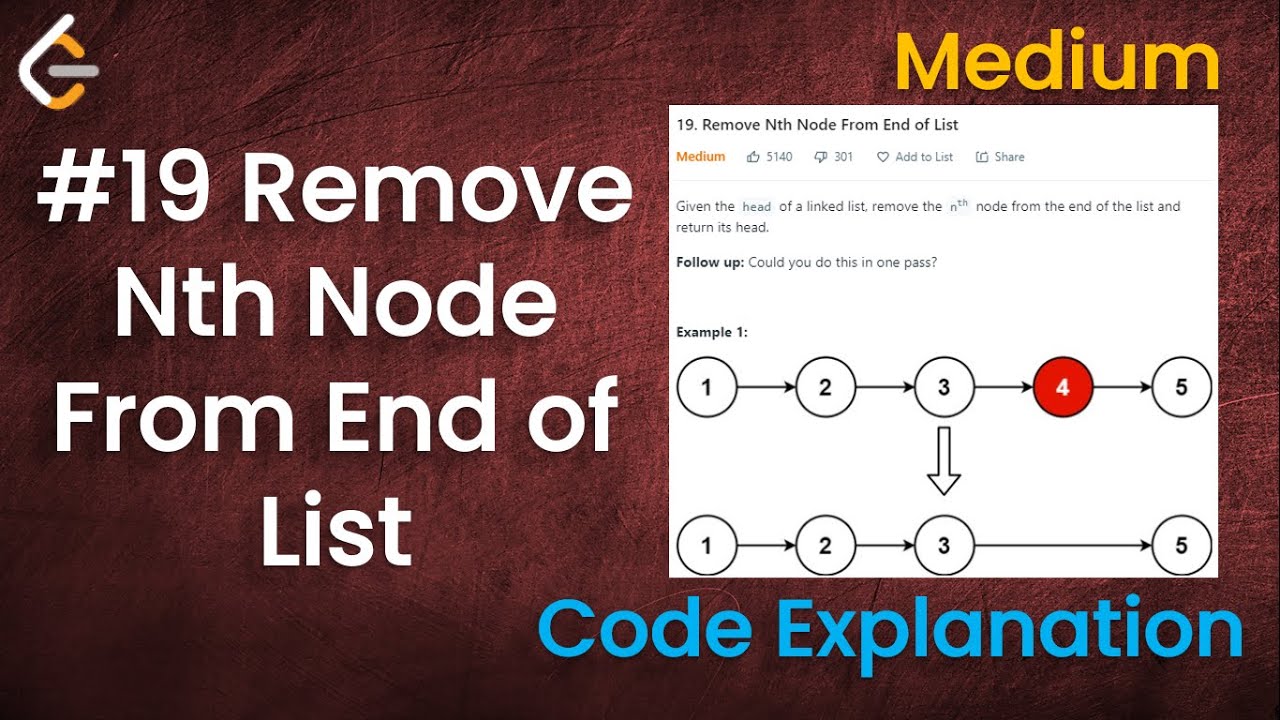
hey everyone welcome back let's write some more neat code today today let's solve remove nth node from the end of a list so we're given a linked list and all we need to do is remove the nth node from the end of the list and then return the new list so that's pretty straightforward right so in this case we got five nodes we just want to remove the n equals two so meaning the second node from the end of the list right so this is the first from the end of the list this is the
second so we remove this and then we return this list which now has four elements remaining so what's the easiest way to solve this well they say from the end of the list that's inconvenient if it was from the beginning of the list it'd be super straightforward right n equals 2 remove this node how can we make that even easier i mean what if these pointers were reversed can't we just reverse this linked list start from here and then remove the second node and then we're done that's definitely a possible solution but it requires reversing
the linked list which we don't actually have to do and i'm going to show you the easier way to do it so let's say n equals 2 again so we want to remove this node so how can we identify that this is the second node from the end of the list like a lot of linked list questions we can use two pointers but how are we gonna make use of our two pointers so what if i had two pointers right a left pointer and a right pointer the left pointer is at the beginning of the
list and the right pointer is shifted by n equals two so our right pointer is gonna be shifted one and then it's gonna be shifted again and our right pointer is gonna be over here so now we're just gonna keep shifting our pointers until this right pointer is at the end of the list and watch what happens when we do that so we're just going to be shifting each pointer by one and this is going to make sure that the space between these pointers is exactly equal to n which is two right so now we're
going to shift by one again making sure that the gap between them is still two now we're going to shift one last time because right is almost at the end so now our right pointer is at null right it's at the end of the list it can't go any farther and our left pointer is exactly at the node that we want to delete and the reason is because remember the offset between these two is n making sure that we have the node we want to delete now there's only one problem we have access to the
node that we want to delete but we want to delete it how do we delete it the only thing we have to do is take this pointer cross it out and then reassign it over here right once we've done that we've gotten rid of this node so the problem is we're at this node when really we want to be at this node if we want to delete this node and this can actually be solved by another pretty common technique the dummy node right so we're going to actually have another node that we insert at the
beginning of this list that we don't really use and the main thing that's going to happen is happen is instead of our left pointer instead of our left pointer being initialized here we're actually going to initialize it at the dummy node so left is really going to be initialized here and our right pointer though is still going to be initialized over here so in reality when our right pointer reaches the end of the list we will have a left pointer at 3 and then we can update its pointer removing this node that we want to
remove and to return the new linked list all we have to do is take our dummy pointer and say return dummy dot next which is going to be this node and since this is a 2.0 technique the time complexity is going to be big o of n so just like in the drawing the first thing we really want to do is create a dummy node we don't really care what the value of this node is but i'll just say zero but we want to make sure that the next pointer of this node is set to
the head of the list because we're inserting it at the beginning next we can initialize our left pointer to dummy and we want our right pointer to be head plus two right or head plus n whatever n happens to be so we need a loop to do that right we can't just do that with a calculation so we can initially say right is equal to head and while n is greater than zero and right is not null we want to keep shifting right so shift right by one and decrement n by one because once n
equals zero that means we've shifted by the amount that we wanted to shift by and the last thing we want to do is keep shifting both of our pointers now now we're shifting left and right and we're going to keep going until right equals until right reaches the end of the list so we can shift our left pointer and we can shift our right pointer now last but not least we actually want to delete the node and remember all we need to do to delete is update the left node's next pointer and it's going to
basically be shifted by one so left dot next is going to equal left dot next dot next so for example if my left node was at my left pointer was at this node its next pointer is at 2 but i want to set its next pointer to 2's next pointer so basically what i'm doing is this and we know that dummy.next is at the head of our list which is what we want to return we want to return the updated list so we can just return dummy.next we don't want to include our dummy node in
the output we never wanted to add a node to the list we just wanted to remove a node so our solution works beautifully we could have just reversed the list but we definitely did not need to do that i hope this was helpful don't forget to like and subscribe it supports the channel a lot and i'll hopefully see you pretty soon