Donald Trump enters the Army. What he told the men made them cry. The sun beat down mercilessly on Fort Benning's parade grounds as Staff Sergeant Martinez stood with his hands clasped behind his back, watching the new recruits file off the buses—the same scene he'd witnessed hundreds of times before: young faces trying to mask their fear with bravado, already sweating in their civilian clothes, another batch of civilians to turn into soldiers.
"Sergeant Wilson," commented beside him, checking his clipboard. "243 for this cycle. " Martinez nodded, scanning the faces—same as always.
"Some will break, some will. . .
" His voice trailed off as an unusual commotion erupted at the gate: three black SUVs with tinted windows rolled through, followed by what appeared to be a small security detail. "What the hell? " Wilson muttered, straightening his back.
"We weren't notified of any VIP visits today. " The vehicles came to a stop near the parade ground, and the doors opened. Secret Service agents emerged first, their earpieces and alert postures unmistakable, and then, stepping out into the Georgia heat, came Donald Trump.
Martinez blinked hard, certain he was hallucinating from the heat, but no—there stood the former president in a crisp navy blue suit, red tie catching the breeze, his signature hair barely moving despite the wind. "Is this some kind of publicity stunt? " Wilson whispered, but Martinez could only shake his head in bewilderment.
The recruits, who had been standing in their designated areas, broke formation as heads turned and murmurs spread like wildfire. Trump strode forward, flanked by his security detail and trailed by what appeared to be military brass—a colonel and several other officers Martinez didn't recognize. "Where's the commanding officer?
" Trump's voice carried across the parade ground. "We have some paperwork to finalize. " Colonel Richardson, the base commander, stepped forward; even he seemed caught off guard.
"Mr President, with all due respect, there must be some mistake. We weren't notified of your visit. " Trump pulled an envelope from his suit jacket.
"No mistake, Colonel. I'm not visiting. " He handed over the papers with a flourish.
"I'm enlisting. " The silence that followed was deafening. Someone in the back of the recruit formation laughed, quickly stifled by their peers.
Colonel Richardson scanned the documents, his face cycling through confusion, disbelief, and concern. "Sir, these appear to be legitimate enlistment papers, but surely you understand—" "I understand perfectly," Trump interrupted, his voice carrying across the parade ground. "I've made all the necessary arrangements: age waivers, security considerations, everything.
" He turned to address the gathered recruits, who stood in various states of dishevelment and shock. "You know, people tell me, they say, 'Sir, you can't do this. It's crazy.
' But that's what they always say before I do something tremendous. " Martinez exchanged glances with Wilson. This had to be some elaborate PR stunt.
Any minute now, the cameras would appear, and Trump would give a speech about supporting the troops before departing in his motorcade. But the minutes ticked by, and Trump remained engaged in intense discussion with the colonel and what appeared to be JAG officers. The recruits shifted uncomfortably in the heat, whispering among themselves.
"Did you hear about this? " Private Jenkins, a fresh-faced kid from Arkansas, asked his neighbor. "Man, this has got to be for his campaign or something," another recruit responded.
"No way; he's actually—" Martinez barked, bringing the chittering recruits back to attention. Whatever circus was unfolding, he had a job to do. The discussion between Trump and the officers continued for nearly an hour.
Martinez could see the colonel gesturing emphatically, probably explaining the physical demands, the protocol nightmares, the security concerns. But Trump's expression remained unchanged, that familiar mixture of determination and defiance etched on his face. Finally, Colonel Richardson approached the drill sergeants.
"Gentlemen, a word," his face was grim as they huddled. "I know this is unprecedented, but the paperwork is in order—all the way from the top. Mr Trump will be joining basic training.
" "Sir, you can't be serious," Wilson protested. "He's 78 years old; the physical demands alone—" "He signed every waiver in the book," the colonel interrupted. "And he's passed a military physical.
Don't ask me how. Orders are orders. He's to be treated like any other recruit.
" Martinez felt a headache building behind his eyes. "Sir, the media circus alone—" "There won't be any media," the colonel said. "Part of the agreement: no press, no cameras, no social media.
Anyone who breaks that rule faces court martial. " He looked each drill sergeant in the eye. "This is happening, gentlemen.
" As they broke their huddle, Trump was already removing his suit jacket, handing it to one of his Secret Service agents. "When do we start? " he called out, rolling up his expensive shirt sleeves.
Martinez stepped forward. "Mr TR—recruit Trump, formation is this way. " The words felt surreal leaving his mouth.
Trump nodded to his security detail, who reluctantly stepped back. He joined the line of recruits, standing out in his tailored clothes among their t-shirts and jeans. "Listen up!
" Martinez addressed the formation. "I don't care who you were yesterday; today, you are all equally worthless. You are no longer civilians; you are recruits—nothing more, nothing less.
" He paced the line, stopping in front of Trump, whose familiar smirk had yet to fade. "Is something amusing, recruit? " "No, Sergeant!
" Trump replied, louder than necessary. "Just thinking how tremendous this is going to be. Nobody does basic training better than me, believe me!
" Snickers rippled through the formation. Martinez felt his jaw clench. "Drp and give me 20, all of you!
" he bellowed. "Thanks to your battle buddy here, you're learning early that every word has consequences. " The recruits dropped to the ground, Trump included, though his descent was notably slower.
His first push-up was shaky, his arms trembling. "I've seen better form from my grandmother," Martinez snapped, "and she's dead! " More snickers quickly silenced.
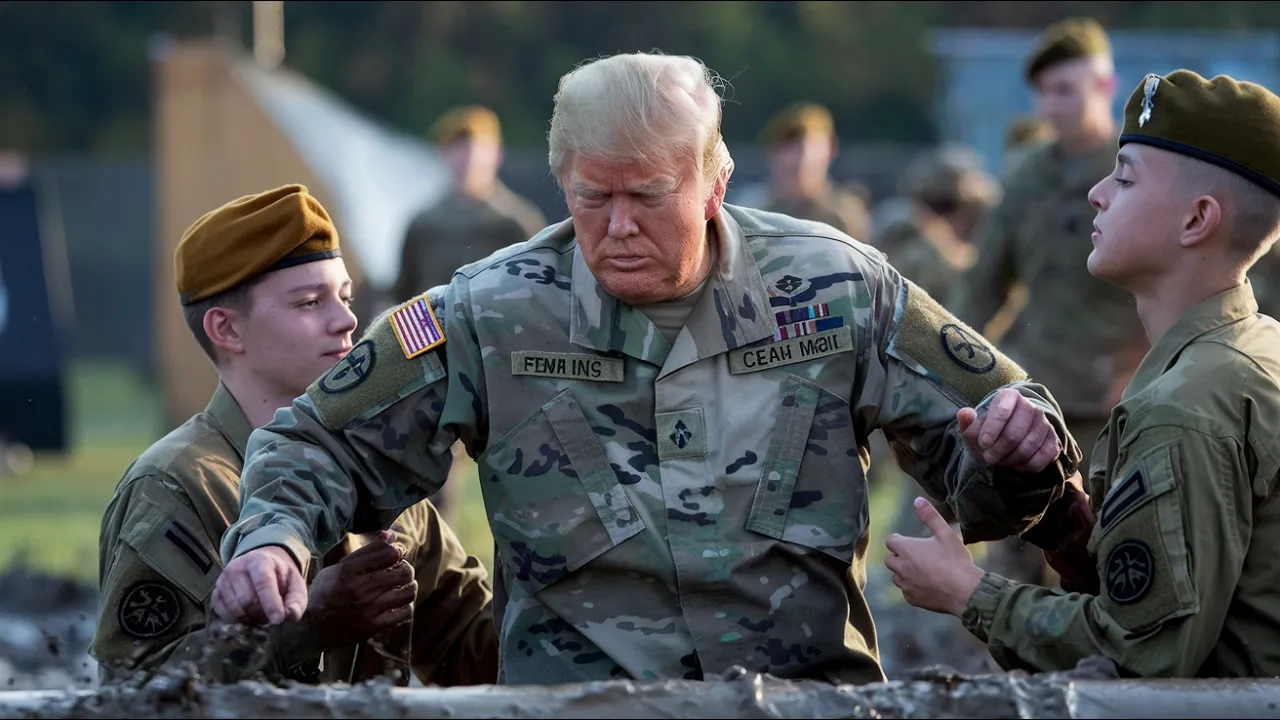
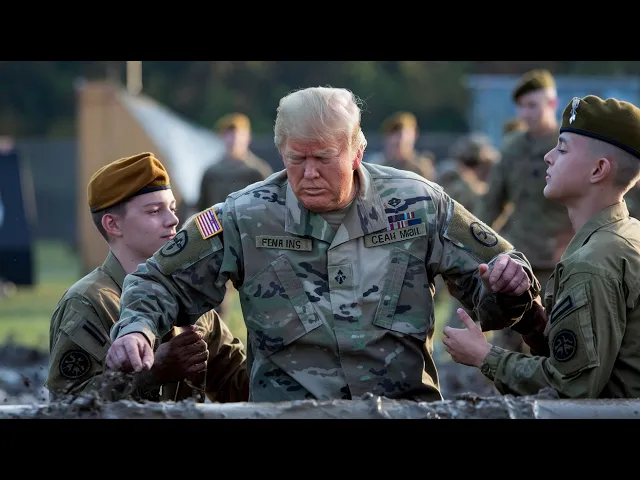
By the effort of push-ups in the hot sun, Trump struggled through five push-ups before his arms gave out. He lay there in his expensive shirt, face red, hair finally disrupted, breathing heavily on your feet. Martinez ordered the recruits to scramble up.
Trump, requiring help from those nearby, let the moment sink in. "Let that be your first lesson here: your past means nothing, your money means nothing, your titles mean nothing. " He turned to Trump, who was still trying to catch his breath.
"Do you understand that, recruit? " Trump's face was flushed; whether from exertion or embarrassment wasn't clear. For a moment, that famous temper flared in his eyes, and Martinez thought he might quit right there.
But then something shifted in his expression. "Yes, Sergeant," he said, quieter than before. The rest of the day was a blur of paperwork, uniform issues, and initial procedures.
Trump's security detail hovered at the edges of the base, clearly uncomfortable with the arrangement, but bound by whatever agreement had been made. In the barracks that evening, Trump sat on his assigned bunk, now dressed in standard issue physical training gear like everyone else. The other recruits gave him a wide berth, unsure how to act around him.
"Hey," a voice said. Private Jenkins, the kid from Arkansas, sat down on the neighboring bunk. "Can I ask you something, sir?
I mean, recruit? " Trump looked up from examining his newly issued boots. "What's on your mind, kid?
" "Why are you really here? Is this for your campaign or something? " The barracks fell silent, everyone straining to hear the answer.
Trump was quiet for a moment, running his fingers over the rough canvas of his boots. "You know, I've seen wars," he finally said, his voice carrying in the quiet barracks. "Beautiful wars from my office.
Signed orders, made decisions. . .
" He paused. "But I never, I never felt what you feel. I never understood what it means to be down here, doing the real work.
" He looked around the barracks, meeting the skeptical gazes of his fellow recruits. "Everyone thinks this is a publicity stunt. Maybe it started that way; who knows?
But I'm here now, and I'm not leaving. " Private Chen from California scoffed. "No offense, but you couldn't even do 20 push-ups.
Basic training will eat you alive. " "Probably," Trump admitted, surprising everyone with his candor. "But I've got nine weeks to prove you wrong.
" The night continued with the usual first-day chaos—recruits learning to make their bunks to military standards, figuring out shower rotations, dealing with the shock of their new reality. Trump struggled with each task, his soft hands unused to manual labor, his privileged life evident in his confusion over basic chores. Yet he didn't complain—not when he had to remake his bunk for the fifth time, not when he struggled with the tight laces of his boots, not even when he realized the bathrooms offered no privacy.
As lights out approached, Martinez walked through the barracks for a final inspection. He paused at Trump's bunk, examining the crooked hospital corners and imperfect alignment. "This is unacceptable, recruit," he said, but without the usual heat.
Something about the sight of the former president, stripped of his usual pomp and power, doggedly attempting to fold sheets gave him pause. "I'll do better, Sergeant," Trump replied, and for once there was no bluster in his voice. Martinez continued his rounds, but his mind was troubled.
In 20 years of service, he'd seen every type of recruit—rich kids playing soldier, poor kids escaping poverty, patriots, skeptics, dreamers, and lost souls. But this was different. This was a man who had held the highest office in the land, voluntarily subjecting himself to the lowest position in the military hierarchy.
The question that nagged at him—at everyone—was why? What could drive a man like Trump, known for his ego and love of luxury, to subject himself to this? As the lights went out and the barracks settled into uneasy sleep, Martinez stood at his post, watching the Secret Service agents patrolling the perimeter.
Tomorrow, the real training would begin. Tomorrow, they would see if the former president's determination could withstand the brutal reality of military life. In his bunk, Trump lay awake, his body already aching from the day's minimal exertion.
The sounds of the barracks were alien to him: the creaking of metal beds, the soft breathing of young men, the distant sound of boots on concrete as the night guard made their rounds. Private Jenkins' words echoed in his mind: "Is this for your campaign or something? " The truth was more complicated than any of them knew.
As he drifted off to sleep, his last thought was of the letter in his jacket pocket—the one no one knew about, the one that had started all of this. But that was a story for another day. The first day had ended.
The former president of the United States was now just another recruit, facing the same challenges, the same fears, the same uncertain future as every other young man in those barracks. Tomorrow would bring new challenges, new humiliations, new opportunities to quit. But as Martinez had noticed, something was different about Trump's expression when he'd responded to that last order.
There was no trace of the familiar smirk, no hint of the bombastic personality that had dominated American politics. Instead, there was something that none of them had expected to see: humility. Just a glimpse, but it was there.
The pre-dawn darkness shrouded Fort Benning as Trump stood at attention with his platoon, his body already protesting the early hour. Two weeks had passed since his arrival, and the initial media frenzy had died down thanks to the strict no-coverage policy. "Good morning, sunshine!
" Staff Sergeant Martinez's voice cut through the humid Georgia air. "Today we separate the soldiers from the civilians. Three-mile ruck march followed by the obstacle course!
" Trump shifted. Uncomfortably in his boots, his feet were covered in blisters, and his uniform, despite being tailored to his measurements, felt increasingly loose on his frame. "Something wrong with my briefing?
" Recruit Trump. Martinez stopped in front of him. "No, Sergeant," Trump responded, his voice hoarse from days of shouting responses.
Private Jenkins, standing next to Trump, whispered under his breath, "Just don't quit on us today, old man. " Over the past two weeks, an unexpected camaraderie had developed between Trump and some of his fellow recruits. They'd watched him struggle through every physical challenge, expecting him to quit; yet he kept showing up.
“Ruck sacks on! ” Martinez ordered. The platoon shouldered their 35lb packs.
Trump's knees buckled slightly as he adjusted the weight. Private Chen approached Trump as they prepared to move out. "Sir, I mean, Trump, remember what we practiced: keep the weight high on your shoulders.
" Trump nodded, grateful for the advice. The younger recruits had been teaching him tricks for surviving the physical challenges, though they'd never admitted it to the drill sergeants. As they began the march, Trump's mind wandered to his first week when he'd nearly quit.
"I can't feel my arms," Trump had gasped, lying on his bunk after their first full day of training. "Welcome to the suck," Jenkins had replied, tossing him a tube of Icy Hot. "But hey, at least you made it through the day; that's more than most of us expected, you know.
" Trump had started his usual bravado creeping in. "I could make one phone call—" "And what? " Chen had interrupted.
"Prove everyone right that you're just here for show? " Those words had stung more than the physical pain. "Pick up the pace, ladies!
" Wilson's voice snapped Trump back to the present. They were one mile into the ruck march, and he was already falling behind. "Come on, Trump," Jenkins encouraged, dropping back to match his pace.
"Remember why you're here. " Trump's breath came in ragged gasps. The letter in his footlocker flashed through his mind—the one from a soldier's mother questioning his understanding of military sacrifice.
That letter had sparked something in him, driving him to prove what exactly? "I didn't," Trump wheezed. "Didn't know it would be this hard.
" "None of us did," Jenkins replied. "But we’re all in it together now. " The sun was rising as they reached mile two.
Trump's legs felt like lead, and his shoulders screamed from the weight of the ruck; sweat had soaked through his uniform, and his signature hair was plastered to his forehead. "Hey, Trump! " Private Rodriguez called from behind him.
"Tell us about the time you fired Gary Busey on The Apprentice; might help pass the time! " A few recruits chuckled, and Trump managed a weak smile. "You know, that show was nothing compared to this.
" "No kidding,” Rodriguez replied. “Can't just point your finger and say you're fired to these drill sergeants," although Trump gasped between steps. "I've been tempted, especially with Martinez.
" The quiet laughter helped, but as they approached the final mile, Trump's vision began to blur. The Georgia heat was oppressive, even in the early morning hours. "Looking a little wobbly there, recruit," Martinez appeared beside him.
"Ready to call it quits? " Trump wanted to respond with his usual defiance, but he could barely breathe. His legs trembled with each step.
"I. . .
I," he stumbled, catching himself on Jenkins's shoulder. "Sir," Jenkins started, concerned, but Trump waved him off. "I'm not quitting," Trump managed, though his face was alarmingly red.
Martinez studied him closely. "This isn't one of your reality shows, Trump. There's no shame in recognizing your limits.
" "My limits? " Trump straightened as much as he could, drawing on reserves he didn't know he had. "I'll show you my limits.
" They completed the march, Trump bringing up the rear but finishing. As they approached the obstacle course, however, the real challenge loomed. "Water break, then we hit the course!
" Martinez announced. "And Trump? " "Yes, Sergeant," he replied.
"Try not to die on my obstacle course; the paperwork would be hell. " The obstacle course stretched before them: walls to climb, ditches to cross, ropes to navigate. Trump stared at it, his body still shaking from the march.
"First up: low crawl under the wire! " Wilson bellowed. Trump dropped to his stomach, the mud soaking through his uniform as he began to crawl.
His arms trembled violently. "Look at the former president now," someone muttered, though not unkindly. "Keep your ass down!
" Trump, Martinez shouted, "unless you want to catch it on the wire. " Inch by inch, Trump dragged himself through the mud; his manicured nails were long gone, replaced by broken, dirt-filled crescents. His hands, once soft from a lifetime of luxury, were blistered and raw.
He made it through the low crawl only to face the wall climb. Six feet of solid wood stood before him. "Need a boost, Oldtimer?
" Chen offered quietly. Trump looked at the wall, then at his shaking hands. "I did this yesterday," he muttered.
"I can do it again. " He approached the wall, jumped, and caught the top edge. His arms screamed in protest as he tried to pull himself up.
"Come on, Trump! " Jenkins called out. "Show us some of that billionaire strength!
" Trump's face contorted with effort, his fingers slipping on the wood. Just as he began to make progress, his grip failed. He hit the ground hard, landing on his back.
The impact knocked the wind out of him, and for a moment he lay there, staring up at the Georgia sky. "On your feet, recruit! " Martinez's voice seemed distant.
"Unless you're ready to quit. " Trump tried to stand, but his body wouldn't respond. The heat, the exhaustion, the constant physical strain of the past weeks—it all crashed over him at once.
"I," he gasped, "I can't. " The other recruits gathered around, their faces showing genuine concern. They'd seen countless others quit, but somehow this felt different.
"Trump? " Jenkins. "knelt beside him.
Remember what you told us that first night about proving everyone wrong? " Trump nodded weakly. "Well," Jenkins continued, "right now everyone's watching.
What are they going to see? " Martinez approached, his expression unreadable, medical, tense. "That way, Trump.
No shame in it; you've lasted longer than anyone expected. " Trump closed his eyes, feeling the mud seeping through his uniform. In his mind, he saw the Oval Office, the gold-plated fixtures of Trump Tower, all the trappings of his former life.
Then, he saw the letter—the one that had brought him here. "My son died believing in you," the mother had written. "Did you ever truly understand what that meant?
" With a groan, Trump rolled onto his side. "Help me up," he whispered to Jenkins. "What was that, recruit?
" Martinez demanded. "I said—" Trump's voice grew stronger—"help me up. " Jenkins and Chen each took an arm, pulling Trump to his feet.
He swayed but remained standing. "I'm not—" he paused, catching his breath—"not finished yet. " Martinez's lip twitched, the closest thing to a smile anyone had seen from him.
"Then get your ass back on that wall, recruit. " This time, when Trump approached the wall, he didn't try to jump. Instead, he turned to his fellow recruits.
"I—I need help," he admitted, the words feeling foreign in his mouth. Without hesitation, Chen and Jenkins formed a stirrup with their hands together. They boosted Trump high enough to grab the top of the wall securely.
With their encouragement and his last reserves of strength, Trump pulled himself up and over. He landed hard on the other side, his legs buckling, but he was upright. The rest of the obstacle course loomed ahead, but something had changed.
The other recruits cleared the wall and gathered around him—not too close, but close enough to show support. "Ready for the rope climb? " Trump, Martinez called out.
Trump looked at his blistered hands, then at his fellow recruits. For perhaps the first time in his life, he didn't feel the need to boast or pretend. "No, Sergeant," he answered honestly, "but I'm going to do it anyway.
" As they moved to the next obstacle, Jenkins fell in step beside Trump. "You know," Jenkins said quietly, "my dad voted for you twice. He said you were a fighter.
" Trump wiped sweat from his eyes. "Your dad was wrong about a lot of things, but maybe—maybe he was right about that one thing. " The sun climbed higher in the sky as they faced the remaining obstacles.
Trump's body screamed for rest, but something deeper drove him forward. With each challenge, he relied less on his ego and more on his fellow recruits, accepting their help, their advice, their support. By the time they reached the final obstacle, Trump was moving purely on willpower.
His designer hair was caked with mud, his uniform was torn, and every muscle in his body trembled. "Last one! " Trump—Martinez announced the rope swing over the water pit.
Trump stared at the rope, swaying slightly in the breeze. In his current state, it might as well have been Mount Everest. "You've got this," Chen encouraged.
"Just like we practiced. " Trump gripped the rope, his raw hands protesting as he prepared to swing. Martinez's voice cut through his concentration.
"Why are you really here? " Trump, the drill sergeant asked quietly enough that only Trump could hear. "All this pain, all this humiliation—what's it for?
" Trump hung there, feet still on solid ground, the rope rough in his bleeding hands. The answer came to him, suddenly clear as the Georgia sky above. "Because," he gasped, "I needed to understand.
" Before Martinez could respond, Trump pushed off, swinging out over the water pit. His arms screamed in protest, his grip weakening with each second. "Hold on!
" multiple voices shouted. Trump's world narrowed to the rope in his hands and the pit below. In that moment, he wasn't a billionaire, a former president, or a celebrity; he was just another recruit fighting against his own limitations.
His grip failed three-quarters of the way across. The splash echoed across the training ground as Trump hit the water. For a moment, everything was quiet and cool and dark.
Then hands were pulling him out, voices asking if he was okay. Trump coughed up water, his entire body shaking with exhaustion. "Did.
. . Did I make it?
" he asked, looking up at Martinez. The drill sergeant looked down at him—soaking wet, covered in mud, completely depleted yet still asking about completion rather than quitting. "Close enough, recruit," Martinez replied.
"Close enough. " As his fellow recruits helped him to his feet, Trump realized something: the physical challenge had broken him down, yes, but in breaking, he had discovered something unexpected—a kind of strength he'd never known he possessed. "Let me get you to medical," Martinez ordered.
"You've done enough for today. " "No," Trump straightened, though he needed Jenkins' shoulder for support. "I finish with my platoon.
" Martinez studied him for a long moment, then nodded. "Your choice, recruit, but remember this moment. Remember what it feels like to earn respect instead of demanding it.
" As they walked back to the barracks, Trump's body ached with every step, but for the first time since arriving at Fort Benning, he felt something new—a sense of genuine accomplishment not from his wealth or his fame, but from pushing through his own limitations. The day wasn't over; there would be more challenges, more pain, more moments of doubt. But something had shifted, both in Trump and in the way his fellow recruits saw him.
He had entered basic training as Donald Trump, former president and billionaire, but today, covered in mud and barely able to walk, he was just another recruit who had refused to quit. And somehow, that felt more meaningful than any election victory or business deal. As they approached the barracks, Jenkins spoke up.
"You know, Trump. . .
" "I owe you an apology. I thought you were just here for show. The moon cast long shadows across Fort Benning as Trump adjusted his helmet for the hundredth time.
Five weeks into training, and night watch still felt surreal. The weight of his M16, loaded with blanks for training, pressed against his shoulder as he scanned the perimeter. "Clock check," he whispered to his watch partner.
"Two hundred," Specialist Williams replied quietly. "Four more hours. " Williams was different from the other recruits: older, quieter, with eyes that had seen too much.
Trump had noticed him during weapons training, the way he handled his rifle with familiar ease. They stood in comfortable silence, the Georgia night alive with cricket sounds and distant artillery fire from night training exercises. "Can I ask you something?
" Trump? Williams finally spoke, his voice barely above a whisper. "Sure, battle buddy.
" The military terminology no longer felt foreign on Trump's tongue. "Why'd you really come here? And don't give me that speech about understanding sacrifice—that's for the cameras that aren't here.
" Trump shifted his weight, his boots crunching softly on the gravel. The past weeks had stripped away much of his bombastic exterior, replacing it with something more contemplative. "You know, when I was in office," he began, then stopped.
"No, that's not the right way to start. " Williams waited patiently as Trump gathered his thoughts. "My brother," Trump continued, "he served.
Did you know that? Fred? " Williams nodded.
"I looked you up before they took our phones. He was in the Air National Guard. " "Yeah.
We never really talked about it—about what it meant to him. I was too busy with business, with building my empire. " Trump's voice grew distant.
"Now he's gone, and I never asked. " A convoy of trucks rumbled past their position, momentarily drowning out the night sounds. "My brother served too," Williams said after the trucks passed.
"Afghanistan, third tour. " Something in his tone made Trump turn to look at him. "Served?
" Williams nodded, his jaw tight. "IED, two years ago. " The silence that followed felt heavy with unspoken weight.
Trump started his usual torrent of words, but for once, he didn't try to fill the silence with boasts or promises. "You know what's funny? " Williams continued, his eyes fixed on the darkness beyond their post.
"He believed in you. Voted for you. Said you'd bring everyone home.
" Trump felt the words like physical blows. "I tried. We had plans—" "Plans," Williams interrupted softly.
"Yeah, lots of plans, lots of tweets, lots of promises. But you know what? There wasn't a lot of understanding.
" They stood in silence again, the weight of Williams's words hanging between them. "Tell me about him," Trump finally said. "Your brother.
" Williams glanced at him, surprised. "What? " "Your brother!
Tell me about him. Not how he died—tell me how he lived. " For a moment, Williams seemed to struggle with the request.
Then slowly he began to speak. "His name was Marcus. He could play the guitar like nobody's business.
Used to drive our mama crazy practicing at all hours. " As the night deepened, Williams shared stories about Marcus—his childhood dreams, his love of classic cars, the way he'd helped neighborhood kids with their homework. Trump listened—really listened—without interrupting, without trying to relate it to himself.
"And this one time," Williams was saying, a rare smile crossing his face, "he convinced our whole platoon to learn the Macarena. Said it was essential combat training. " A twig snapped in the darkness, and both men instantly raised their rifles, training kicking in.
After a tense moment, a rabbit hopped into view, paused, then disappeared into the underbrush. "Good reactions," Williams commented, lowering his weapon. "You had good teachers," Trump replied.
Then, after a pause, "I'm sorry about Marcus. " "Are you? " Williams asked.
But there was no hostility in his voice—just curiosity. Trump thought about the question. In his old life, he would have launched into a speech about supporting the troops, about being the best president for veterans.
Now, standing in the Georgia night with aching feet and calloused hands, those words felt hollow. "I'm sorry," he said again. "That I didn't understand.
That I treated it all like a game—like one of my TV shows. " Williams studied him in the moonlight. "You know what Marcus said about you right before his last deployment?
" Trump shook his head. "He said you were like one of those guys who talks big about football but has never been tackled—all strategy, no bruises. " The words stung, but Trump nodded.
"He was right. " "Yeah," Williams agreed. "But you're here now, getting tackled.
The question is why? " Trump shifted his rifle to his other shoulder, buying time to organize his thoughts. The morning of graduation dawned clear and crisp over Fort Benning.
Nine weeks had transformed the ragtag group of civilians into soldiers—some more than others. Trump stood in front of the mirror in the barracks, adjusting his dress uniform with careful precision. His fingers, once soft and manicured, were now calloused and steady as they straightened his collar.
The face that looked back at him was leaner, tanned by the Georgia sun, with eyes that held a different kind of confidence than before. "Need help with that tie? " Trump turned to see Jenkins approach, already perfectly dressed.
"I've tied a thousand ties, kid," Trump replied, then paused. "But yeah, maybe I could use a hand with this one. " Jenkins stepped forward, his movements crisp and practiced.
"Never thought I'd be helping Donald Trump with his tie. " "Never thought I'd be letting you," Trump chuckled. "A lot of 'never' thoughts these past nine weeks.
" The barracks buzzed with nervous energy as the other recruits prepared for the ceremony. Chen was polishing his boots one final time while Rodriguez practiced his salute in a corner. "Hey," Trump, Williams called from his bunk.
"Word is you're giving a speech at the ceremony. " Fell quiet. Everyone had been curious about this—whether the former president would revert to his old self for the graduation.
Trump turned from the mirror. "They asked me to. .
. " "Yeah, going to tell us how it'll be the best graduation speech ever? " Rodriguez teased, mimicking Trump's old speaking style.
"Really tremendous, believe me. " There was laughter, but it was friendly. The men in this room had seen Trump at his lowest—struggling through PT, falling in the mud, standing watch in the rain.
They'd earned the right to joke. "Actually," Trump said quietly, "I've been thinking about what to say. " Jenkins prompted, finishing with the tie before Trump could answer.
Staff Sergeant Martinez's voice boomed from the doorway, "Looking sharp, ladies! Formation in 10 minutes! " As the recruits scrambled to make final adjustments, Martinez approached Trump.
"Your security detail is waiting outside," he said. "They want to brief you about the ceremony. " Trump nodded.
"They'll have to wait. I'm falling in with my platoon. " Martinez studied him for a moment.
"You know, Trump, when you first showed up here, I gave you three days before quitting. Just three. " Trump raised an eyebrow.
"I'd have bet on two. " "The point is," Martinez continued, "I was wrong. We all were.
" Coming from Martinez, this was practically a declaration of love. Trump felt his throat tighten unexpectedly. "Thank you, Sergeant.
" "Don't thank me yet," Martinez grinned. "Still got one more formation to mess up. " Outside, the parade ground was filled with families and friends.
Trump could see his own family in the VIP section, looking somewhat out of place among the other military families. As the platoon formed up, Trump took his place in line—not at the front, not in any special position—just another recruit in formation. Colonel Richardson approached the podium.
"Ladies and gentlemen, welcome to today's graduation ceremony. Nine weeks ago, these civilians arrived at Fort Benning. Today, they leave as soldiers.
" The speech continued, but Trump found his mind wandering to his first day—the suit, the swagger, the complete ignorance of what lay ahead. And now the colonel was saying, "We have a unique opportunity. One of our graduates has been asked to say a few words.
Recruit Trump, front and center! " Trump marched forward as he'd been trained, each step measured and precise. He could feel every eye on him as he approached the podium, could sense the anticipation.
Everyone was waiting to see which Trump would appear—the politician or the soldier. He reached into his pocket and pulled out his prepared remarks. Then, looking at the faces of his fellow recruits, he set the paper aside.
"You know," he began, his voice different from his campaign tone, "I had a whole speech prepared about leadership, about making the military great again. " He paused, a small smile playing at his lips. "But that feels wrong now.
" He looked out at the assembled families, then back at his platoon. "I came here thinking I'd teach you about leadership. " His voice wavered slightly.
"Instead, you taught me about brotherhood, about sacrifice. " His eyes found Williams in the formation. "Some of you lost brothers in wars I helped direct.
Some of you will deploy to places I once pointed to on a map without truly understanding what that meant. " The crowd was silent now, hanging on every word. "I used to talk about sacrifice," he continued.
"Used it in speeches, threw the word around like I understood it. But standing watch with men who lost family members, learning from drill sergeants who spent their lives in service, falling down in the mud and having my battle buddies pick me up—that taught me what sacrifice really means. " "I got a letter," he finally said, "from a Gold Star mother.
She wrote that her son died believing in me and asked if I ever truly understood what that meant. " He paused, swallowing hard. "I couldn't answer her.
And now. . .
" Now, Trump looked out into the darkness. "Now I'm starting to understand that I never understood anything at all. " A flare lit up the sky in the distance, casting everything in harsh light for a moment before fading.
Marcus Williams said quietly, "He used to say that the hardest part of war wasn't the fighting; it was the waiting, the watching, standing guard while your brothers slept, knowing their lives depended on you staying alert. " Trump nodded, feeling the weight of his rifle, the responsibility of his post. "You know what's crazy?
" Williams continued. "When I heard you were joining basic, I was angry. Thought it was just another publicity stunt.
But watching you these past weeks, you're different. " "Different how? " "You listen now—really listen—like you're doing right now.
The old Trump would have turned this conversation into a campaign speech 10 minutes ago. " Trump chuckled softly. "The old Trump wouldn't be standing watch at 0200 either.
" "True that. " They fell into comfortable silence again, scanning their sector as they'd been trained. The night grew colder, and Trump suppressed a shiver.
"You know what else Marcus used to say? " Williams spoke again after a while. "He said everyone's got two battles: the one they're fighting out there and the one they're fighting in here.
" He tapped his chest. "And which one's harder? " Trump asked.
"You tell me. " "You're fighting both right now, aren't you? " Before Trump could respond, their radio crackled to life.
"Guard Post 4, radio check. " "Guard Post 4, all clear," Williams responded professionally. As silence returned, Trump found himself thinking about Marcus Williams—a soldier he'd never met but whose death he'd been ultimately responsible for as Commander-in-Chief.
How many others had there been? How many names had he signed off on without really understanding? "Your brother," Trump said suddenly, "the guitar thing.
Tell me more about that. " Williams looked surprised, then pleased. For the next hour, he shared more stories about Marcus, his first terrible guitar.
. . The band he formed in high school, the way he'd play for his unit in Afghanistan.
. . Trump listened, listened really listened, storing away every detail not for political gain or public image, but because for the first time he truly wanted to understand the weight of the decisions he'd made, the lives he'd affected.
As the night wore on, their conversation drifted to other topics: Williams's family back home, Trump's experiences in basic training, the way both their lives had changed in unexpected ways. "You've got kids, right? " Trump asked during a lull.
"Two girls," Williams nodded. "Marcus was their favorite uncle; he used to spoil them rotten whenever he came home. " "How do they.
. . how are they handling it?
" Williams was quiet for a long moment. "They're young. Sometimes they still ask when Uncle Marcus is coming home.
" Trump felt something catch in his throat. He thought about his own children, about the decisions he'd made that affected other people's children. "The hardest part," Williams continued, "is knowing they'll grow up without him, that they'll only know him through stories and pictures.
" "Tell me more," Trump said softly. "Tell me about your girls. " And so the night passed, two men standing guard, sharing stories, understanding growing between them—not as a former president and a soldier, but as two humans connecting over loss, duty, and the weight of responsibility.
As the sky began to lighten with the first hints of dawn, Williams turned to Trump. "You know something? Marcus would have liked this version of you.
" Trump raised an eyebrow. "This sweaty, exhausted version? " "This listening version," Williams corrected.
"This version that stands watch without complaining, that asks about other people's stories instead of telling his own. " Before Trump could respond, the relief guard arrived. As they prepared to head back to the barracks, Williams paused.
"Trump. . .
yeah, thanks for listening, for wanting to know about Marcus. " Trump nodded, unable to find the right words for once in his life. As they walked back in the pre-dawn light, Trump realized that something had shifted during their watch.
He'd come to basic training looking for understanding, but he'd found something more: a genuine connection with someone whose life had been profoundly affected by his decisions. The weight of his rifle felt different now; the weight of everything felt different. Somewhere in the Georgia dawn, among the crickets' sounds and distant artillery fire, Donald Trump had learned more about leadership and sacrifice than he had in four years as Commander-in-Chief.
He gestured to the American flag flying overhead. "That flag? I used to wrap myself in it, use it as a backdrop.
But you taught me what it really costs, what it really means. " Trump's voice grew thick with emotion. "I was wrong about so many things: wrong about what makes a leader, wrong about what makes a soldier, wrong about what makes America great.
" He turned to face his platoon directly now. "It's not the generals with the most stars, it's not the politicians with the biggest speeches, it's you—the ones who stand watch while others sleep, the ones who care for each other when the ruck gets too heavy, the ones who remember fallen brothers and still keep marching forward. " Several of the drill sergeants were blinking rapidly now, though they would deny it later.
"Private Jenkins," Trump continued, "taught me that strength isn't about how many push-ups you can do, but about how many times you get back up. Specialist Williams showed me that true courage is standing guard with a broken heart and still finding reasons to smile. " He paused, looking at each face in turn.
"Staff Sergeant Martinez taught me that leadership isn't about giving orders; it's about earning trust. And every single one of you taught me humility, which, trust me," he smiled slightly, "was not an easy lesson. " The crowd chuckled softly.
"I'm not going to stand here and say I'm a changed man. Nine weeks doesn't erase a lifetime, but I will say this: I understand now— not everything, not fully, but enough to know how much I didn't understand before. " Trump's voice grew stronger.
"To the families here today: your sons, daughters, husbands, wives, they are the real leaders, not because of rank or position, but because they choose to serve something bigger than themselves. " He turned back to the podium, gripping it tightly. "I've held what some call the highest office in the land, but the highest honor I've received was standing watch with men like Specialist Williams, learning about brothers I never met but will never forget.
" The silence was absolute now; even the Georgia wind seemed to hold its breath. "I was wrong about so many things," Trump repeated softly. "And I know now that admitting that isn't weakness; it's the first step toward real strength.
" He straightened, squaring his shoulders. "To my fellow graduates, thank you—not for following, but for teaching; not for serving under me, but for serving beside me. And most of all, thank you for showing me what real leadership looks like.
" Trump stepped back from the podium, executed a precise about-face, and saluted his platoon. The gesture wasn't required by protocol, but its meaning was clear to everyone present. As he returned to his place in formation, he could see tears in the eyes of hardened sergeants and could feel the weight of what had just happened.
The ceremony continued with the presentation of awards and the official graduation proceedings, but something had shifted in the air: something profound and unexpected. Later, as families mingled with the new graduates, Williams approached Trump. "That speech," Williams said quietly.
"Marcus would have stood and cheered. " Trump felt his own eyes grow moist. "I think I earned the right to hear one more story about him.
" Williams smiled. "Come meet my girls. I'll tell you about the time Marcus tried to teach an entire platoon to line dance.
" As they walked across the parade ground. . .
Martinez stopped Trump with a hand on his shoulder. "You know what," Trump, the drill sergeant, said gruffly, "you might not have been the best soldier I've ever trained, but you're the one I'll remember most. " Trump nodded, understanding the compliment for what it was.
"Thank you, Sergeant, for everything. " The Georgia sun climbed higher, shining down on the scene: families embracing, soldiers standing proud, a former president who had found something he hadn't known he was looking for. And somewhere in the quiet corners of Fort Benning, the echoes of "I was wrong" lingered, more powerful than any campaign slogan had ever been.
The transformation was complete: fleet not into a perfect soldier, but into something perhaps more valuable—a leader who had learned to follow, a commander who had learned to serve, a man who had finally understood the weight of the flag he had so often waved. The story of Donald Trump's basic training would be told many different ways in the years to come, but for the men of his platoon, the real story wasn't in the speeches or the ceremonies; it was in the night watches, the muddy struggles, the quiet conversations in the barracks.



![Chris Langan - The Interview THEY Didn't Want You To See - CTMU [Full Version; Timestamps]](https://img.youtube.com/vi/9miVG2xT5jY/maxresdefault.jpg)