hello this is a lecture topic video discussing molecular polarity all right so we've been talking a lot about bonding okay Cove valent bonding where we're sharing electrons all right so remember that in order for this to happen we have to have two atoms and they both have their own veent shell okay and within that veent shell they have their veence orbitals all right which are containing their veence electrons okay inorder order for those two atoms to actually form a bond and share those electrons we have to get some of those veence shell orbitals to actually
overlap and when we overlap all right what we start to do is we focus electron density between those two nuclei all right and that is our bond okay and so we're sharing electrons now one of the consequences all right of some of the things we've been talking about so we talked about bonding okay we talked about naming we talked about bonding how bonding happens and then what we start to do we start to talk about our leis Do symbols all right and then we can take our leis Do symbols and we can merge those guys
together to make these molecules that we can represent with leis do structures and those leis dot structures are really good about showing us the connectivity between those atoms all right and where those veence electrons are so we've essentially defined two types of electrons those bonding electrons okay those are the guys that are being shared between our two nuclei of our two atoms of interest and then those lone pair electrons okay um and then what did we go to after that we started talking about molecular geometry well one of the most important consequences of molecular geometry
all right is molecular polarity because the polarity of a molecule really has a lot to do with how it reacts chemically how it behaves physically and how it behaves biologically okay so uh it's it's it's really important topic all right and you can see how all these things we've been talking about are starting to tie together okay so we have bonding okay and so um we started to just uh kind of introduce this idea of of polar Co valent bonding okay because we started off again if we go way back a couple weeks at this
point we started to talk about ionic bonds first okay so we have ionic bonds and what were ionic bonds that's where we had a metal and a non-metal interacting and essentially we can think of these as being uh charge charge interactions okay charge charge interactions where we have whatever some plus and maybe some minus charge interacting and we can def we can kind of characterize this sort of bond using coolum's law okay and then we started to talk about Cove valent bonding all right um and that's all the way over here at the other end
all right and when we're talking about this other uh extreme end this polar end this Co valent uh sort of bonding we started to talk about nonpolar molecules where things were sharing electrons perfectly equally okay so like H2 so two hydrogens bound together all right neither one of those hydrogens wants the electrons more than the other all right or f um F2 okay um neither one of those flines wants the mole uh the electrons more than the other so there's perfect sharing of electrons okay and then we we had is some Continuum in between all
right and that Continuum in between all right was where we started to talk about our polar Cove valent bonds so many of the bonds that we talk about are in fact polar calent bonds and how do we get these polar calent bonds well it all depends on the difference all right in electr negativities between those two centers that we're trying to bond together okay and so let's remember how electro negativity Trends um kind of fair on the periodic table remember we are increasing from left to right okay so if we're talking about electr negativities and
we increase from the bottom to the top okay bottom to the top all right so we have this electro negativity and what is electro negativity this is um the desire if you will of one atom to have more electron density uh relative to the atom that is bonded to now we talked about how electro negativity should make some sense if we're starting to think about those Trends some other trends that we saw um along the periodic table uh one of those Trends being ionization energies all right ionization energy again remember this is the amount of
energ it takes to essentially liberate a veence electron from a given atom so the more that an atom uh wants those veence electrons okay the more energy is going to take to kind of remove one of those okay and so the ionization energies let's let's essentially think about the first ionization energies um increase just like an El Electro negativities from going from the left to the right on the periodic table and they also increase from the bottom to the top top of the periodic table and then we had electron affinities okay electron affinities also increase
going from the left to the right of the periodic table and also from the bottom to the top of the periodic table well what is an electron affinity this is some desire or the ability of an atom to accept an extra electron and when it does so how much energy is it giving off all right so and but this is a this is a gas G phase atom okay this is not within a compound all right so when we get down here all right it's really quite favorable for these elements in the periodic table to
kind of accept an extra electron okay um and so and so all three of these uh periodic trends kind of uh more or less mirror each other all right and that should make some sense because what do we have over here on the upper right of the periodic table we have our non-metals okay remember non-metals what do they want they want extra electrons and by getting extra electrons all right what they start to do is adopt the electronic configuration of the noble gas that follows them okay so therefore if they want extra electrons you might
expect that those atoms are going to be more electr negative in other words if they're bound to something that is less electronegative than them they are going to pull electron density away okay from that other atom all right it's not that they're not sharing electrons okay because they're bonding all right this is not a charge charge interaction okay but um these guys that have extra electro negativity versus the other or relative to the other atom they're bound to are going to want to pull extra electron density away from uh that other uh element that is
bound to them okay and along the same lines if they want extra electron uh uh density all right you might imagine that's pretty hard to remove an electron from their veence shell so they would have higher ionization energies okay you also might imagine that they would release it' be more favorable for them to accept an electron okay and that's where the electron affinities come from now it works really well with non-ms but also works really well with our metals because remember our metals are over on this side of the periodic table all right remember our
metals they want to donate electrons they want to give up electron density okay and by doing so what do they do they tend to make cat ions all right and so you might imagine that they're going to have pretty low Electro negativities they don't really want that extra electron density you might imagine their ionization energies are going to be uh relatively small relative to our non-metals and they in fact they are and you might also expect that it's actually pretty hard to put an extra electron in their veence shell okay so in other words their
uh electron affinities are actually quite low all right and so these sorts of Trends should uh hopefully be making more sense to you now as we proceed through this material okay and so the fact that we have this kind of um um gradient of the the desire for uh atoms and elements to want extra electron density all right is what essentially leads to these polar calent bonds okay and how do we start to represent polar calent bonds okay well well what we can do is two different ways well one way that we already talked about
okay is with these partial excuse me partial positive and these partial negative charges okay because again if an atom is more electronegative than the other atom that is bound to is going to want to pull electron density away from it well if it's pulling more electron density away from that other atom it's going to essentially adopt these partial partial negative charges that's what this Delta symbol means so this is partial charge okay not to be confused with these whole charges like this transfer of an electron like what we like to think about with ionic bonds
okay this is not an ionic bond okay this is not a metal non-metal interacting remember the whole a of a molecular compound all right is that we have two non-metals B bound together okay so these are partial charges and the partial charge here okay this negative partial charge perfectly offsets the partial charge that's over here focused on this hydrogen so we get a partial positive charge and a partial negative charge on the Florine now when we add those two partial charges together hopefully we get something that's neutral because uh HF is in fact neutral so
we can represent with these partial charges all right this is what we would call all right a dipole okay this is a dipole uh for this Bond so a bond in another way you'll see this is a dipole vector or see it um kind of uh uh written out dipole vectors okay the other way we can represent that is with this kind of Arrow all right with a cross okay and the cross is always on the least electr negative atom okay and so what is this representing this is representing the direction of where we're getting
electron density buil up okay so this is telling us that we have more electron density okay here on the Florine and the more or the least electron negative atom which again here is the hydrogen which has the plus symbol at the end all right has less um electron density okay and so again this is what we would call a dipole Vector okay and the other nice thing about looking at diatomic uh molecules like again these molecules are made up of two different atoms okay um so like HF for example is that what we it's really
easy to think about the overall polarity of the molecule okay and what you can see here is that this molecule is going to have something we call a dipole moment all right a dipole moment so this dipole Vector also mirrors the dipole moment okay so the dipole moment is usually also represented as this big um kind of arrow with this cross and the cross again being near the least electr negative atom within the bond okay and so we get um this would be a dipole moment all right again really easy to see on this uh
diatomic molecule and these dipole moments are really easy to also see when we start talking about or looking at these Electro static potential Maps Okay where again what are these different colors representing they're essentially representing electron density all right so when you start to get to the yellow oranges and reds we get a lot of U negative character so these partial negative charges building up and when we start to get to these uh light greens these Aqua blues and to the purples and violets this is representing okay a partial draw it out here partial positive
charges all right and this is a great way to depict a dipole moment okay again what is a dipole moment it's a property of a molecule whose charge distribution can be represented by a center of positive charge that would be here okay on our hydrogen see all that blue starting to build up and and the greens and those light light blue colors and those Purple colors all right that's our partial positive charge and a center of negative charge which again is focused okay out here around the flooring okay and so that is the definition of
a dipole moment it's where you have this charge distribution all right and so uh and that charge distribution is not symmet elal across the molecule in other words one side of the molecule will have one sort of charge while the other one will have an opposite charge okay and so that again is a dipole moment which we can represent as again this big Arrow okay with a little cross all right um and this big Arrow coming um well with this little cross on it this dipole moment is in this case in a diatomic molecule very
similar to a dipole Vector all right a bond dipole okay and we can also measure this all right so because what you can do is you can take say HF where it's randomly oriented you can take a sample of it all right and you can put it between two electrodes all right so you can say this is electrode and this is an electrode and then what can you do all right we can put a charge across cross those electrodes right so here's our negative okay here's our positive and what do we do all right we
start to reorient what was once randomly oriented all right into something that is now oriented and how are they oriented okay well what you can see here is that that negative charge that partial negative charge that's on the flooring again represented by these kind of green spheres all right is all f faing okay it's all facing this positive terminal this positive electrode okay that makes sense right opposite charges attract one another okay whereas the partial positive charges on those hydrogens are uh now reoriented towards the negative electrode okay so we can also measure this doing
experiments like this you can actually measure the dipole moment and the dipole moment all right is equal to the symbol for it is Mu all right and all it is is equal to Q which this is the magnitude of the charges all right so this is we're talking about this Delta symbol here all right because these are partial charges so we don't care about the sign we're just talking about the magnitude so this is magnitude of the charge times the distance separating those charges okay the distance separating those two nuclei all right and so this
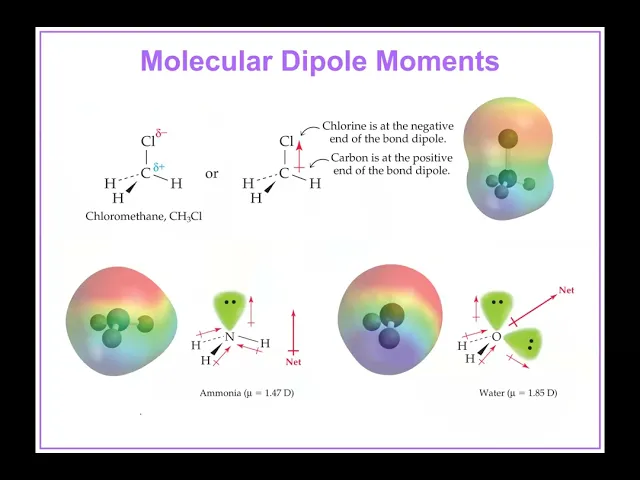
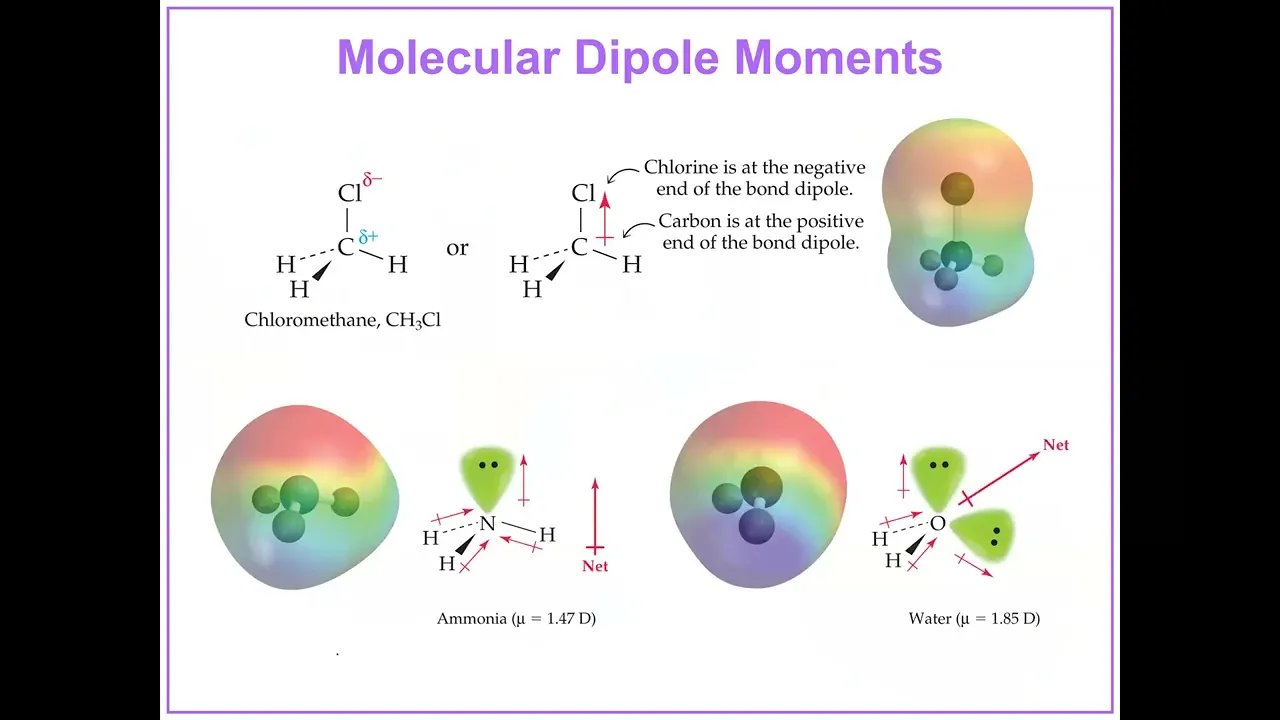
is how we would calculate a dipole moment again uh the magnitude of the charge all right again think about those partial charges we're not thinking about the sign we're talking about the magnitude times the distance that's separating those charges okay and so we can also kind of extend this idea Beyond um these diatomic molecules and we can talk about uh bigger molecules okay and the dipole moments within bigger molecules right so again we can think about uh chloromethane all right ch3cl now I told you in uh previous um lectures okay um and lecture topic videos
that we most of the time we consider these carbon hydrogen bonds to be nonpolar calent bonds okay in other words the carbon and the hydrogen are essentially sh sharing uh the electrons equally okay now that's true um more or less but remember carbon is slightly more electron negative than hydrogens so we could draw some dipoles dipole vectors okay where we get a partial positive charge and a partial negative charge building up on the on the carbon and so how would we represent that we can also represent with our little um Arrow all right again with
that cross being on the least electronegative atom in the pair which again is the hydrogen and so what we would get we would get three of these okay we get three of those all right and so what are we doing we're building up negative charge on that carbon but all right what else is happening okay well that carbon is bound to chlorine and chlorine is in fact quite electronegative and so what's it doing it's pulling electron density away from the carbon so the carbon is slightly okay ever so slightly pulling electron density away from those
hydrogens and now you get this big Electro negative chlorine atom that is pulling electron density away from the carbon and so what you can get is a bigger Vector here okay and so what does that lead all right it leads to essentially this partial positive charge out here on our hydrogens okay and this region of partial negative charge out there on the chlorine so what does that show us all right the these vectors all right are essentially all pushing in One Direction outward from those hydrogens through the carbon through to the chlorine okay and so
you might expect that this will lead us to having a overall dipole moment all right and in fact it does okay it does and you can see that with this electrostatic potential map right see here's hydrogen 1 hydrogen 2 and hydrogen 3 and you can start to see that blue that green those like darker Blues starting to build up on this side of the molecule again this is where we have our partial positive charges whereas out here on this chlorine okay you're starting to build up our this colors of our yellows our oranges and our
Reds okay that's telling us that we have a partial negative charge out there focused around that chlorine so what do we have we have a molecule okay that's got a three-dimensional shape all right and what do we get we get a distribution of charges one side of this molecule has got one charge whereas the other side of the molecule has another charge again this is a dipole moment okay so this would be called a polar molecule it is a polar molecule just like if we go back HF this is a polar molecule now how about
ammonia all right NH3 well same thing you can see that ammonia or the nitrogen excuse me is more electronegative than the hydrogens and so we get these kind of uh Bond dipoles these dipole vectors all right representing again that the nitrogen is kind of stealing away Electro electron density away from those hydrogens it's still a Cove valent Bond it is just a polar coal Bond all right and then we have this big cloud of um electron density for that lone pair of electrons okay and so if you think about this what are we going to
get all right we get this Vector here and if we kind of look at where our electron density is moving within this molecule it is all generally moving towards the direction of that lone pair okay again so this is a polar molecule it's a polar molecule all right and you can see that the electrostatic potential map again down here on these hydrogens we're getting these blue colors all right and so we get our partial positives okay and out here okay near that um lone pair of electrons and almost to that you can see there's yellow
even focused on that nitrogen all right we're getting our partial charges okay again um I just want to emphasize that these partial charges have to end up equaling each other because these molecules when you write the formulas out they are overall neutral in character okay it's just there's a distribution of charge okay um that is not symmetrical across the molecule so these again these charges have to essentially these partial charges have to come together to give us something that's neutral all right and again we see this with water water okay we've talked about water quite
a bit all right you can see these vectors these dipole vectors and then of course there's these two lone pairs all right so there's a lot of electron density out there right and so the our net all right our net is going in this direction there's electron density kind of moving away from the hydrogen's towards the oxygen and out towards those lone pairs we're getting a separation of charge okay again remember mu is equal to Q * R all right and what that does is it gives us an unsymmetrical distribution of electron charge okay again
out here where those lone pairs are going to be hanging out where that oxygen is we get our partial negatives whereas here kind of focused on our hydrogens we get these partial positive charges and again those partial positives and the partial negatives when you add those things together all right uh yes we have an overall uh dipole moment we have a polar molecule but those partial positive charges have to come together to negate one another okay so polar molecule so not every molecule okay has to be polar Okay so we've gone through diatomic uh molecule
that was polar HF and we've just gone through three examples here all right uh of bigger molecules okay and these are all in fact polar but this doesn't have to be the case okay okay because think about CO2 okay so carbon dioxide all right well it has two polar carbon oxygen double bonds all right so we can think about drawing this this way right Oxygen's really quite electronegative okay uh more electronegative than carbon so it's going to be stealing okay electron density away from that carbon when we're talking about these carbon o double bonds all
right but think about the geometry in this case all right well in this case this is a linear molecule and so these two um Bond vectors these two dipole vectors okay these Bond dipoles all right will essentially negate one another because the what are we what are we talking about when we're talking about a polar molecule we're talking about an unequal distribution of charge okay well in this case we don't have it these guys kind of negate each other so that we get a molecule that looks symmetrical okay where we got our partial positive charges
here in the middle and again these things have to equal to give us something that's neutral right and so essentially you can think about this is being like uh two Delta plus all right so that when we add those guys all together we get a neutral molecule and what do we get we have a pretty even distribution of electron density across this molecule okay um sulfur trioxide uh same sort of thing okay we have uh sulfur oxygen bonds those are polar bonds okay they are polar bonds just like these carbon oxygen double bonds up here
all right but in this case in this case they are also negating each other and maybe you can't see that but look at the electrostatic potential you can see that there is not one side of this molecule that has a buildup of charge relative to any other side of the molecule okay so we get a symmetrical again a symmetrical electron cloud distribution okay so again this would be a non-polar molecule okay a molecule in this case that has three polar bonds all right but they kind of cancel each other out to give us something that
is a non-polar molecule that has kind of the symmetrical electron cloud distribution right just like what we saw with the carbon dioxide again nonpolar and how about methane okay so this is methane all right again again carbon is slightly more electronegative than hydrogen so you can imagine that we get these our bond dipoles okay and now they're all coming in all right into that carbon okay and again that leads us to this idea of a symmetrical molecule in terms of its uh electron distribution all right the partial charge distribution of the molecule all right where
again out on these we get these partial positives can see that really easily with these front two okay and we get these partial partial negative being built up on that carbon all right but it's again it's a symmetrical distribution of our charge okay so this again is a non-polar molecule so what can you tell all right there's something you can tell if you take a look at these molecules versus the molecules that we were talking about before all right and I will tell you that the geometry of the molecules really helps determine right if a
molecule is going to be polar or non-polar all right and how do we know that what are we looking for we are looking for symmetrical molecules symet metrical molecules both in terms of their placement of their peripheral atoms okay and the identities when we have something that's symmetrical it tends to be non-polar okay and so what do I mean by that well let's think about the geometry okay of this uh CO2 molecule okay again carbon dioxide well it is linear okay it's linear and which means that those guys these two oxygens separate by about 180°
right we have equal pole okay and and those bonds okay those carbon oxygen bonds are symmetrical okay so therefore all right we had a a remember the whole idea of Vesper okay when we're talking about geometry is to put those electron groups as far away as possible okay as far away from each other as possible and in this case they are right right those two oxygens all right are as far away as possible and they're also symmetrical Bonds in other words they're carbon oxygen double Bonds on both directions so essentially that symmetry all right that
symmetry causes uh us to have this kind of equal distribution of our uh uh partial charges all right or our electron density okay same thing with s SO3 well what's the geometry of that well we have three uh uh domains electron domains all right and in this case they're all bonding all right so this is trigonal planer okay so we have a again those oxygen are essentially in equivalent places they're in equivalent positions all right because they want to get as far away from each other as possible all right and we have symmetrical bonds as
well right they're all oxygen all those peral atoms are oxygen all right so because of the symmetry of the geometry again all these guys being 120 degrees away from one another and the fact that all of our peripheral atoms all right are the same they're all oxygen all those oxygen are Electro negative but not one oxygen wants more electron density than the other okay the Symmetry and both the geometry and in the peripheral atoms leads to something that is non-polar all right and you can also see this with our methane well what's the geometry of
methane here we have four electron domains they're all bonding domains therefore our molecular geometry okay is Tetra hedral okay tetrahedral so what does tetrahedral mean well it tells us that those hydrogens are all in equivalent positions and all those peral atoms are in fact hydrogens all right so we have symmet syry in our shape symmetry in our molecular geometry and symmetry in our bonds okay and again that led to something that's non-polar well what you can see is that that is not true okay it's not true if we go back here to chloromethane all right
or ammonia or water well chloromethane is tetrahedral just like methane is but in this case one of those purle atoms all right is not a hydrogen it's it's chlorine and chlorine is much more Electro negative than hydrogen therefore we get this distribution of electron density being pulled all right more towards that chlorine relative than what we're seeing with those hydrogen carbon bonds all right and so that leads to something that's polar okay and again if we look at ammonia all right it is also tetrahedral in terms of its molecular or electron cloud geometry or its
electron domain geometry but in terms of its molecular geometry the thing again what what can we see we're about the bonding groups all right this guy is trigonal parameter okay so its geometry is not symmetrical in this case okay that um and so and so and and again that leads to this idea that we're going to have a polar molecule okay and we can apply the same Concepts to water so let's look at some sample problems all right and so I like to think about these dipole vectors okay uh these Bond dipoles if you will
all right and how they kind of add or subtract from one another and I use that a lot to determine if a molecule is going to be polar or non-polar okay so you can think about you can think about your bond dipoles all right that's number one and how they cancel all right or add together but you can also ask yourself a couple of easy questions all right so a what's our first question is the molecular shape the same as one of the electron cloud geometries or is it Square planer so that's the first question
you want to ask yourself in other words this is getting at the symmetry of the geometry okay okay is the molecular shape and we can call this again be a little bit more specific the molecular geometry the same as one of the electron cloud geometries or is it Square planer remember if the molecular geometry and the cloud electron cloud geometries are the same that means all of our electron domains are bonding groups okay which means all right that we're going to have one of five different molecular geometries that are possible we can have linear so
again we can say um a x a all right where those guys are 180 degrees away from one another we can have two all right which is trigonal planer and that would be where we have a x x a and a again all those A's are in equivalent positions separated by 120 degrees right we can have three tetrahedral where we can have a oh excuse me x a a and then we can have try and show a little geometry that guy going back into the plane and this guy coming out at us and my pen
won't work down there so imagine an a being there okay um and again these are all separated by 109 degrees okay because again they're all equivalent positions what's our fourth one we can have can have trigonal b pyramidal or bip paramal however you want to say it now this remember is an interesting one where we have two different uh planes in this case 180 degree perpendicular to each other all right and so we have those will be our axial positions and then we have our equatorial positions okay and if we're talking about an A in
an equatorial to an A in the axial those are 90 de separated from one another remember we have a plane all right in those equatorial positions a trigonal planer right so these guys again my drawing is not to scale but these guys are 120 degrees all right and then the two axial are separated all right by 580° all right again all those positions are equivalent to one another okay and so um that is our fourth that we could have and then our fifth could be octahedral okay octahedral again you can think about having axial and
equatorial positions all right in this case and again if you want to think about adding some Dimension to this you can make these guys coming out at us and you can make these guys going back into the page all right and again all these guys are SE separated by 90 degrees all right so again is our molecular geometry the same as one of the electron cloud geometries in the only case where that is true is if our electron domains are all bonding okay that is the only case where the molecular geometry will be the same
as the electron cloud geometry or is it Square planer again Square planer they'll all be in these uh equal positions so imagine that this guy the these two axial positions have lone pairs of electrons that would lead us to a molecular geometry that is square planer okay again we have the square being formed by these fouras and those equatorial positions so we get a square and it's in a single plane okay so therefore uh this would also lead to something that is non-polar okay if your molecule has that if okay because there's another question there's
two questions if all okay let's just phrase this as a question are all of the peripheral atoms the same element that is our second question all right and so those are the two questions you can think about the bond dipoles all right adding up our vectors okay and thinking about the kind of the electron flow throughout the molecule or you can ask yourself these two questions is the molecular geometry the same as one of the electron cloud geometries and that's only true again if all those electron domains are bonding um or is it Square planer
and has to be both are all the prer atoms the same element okay and again what are we getting at we're getting at just symmetry we're getting at symmetry in terms of uh the molecular geometry or the shape and symmetry in terms of what those peripheral groups are okay so let's do some examples all right so chcl3 now we've drawn all these Le dot structures all right we've talked about the geometry of all these guys so you can go back to your notes and kind of uh review that all right but we have something that
looks like this okay and we can think about it in terms of our vectors all right our dipole vectors or a bond dipoles well remember hydrogen is less electr negative okay than carbon is so there's a little bit of pull there but chlorine is much more electronegative okay than the carbon is so we're going to get a stronger pull going out to our chlorines and already you can tell that these Bond dipoles are not canceling one another out in fact what they're doing is leading to this General Trend where near that hydrogen all right we're
going to have this build up of partial positive charge versus down here on this bottom part all right right where these chlorines are kind of focused we're going to get this partial negative charge okay and so we could already already see that this guy is going to have a dipole moment all right in other words it's going to be a polar molecule right but let's think about our questions okay well the question is is our molecular geometry the same as the electron cloud geometry well again our carbon has four electron domains that means it's tetrahedral
okay all of those electron domains are bonding so all are bonding and so we'll just call this our electron cloud geometry so therefore since all those bonding uh all those electron domains are bonding all right our molecular geometry um is also tetrahedral okay so for question number one we have a resounding yes okay both of those geometries the electron cloud geometry and the molecular geometry okay or tetrahedral now what's question number two question number two is are all those periphal atoms the same element well in this case one of the four all right that's uh
with one of those apexes of these um tetraedron all right is a hydrogen versus the other three which are chlorine so in this case it's no and what should we get if we have a yes and a no all right we should get a molecule that is polar okay so thinking about it both directions all right or both ways leads to the same conclusion all right we have a polar molecule here okay how about nh2 CL again we've drawn this all right so you guys can go back and take a look and again if you
want to try and add your hashes and your wedges in there to kind of show some geometry you can all right it's good to practice okay and this is what our leis Dot Structure would look like okay again nitrogen is more electron negative than hydrogen so we' get our bond dipoles that look like this but in case of the nitrogen chlorine all right the nitrogen is less electronegative than chlorine okay and so what are we going to get generally near this side of the molecule we're going to get partial negative charges building up all right
because don't forget there's this lone pair of electrons out there kind of uh zipping around in its orbital okay and then down here near this hydrogen we're going to get these partial positive charges all right so you can already see that there is a kind of a buildup and again not to say that this is exactly where that dipole moment would be all right but it's going to be generally going towards the hydrogens towards the nitrogen chlorine okay um we have a polar molecule just by looking at those uh Bond dipoles all right but let's
ask ourselves the questions too so is the the uh molecular geometry the same as the electron cloud geometry well what do we have here we have four bonding groups okay so we got four bonding groups or excuse me four electron domains okay three bonding and one non-bonding okay well for thinking about the electron cloud domain we have something that is tetrahedral so electron cloud geometry is tetrahedral okay but because one of our electron domains is nonbonding our molecular geometry okay our molecular geometry is trigonal paramal or pyramidal however you want to say it okay and
so they do not equal each other so in this case number one our question for number one is no all right so automatically this tells us this molecule is going to be polar which we've already seen by looking at our our bond dipoles but let's continue on all right question number two is well are all of our peral atoms the same in this case two of them are hydrogen and one is chlorine so that is also a no okay so again this would be a polar molecule all right all right let's see here let's take
our next one ch2o okay all right and so we can think about our bond dipoles right G to get a little bit going from those hydrogens to uh the carbon there's a slight um unequal sharing of electrons there all right but then there's a pretty large one because oxygen is much more electronegative okay than carbon and so and so there's also a pretty strong bond dipole there all right and so what can you see you can see the electron density is kind of moving away from the hydrogen's towards that carbon out towards the oxygen all
right and so we're going to get kind of this unequal distribution of our charges where it looks something like this and of course we're going to have a dipole moment here okay we're GNA have a dipole moment here so we expect this molecule to be polar all right well let's ask our questions all right well let's think about how many electron uh domains we have we have three three electron domains okay and in this case they're all bonding all right and so our electron cloud domain our electron cloud geometry excuse me is trigonal planer and
our molecular geometry is also trigonal planer okay so that looks good right looks good so for question number one we have a yes those geometries are the same but how about the peripheral atoms are they all the same element and in this case they are not okay they're not all right one is an oxygen two are hydrogens all right so again this is telling us that this is polar and you can also think about the Symmetry here as well okay remember in terms of how much space things take up right double bonds because there's four
electrons there versus a single bond which only has two that double bond those things take up more space they cause more repulsion all right and so while the electron cloud geometry would suggest that this these are guys are going to be 120 degrees all right all the way around that's not actually true okay so in actuality all right that carbon hydrogen uh carbon hydrogen to the carbon oxygen is going actually going to be greater than 120 because that double bond takes up more space and these hydrogen hydrogen angles are going to be uh less than
120 because they're going to get compressed okay because this guy takes up more space all right in other words it causes more repulsion so even though the electron cloud geometry and the molecular geometries are in fact the same it is not really a symmetrical molecule at all okay and it falls out in our analysis that this is going to be a polar molecule how about BF3 okay so have Boron Florine Florine Florine all right um as you can see we have three electron domains they're all bonding okay they're all bonding so our electron cloud geometry
is trigonal planer and our molecular geometry is also trigonal planer okay well in this case again they're all the same they're both the same the electron cloud geometry the molecular geometry and the only way that's true is if all those electron domains are bonding which they are so for question one we have a yes how about for question two are all the peripheral atoms the same element and in this case they are all the same element they're all Florin so in this case this is yes so we would expect a nonpar molecule okay well how
about we're looking at the the bond dipoles all right well okay Florine all right again is incredibly electronegative all right in fact it's the most electronegative atom and so what we see is that the outside of this molecule just by looking at these vectors they're essentially going to cancel each other out in other words we're going to have a pretty symmetrical distribution of negative charge on the outside okay whereas the inside we're going to have this uh partial positive charge again when we're talking about polar versus non-polar we're trying to think about is there a
dipole moment okay and in this case there is no dipole moment there is no drastic separation of charge from one side of the molecule to the other side of the molecule again suggesting that this is non-polar okay and what's our last one pcl5 okay all right and so we got five groups right so we're going to go into our geometry where we have different positions those are axial positions then we can go into our equatorial positions I'm going to show a little geometry on this one okay and so how many let's let's think about the
the dipoles all right well chlorine is quite electronegative relative to phosphorus so we're going to get these two guys again they're 180 degrees away from each other all right so they're kind of cancelling each other out all right and these guys in the center are making a perfect triangle so they're in symmetrical positions with um these equal Bond dipoles all right and so they're also going to kind of cancel each other out so that around our equatorial positions we're going to get this kind of equal distribution of negative charge and if we're looking at the
top and the bottom of this molecule we also see an equal distribution of charge and here in the center where around that phosphorus we're going to have a pretty substantial partial positive charge okay again remember all these charges have to kind of come together to give us a neutral overall neutral molecule all right and so just by looking at this looking at the symmetry of this molecule and these these Bond dipoles all right or these vectors right I would say this is non-polar and we can also ask ourselves the question well we have five um
electron domains again they're all bonding okay which tells us that our electron cloud geometry is trigonal by pyramidal or parameter and our molecular is also trigonal by paramal okay so our geometries are the same the electron cloud geometry and the molecular geometry are the same again because all those electron domains were bonding all right so for question number one put it out here to the side we got yes and question number two are all those peripheral atoms the same element and in fact this is true as well they're all chlorines so by asking ourselves these
questions all right it also supports this idea that we've already developed using these uh Bond dipoles or these dipole vectors okay and so this is a non polar molecule okay all right time for you to try some and so this is our participation questions all right so the question is you want to fill in these blanks all right phosphorus tribromide pbr3 is it polar or non-polar okay um with the phosphorus bromine or neither and being slightly positive remember in order to be polar right you have to have an unequal distribution of charge all right one
side of the molecule if you will has to have one type of charge and the other side has to have an opposite charge okay partial charge we're talking about partial charges here again we're not talking about ionic we're not talking about the complete transfer of electrons okay so the question is go through this steps all right rather you like to think about the um Bond dipoles all right and how those vectors kind of add up or negate one another all right or you can ask yourselves the simple questions okay that we went through and maybe
you want to do both all right it's good practice to do both all right but the question is go through the practice make a Lewis Dot Structure determine the geometry of pbr3 figure out if it's polar or non-polar all right if it's polar all right the phosphorus or the bromine is going to have a slightly positive charge and so tell me which one uh which end of that molecule is slightly positive is it the phosphorus or the bromine either if it is non-polar okay neither end all right will be slightly uh more positive than the
other okay so that's kind of how we're approaching this and then what you want to do is you want to do this for all four of these questions so the next one is chlorine Tri floride clf3 tell me if is it polar or nonpolar all right if it's polar right tell me is it the chlorine end the floring end uh that is slightly negative in this case all right read the question answer what the question is asking for and if it's non-polar okay again neither end should be predicted to be more positive or more negative
than the other okay and then do this with Xena Xenon tetrafluoride so xf4 figure is it polar non-polar all right if it's polar is it the Xenon or the flooring in that is slightly positive in this case all right and again if it's non-polar neither int should be uh more positive than the other and then finally phosphate okay and so don't get confused here all right you see that we're dealing with a polyatomic annion okay a polyatomic anion and the question is is it polar or non-polar just because of polyatomic annion has accepted an extra
three electrons in the in the its path to being formed does not necessarily mean that it's polar okay so do the same steps draw your valid leis do structures all right and I'm going to just remind you all right and I think many of you are or all of you hopefully can already tell that this guy is going to have resonance structures all right so make sure you draw your Lu Dot Structure and all the valid resonance structures and remember what a resonance structure is okay it's just where all of our atoms are placed in
the same positions but we have have different electron distributions okay in other words we've drawn uh a double bond in a different place relative to structure uh one all right all right um and so on and so forth so our atoms are connected the same it's just the electrons are placed in different places okay and each of those leis do structures that you draw are equally valid okay and so and then remember what the overall structure okay is it is an average of all your resonance structures all right so keeping those things in mind you'll
be able to tell that just because all right we have a three minus all right for our phosphate all right it does not necessarily mean that it is a polar molecule anyway draw your Le structure determine your resonance structures okay you can check those using the rule of thumb check or formal charges and or both all right and tell me if it's polar or non-polar okay if it's polar is the phosphorus or the oxygen end slight more slightly negative all right and if it's non-polar uh neither end should be more uh slightly negative okay so
uh I think with that tip you should be able to figure this one out as well all right awesome if you guys have questions don't hesitate to reach out I'm always happy to help and I will be seeing you all soon I hope you have a great rest of your day