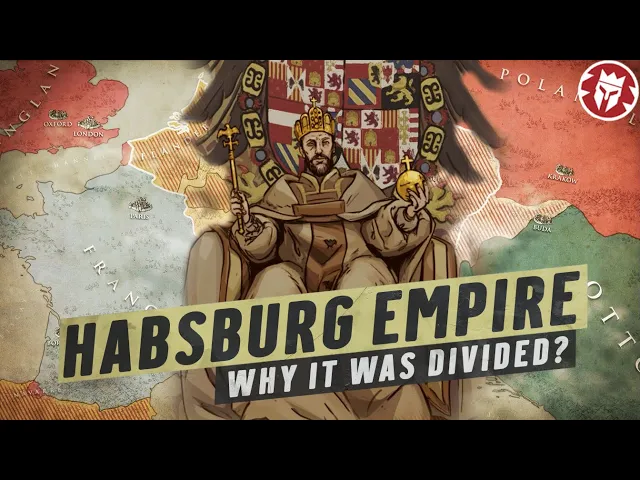
In the sixteenth century, Emperor Charles the Fifth of the Austrian Von Habsburg family sat at the helm of much of Europe, sitting on the thrones of Spain, several central European kingdoms, several Italian states, and many principalities in the Holy Roman Empire. By the middle of the century, this massive, pan-European dynasty had split, with two branches of the Habsburg line consolidating their rule over two different parts of Charles’ inheritance, one ruling from Madrid and the other from Vienna, never reuniting again under one ruler. In this video, we will explain how Charles inherited his enormous empire, his relationship with his brother Ferdinand and the events that led to the creation of a Spanish and an Austrian Habsburg dynasty.
This video was kindly sponsored by our youtube members and patrons. Right now, the patrons and youtube members are exclusively watching our First Punic War and Pacific War series, while the series on the history of Prussia and Italian Unification Wars - Risorgimento have been concluded, and the series on the Russo-Japanese War and Albigensian Crusade and Xenophon’s anabasis will be released next. You can join their ranks via the links in the description and pinned comment to get exclusive videos, early access to all public videos, schedule, access to a special discord server, where we are very active and much more.
Thanks for supporting us, we couldn’t be doing it without your help! “Bella gerant alii, tu felix Austria nube” is the famous saying attributed to King Mathias of Hungary to describe the Austrian policy of expansion through political marriages, and it was this strategy that brought much of Europe under the rule of Emperor Charles V von Habsburg, and his brother Ferdinand I of Austria. When the parents of Charles and Ferdinand, Joanna the Mad and Philip the Handsome, were married in 1496 to seal a political alliance between the Spanish de Trastamara and the Austrian Habsburg dynasties, few people at the time foresaw that their marriage would also mean a union of their respective dynastic lands.
In fact, Joanna was only the third daughter of the Catholic Monarchs Isabella, Queen of Castille, and Ferdinand the Second, King of Aragon. It just so happened that her elder sister and brother and their offspring did not live longer than the year 1500, leaving Joanna the heiress presumptive to not just the crown of Castille, whose inheritance laws allowed women to inherit the crown, but also to the crown of Aragon and its dependencies. On the other side, Philip the Handsome was the only son of Maximilian I von Habsburg, Austrian Archduke and king of the Germans, and the heiress of the Burgundian inheritance, Mary of Burgundy.
A generation ago, Maximilan’s father had managed to reunite the disjointed lands of the Habsburgs which previously had been divided between different branches of the family, thus allowing his son, the energetic Maximilian, to focus his attention on securing his wife’s rich inheritance . By 1477, Mary of Burgundy was the last surviving member of the powerful Valois-Burgundian dynasty, which had been highly influential at the French court during the Hundred Years War and had created a large state in the Low Lands between France and Germany thanks to a clever marriage policy executed throughout a span of a century. Maximilian and Mary had to fight and defeat the French King to keep most of the lands, after which they had two children who would become adults before Mary died in 1482.
When Maximilian inherited the Austrian Habsburg lands and the rulership of the Holy Roman Empire in 1493, he left his fifteen-year-old son Philip to govern the Low Countries as Duke of Burgundy. Philip would rule his state independently, sometimes even clashing with his father in foreign policy decisions by entering into diplomatic agreements with the king of France. Following the death of Isabella of Castille in 1406, Philip and Joanna travelled to Spain to take over her throne.
Here, the young couple had to negotiate with Ferdinand of Aragon, who agreed to leave the regency of Castille and return to Aragon. Unfortunately, Philip died a few months after his arrival, leaving Castille again under the regency of Ferdinand, as Joanna had been declared mentally unfirm, while the Low Lands were governed by Philip’s sister Margaret until the couple’s eldest son Charles would reach maturity. Charles, born in 1500, grew up in Burgundy under his aunt’s tutelage, while his three-year-younger brother Ferdinand grew up at the court of their maternal grandfather in Spain.
In 1515, Charles matured and began to govern his father’s lands in the Low Countries. In the previous years, Ferdinand of Aragon had attempted to father another child so that his Aragonese lands would not fall under the Habsburg dynasty, but he did not succeed, so when he died in 1516, he left Charles his Aragonese possessions, his deceased wife’s Castilian lands and the recently conquered Kingdoms of Navarre and Naples. Charles sailed to Spain, where he was crowned king of these numerous titles, before meeting his brother Ferdinand for the first time.
The younger brother was swiftly sent to Brussels to prevent any challenge to Charles’ power. Ferdinand was very popular in Iberia, and some Aragonese courtiers had already begun to conspire against Charles to make his younger brother King of Iberia in his stead. Thus Charles began to govern his mother’s inheritance, technically jointly with his mother.
However, Joanna would never be allowed to hold any power and was relegated to house arrest, where she would die in 1555. Three years later, his paternal grandfather, Maximilian von Habsburg, passed away, leaving the Austrian lands to the two brothers and a clear path to be crowned Holy Roman Emperor for Charles. By the year 1520, Charles was officially elected Holy Roman Emperor and had inherited all the titles and lands his grandparents had ruled.
In the Diet of Worms, he created a council headed by his brother Ferdinand as its active regent to take care of the daily affairs of the Empire, for Charles himself was more focused on ruling his lands in Iberia and Italy. At the Diet, Charles ceded the governorship of the Austrian duchies to Ferdinand: although it seems that Charles originally did not want to cede any part of his inheritance to his brother, Ferdinand was designated as co-ruler in the will of Maximilian I, and he was an obvious candidate for any region of Charles’ realm that wished to separate and have its own ruler, so to deter rebellion and unrest, Charles was convinced to share some of his lands with his younger sibling. Moreover, since Ferdinand remained loyal to Charles, Charles rewarded him with the prestige necessary to govern the Empire and be a viable candidate for the Kingdoms of Central Europe.
A final agreement was reached in 1522 when the Treaty of Brussel was signed between the brothers: Ferdinand would assume rulership over other Habsburg lands that had remained in Charles’ possession in the previous arrangement, including the duchy of Wurttemberg. Moreover, Ferdinand would be elected King of the Romans, becoming de-facto heir to the Emperorship as soon as Charles was crowned Emperor by the Pope. Charles was aware of the difficulties he would face if he tried to govern his vast realm by himself, both due great geographic distance separating the regions he ruled and the eclectic diversity in customs and rules each territory had.
Castille was a Kingdom with a strong centralized monarchical power, while in Aragon, the deliberative body, the Cortes, was particularly strong, especially in Catalonia. Because of its small size, Navarre was used to having a king close to the people, while powerful barons dominated Naples, and the Low Countries had a strong urban middle class, particularly in Flanders. To govern these many regions, he assigned a viceroy to all his kingdoms, including the nascent American colonies, the most important of which were given to his family, like his aunt Margaret who resumed her governance of the Low Countries, and Ferdinand, who ruled the Austrian lands and governed the Holy Roman Empire.
Although one of his first chancellors, Mercurino of Gattinara, hoped to create a unified Imperial government that would administer all of his lands, this never happened, and when Gattinara died in 1530 so did his idea of a universal empire, with no one taking his place as the general Chancellor of Charles’ empire. Some have described Charles as being at the head of a dynastic organization, and more a king of many kingdoms than an emperor of an Empire, with members of his family being called to put the good of the Habsburg dynasty above their personal ambitions. Still, the relationship between Charles and Ferdinand was not always smooth sailing: Ferdinand was frustrated by the delay in his coronation as King of the Romans, which was crucial to legitimizing his role in an Empire that he found impossible to govern.
Ferdinand’s coronation only took place in 1531, after Charles had been crowned Emperor by the Pope. In the 1520’s Ferdinand had demanded to be made governor of some of Charles’ lands in Italy, only to be told that you can’t have any Italy until you finish your Austria. However, events on his eastern borders changed Ferdinand’s focus of attention.
In 1526 the King of Hungary and Bohemia, Louis II, died alongside most of the Hungarian army at the Battle of Mohács. The Habsburg dynasty had been developing an interest in the two Central European kingdoms ever since Albert von Habsburg married Elizabeth of Luxembourg and obtained a claim to both Hungary and Bohemia, which he would seize in the 1430s, coinciding with the beginning of Habsburg hegemony over the Holy Roman Empire. However, the Habsburg hold over these kingdoms was lost after the death of Albert’s son, Ladislaus the Posthumous.
In the second half of the fifteenth century, the Habsburgs fought first against the Hungarian Corvinids and later the Lithuanian Jagiellonians for control over central Europe. Finally, in 1515 Maximilian the First confirmed a previous agreement with the then King of Hungary and Bohemia, Vladislaus II Jagiellon, where Maximilian’s grandchildren Ferdinand and Mary would marry Vladislaus’ children Anne and Louis II, and should the Hungarian line die out, the Habsburgs would inherit the throne. Thus, when Louis II was killed in battle in 1526, Ferdinand was swiftly elected King of Bohemia and Croatia, a kingdom attached to the Hungarian throne since the thirteenth century, thanks to the help of his wife’s inheritance.
However, while Ferdinand was also elected King in Hungary, another claimant emerged to challenge Habsburg's control there. Both Ferdinand and the Voivode of Transylvania, John Zápolya, were elected King of Hungary in different diets, and the kingdom was split between them, with the western half submitting to Ferdinand and the eastern half and Transilvania becoming part of Zápolya’s domain: Zápolya would immediately submit to the Ottomans to obtain protection from the Habsburgs. This gave the Ottomans a casus belli to attack Ferdinand, which led to the 1529 Siege of Vienna.
Although this initial conflict was inconclusive, Ferdinand would spend much of his reign trying to have Zápolya deposed and defending against the constant threat of the Ottomans. In this, he was always in constant need of resources to fund the defences of the eastern flank, which his brother Charles was rarely able to provide. When Ferdinand wasn’t diverting his resources towards fighting the Muslim infidels to the east, he had to contend with a source of religious turmoil closer to home: the spreading of the Protestant faith.
In 1517, the Saxon preacher Martin Luther began his preaching against the sale of indulgences. Within a few years, his ideas had spread through Germany, and several powerful princes within the Empire had converted. Charles tasked his brother with dealing with the heretic princes, but Ferdinand did not have the resources to even begin to tackle the problem.
The situation became alarming for Emperor Charles in the 1540s, who, after many years fighting the French in Italy and the Ottomans in the Mediterranean, found that the threat of Protestant princes was becoming one of the biggest obstacles in his quest to create a strong, unified Empire. Indeed, to rule, Charles needed the support of the Pope, and because of this, he could in no way be seen as accommodating to the Protestants of the empire lest he risks an ex-communication. Thus, protestant rebellions against him became endemic.
The first time the Lutheran princes united into a league against the Emperor, they were defeated in 1547. A second rebellion took place in 1552 during the last Italian War, with this one defeating Charles and forcing him to flee to Austria. Here, Ferdinand emerged with a new role as a peacemaker between his brother and the Lutheran princes, successfully brokering the Peace of Augsburg in 1555, which granted religious freedom for the princes of the Empire and the right for them to choose to either be Catholic or Protestant.
Ferdinand also improved his standing within the Empire when he supported a league to defeat the Margrave and brigand Albert Alcibiades who had ravaged his neighbours, while Charles had previously forgiven his crimes to gain access to his experienced troops in his battles against France. Around the 1550s, the question of succession came up: Charles was, by this point, a tired and disappointed man, so he made preparations to abdicate. He hoped to leave the imperial title to his only legitimate son, Philip, to continue his vision of a universal Habsburg monarchy ruled from Spain, but this encountered several obstacles.
First of all, Philip was a highly devout catholic, he only spoke Castilian and was quite disliked in the region, especially among the Lutheran princes. It would have been impossible for the young monarch to rule without speaking German and being more tolerant of other Christian denominations. Meanwhile, Ferdinand had been in Austria for thirty years, and there was no question that his Austrian lands and Central European Kingdoms would go to his eldest son Maximian.
Ferdinand was furthermore the heir apparent to the Imperial throne as he was the King of the Romans. So in 1551, a secret agreement was reached among the family members where Ferdinand would succeed Charles, and Philip would succeed Ferdinand at his death. Only after the death of Philip would Maximilian become Emperor.
The idea Charles had in mind was probably to have the imperial throne switch between the family's two branches, but this would never happen. Philip would inherit his father’s possession in Spain, the Low Countries and Italy: first, he became Duke of Milan in 1540, although without governing the state, and King of Naples and Sicily in 1554. Finally, on the 21st of September 1556, the old Charles abdicated from all his titles two years before his death, allowing Philip to succeed him in Spain and Ferdinand to be crowned emperor a few years later.
At the death of Ferdinand in 1564, he was succeeded by Maximian II, who had befriended some Lutheran princes in his early years, consolidating the division of the two families into two branches. The families would still coordinate their foreign policies against France and the Ottoman. Still, when the Spanish line died out in 1700, the Habsburgs failed to return to the Iberian throne, ending the family's dominance in Spain.
We have more videos on various weird families and have now employed numerous phrenologists to measure skulls and chins, so make sure to subscribe and have pressed the bell button to see it. Recently we have started releasing weekly patron and youtube member exclusive videos. Join the ranks of patrons and youtube members via the link in the description or by pressing the button under the video to watch these weekly videos, learn about our schedule, get early access to our videos, join our private discord, and much more.
Please, consider liking, commenting, and sharing - it helps immensely. This is the Kings and Generals channel, and we will catch you on the next one.