[narrator] We live in a world our ancestors would barely recognize. Around the globe, the impact of human ingenuity is now everywhere. We've pushed back the limits of our planet at speeds, depths and heights that would have left our forbearers breathless.
Drving all these achievements is humankind's extraordinary gift for invention. Through genius and inspiration, we've created exceptional solutions to complex problems. From the everyday to the spectacular.
Some good and some not so good. This series celebrates the million ways our great inventions have transformed our world. [male voice] That's one small step for man, one giant leap for mankind.
[narrator] Imagine being unable to cross this canyon or traverse this stretch of water in a boat. Now we have the ultimate solution. [female voice] These are an incredible feat of engineering that seemed to defy the forces of nature.
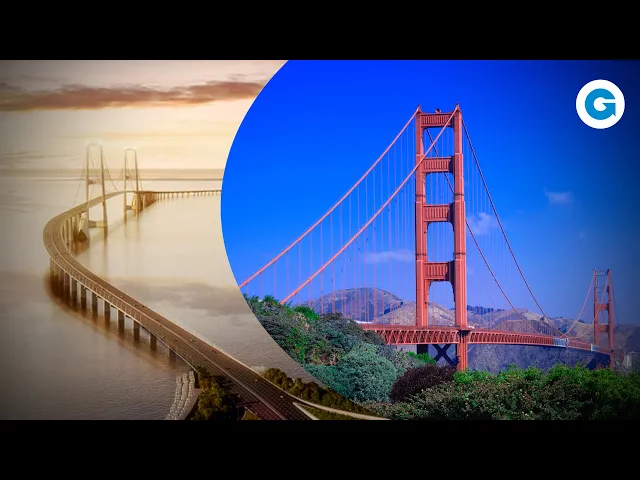
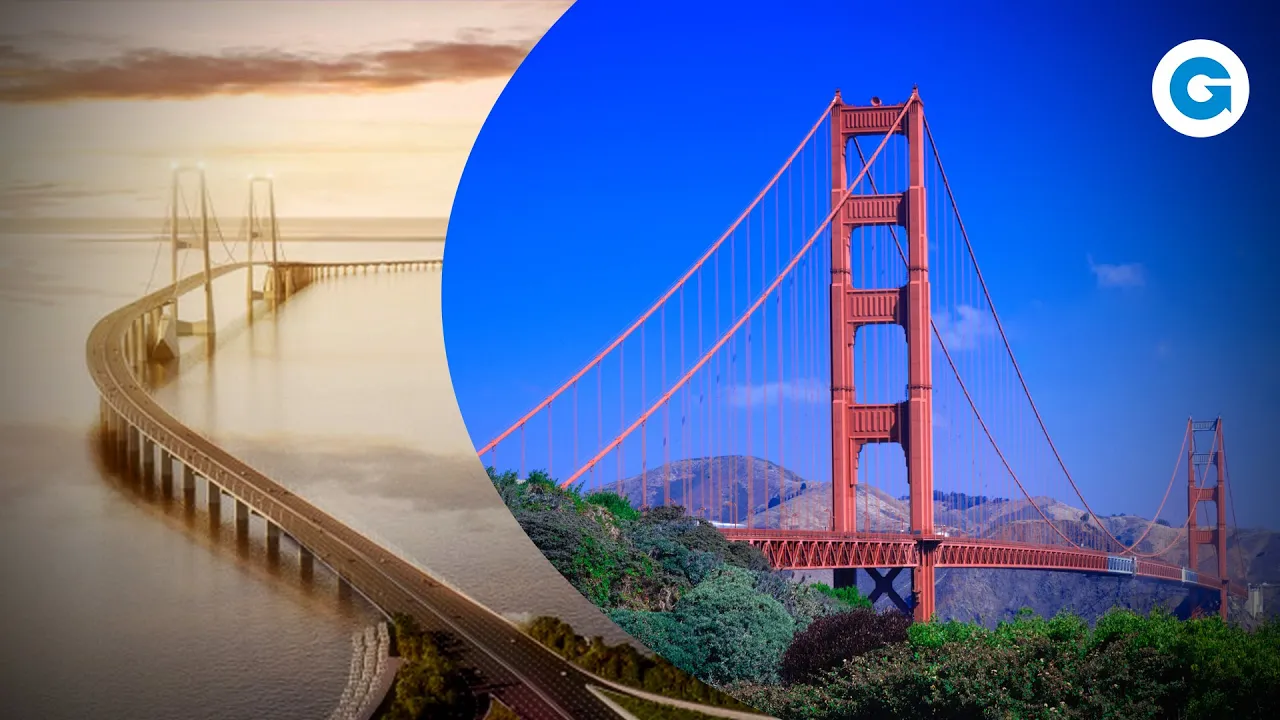
[female voice 2] There's two kilometers of road that's hanging with nothing underneath it. [narrator] This revolutionary design provides lifelines to rural communities and joins up great towns and cities, connects islands, like Denmark's Great Belt Bridge, and links countries, like England and Wales's Severn Bridge. And even unites continents, like the Bosporus Bridge, connecting Europe to Asia.
[male voice] They're some of the most beautiful structures in the world. They're iconic. [narrator] To create these amazing structures, we have had to overcome immense engineering challenges and weathered failures to see them improve.
So now they connect us, fuel our economies and oil the wheels of the developing world. [male voice 2] One bridge makes a massive impact. The root cause of poverty in those situations is broken.
[narrator] These engineering marvels are suspension bridges. [high-octane music plays] [narrator] Bridges come in many forms. But the most typical are the beam, arch and suspension bridge.
The UK's Severn Bridge is a glorious example of the modern suspension bridge. A triumph of complex engineering in an elegant form. It's a beautiful looking bridge.
It stands out from the rest, and it is quite unique. Always felt it would be nice to work on such an iconic structure. And that's eventually when I did see the advert.
I took that opportunity to work on it, and I've been here ever since, which is over 30-odd years. The Severn Bridge is a very simple, sleek, beautiful looking structure. But it's very complex in its design.
[narrator] But the roots of this complex bridge lie in the deep, distant past. One of the oldest known bridges is at the Sweet Track Causeway over bogs in the Somerset Levels, England. Simple log bridges, originally constructed by Neolithic farmers nearly 6,000 years ago.
A beam bridge is perhaps the simplest kind of bridge you can imagine. It's what happens if you get something solid and then just plonk it straight over whatever gap you're trying to bridge. [narrator] The principle of the beam bridge is simple.
Any weight compressing the center is transferred to its edges where it is directed down through the banks or supports. It's effective, but only over short spans. The problem with the beam bridge is you can only make them so long, and they can only carry so much weight.
Ultimately, it depends on the strength of the material that you're using to make that beam. Once something gets very, very long and you put a large weight in the middle then slowly that force, the compression, is gonna just rip the material apart, the bridge will break, and you'll end up crashing into the gorge. [narrator] The solution is to shorten the span with central supports.
The way you can get around it is effectively to make a load of short beam bridges across whatever gap you're trying to bridge. And that means you have to put supports across that gap. [narrator] This solution can be seen at Lake Pontchartrain in the American state of Louisiana.
It is the world's longest continuous bridge over water. More than 38 kilometers long. And uses nine and a half thousand supports.
The solution works in shallow water, but it's not so practical for deep rivers or vast canyons. [Steele] You might have to make tall supports if you're going over something particularly high or you might have to build in the middle of a flowing river, so all of this makes building the bridge more difficult and more expensive. [narrator] 3,000 years ago, engineers in ancient Greece improved the beam.
This Arkadiko bridge, in the Peloponnese, features an arch. The Romans developed the idea a few centuries later and made glorious use of the arch throughout the empire. Arched bridges are stronger than beam bridges, spreading central load more effectively.
Arches extend the maximum single span of a beam bridge from 20 meters to 30. But beyond 30 meters, engineers still have to add further supports. A bridge that could float, seemingly unsupported across wide rivers or deep ravines, still seemed beyond us.
But the solution had, in fact, been with us for millennia. [narrator] Rope bridges first appeared near the Himalayas at least 4,000 years ago. A simple design, ropes are attached to each side of a wide gap.
Decking can be added to ease crossing. Unlike beam and arch bridges, the weight is transferred to the banks by the tension pulling through the ropes. [Steele] Rope is something that's really strong in tension, and this simple rope bridge takes advantage of that tensile strength.
It means that all the forces acting on the rope are stretching it, pulling it. And that's how the rope supports your weight. [narrator] Light and strong, rope can span longer distances than heavier materials without supporting pillars.
But they're not for the faint-hearted. [female voice 3] It moves around. So if someone's crossing ahead of you, it causes undulation on the back, so the structure's moving up and down.
And of course, when you have wind, this also adds more movement. So the structure has a lot of movement that needs to be designed out. [narrator] These unstable bridges are okay for people.
But not for heavy traffic, like army or trade vehicles. When it comes to trying to get really heavy traffic across a bridge, like, you know, a horse and a cart or a lorry, then a simple rope bridge isn't enough. [narrator] So the rope bridge, cheap, strong and easy to build, was confined to small communities with light traffic.
While the developed world relied on more sturdy beam and arch bridges to facilitate heavy traffic. It stayed that way until the late 18th century, and by then, the need was pressing. Across grand European rivers, like the Thames, piers effectively blocked large shipping, and small boats faced manmade rapids.
London Bridge was for "wise men to go over and fools to go under. " [male voice 3] Bridge piers tend to block part of the river, which means that the water flowing through the spans tends to speed up. And like most things in a fluid flow, what we get is eddies.
And we often get dangerous eddies coming off of bridge piers. Shooting through there, you took your life in your hands at certain tides simply because of the disruption that multiple spans caused to the river. [narrator] With fewer piers, large shipping could reach further upstream.
[narrator] This was the solution: the modern suspension bridge. The Severn Bridge linking England and Wales illustrates the benefits. The Severn Bridge is designed so that it gives you a clear shipping channel with a 47-meter headroom and enough width for large ships, rather than a multi-span structure, which would have multi piers in the river, which could be an obstacle and a danger to the structure if hit by shipping.
[narrator] If the link across this important shipping lane were blocked by piers every 30 meters, it would severely restrict shipping. The River Severn has got the second highest tide and very fast currents. And therefore, you need that space between the two towers to allow safe shipping access to Sharpness Docks.
[narrator] The secret to the suspension bridge's ability to span far greater distances than beam and arch bridges is also part of its elegance. It's only by traveling to the very top, a place where the public are never allowed to go, that you can appreciate its true scale. [Phillips] You can see from the scale how big the crossing is, and that clear span of 988 meters with glorious views in both directions.
[narrator] But how does this bridge manage to span such an enormous river? The breakthrough happened in America, at the beginning of the 19th century. The inspiration came from merging two of the most enduring bridge designs.
[Boeree] So you've got your conventional beam bridge, which, yes, that will span a gap without a support, but is limited above a certain width. And then you've got your rope bridge, which can span a larger gap, but is really, really wobbly, so that's no good. So is there a way that you can combine the two together?
[narrator] The breakthrough came in. No image exists of the genius behind the plan, James Finley, but there is a surviving sketch of one of his early designs. Instantly recognizable, Finley designed a chimera, half beam, half rope bridge, with the advantages of both.
The real revolution in suspension bridges was when they realized you could make the deck flat and rigid. And that meant that so much more heavier traffic could travel across the bridge. And they became infinitely more useful.
[narrator] The weight carried by a beam bridge normally transmitted downwards through piers is instead transmitted upwards through suspension cables. [Arney] The flat deck is supported all the way along. That distributes the weight throughout the entire bridge.
And it means that the forces are balanced in a way that keeps it flat, keeps it up, and doesn't put too much pressure on any single part of the bridge. The modern suspension bridge is deceptively clever. You take a flat bridge, but instead of supporting it at either end or from underneath, you support it from above.
[narrator] But the new design wouldn't work unless the suspending cables were made of a material capable of carrying the heavy loads. And that material wasn't available until the end of the 18th century, when the falling price of wrought iron in the US made the design affordable. The idea of using iron to create super-strong chains came from the Chinese.
[Somara] Initially they were using rope, but the Chinese came up with this idea that if they heated iron ore, they could bend iron into the shape of links, chain them together, and you'd have a material that was able to take a much greater weight. [narrator] Back in the 1430s, a Tibetan saint named Thangtong Gyalpo built the first iron chain bridges. The bridges have since been replaced with reconstructions, but they still use some of the original chains.
James Finley up-sized the Chinese design to take advantage of cheap wrought iron. Each chain weighing over ten tons. His revolutionary design became the first modern suspension bridge.
The genius of the design isn't immediately apparent. If Finley had simply attached his suspension cables to bank side towers, the tension would have pulled them down. The towers seem like a great idea until you think about the forces acting on them.
If you had a tower on each bank, all the force, all the tension from that chain is coming from the middle of that gap. And that means it's gonna be pulling both of those towers inwards, and potentially if they're not really, really solid, it's gonna cause them to collapse. So imagine instead of having that cable just pulling on one side of the tower, you stretch it all the way over the top and bring it down to the bank on the other side.
[narrator] The suspending cables are anchored beyond the towers, splitting the tension between the ground and the bridge. That means you've actually got tension acting in both directions, and that then means the tower. .
. the forces are balanced. It's not being pulled either way, and that means it's stable and won't fall over.
[narrator] The same principle is still used today. In Chile these gigantic concrete anchors spread the strain over the towers. On the Cau Cau Bridge, we're using a mass anchorage, so it actually relies on its sheer weight.
So we have a very large, 120-thousand ton concrete mass at the end rather than a small tunnel. [narrator] From the 19th century to the largest structures of today, all suspension bridges follow Finley's design. Allowing flat, rigid roadways, which can carry modern traffic spanning vast distances.
This modern suspension bridge is critical to developed cities, but it's also of vital importance to remote communities across the world. The need for suspension bridges in rural communities where people are so isolated is acute. If you imagine living in those kinds of environments, where you've got to walk miles and miles to get to anything, a river, particularly a river that floods, is a major obstacle to any kind of opportunity.
And the result is people remain in poverty. If you think about it isolation means poverty, if you can't get to market and you can't get to school, you can't improve yourself, and others can't get to you. I've actually seen children holding their schoolbooks above their heads and wading, holding their breath as they have to get their head under the water to wade through the river on the way to school.
It enables others to get to the community, not just the communities to get to places. But so other charities, other aid workers can get to the people who need them. One bridge makes a massive impact.
Huge change to the lives and livelihoods of those people. And in fact to the economy as a whole. That tyranny of isolation, which is the cause, the root cause of poverty in those situations is broken, so that now opportunity exists.
[narrator] These modern bridges now span rivers around the world. But the early bridges were far from perfect, as a fatal tragedy demonstrated in Great Yarmouth in England. It's 1845, and a huge crowd of families and children have gathered to see a circus performer.
The best place to view this performance is on the bridge. And as they saw the performer traveling down the river everyone rushed to one side of the bridge, which created an enormous force on the chains. And unknown to anyone, there was a weak link.
That weak chain broke and caused a catastrophic failure of the entire bridge. Seventy-nine people died, many of them under the age of 13. And as the bridge collapsed, people were crushed or thrown into the water.
It was a heartbreaking tragedy, and it meant that suspension bridges had to be rethought. There had to be a better way than this. [narrator] This tragic incident highlighted the limits of the iron chain design.
[Steele] A chain is only as strong as its weakest link. It just takes a single one of those links to be in some way not structurally sound, and then it can snap, and the whole chain has completely lost all of its tensile strength. [narrator] It was clear that the iron chain suspension needed an upgrade.
Engineers searched for something stronger and lighter. The answer isn't immediately apparent on the Severn Bridge, because it's encased in a protective sheaf. But deep underground, where the bridge is anchored, you can get a glimpse of the modern solution.
Inside their rust-proof dehumidifying tent, you can see that the thick, heavy iron chains have been replaced with thousands of thin, super-light steel cables. [Phillips] We're now inside one of the main cable anchorages on the Severn Bridge where we've got the main cable, which consists of 8,322 individual wires making up the bundle. This then splits up into the small bundles, which are anchored around the shoes.
[narrator] Like all modern bridges, the Severn Bridge benefits from safety in numbers. With bundles of thin steel strands acting like super strong rope. [Arney] Cables are strong under tension, and you can use several together, so if one snaps, there are others to take over.
A failure is no longer catastrophic. [narrator] The use of cable has made bridges safer, but bridge builders faced many deadly challenges. Some from completely mysterious forces.
[narrator] In America, the East River separates Brooklyn and Manhattan. At points, it stretches over a kilometer wide. For many centuries, the only way to cross had been by ferry.
In the 1860s, a new suspension bridge promised to change all that: the Brooklyn Bridge. It was designed by a German immigrant, John Augustus Roebling. Too wide for a single span, it was inevitable that one of the towers had to be built in the river.
Perhaps the single biggest problem of working underwater is that we can't breathe under water. So if all your construction is being done by hand, then there's just no way that you can get people down there digging up the riverbed trying to put those foundations down. What you need to do is provide them with a protective atmosphere that they can work in.
And the way that this was done is with a device called a caisson. [narrator] A caisson is a large diving bell. It allows workers to breathe and keep setting concrete dry under water.
You can think about a caisson like trying to push a cup down in the bath when it's upside down. It's full of air, and as you push it underneath the water, that air stops the water from rushing in as a protective atmosphere for your workers. [narrator] But as the caisson drops, the pressure forces water into the bell.
[Steele] In order to keep that water out, you have to apply more pressure by pumping air into that caisson to make sure the water stays outside. And the only way to stop the whole structure just crumpling is to make sure that the pressure on the inside balances the pressure on the outside. So there's no force on the walls, and they can stay intact and keep your people inside safe.
[narrator] The caisson makes construction possible, but it's quickly apparent that something is wrong. The workers return to the surface unwell. Some even die.
Is the air inside the huge underwater casing poisonous? Or is there some deepwater virus? The mysterious illness seemed to defy explanation.
[Arney] Sending workers down under the water had an effect on their bodies that no one could have predicted, and no one really understood. [narrator] In fact, it was a simple physics problem. At high pressures, more of the air we breathe dissolves into the blood.
This isn't immediately dangerous until you return. [Arney] The problem isn't so much working at high pressure for long periods of time. It's when you come to the surface that the problems happen.
That dissolved gas tries to expand back into its gaseous form, and if it's still in your system, that can cause blockages that could be fatal. [narrator] Today, caisson's disease is known as the bends, and is a constant danger for divers. But back in 1870s Brooklyn, the phenomenon was little understood.
As a result, the designer's own son, Chief Engineer Washington Augustus Roebling, was permanently disabled by it, and at least 21 men died. Tragically, it was only after construction that scientists discovered how to prevent it from happening. When you go from a highly pressurized environment to normal atmospheric pressure, it has to be done with time.
Because that allows for any bubbles that have formed in the blood to dissipate. [narrator] Decompression helped to save the lives of future caisson workers and divers. Safety procedures were brought in for later construction projects like the tunnels under the Hudson River in the early 1900s.
[male newscaster] Let's join a crew of sand hogs as they start on the day's job under the river. They must stay in the airlock a few minutes, until the air pressure is built up to equal that in which they will work. It is different when they return from work.
Then they must be gradually decompressed, which takes a much longer time. This whole process is for the protection of compressed air workers. [narrator] But even with these precautions, the process is still dangerous.
So these days, the risk is eradicated by using technology to replace workers to build underwater foundations. But the challenges facing suspension bridge engineers are far from over. And it's not just how they're built, but where they're built.
[rumbling sound] [narrator] In 1906, an earthquake devastates San Francisco. Up to 3,000 people died, and over 80 percent of the city is destroyed. The stone buildings can't withstand the 7.
9 magnitude shake. This disaster makes it essential to earthquake-proof future building. Two decades later, San Francisco plans to build the first bridge ever to cross the Golden Gate Strait, spanning over two kilometers.
[upbeat jazzy music plays] [narrator] In the early 1930s, the city of San Francisco is a major trade center. Yet it's isolated from the rest of California to the north. Besides boats, they're cut off.
But a suspension bridge requires towers that would eclipse all the city's skyscrapers, reaching over 200 meters high. To make the strongest possible suspension bridge, there's a very particular shape of cable that you want to get to optimally distribute those forces. And what that means is that as you make your span wider, you're gonna need to make the towers taller to compensate, so you can keep your cable in that special shape.
[narrator] The stone towers of the Brooklyn Bridge would no longer be suitable. They would be too tall. And stone would be particularly unstable in an earthquake zone.
A stone pillar, as it gets taller and taller and taller. . .
the mass of the stone will crush the stone below. So there is only a certain height that you can go to. For the San Francisco bridge's chief engineer, another German descendant, Joseph Strauss, it was clear he needed a completely different design.
Once again, a breakthrough in technology comes just in time. Advancements in metallurgy bring about a new affordable material, steel. The mix of iron and carbon creates a strong but lightweight alloy far more flexible than stone.
[male newscaster 2] Box girder towers of massive strength carry the strain of huge cables in many modern suspension bridges. [narrator] The new bridge will span an earthquake zone, so it must be compliant, or, flex. [Wojcik] That is naturally compliant.
It will move. That movement is important. Allowing that movement means that you cannot build up stresses within the material to the level at which that material will then subsequently fail.
[narrator] When subjected to the forces of nature, materials need to absorb them and allow the energy to pass through. Compliance prevents materials from getting damaged under stress. If you think about a blade of grass in a gust of wind, it will give.
It doesn't permanently give. The grass will spring back into place. You haven't broken the grass by blowing the wind across it.
It's just kind of allowed the wind to blow over it. So if we compare, let's say an oak tree and you have a gust of wind, then that structure can't comply. And as a consequence as the force of the wind pushes up against the tree, all of that force has no way of being relived.
And as a consequence of that, could exceed the actual tensile strength of the tree itself. And the tree could snap, literally snap. [narrator] And so in 1933, construction begins.
And the iconic steel towers of the Golden Gate Bridge rise up. Instead of creating a heavy, solid tower, the steel creates a honeycomb lattice structure, which is lighter but still strong enough that each tower can support a 60,000 ton load. Although this bridge was designed to be safer, construction comes with a human cost.
Working at these heights is extremely dangerous, and 11 men lose their lives. But the death toll could have been much higher. Incredibly, 19 other people were saved when they were caught by nets as they fell.
This was also the first bridge to insist on workers wearing hard hats and safety lines. It was a big step towards the greater protection that construction workers enjoy today. At the same time, an almost identical steel design to the Golden Gate is used for the Oakland Bay Bridge, just around the corner.
The bridges stand proud for decades until they are finally put to the ultimate test in 1989. [dramatic music plays] [sirens and screaming] [narrator] The earthquake causes heavy damage across the Bay Area, though less severe than 1906. It causes six billion dollars of damage and kills 63 people.
Roads and bridge decks collapse. But not the suspension bridges across the Golden Gate or the Oakland Bay. [Collings] The West Bay Bridge, which is the suspension bridge, nothing happened.
The suspension bridge is very good in earthquakes. Very little happens to it. [narrator] The 1930s design was so effective that the suspension bridges still stand strong today.
But earthquakes are not the only natural force engineers have to overcome. They face a problem related to rope bridge ancestry. [narrator] As decks get longer, they become more vulnerable to a phenomenon all too familiar to the original suspension bridges.
Swaying, sometimes with dramatic results. Three years after the Golden Gate's construction, the Tacoma Narrows Bridge in Washington is opened in 1940. This bridge was designed to safely withstand 225 kilometer per hour gales.
What happened next should have been impossible. The result of a comparative 65 kilometer per hour breeze. An amateur cameraman captures this incredible footage as the center of the 11,000 ton span twists like a ribbon in the wind.
The oscillations become life threatening and the bridge is evacuated. But one man stays. His dog is trapped in his car, and he doesn't want to leave it.
Despite the dangers, there's little sign of panic as no one seems to recognize the stress the bridge is under. The man decides he has to leave his dog in the car for now. The twisting weakens the bridge until it can take no more.
[Arney] It's incredible that no human lives were lost when this bridge collapsed. But it was so close. Imagine if this bridge had been full of commuters early in the morning.
Dozens and dozens of cars. They could all have been thrown off into the river. It could have been an enormous human tragedy.
[narrator] No one understands how it happened. [Arney] This bridge was designed to withstand high winds and air turbulence. But the incident happened at a relatively low wind speed.
So the engineers had a challenge. They didn't know what they'd done wrong. Why would this bridge collapse when it should have withstood those forces.
. . easily?
[narrator] Had scientists got their calculations wrong? The Tacoma Narrows disaster sent shock waves through the engineering community. Was this a fundamental design flaw in suspension bridges?
And did it affect all other bridges around the world? [Boeree] Any person who'd ever built a suspension bridge was sitting there thinking: "Well, damn, is this gonna happen to my bridge? " And as a result, building of all suspension bridges was put on hold for nearly a decade.
[narrator] The pressure was on to explain the seemingly inexplicable. [Wojcik] The situation is rather complex, and for many years, there was some argument as to what caused the bridge collapse and how in fact it did collapse. Most experts now agree that Tacoma Narrows failed as a consequence of aeroelastic flutter.
Flutter is something that all aerodynamicists are very worried about. You build an airplane, and then it's tested against this form of oscillation movement. [narrator] Flutter is a dangerous instability caused by air flow over the deck.
[Boeree] Basically what happens is, as a sustained wind is blowing from one particular direction, it starts creating these air currents, these sort of vortices and eddies on the leeward side of the bridge, on the side where the wind is passing over to. And over time, these vortices start getting underneath and over the bridge and starting to sort of make it swirl a little bit like this, and the more it does it, the more these forces grow, and it starts getting stronger and stronger until this motion is unbelievably exaggerated. [narrator] As the eddies push and pull at the bridge, they strengthen.
If the timing of the swing matches the bridge's resonant frequency, the structure oscillates violently. Everything has a natural resonant frequency. So that's a frequency at which you can wobble it, and that wobble will continue to amplify.
[narrator] Under specific conditions, the movements build upon each other. [Boeree] So what the wind was kind of doing was, it was behaving like, you know, an adult pushing their kid on a swing. [Boeree] It kept applying a little bit more force at just the right time to get it going until it was getting really, really out of control.
[narrator] The bridge hadn't been designed to resist this vertical flutter. [Steele] The engineers had considered the horizontal force of the wind trying to push the bridge over, but they hadn't considered the vertical forces, things like the lift, which pushes it into the air. And because of those additional forces, it meant the bridge was being pushed up and down, up and down, to the point where it could get into this resonant groove until it amplified and amplified, and the bridge collapsed.
[narrator] How could they engineer the structure to prevent the eddies from forming? It wasn't until the 1960s that they found the answer. For decades, there had been an oppressing need to build a bridge across the River Severn.
A road bridge that wouldn't just connect two cities, but two nations: England and Wales. [triumphant music plays] [narrator] Cars going from Bristol to Cardiff had to cross by ferry. The Severn Bridge became the first bridge designed to overcome the oscillation problem.
The engineers had a radical solution. For inspiration, they had looked to the sky. Designers realized that instead of fighting the wind, they could use it.
[Boeree] Plane wings have an interesting sort of fact about them in that they're shaped in order to provide lift. And the problem that they had with bridges and wind is that they wanted the opposite: They wanted a downward force to keep the bridge stable. So what do they do?
They just copied the design of aircraft wing but turned it upside down. [narrator] Structural engineer Bill Brown's design turned the bridge deck into an inverted plane wing, called a box girder. The deck is aerodynamically shaped to create stabilizing air pressure.
So basically the bottom side of the bridge would have a curve while the top of it would be flat. And this lowered air pressure down here would mean that the bridge would have a downward force acting upon it. [narrator] The box girder decks are hollow, allowing interior access for maintenance and an exclusive glimpse inside the labyrinth of tunnels directly underneath the bridge.
This is a typical bay in the box girder bridge with an aerodynamic shape. It's very lightweight steel. It's ship building construction with very thin plate with stiffening.
The Severn Bridge was the first bridge to use this aerodynamic shape. From there, everybody is using this for their suspension bridges. [narrator] The bridge's bold innovation was world-changing, stabilizing long span bridges.
[Boeree] This solution was the breakthrough engineers were looking for. It was a leap forward in terms of suspension bridge design and enabled them to build bridges spanning gaps previously thought impossible. [narrator] The Severn Bridge set the standard, but the challenge is greater in typhoon regions.
[Firth] When you're building bridges in places like Hong Kong, China, South China Sea, typhoons, of course, are a major design parameter. You've got to be dealing with some very, very strong winds. [narrator] To survive typhoons, the Shenzhong Link in China has made use of a clever twist on the old design.
In high winds, the traditional box girder can't always stabilize the deck. [Firth] The wind impacting those incline surfaces may actually have the opposite effect, to push it up. So it's quite a complicated design exercise when you're doing this, to get that balance right so that the lift forces are carefully controlled.
[narrator] The solution for this is to split the box girder deck into two parallel decks with a space between them. The gap reduces the impact of the wind. [Firth] There's an air gap down the middle.
What that air gap does is it equalizers the pressure or helps to equalize the pressure top and bottom, so that you don't have such big dynamic forces to deal with. [narrator] But more radical is the positioning of the main suspension cables. Instead of running parallel either side of the deck, they run down the center of the deck above the gap.
The cables start out at the top of the towers on the center line. But as they come down to the bridge deck, they splay out and they pick up the deck on the outside, go at a sort of triangulated cable system. So when the wind blows, the bridge deck, when it tries to move sideways, is more resisted, the movement is more resisted by this arrangement.
So the Shenzhong Link is designed very much with the aerodynamic and the wind load situations in mind. [narrator] Despite all the advantages of steel suspension bridges, they have an Achilles heel. It's mother nature's ultimate corrosive challenge to engineers.
[narrator] Rust. An insidious creeping problem suffered most in humid areas, particularly near the sea. To try to prevent rust, bridge builders paint the metal, but water can get under the paint and destroy the structure from within.
[Wojcik] It has this terrible tendency to corrode. And there's very little we can do about that. It's nature having its own way.
[narrator] It's critical to spot this corrosion before it becomes dangerous. But this is no mean feat. [Collings] Suspension bridges are very large structures.
They have towers that are high in the air. They have cables that are high, usually over the sea or a river. And often, it's windy and it's rainy.
It's a very difficult thing to access, but inspection is a very difficult and really quite a dangerous activity. [narrator] So incredible, gravity-defying robots have been designed, which can cover every inch of bridges above and below. Maintenance robots aren't just looking for corrosion, they can also spot signs of otherwise hidden damage to the bridge.
In the past, bridges have collapsed because of weaknesses in the structure. Future technology may prevent collapses and help us have the confidence to build bigger and more ambitious suspension bridges. Perhaps the most innovative design is by engineers from Norway, which would take suspension bridges to the next level.
Norway is a country that's dominated by waterways. And there is constantly this engineering conundrum of trying to join up islands. And rather than using the conventional technique of drilling foundations down into the fjords, which would be a really difficult task, they've come up with a much more novel way of creating bridges.
[narrator] Instead of sinking deep legs for the towers, they are inspired by an industry that is no stranger to deep sea construction. These oil rigs have no solid foundations. Instead, they float.
It's almost a sense of repurposing engineering. Floating oil rigs have been successful, and now Norway is using that concept to be able to create floating suspension bridges. [narrator] If they make the base of the towers sufficiently buoyant, they can support themselves and the weight of the multi-thousand ton bridge deck.
[Boeree] And it's kind of elegant that, actually, in the end, the way to span a bridge of water is to end up floating on it. [narrator] But there's a catch. [Boeree] If you have a floating tower, now, that brings up the old problem of instability, because you don't want your bridge to be able to start rocking and moving or going with the tide.
[narrator] The solution is in precise anchoring. [Firth] You have tension cables, which are anchored into the bottom of the fjord, and you then pull this thing down, so it's just below the surface, so that you've got this buoyancy force, which is trying to lift it. It's trying to float, but it's held down.
And that becomes a platform just below the surface of the water on which you can build your bridge. [narrator] Just like oil rigs, as long as the anchoring cables are tight and secure, the floating structure will hold steady, even in heavy weather. But if the anchors were to fail, the repercussions would be serious.
To work, these bracing tethers would have to perfectly balance competing forces to ensure stability without too much flexibility. Extraordinary technology, very complicated, very difficult to deal with, and of course it's still in its infancy. But what it does is it suddenly opens up the possibility to be able to build bridges across places that we hitherto have just not even been able to conceive of doing because the water's just too deep.
So we'll see where it goes, but I think floating suspension bridges are a really exciting development. [narrator] Suspension bridges have a bright future and will continue to push the limits of engineering. Since the modern suspension bridge was invented, their span has roughly doubled every 50 years.
So I'm so excited to see just how wide of a gap we can bridge one day with a suspension bridge. [Boeree] Who knows, one day we might be able to do away with the majority of boats, because actually we can connect most islands to each other or to the mainland, just by beautiful suspension bridges. [narrator] But not all bridges will be so complicated.
There's still a need for cheap, simple bridges. Though these may well be delivered with a twist of the high tech. And now more than ever, suspension bridges can unite communities and enable people to thrive in both cities and remote regions alike.
Boasting iconic designs, which have evolved to span further, carry more and survive earthquakes, tornadoes and corrosion. And admirers will continue to celebrate their scale and majesty in every kind of way.