hello and welcome to this introduction to climate modeling How likely is it that the area where you live will be affected by rising sea level within your lifetime or perhaps affected by extreme weather events like droughts or floods what's the likely range of possibilities for future global temperatures given the range of possible future Pathways we might choose or how is Earth's climate system as a whole likely to respond to Future changes in energy flows climate models can help us understand how Earth's climate system works and they are our only tools for peering into the future
to help us estimate the likely ranges of possibility down the road we can't actually run more than one experiment on the real planet Earth so climate models allow us to try out all sorts of wh if scenarios we can turn things on and off and we can see what happens if you've ever folded a piece of paper into the shape of an airplane and thrown it you have made a model if you speak or write or gesture in some language you're using a model language is a representation of your thoughts but can never really quite
be what you're thinking though in our language we do aim to get as close as possible to communicating what it is that we're thinking we use physical models in architecture to show what something might look like if we were to build it we use models in engineering to test designs before putting the time effort and energy into building the real thing we even model our own Futures ourselves and our models help us plan ahead because we have expectations of the future we expect for example that next winter will be colder than the following summer we
might not know exactly how cold or how warm the seasons next year will be but we have a pretty good idea what clothes would be useful to have handy and whether it would be useful to buy a snow shovel how is it that we're able to model these things we have experience and we have observations from the world around us we certainly have varying levels of confidence in our experience and our observations depending on how extensive they are how many times they might have been repeated and whether we're pretty sure we've considered most of the
things that are relevant or if we're leaving something out essentially our models of the future fit within what we think is the likely range of possibility and we revise and refine them all the time as we gain new insights climate modeling is conceptually similar to the Future modeling you and I do all the time for ourselves climate models are based on physical principles of how the world Works things like conservation of mass and energy gravity Laws of Motion how chemical reactions work and what we know about how biology works these models don't exist in a
vacuum nor do they arise out of thin air they are our attempts to represent earth's climate system with the purpose to help us learn more about it since again we can't run a global scale real life experiment here more than once this is a drawing of the major components of Earth's climate system with arrows representing the flows of mass and energy among the different parts this essentially represents a static model of what earth's climate system looks like which helps us get started thinking about it the next step is to try to represent how the mass
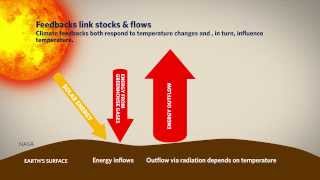
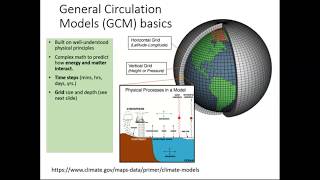
and energy flow through the system turning this into something Dynamic that can change over time we'd use what we know about physics chemistry and biology to give the model information about how different processes work and how fast and under what conditions so we're giving the model information about how to deal with stocks and flows typically this is done using a bunch of equations which represent stocks flows and feedbacks including time scales on which different processes operate and then the equations are solved by a computer once we've built a model and it's seems to operate with
reasonable stability then we could add for example some kind of perturbation then if our model does a decent job of linking the different parts together we could see how that perturbation ripples through the system and affects other parts we could see whether and how fast the system approaches some equilibrium again and what processes were largely responsible we could actually turn different processes on or off to try to isolate their influence on the system again something we can't do on the real planet we also test our climate models output against observations of the real world and
we might find out that the model aligns well with those observations or we might find out that we need to revise the model or maybe that we need to go out and make some more real world observations to get a better handle on how things really work here's an example of a real world constraint on climate models that has to do with the relative proportions of liquid water and water vapor at warmer temperatures more of the water present will be in vapor form and at colder temperatures less of the water present will be in vapor
form and more will be as liquid water or even solid ice which isn't shown here if a model is trying to represent what happens to water cycling through the climate system it would have to take into account how the proportion of vapor to liquid changes if the temperature changes if some air warms up in the model then the model should also make some of the water in that air change phase from liquid to Vapor within some range that makes physical sense if some air cools as is common and as air rises through the atmosphere then
in the model some of the water vapor present in the air should condense using a relationship like this which is based on observations in the real world a modeler can tell the model what to do with water as temperature changes this is just one example of how observations help in form what goes into climate models there are many more like the rate at which CO2 exchanges with the ocean or the heat capacity of water or the average growth of trees each year or the temperature profile of the atmosphere ideally climate models align with physical reality
so observations inform climate models but climate models also can inform observations for example we've talked about how some of the excess CO2 emitted from human activities gets taken up by plants on land and some gets taken up by the oceans with models and observations together we can learn in more detail more specifically about where that carbon goes observations of atmospheric carbon dioxide and different parts of the world can be incorporated into models of atmospheric circulation which tell us how the air moves around and the output from those air circulation models can indicate which parts of
the world are likely responsible for the uptake of CO2 from the atmosphere is it tropical forests is it certain areas of the ocean the model output can actually help people decide in what regions of Earth would it be useful to conduct further observational work okay to illustrate a climate model using information we've encountered earlier we're going to construct a simple energy balance model this model uses essentially one physical relationship and we've seen it before it's the Stefan boltzman equation which relates energy output to the temperature of an object you'll recall from earlier that warmer objects
emit more energy and that energy goes up as a function of the object's temperature raised to the fourth power so it goes up exponentially as things heat up we'll use that equation plus some addition and subtraction of energy flows to make this model first we'll start with something completely unrealistic imagine turning off the Sun so there's no solar energy coming in will let the Earth's surface keep its tiny amount of geothermal energy coming from the planet's interior about 06 watts per met squar with this little energy flow Earth surface has to emit 06 watts per
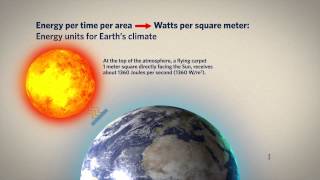
met squ to be in thermal equilibrium and it can do that at a temperature of about 32 Kelvin or about minus 241° C now we'll turn on the sun to its current energy output which means Earth gets about 341 watts per M squ this is an example of an observation that's used in climate models if we want to model the Earth we need to use a realistic number for the incoming solar radiation we'd use a different number if we were modeling Mars for example okay we're going to assume for now that Earth absorbs all the
radiation it gets from the Sun nothing is reflected and there are no greenhouse gases when the sun First turns on Earth is emitting just 06 watts per me squ but now it's getting 341 watts per squ so we have an imbalance over time Earth warms up until it reaches the right temperature to emit the same amount of energy as it absorbs that temperature according to Stephan boltzman where energy inflow equals energy outflow is about 278 Kelvin or about 5° C so that's a very simple model and it doesn't quite capture what's really going on so
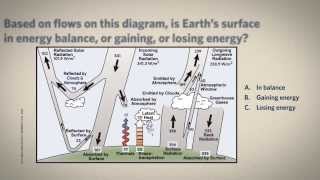
let's add another important process reflection first a question for you what's going to happen to the temperature of our modeled Earth after we add reflection will temperature go up go down stay the same what's going to happen today Earth reflects about 30% of the incoming energy from the Sun so let's make our model do that now Earth's surface only absorbs 70% of what's coming in so it only has to re-emit 239 watts per met squ and so it cools down to a new equilibrium where energy inflow equals energy outflow now at minus 18 degrees C
so that's a little closer to representing the real Earth and minus 18 celsus is about the temperature of the upper atmosphere and the temperature Earth's surface would be if we had 30% reflection and no greenhouse gases Next Step add greenhouse gases for our purpose here we're going to make a simplifying assumption that the greenhouse gases absorb all the radiation coming from our surface and they Reit half of it upward and half of it downward just to make things conceptually more straightforward we know that for the planet to be an energy balance the upward emission from
greenhouse gases will have to equal the solar inflow minus reflection so that's 239 watts per met squ we've assumed in this model that the downward emission from greenhouse gases equals the upward emission so that's also 239 watt per met squared so now earth's surface is absorbing 239 from the Sun plus 239 from greenhouse gases so it has to Reit two times 239 watts per meter squ back upward in order for inflow to equal outflow and so it warms up to 303 Kelvin or 30° celsius if we take a look at what happens to our energy
balance model over time it looks something like this from the left we start just when we conceptually turn the sun back on and suddenly inflow far exceeds outflow the red line is way above the green line temperature is the blue line and you can see the Earth starts off very cold and it takes some time time for it to warm up to its new equilibrium temperature with its new inflow of energy from the sun when it does warm up enough so that inflow equals outflow our model Earth's temperature stabilizes at about 5° C but then
we added reflection so 30% of the incoming solar energy gets reflected away immediately and our model Earth cools down to minus 18 Celsius then we added greenhouse gases to the model and it warmed up again and it stabilized at about 30° C once outflow caught up with inflow again so one thing to notice is that there are transition periods in the model when we change something Earth doesn't respond immediately there's some lag time before it reaches a new equilibrium State okay so there's an example of an energy balance model with some assumptions and some simplifications
and this model produces a temperature for Earth's surface that we can compare to observations again and see how it does well Earth's average surface temperature is about 15° celsus not 30 so how could our model get closer to approximating reality well we could divide the atmosphere into layers and could more realistically represent the flows of energy due to greenhouse gases in the atmosphere which aren't simply half up and half down we could also take into account the fact that some energy emitted from Earth's surface proceeds directly to space it doesn't all get absorbed by greenhouse
gases or we could include that some energy leaves Earth surface through latent heat transfer in thermals not only via radiation we could get specific about what's on Earth's surface is it water is it Rock we could make our energy balance model more closely approximate the real Earth by dividing our model Planet into different latitude bands not just treat the whole thing as one big average the purpose of going through this model is to illustrate how we can use a few equations and construct a model that actually does approximate some of the processes happening on Earth
you could build this model yourself in a spreadsheet with more sophistication you could include more processes giving them magnitudes based on observations in the real world and bring your model closer to resembling reality to summarize with climate models we're attempting to represent earth's climate system so it's important to ground the model in how physics chemistry and biology work in the real world we use real world observations to help Define what's realistic in a model and sometimes modeling can help us decide what new observations would be helpful ultimately people build models to help better understand earth's
climate system it's an ongoing effort