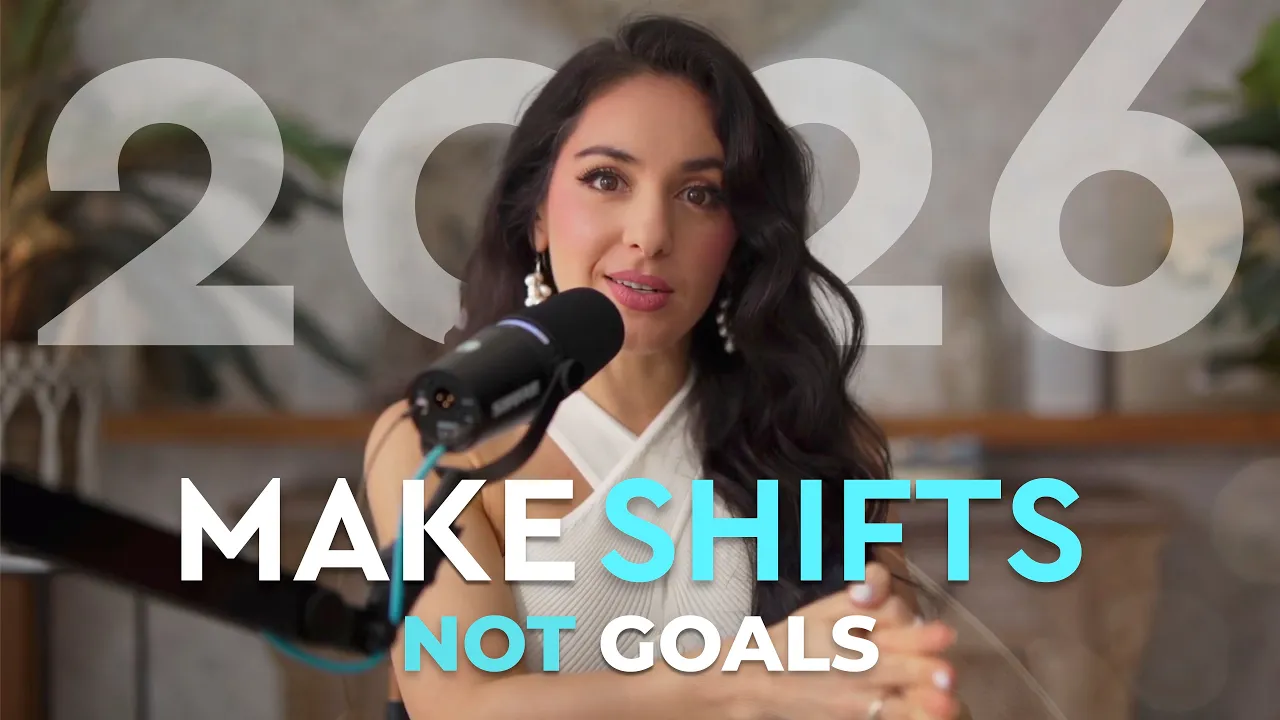
Most people say they want a better life, more purpose, more freedom, more energy. [music] But wanting isn't the hard part. What I've seen after working with tens of thousands of leaders, entrepreneurs, creatives, and career professionals, is that how you move through your day, the small decisions you make, the mindset you carry with you into rooms, these are the things that quietly build the life you're living.
And [music] often, they're the same things keeping you stuck in one that you've outgrown. Everyone I've ever come across who's created a life they truly love all had something in common. [music] They didn't just want a better life, they showed up for it.
And whether they were aware of it or not, they [music] had patterns, ways of thinking, ways of behaving, small, consistent shifts that helped them break free from autopilot and move towards something more intentional. So, I'm going to walk you through four of those shifts. These are not fluffy affirmations.
They are practical psychologybacked principles that you can start applying today. These are the same principles that changed my own career path, helped me grow a global business, and led to the life that I now have, one that I find deeply fulfilling. So, let's get into it.
The very first shift to create the life you want, which also happens to be one of the most underestimated by people, is this. Show up for it. [music] This might sound obvious, but so many people say they want a better life while continuing to show up as the version of themselves that's settling.
[music] And I completely get it. When I started working out in the legal industry, I looked at all the people around me in their gray, black, and brown suits, and I bought exactly the same thing. My entire wardrobe looked like a grayscale mood board.
[music] I was playing the role. And for a while in corporate, that served me well. I fit in and I didn't stand out.
It was what was expected. But then when I moved into banking, I started experimenting with more color, more personality. And I noticed something really interesting.
People responded to [music] me differently. I felt different and I carried that energy into rooms and interactions. I spoke with more confidence and people listened more [music] closely.
Have you ever noticed that people respond to you differently when you show up differently? There's actually psychology behind this. The [music] first part is because of social signaling.
Humans are wired to interpret social cues. When you consistently signal confidence, intentionality, or value through the way that you speak, show up, or dress, others [music] start treating you as someone who embodies those traits. And that feedback reinforces your own belief.
Not only that, there's also the effect of something called embodied cognition. [music] This is the idea that your body doesn't just reflect your emotions, it helps shape them. So the way that you move, how you hold yourself, how you speak, this all sends signals back to your brain.
So when I started dressing more like me, even if admittedly it was still a muted version, it made me feel a little more aligned, more [music] grounded, and that changed how I showed up. I felt more confident and that came across. Now, a few years later, when I discovered how passionate I was about applying psychology principles to help people live and work better, I knew that sharing that message on stages [music] would give me the fulfillment and the impact I was searching for.
But I also knew I wasn't ready to transition into doing that full-time. I was in the middle of building my banking career. At the same time, though, I knew I needed to start somewhere with something.
So, I arranged to get some professional head shot taken. I created a very very basic speaking website. I offered to speak for free for community events and even delivered sessions during lunchtime to other teams in other departments.
I made sure I got photos and video footage and then I shared what I was doing. There is a psychological principle that says that we don't just act based on who we think we are. We [music] actually figure out who we are by watching ourselves in action.
When I created that very basic speaker website, when I offered these free talks and I gathered this video footage, I was teaching myself I am someone who speaks and empowers. I am someone who creates my own opportunities. And then with each action, that belief became more true.
Soon enough, I had to start saying no to speaking offers because there were just too many and I had a day job to get through. I didn't wait for the new life to show up first. I showed up for it while still fully inside the old one.
So, if you're wondering where to begin, ask yourself, what would it look like [music] to show up today as the version of you who already has what you want? How would they speak? How would [music] they treat others?
How would they walk into a room? How would they dress? And what would they prioritize?
That's the version the world responds to. And more importantly, that's the version you start to believe in. So, show up for it.
Now, this episode is brought to you by Big Trust, my new book, which is coming out January 20th, 2026. Bestselling author Sahil Bloom called it a timely and powerful guide for anyone who's ever second guessessed themselves. I'll share more about it later.
Let's dive back in. The second shift is what's going to make this first shift a lot easier. Shift number two is to be around people who have the life you want or are creating the life you want.
Have you ever found that you're more motivated to work out when you're at the gym? seeing everyone else work out or feel more like quietly reading a book when you're at the library. There's a reason why the people we spend time with shape our standards.
There's a whole body of research on something called social contagion, which is the idea that beliefs, moods, habits, and even levels of drive and passion spread through social groups like wildfire. And it goes both ways. When I was a kid, I used to watch the Muppets with my big brother Ryan.
So, when I heard this story, it stuck with me for more than one reason. Jim Henson is the creator of the Muppets. When he was young, he started making puppets.
A teacher saw him and said, "You're wasting your time with those puppets. " And Jim thought about it, and they acknowledged that [music] she was probably right. He said, "I decided to chuck it all.
It didn't seem to be the sort of thing that a grown man works at for a living. " Not long after that, he made his way to Europe, where puppetry was celebrated [music] as serious art. He was suddenly surrounded by people who loved puppets and it completely reframed what was possible for him.
He said, [music] "I came back from that trip all fired up to do wonderful puppetry. " And that's exactly what he did. [music] He revolutionized puppetry, breathing life into characters that I grew up with like Kermit the Frog, Big Bird, Miss Piggy, and Cookie Monster.
The lesson here is that the people you're surrounded by influence you more than you realize. If you're spending most of your time around people who are constantly complaining, downplaying your ideas, or focusing on limitations, it doesn't matter how inspired you are, you will start shrinking to fit. And the same applies if you're around people who swear a lot or curse a lot.
You will start to swear and curse more, too. It's called linguistic convergence. But if you are regularly exposed to people who are building, dreaming, experimenting, speaking with optimism, and taking their goal seriously, something inside you will start to rise to meet them.
Behaviors are contagious. It's one of the reasons why mentorship groups are so powerful and why people love being in communities with like-minded others, whether it's in business, in sports, in keychain making. So ask [music] yourself, who are you around the most?
And who are you becoming through proximity? If you don't currently have someone in your life who's creating the kind of future that you want, go and find someone online. I'm serious.
You don't have to know them personally. Follow their work. Study how [music] they think.
Watch what they prioritize because that influence still counts. Now, I do want to give you one gentle warning here. When you're around people who are further ahead, whether in business, relationships, finance, confidence, [music] it's easy to let comparison creep in.
And when it does, it can quietly erode your confidence. You start thinking, "Look at how far ahead they are. " And then before you realize it, you're in a spiral [music] of, "I am so behind.
I can never catch up. " But what if you reframed it? Instead of, "Look at how far ahead they are.
I must be failing. " Try look at how far ahead they are, what can I learn from them to apply to my own journey. That simple shift [music] from comparison to curiosity and then emulation is everything because one leads to self-doubt and the other one leads to growth.
So yes, get around people who are doing big things, but don't fixate [music] on the gap between where you are and where they are and then feel inadequate. Let it inspire you, not shrink you. And now we move to shift number three.
Treat your attention like a sacred resource because it is. Every time you give your attention to something low value, like endless scrolling, passive comparison, gossip, or complaining, you're training your brain to focus on distraction, on negativity, on things that waste your time. And that has real consequences.
In psychology, attention is considered one of our most limited cognitive resources. It determines what you notice and then shapes what you believe. Through mechanisms like selective attention, your brain filters the world based on what it already thinks is relevant.
And then through confirmation bias, it will look for evidence to support those existing beliefs even if those beliefs are keeping you stuck. One of our students, we'll call him Jay, he shared that he used to feel constantly overwhelmed and behind even though he was always busy. But when we started tracking his attention, we all realized he was spending most of his time absorbing motivational content input, but hardly doing anything with it.
So no real output and then numbing himself with social media in the name of rest which was unhelpful recovery. Once he rebalanced those buckets so less passive learning, more small acts of creation and then better quality downtime. He felt clearer, calmer and far more in control within a few weeks.
And then that came from really just being honest with himself about where his attention was going and then doing something about it. So here's the practice that Jay used. We share this with our students and it's to think of your time and energy in three buckets and to do a short audit each week.
So bucket one is your input. What are you learning or absorbing? Is it helping you grow or are you simply consuming?
Bucket two is output. What are you creating or putting out into the world? What are you actually contributing?
Are you doing anything with that input? And then bucket three, recovery. What genuinely restores your energy?
what is actually building you up internally rather than just numbing you or distracting you. Because often it's not that you need more time. It's that your attention is scattered across things that don't align with the life that you say you want.
Attention is the gatekeeper of your future. And how you spend it today will shape who you become tomorrow. Now, something that's going to help you spend your time on things that are better for you comes up in shift number four.
Design for friction and for flow. What I see most people doing is they try to force their way into change with motivation. And I understand why.
Motivation feels fantastic. [music] It's that rush of inspiration you get after watching a TED talk or finishing a great book. You feel like, "Yes, I'm doing it this time.
" But here's the problem. Motivation is completely unreliable. [music] It's a state, not a strategy.
It comes and goes based on your mood, your sleep, your hormones, even what you had for lunch. That's why the people who stick to their habits and create the life they truly desire for themselves [music] aren't always the most motivated. They're usually the ones who have designed their environment to make good choices easier and then bad ones harder.
And it's because they understand principles of behavioral science and what really changes behavior. For example, let's say you've developed a bad habit of doom scrolling for hours after work. If you want to change the behavior, don't rely on willpower alone.
Just remove the most tempting apps from your home screen or delete them altogether and keep your phone in a drawer or somewhere that you're not tempted to grab it. That's called creating friction. You're making the thing that you don't want to do just a little bit harder to do.
I once heard someone who had a shopping addiction and she filled up a container with water, dropped her credit card inside, and then stuck it in the freezer. [music] She also made sure that she deleted her saved credit card details from her devices. So, this meant that [music] the next time she wanted to make an impulsive purchase on Teimu, she had to pull the block of ice out of the freezer, wait for it to defrost before she could access the card.
And then by that time, [music] the urge to purchase had passed, and she ended up curbing the habit. If you want to journal more before bed, keep a notebook on your pillow. Make it [music] hard to miss.
That's reducing friction. You're making the habit easy to see and impossible to ignore. If you want to write more, keep a blank Google doc open on your browser so it's the first thing you see in the morning.
That visual cue does so much more than you think. One of our students used to complain about not having time to plan her week. So then we looked at her setup.
Her calendar [music] was empty. She had no set times blocked. She had no visible prompts.
Once she moved her calendar to her home screen and started putting things in it, she made weekly planning the title of her Sunday 5:00 p. m. alarm.
She then didn't even have to think about it. She just did it. No motivation required.
She simplified her environment to make it work for her. It sounds so incredibly basic and that's the point. So the question I want you to ask yourself is, what is one behavior I want [music] more of?
And how can I make it so easy that it takes less than 60 seconds to start? Because at the end of the day, your environment is always working on you. So you want to design it with intention.
Now, there are so many other shifts that I could share with you, but if you can start with applying what we've covered in these four principles, you will be well on your way to creating the life that [music] you want. Of course, you need to know what that life is. So, we're assuming that you've taken the time to determine what's important to you and why.
If you've enjoyed this episode, [music] hit like and subscribe because I regularly share practical sciencebacked tools to help you build real confidence, not just the kind that looks good on paper. and tell me in the comments, how will you implement one of these principles? What will that look like for you?
Remember, the gap between where you are now and where you want to be. It's not as wide as you think. Thanks for being here, and I'll see you again soon.
[music] Self-doubt doesn't shout, it whispers, and it keeps smart people playing small. You can't positive think your way past it. [music] You have to rewire it.
Big trust is the result of 5 years of PhD research and over 100 studies, and they all point to one powerful truth. Your career [music] satisfaction, your earning potential, even your happiness are shaped by four [music] core attributes. When one of them is weak, self-doubt gets louder.
Strengthen them and everything changes. Go to bigtrustbook. com to order and [music] grab the exclusive bonuses while they're still available.
Why is my phone buzzing? Is that my phone or your phone? >> We did it.