There are plenty of great written and video guides out there that cover the fundamentals of double-edged safety razor shaving, ours among them, we should add. But if you've mastered the basics and are looking to ensure that your technique is a cut above, then these expert level tips should do the trick. Our first three tips relate to the actual physical mechanics of the act of shaving.
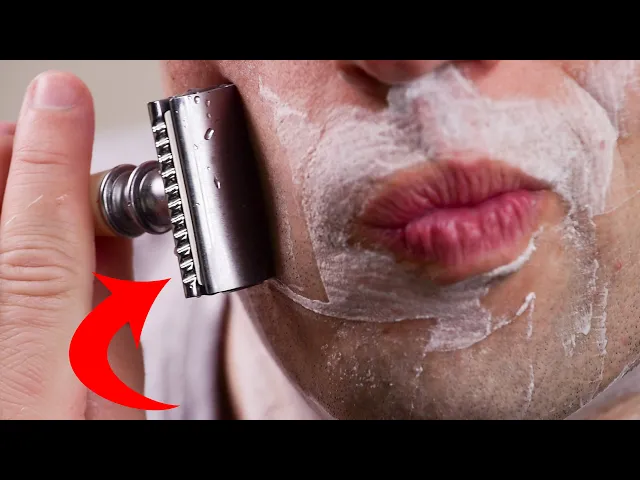
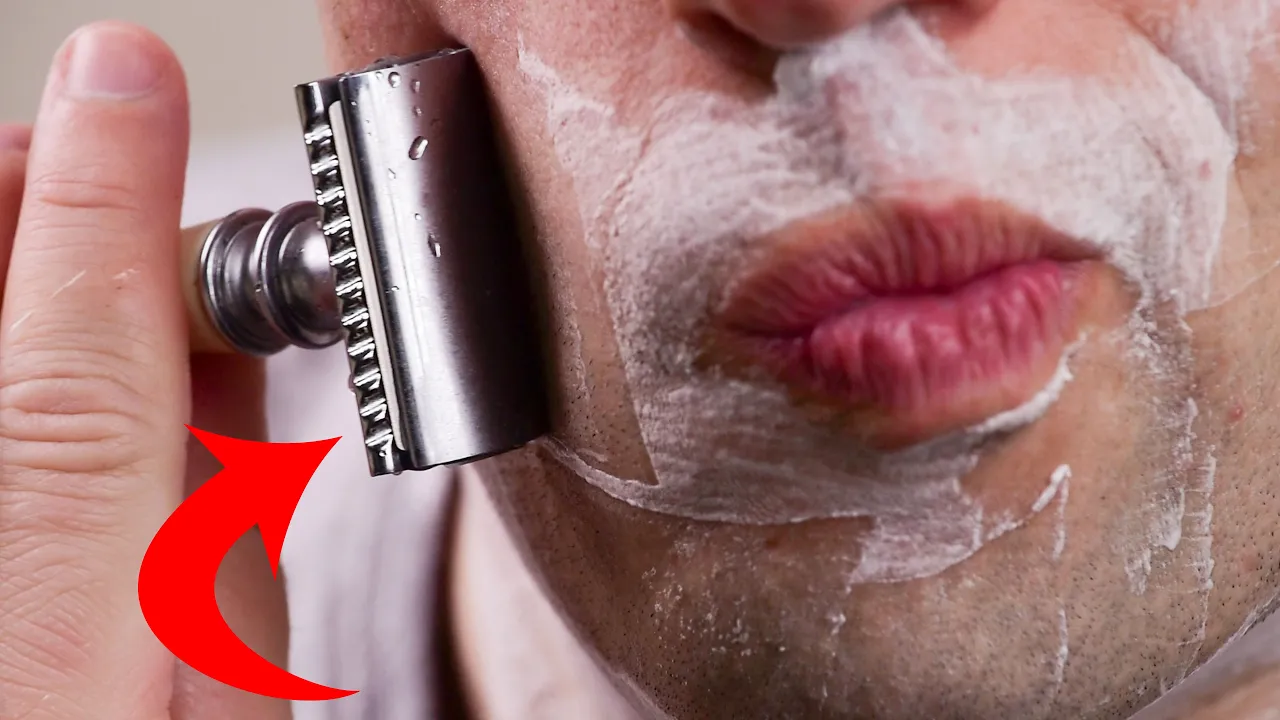
Starting with number one, find your ideal angles. Cap riding versus guard riding. General advice for DE novices and regulars alike is that good results often come from holding the razor's handle at roughly a 30° angle, but your face might benefit from an adjustment of the shaving angle that is.
As such, you can experiment with either riding the cap or riding the guard of the razor. While the conventional 30° angle typically results in neither the cap, the top part of the razor head, nor the guard, the bottom part of the head, making greater contact with the skin than the blade itself. Augmenting this will change the closeness and severity of your shave.
Riding the cap, accomplished by using a more obtuse angle with the handle closer to perpendicular to the skin, will keep the blade in contact with your skin, but at a shallower cutting angle that's less prone to nicking, cutting, or causing irritation. Difficult areas of the face, like under the nose or where the jaw meets the neck, sometimes require a bit more patience and care. For those, consider riding the cap to make the razor cut more mildly, though less closely.
Meanwhile, riding the guard involves intentionally using a steeper, more acute angle, bringing the razor's handle closer to parallel with the skin. This technique will often provide a closer shave, though it may also increase the chance of nicks, razor burn, and other sources of irritation like ingrown hairs. What's more, you can experiment with different angles for different areas of the face or on subsequent passes of the razor.
Consider the frequency at which you shave as well. If you shave regularly, cap writing will probably be more ideal for touch-ups, whereas shaving less frequently may necessitate more guard writing to knock down growth. Of course, part of the genuine DE experience is pairing your razor with a quality brush lthered shaving cream, which leads us to point number two.
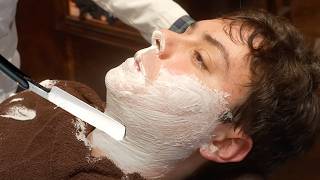
Lather unevenly. By this we don't mean that you should lather halfhazardly, but rather that instead of opting for simple uniform coverage, you can adjust the amount or consistency applied to certain areas. Simply put, thinner lather will mean closer blade contact, good for areas of denser growth, while thicker lather will mean added protection for sensitive areas.
In general, reathering before each pass is best practice as it will help the blade to ride smoothly and minimize irritation. But an experienced hand may be confident enough to use a technique known as blade buffing, whereby short repeated strokes over the same patch are made without reathering. On the other end of the spectrum, be mindful not to apply lather that's too thick in consistency or slather it on too heavily, as this may clog the razor head or lead you to apply too much pressure to the skin, paradoxically, opening the door to more mishaps.
In summary here, just as handling your razor requires practice and technique, so too does mixing your lather to the right consistency by adjusting the proportion of cream or soap to water and applying it in the proper amount with your brush. Next is tip number three. Make funny faces and use your free hand.
Shaving should be an enjoyable experience, but we're not suggesting you mug in the mirror just to cheer yourself up. Though, I suppose we're also not not suggesting it. So, you do you.
What we're getting at here is that contorting and stretching your face will create flat, taut surfaces that are easier to shave. This can also serve to adjust angles and will better address stubborn, multi-dimensional areas that can be hard to shave cleanly with a neutral expression, like the cheekbones and the jaw. In addition to changing your expression, you can also use your free hand to stretch or move your skin so that your razor can tackle those areas more easily and completely.
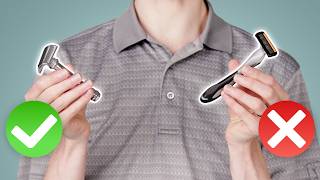
Next up, we've got two tips about shaving hardware. The first of these is number four, customize your razor body. It isn't necessary to have a razor made for you bespoke, although that is an option that exists here.
We simply mean that because a great many razors on the market use standardized threading specifications for the handle and head components to screw together, you can mix and match the handles and heads of different razors to find your ideal weight, grip, blade gap, and so on. Why do this? Simply put, it will help you to get the best shave for your face's unique needs.
Not only should you be mindful of things like hair texture and density and sensitive skin, to the latter of which we've dedicated a video, but consider also that hair may grow faster or thicker on certain parts of your face, or that your bone structure may result in angles that are best navigated by a certain razor head shape in addition to the techniques we covered earlier. To use myself as a personal example here, as someone with sensitive skin, average to slightly coarse beard hair and a sharply angular jaw, not a brag, by the way, especially since it makes shaving more difficult. I benefit from the narrow blade gap and slim head of the Hensen Shaving AL13 coupled with the weight and heft of the handle of the Moola R89 Grand.
By the way, this video is not sponsored. Of course, different blades also have a bearing on the closeness or aggressiveness of your shave. We've covered this in both our PDF guide and a separate video and article.
Our next point on hardware is number five. Properly maintain your razor and other equipment. Experienced DE shavers note that for best results, blades should be replaced frequently, not necessarily with every shave.
If you find that this doesn't provide a clear benefit, if you've got sparse coverage or fine hair texture, say, but enough that they don't dull, as a dull blade leads to both inefficiency and increased chance of irritation. But in addition to regularly switching out your razor blade, don't forget to give equal attention and care to the razor itself. The head assembly should be rinsed and if necessary, wiped while open, so doing it at the same time that you change blades is quick and easy.
The handle may also pick up loose hair, skin, or general grime from the bathroom, so it's worth cleaning off. This will also help to ensure that whatever material it's made from won't flake, chip, or rust over time. And a clean handle will be easier to grip and maneuver and won't feel gross or uncomfortable to the touch.
If you use a shaving brush and/or a mug or bowl to lather up, and we suggest that you do, make sure also that these are clean and mostly dry at the conclusion of your shave. In particular, rinse the brush multiple times to remove any remaining lather. Then, gently firmly squeeze the bristles to remove excess water, finishing by fluffing the bristles a bit with your hand.
And for both your razor and your brush, uniform air drying and safer storage are best accomplished with a razor stand. Our remaining three tips on today's list are more about the general mindset that you adopt while shaving. Beginning with number six, pace yourself.
As you become more experienced and comfortable with DE shaving, your pace will naturally start to increase. And while a faster overall shave time is more efficient and not necessarily a bad thing on its own, remember that speed isn't the goal. In other words, slow down a bit and most importantly, keep a steady pace.
There isn't really any such thing as shaving too slowly, setting aside factors external to the process itself. That is, the only caveat here is that your lather may dry out in certain spots between application and removal. To prevent this, either apply a fresh coat over the first before tackling that area or simply wait to lather certain regions of your face until you're ready to address them.
This dovetales with our earlier point about the benefits of lathering unevenly. Also, when making your strokes, ensure you're gliding smoothly and consistently, as stuttering, stop and start strokes can increase the likelihood of mishaps. Our penultimate tip is number seven.
Don't get complacent. This one is short and sweet and goes handinhand with our previous point. The moment you start to think de shaving is easy.
I'm a pro at this is often the moment you cut yourself. We're not saying that you need to be nervous or guarded while shaving, but don't forget that in simplest terms, you are running a metal blade across your skin. So pay attention, practice good form, and don't forget the basics, and you'll minimize or even avoid nicks, cuts, and other forms of irritation.
Now, for our final point on today's list, number eight, learn the rules so that you can break them. We mentioned at the beginning of this video that there's all kinds of DE shaving content out there, much of which can be very prescriptive in tone. We've even been guilty of this ourselves a time or two.
But despite the fact that a general consensus on de shaving technique has formed because it gives good results for most men, don't feel like you have to rigidly follow all rules and techniques exactly as stated. For a few examples from our GG team, Jack has finer facial hair texture and relatively light density, so he doesn't need to undertake the traditional three pass shave. One pass is enough.
Raphael also often issues the three pass process, opting instead to use multiple tools for the job. He knocks down growth with an electric shaver, then finishes up with the precision of a DE razor, a process which he's outlined in other videos for the channel. I've also adopted this multi-tool strategy, by the way, especially since adopting my beard.
And while most sources say that you should shower before shaving to soften the hairs and open your pores, I find that stripping my skin of its natural oils prior to a shave gives me more irritation. So, I shave using cold water before showering, then apply postshave products after I've showered, unless I'm shaving on camera for a GG video, but you get the idea. In short, build your shaving routine around the particular needs of your skin and hair through experimentation.
And don't be afraid to make your own rules to suit your shave. In conclusion, we hope that these advanced tips on de shaving technique, tools, and mentality will help take your shaves from serviceable to spectacular. Have you uncovered other shaving secrets of your own?
Let us know in the comments below.