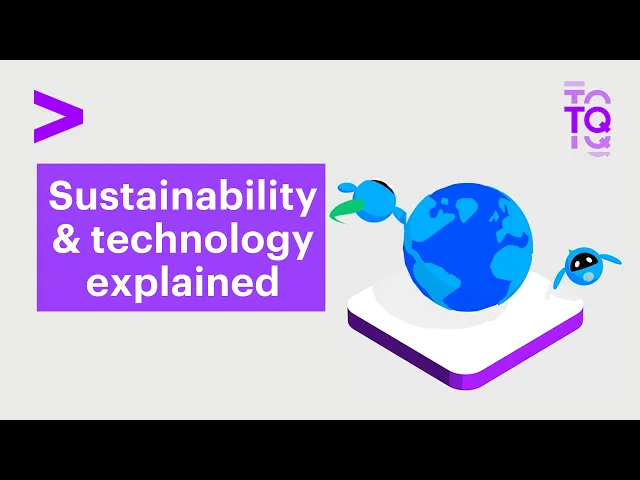
[Music] What is sustainability? Sustainability is the focus on meeting the needs of the present without compromising the ability of future generations to meet their needs. But you can't focus on sustainability without also focusing on technology.
Technology has both positive and negative impacts on sustainability. It enables us to be sustainable, but only after creating a huge energy footprint, which is why we also have to focus on technology. On the positive side, there is sustainability by technology, which uses technology to reduce negative impacts and accomplish our sustainability goals.
Examples would be solar panels and electric vehicles. And did you know that cloud migration can reduce energy use by 65% and carbon emissions by 84%? Mm-hmm.
Yes, it can. Also, a plus is sustainability in technology, whereby we make the tech we use more sustainable by doing things like using it responsibly and reducing its energy needs. But technology can also be wasteful, and it is our responsibility to minimize that waste.
In 2015, the United Nations General Assembly developed 17 Sustainable Development Goals, SDGs, with the target of achieving all of them by 2030. The goals are a global blueprint for a better future. They lead the interconnected impacts of climate change and identify targets for action.
Sustainability isn't just for governments, though. Businesses around the world are also setting goals, too. They fall into three categories, environmental, social, and governance, or ESG goals.
Sustainable businesses aim to have a positive effect when they're global and local environments as they meet their ESG goals. Sustainability and technology, the key to a better future. [MUSIC] What does sustainability and technology do?
It transforms how we live and work for the better. Let's look at how through three lenses, sustainable cloud, sustainable IT, and sustainable software. Electricity consumption at cloud data centers is huge, almost as much as a small country.
But sustainable cloud can reduce global carbon emissions by 59 million tons of carbon dioxide per year. It's like taking 22 million cars off the road. Core IT operations are responsible for almost 4% of our global greenhouse gas emissions.
That's why sustainable IT uses resources like energy and water more efficiently to minimize the impact of those data centers. And because laptops, desktops, servers, switches, and mobile phones account for close to 400 billion tons of emissions per year, sustainable IT reduces the e-waste by recycling or reusing hundreds of thousands of those devices. [MUSIC] Research shows that even choice of coding language can affect energy consumption.
In a minor tweak to an AI's algorithm instructions can increase energy use significantly. Sustainable software looks at the environmental and social impact of digital technologies like machine learning, artificial intelligence, and blockchain. Sustainable software then uses energy efficient coding language and models and even considers ethical aspects of software delivery like fairness, privacy, transparency, and accessibility.
Sustainability and technology transforming the world for the better. [MUSIC] Why does sustainability and technology matter? The obvious answer.
We have no planet B. The surprising answer. Resilience.
Sustainable development improves business resilience. That's why in addition to all the good things that come from working towards sustainability, there are business benefits too. We saw this during the COVID-19 pandemic.
Resilient businesses were able to adapt more quickly. That's why shareholders, consumers, and employees are all encouraging more sustainable practices to rebuild for the better. More sustainable design includes designing for inclusion and diversity, creating a resilient future where everyone benefits.
Based on analysis from Accenture Research, it's clear that companies with consistently high ESG ratings see higher operating margins and higher returns to shareholders. These businesses outperform their peers and experience less volatility. Sustainability.
It makes us more resilient. [MUSIC] How is sustainability and technology applied? Technology is applied to improve sustainability.
That application happens in three different ways. Number one, to measure environmental impact. In London, a coalition uses data collected by state-of-the-art sensor technology to provide a visual tool showing Londoners exposure to air pollution around the city.
Number two, to increase efficiency. Google uses AI to reduce the amount of energy used for cooling in their data centers by up to 40%. Number three, to minimize risk caused by climate change.
AT&T analyzes climate change risk to inform their business decisions. They collaborate with the US Department of Energy to create climate model data sets to help focus on extreme weather risk. Remember, sustainability isn't just about environmental issues.
It's also about social aspects such as human rights and economic governance. Leading companies around the world are setting ambitious sustainability technology targets. Sustainability and technology apply liberally to chart a path to future success.
How does sustainability and technology work? There are as many ways to make sustainability and technology work as there are technologies to employ. But let's focus on one specific case.
Metro de Madrid transports over 2. 3 million people a day in and around Madrid, Spain. Keeping commuters cool in the summer heat is a monumental task.
The energy required to power 891 ventilation fans is huge, about 80 gigawatt hours a year. Accenture partnered with Metro de Madrid using artificial intelligence and machine learning to fine tune and minimize their energy use. We built an optimization algorithm that uses massive amounts of data to explore every possible combination of factors like air temperature, station architecture, train frequency, passenger load, and electricity prices.
We filtered it through historic data and current weather information to generate plans that can predict the best, most optimal energy strategy for each station. The AI-based system has reduced Metro de Madrid's energy costs for ventilation by 25% and their CO2 emissions dropped by 1,800 tons a year. That's just one way sustainability and technology can work.
How does sustainability combine with other technologies? We know that technology and sustainability partner to do great things for our world. But let's look at how some of the technologies discussed in previous TQ topics work sustainably.
Cloud is a centerpiece of sustainability technologies. Initial cloud migrations alone reduce carbon emissions by more than 84% compared with conventional infrastructure up to 98% if dedicated cloud applications are used. Blockchain helps build circular economies and enables economic opportunity.
It tracks and traces materials across the supply chain from end to end, providing transparency for both buyers and sellers. Data provides the basic building blocks of sustainability. Measuring, analyzing, tracking and reporting emissions data helps identify and create an inventory of hot spots and find opportunities for more sustainable operations.
Enterprise platforms make sustainability easier to achieve. They collect the right data and provide a streamlined technological approach to sustainability. Sustainability and technology a winning combination.