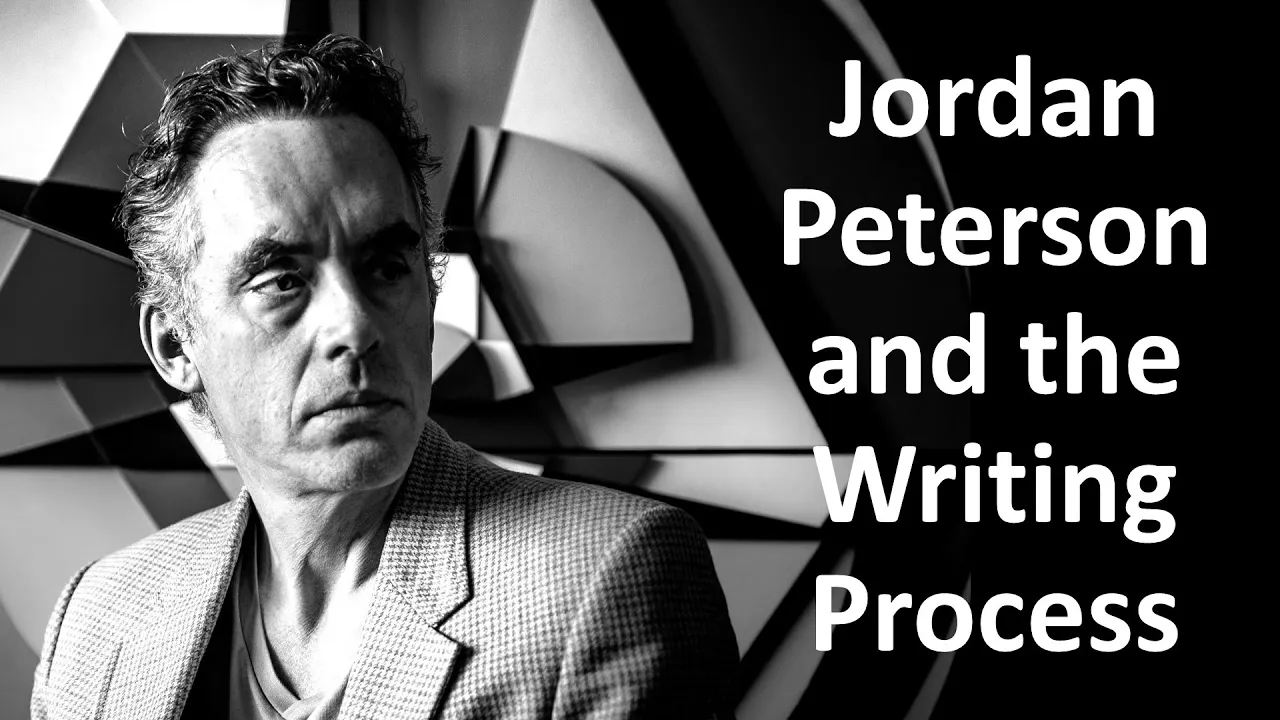
This video explores what Jordan Peterson says about writing. It's very very very difficult to learn to write. And there's arbitrary rules that you have to follow and bind yourself to.
And while you're learning those rules, the probability that you have any creative freedom to speak of or any facility with the rules is very low. You're a rank beginner, and even to some degree whatever creativity you have is going to have to be stifled while you're passing through that keyhole. But if you pass through it, then something massive opens up on the other side.
When lecturing on the 25th of January 2019, at Balboa Theatre, San Diego, California, Peterson explained his writing process. He said: I think this is a good way of approaching something that you are writing. It is a good way of approaching anything that you are thinking about.
I write out what I'm thinking about without a lot of self-editing. You know. One of the things I've noticed when undergraduates write essays, which they can't do, by the way.
Writing is quite hard, and people don't really learn it, and it's not easy to teach. So, I have taught a lot of undergraduates how to write, and you can actually teach people to write quite quickly, but you have to know how to do it, and most of the people who teach kids how to write, don't know how to write, and so they can't teach it, or they don't know how to teach it. But it doesn't matter really which of those it is.
Many of you do have to write, because generally you know you have to produce documents at work or you have to produce arguments of one form or another. So, it turns out that it's very important to write. So, the first step is to have a problem that you're trying to address that's useful and interesting.
It has to be something that grips you, because, otherwise, why would you bother writing about it. It has to be something important. This has to be a problem that you're really trying to solve.
And I would say you generally want to write about something that you don't know the answer to. One of the things you want to do when you're writing is you want to take the reader on the journey of deriving the conclusion rather than just presenting it sort of as a fait accompli. If the writing is exciting, and this is the same if you're delivering a talk, if the writing is exciting, then there's a journey of discovery that characterizes it.
You have a problem whatever the problem might be and then you try to explore it, and you attempt that's what essay means you attempt to formulate the problem more clearly. You try to formulate the answer. So, the first thing you do is you have your problem, and then you do your background research, your reading, so that you have some knowledge about the domain at least, or you do some thinking.
And then you write, and you write without too much self-criticism. You know, if you're if you're not a good writer or if you don't know what you're doing, what you try to do is you try to write each sentence so that the sentence is perfect when you write it, so you don't have to edit. And that won't work, because you're not capable of doing that.
There is no way in the world that you can come up with a sentence that is high quality in content and properly formulated in an elegant manner all at once. That's not happening. No one can do that.
So, you know, if you're making a movie, you produce way more footage than you're ever going to use in the movie, and that's actually quite convenient, because that then you have an excess of material and you can choose the best from it, and that's what you want to do when you write. So, you write to begin with. You just write down everything you think, and if you get stuck you, write I'm, Stuck here, and you just keep going.
You know? Seriously! You don't want to stop, and you don't want to criticize yourself.
You don't want to worry about how the sentences are formulated and all of that. And then you have a bad first draft, which is a wonderful thing to have, because it's way better to have a terrible first draft than to have nothing at all. And then you can edit it, and you have to assume that what you're going to do when you edit is throw away like 80% of it, and if you know that to begin with when you're writing, then it loosens you up, because who cares if what you're writing is perfect if you're going to throw 80% of it away.
So, you can afford to take some risks and to write down some things that that you're not going to keep that you might not even think are reasonable, because you're exploring and you know you can take chances, because you're going to throw 80% of it away anyways. And then it turns out that if you're willing to throw 80% of it away -- it's sort of analogous to be willing to throw 80% of yourself away as you learn through life. I would say.
Then it's much much easier to produce. It's actually the case that neurologically you have the systems that produce language and the systems that edit are different. One of the ways that manifests itself -- it's quite interesting -- sometimes people who have frontal temporal dementia it's a variant of Alzheimer's -- but sometimes people with frontal temporal dementia get more creative as their dementia progresses.
Right? It doesn't make any sense at all. You think, well, as your brain deteriorates, you get more creative.
How can that possibly be the case? And the answer is that the editor, the part of the brain that does the editing, the inhibition, deteriorates first and leaves the part that can do the creation outside of that critical realm, and so people can experience bursts of creativity that they never had before in their life. You know it's still a degenerating game across time.
But it's fascinating that that can be the case. And so, one of the things you really want to know, if you're trying to think something through, something important, is don't edit while you're producing. It's a bad idea.
It's greedy in some sense, because what it means is that you're trying to do [too much]. Like just creating is really hard and just editing is really hard, but to do both of them at the same time that's just impossible. There's just no way you can do that.
So anyway, I lay out all the ideas, and I'm assuming I'm going to throw away at least 80%. It might be 90%, because like with my first book, Maps of Meaning, I think I rewrote every sentence at least 50 times, and that is literally the truth. It wasn't quite that intense with 12 Rules, but it would have been a dozen times at least or maybe more than that, and multiple people also editing and commenting to make sure that you know that everything was set out properly.
So then, the way I manage it technically is I usually use a split screen. I have two screens, and I have the rough draft on the left hand side. Then I'll cut a piece of it out, two or three pages long, that makes a section, usually add a section title so that I can pull out a piece that I can kind of grasp intellectually, because it's hard to edit a whole 30-page document, because you can't keep the whole thing in your head.
So, you have to kind of chunk it down to something that you can manage. Then I'll throw it on the right hand monitor, and then start organizing it -- go through it sentence by sentence and paragraph by paragraph. If you think, if you're editing properly, and I'm telling you this because this is actually how you think.
If you really want to think something through, this is how to do it. So, then you have to edit and [see] what's the conceptual framework for editing? Well, the words that you use should be the right words.
So, you want to attend to every word and make sure that each word is exactly the right word for that position in the sentence, and then you want to make sure that your words fit together properly in proper phrases, and that the phrases are strung together properly within each sentence, and then you want to make sure that each sentence has its proper place in the paragraph, and then you want to make sure that each paragraph is sequenced appropriately within the context of all the other paragraphs, and then, finally, you want to make sure that the collection of paragraphs that makes up the section or perhaps the chapter tells a coherent story. I pull the material onto the other page and then I'll start with a preliminary reorganization and just try to make a better draft, and then put that back, and then I pull out one paragraph at a time. Break it up into the sentences.
So, you pull the sentence out. You put a couple of spaces between the next sentence. You unpack the paragraph, and then you can rewrite each sentence, and I mean that literally.
You have a sentence. So, then you rewrite it, and then you rewrite it again, and you rewrite it again. Now you have four of the same sentences, and now you can figure out which of those sentences is better, and you get rid of the three that are worse, and so now the first sentence is improved.
And then you do the same thing for all the other sentences, and then you see -- OK -- are those sentences in the right order, and you reorder them until you get them in the right order. Maybe you throw a few away. And I often keep the things I throw away.
I have a little -- what would you call it -- document called culls, and I just throw things in there, and sometimes I find a place for them somewhere else. But then now the sentences are written much more elegantly and they're in the right order. And, then I look at the paragraph that's rewritten, and then I look at the old paragraph, and if the new paragraph is better than the old paragraph, then I replace it, and then I go and do the same thing with the next paragraph, and then maybe I do that like 10 times.
And then I can tell when I'm done, because when I'm done, it's not that it's finished, because something like that's never finished in some sense, but I know when I'm done editing, because I'll write it, I'll take a paragraph and take it apart and make a new paragraph, and then I can't tell which paragraph is better, and so once I've got to the point where I can't make the paragraph any better, that's it. I'm finished. I can't make [it any better].
That doesn't mean it's good. It just means that I can't make it any better. It actually gets dangerous near the end, because if let's say you're feeling pretty bright one day and you're kind of alert and clear-headed and you improve a paragraph and you have a better paragraph, maybe the next day you're kind of muddle-headed and stupid and so you take a paragraph and you edit it -- this is near the end of the editing process -- and you make a worse paragraph, but you're too dim to notice, and then you replace the perfectly good paragraph with the worst one, then you've gone too far.
And so a good editor can help with that, and then you know during the process, if you're fortunate you have an editor who[m] you're submitting the work to, who then tells you where things don't flow and where you're being arrogant or egotistical or unclear or you've got your facts wrong or the sentences don't flow, and then, if you have any sense, you listen to the editor, because the editor, at least in principle, reflects the audience, and so if an editor makes a comment on something I've written, and I was kind of happy about it, I'll usually rewrite it until I get something that deals with what the editor said that I like just as well as what I had written to begin with, and then I'll substitute it. And then that also keeps the editor happy, because you know you don't want to ignore your editor, because they're working hard trying to make the thing better. So, what good is it to ignore it?
It's useful to be criticized, and I've had some very good editors. So, anyways that's basically how that works. So, those are useful things to know technically.
You think, well, you can make a bad first draft. If any of you have to write complex documents, that's a perfect way to approach it. Write a really bad draft as fast as you can.
Then you've got something, and then you can do the editing. The other thing I do too is I read all the sentences aloud, because if a sentence -- that helps with the poetic element of it. If a sentence is crafted optimally, not only does it say what you want it to say, but when you read it, it has a rhythm -- and that actually turned out to be very helpful -- even Maps of Meaning was like that, although it's a much more difficult book.
That was my first book. It has some, you know, five or six line sentences in it, but they have a rhythm, and so when I did the audio book, it was much easier than it would have otherwise been, because there was a rhythm in the sentences, and it was much easier to read aloud. And so that's nice.
And if you read a book that has been read aloud by the author, then it sort of sings, and it makes it much easier to read, and then you can also play with the music of the sentences the words and the sentences. And that's a lovely thing too. You know.
It's a wonderful thing to be able to concentrate on something like that, because it really cleans up your thinking. This is one of the things that that I've strived to talk to -- my undergraduate students about my graduate students as well. It's like, well, why would you bother writing an essay?
Why bother? Well, because you need the grade. It's like, well, why would you prepare documents?
Like, well, you know, it's a requirement for work. It's like no. That's not the reason.
The reason is you pick something that's worth thinking about, and then you think about it, because then you've thought about it, and it's useful to have thought about things, assuming that we think so that we don't do foolish things in our lives. The better you get at thinking, the clearer apprehension you have about the nature of the world and your place in it. And to pay attention to each word in each phrase in each sentence, when you're dealing with a complicated problem, it pays off massively.
You know, it clears you up. There's good evidence for that. You know if you have people write about their past then they tend to shed the baggage that they're carrying.
If you have them write about their futures, they're much more likely to put those plans into action and be successful. And so, I mean, it shouldn't be that surprising, if you think about it, because it shouldn't surprise you that thinking is useful, but it might surprise you, even though people don't do it that often, because it's difficult. But it is somewhat of a surprise to think of writing as technically sophisticated thinking.
The huge advantage to writing, and it's a massive advantage with a word processor, because editing is cheap with the word processor. Right? I mean, 40 years ago when you when you were writing by hand or typing, if you made a mistake in a sentence, you had to retype the whole damn page.
You know, it was really annoying. Now, if you write a bad sentence, you can rewrite it 10 times, and the cost of that is virtually zero. And so, what it means is you can continually edit and improve what you think, and you can make that more elegant and more powerful.
And that has unbelievable practical utility As you progress through life, one of the things you realize, especially, if you're dealing with people in relatively sophisticated situations -- but it doesn't really matter -- is that those who formulate the best arguments win. They win everything! Right?
They negotiate more effectively at work. People are more likely to listen to and abide by the plans that they formulate. They formulate better plans.
They can negotiate better with their spouse and their children, because they're articulate. And it's such a funny thing, because it's so seldomly the case. You know.
What's the utility of a liberal arts degree? Well, right now, damn little, I would say. But previously the whole idea was, well, it would teach you to communicate.
It would teach you to write. Why is that useful? Well, because if you could communicate effectively, then you always do better at everything.
You know. And it doesn't matter what endeavor you're pursuing. If you're a housing contractor and you have to negotiate with your clients, if you can formulate your plans and your arguments in an articulate way, you're way ahead of the game.
And it sharpens you up in such a remarkable way. So anyways, it's one of the wonderful things about being able to write is that it does give you that chance to really sit and think things through, and so it's something I would highly recommend. It's a hard thing to do, but you can do a little bit of it every day.
That's another thing. If you're ever interested in writing, here's something else that's practical. I learned this partly from Hemingway, because Hemingway wrote a little bit about writing.
He was very good at it. He did a lot of throwing away. You know one of his rules was if you took a sentence and you're trying to fix it, one of the first things you do is throw away every word you can possibly get rid of in that sentence and still have the sentence make sense, and one of the things that I often tell my undergraduates, when they're trying to fix their writing, is go through and shorten every sentence by 25%, and then do the same thing with the essay.
Throw away 15% of it. Shorten the sentences. Shorten the essay.
It'll improve it by a factor of 2. And then they try that, and their writing quality goes way up. So that's a nice thing to know.
Hemingway also said if you want to write you should write a little bit every day, and there was some evidence of that. I read a book when I was a first university professor called the New Faculty Member, and it was an empirical study of why faculty members failed, and most of them do. Most people in most positions fail.
I think the evidence is something like 50% of middle managers add negative net value to their companies. It's something like that. Yeah.
Well, you know people operate in failure mode frequently. And one of the mistakes that faculty members made -- they made two -- one was if they were teaching, and they were doing badly, they prepared more, and that made their lectures worse, and the second was that if they weren't writing, then they would wait until they had large blocks of time where they could concentrate on writing, because people often think, Well, I have a novel I'd like to write [and] one day I'll have enough time and I'll sit down and do it. It's like that will never happen.
That will never ever happen. You will never have enough time to write your novel, because your time isn't your own. Your time is distributed among other people, and if you want it, if you want to take some time for something that you want to do that's personal like that and that's private, you have to steal that time away, and everyone's going to object to it, and so you can't steal that much.
You have to steal it in a sort of a sneaky way. You have to sneak off and have your own time. And so maybe you could write half an hour a day, or maybe you could write 15 minutes a day, or maybe you could write 45 minutes a day.
I spent some time in my life writing 3 hours a day, but I had to viciously discipline my family before I could ever get to that point. You know in something like a junkyard dog defending my time. But this is something that's really important to know.
Like if you want to write, then you take a little time every day and do it. And you know if you write a page a day, that's 400 pages a year. Right?
That's a whole novel in a year. So, you can get a tremendous distance doing a little bit every day. That's a good thing to know about whatever it is that you want to pull into your life.
You can steal a little bit of time every day. But if you wait until the luxury of having a week to write or a month to write or even a weekend to write on a regular basis, like that's never going to happen. Your time is valuable, and other people will use it up on important, but also short-term, things.
So anyways, that's a bit of a discussion of the technical process. To summarize, Peterson said: Write to improve your thinking. Drft quickly and without self-judgment.
Read aloud what you wrote. Make time to write. Words have power.
You might want to look at Peterson s 10 step process for writing essays. It is available on his website at: https://www. jordanbpeterson.
com/ A longer, more specific, url is in the video notes. Peterson's essay writing steps are: 1. Find a reason for writing.
2. Understand that written language possesses levels of complexity from words to groups of paragraphs. 3.
Make a list of interesting topics and a list of reading material on those topics, read the material, take notes, and select ideas that interest you. 4. Choose a topic, and make an outline.
5. Drft sentences for each outline element. 6.
Create variations of your sentences, read your sentences aloud to find phrases that flow well, and rearrange the rewritten sentences in to paragraphs. 7. Reorder your paragraphs.
8. Create a new outline from memory, and slot your paragraphs into the new outline. 9.
Rewrite and reorder your sentences and paragraphs. 10. Document where you obtained the facts, opinions, and quotations that you borrowed from other people.
If you are doing other information writing, such as writing reports, proposals, email, blogs, or web content, you might want to check out my 7-step writing process. Go to: www. toweringskills.
com/7steps/. If you can think and speak and write, you are absolutely deadly! Nothing can get in your way.
That is why you learn to write.