The kingdom of Congo, 1482. Portuguese explorer Diogo Cao is the first European to sail up the Congo River into the heart of this ancient African nation. Despite the dense rainforest on both sides of the river, Cao spends months exploring this unknown land and meeting its inhabitants.
[music playing] After he reports his discoveries back home, the king of Portugal dispatches waves of missionaries to the region. The goal is to convert tribesmen from their ancient religion of Vodun to Catholicism. [music playing] TOK THOMPSON: You have to remember this isn't too long after the crusades.
So Europe had already sort of went from right from the crusades into colonialism. And one of the big projects was not just to get land and money and slaves, although that was it, but also to gain souls, converts for the Catholic Church. [music playing] NARRATOR: Over the next century, European missionaries have great success turning the kingdom of Congo into a Catholic land.
Their belief that a sky god created the Earth and its inhabitants is changed to the Catholic origin story. But the locals hold on to some of their beliefs, including the concept, which is also held by the ancient Egyptians, that people have more than one soul. TOK THOMPSON: We have what's called a big soul and a little soul.
And one of them is responsible for what we normally think of us our personality-- what makes you, you; what makes me, me. But the other one is more of a basic sort of soul that animates us. It gets the flesh moving.
They speak of us as each having lesser angel and a greater angel. At the time of death, the lesser angel stays with the body. It doesn't know what to do, but the greater angel leaves the body.
[music playing] NARRATOR: As missionaries convert much of the population to Christianity, traditional bocors or witch doctors are forced to perform some Vodun ceremonies in secret. European missionaries hear astounding stories that these witch doctors use ancient rituals and traditional knowledge to raise the dead, creating automatons that are later dubbed zombies. TOK THOMPSON: The idea of the zombies is that they actually have only one of these two souls.
They've passed on; they've died; and they've been resurrected, but only with the soul that animates us. So they're lacking in that personality and in that personal feelings and things. DAVID CHILDRESS: With zombieism, it is then only the physical body is resurrected in a sense.
And the personalities, that part of the soul, has completely disappeared. [music playing] NARRATOR: Could these stories have been true? And if so, might this be proof that both the Egyptians and the tribes of the Congo were correct in their belief that our consciousness is divided into separate parts?
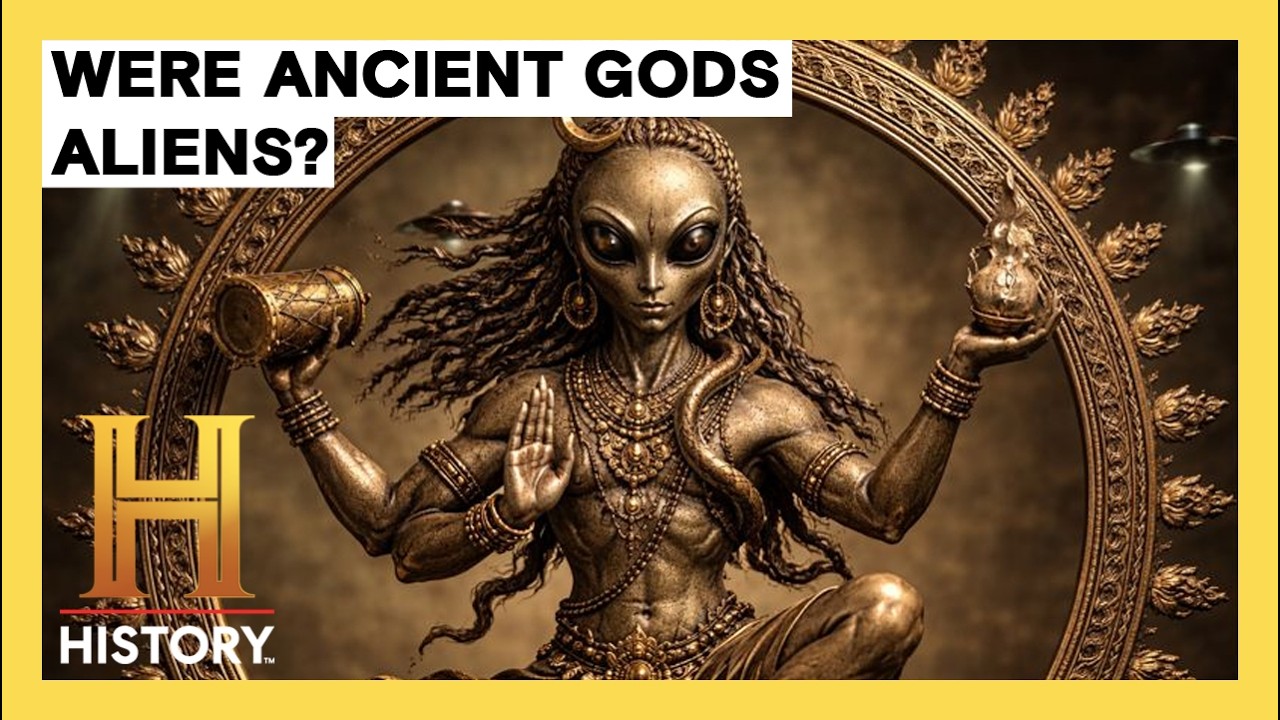
But how could witch doctors who lived hundreds of years ago with no access to modern technology have been able to breathe life into the dead, reviving just the part of the soul responsible for animating the flesh? [music playing] Ancient astronaut theorists point out that African myths suggest voodoo magic originated with the sky gods and their emissaries to Earth, known as a Orishas or Loas. GIORGIO A.
TSOUKALOS: The topic of the Orishas is very interesting to me because they are looked upon as these divine messengers, messengers of knowledge. And the stories are very clear that the Orishas arrived from the sky. And what I find interesting is that in many of the old carvings that we can find in wood, for example, they are depicted in sitting in these weird craft that look like craft.
And that they all seem to feature these elongated skulls. NARRATOR: Is it possible that these African sky gods were actually extraterrestrials that not only taught the natives the secrets of the soul, but also showed them how to resurrect the dead? And could this be the origin of our modern day stories of zombies?
WILLIAM HENRY: Perhaps, through the centuries, these original teachings of these celestial beings were lost. Sorcerers and magicians in Africa and elsewhere began mimicking-- we're trying to copy what the originals had done and had a limited degree of success. They were able to create zombies.
But the source is clear, these teachings originally came from celestial beings. The Sahara Desert stretching across northern Africa and covering nearly 3 and 1/2 million square miles, it is one of the hottest and most formidable places on Earth. With an average rainfall of only half an inch per year, humans have fought a relentless battle to adapt to the harsh environment or die.
DAVID CHILDRESS: Historians have often looked at the Sahara desert and wondered what it is that created this particularly inhospitable desolate area of the planet. But in the Algerian Sahara in the region up to Tassili N'ajjer, numerous cave paintings, some estimated to date back as far as 8,000 BC depict a time when the land was lush and teeming with life. But if so, what happened?
The scenes that you see at Tassili N'ajjer are totally bizarre. They're showing a Sahara that was once fertile with giraffes and antelope and other animals we find only in Central Africa really. And combined with them are these bizarre pictures of what even the archaeologists have called the martians and the spaceman.
They have strange helmets on and suits. They look exactly like extraterrestrials. GIORGIO A.
TSOUKALOS: The petroglyphs that we find there are incredible. They look like modern day astronauts with suits, with helmets, with visors. And according to the legends of the Tassili region, the natives were visited at a time when a climate change was about to happen.
So is it possible that the reason why we have these depictions of these ancient aliens is because they assisted the Native population at the time of climate change to move into a new area of habitation? NARRATOR: Did alien beings visit this region thousands of years ago? And if so, might they have warned the local population of an enormous climate change, one that would trigger a vast migration.
Ancient astronaut theorists believe the answer is yes. And for evidence, they point to the ancient legends of a West African tribal people known as the Dogon. DAVID CHILDRESS: According to the Dogon themselves, they were guided by their alien fish gods, the Nomo, to this area near the Niger River where there's a lot more water.
So they had to transit across the inhospitable Sahara to find their homeland. And their own explanation is that alien gods led them to this fertile area where they could establish their civilization. JASON MARTELL: The Nomos describe coming down in some type of flying craft.
The Dogon tribe gave some very interesting details which sound like a UFO, a large spinning disk that made a lot of sound and wind as it descended to Earth. And the Nomo was up here. So this is a very interesting story which was replicated by many different cultures of seeing beings descending from the heavens to Earth.
Were they gods, or were they extraterrestrials? Even today, the Dogon believe they are the children of the Nomo-- strange gods who came here from the Sirius star system. GEORGE NOORY: The Dogon tribe look up at the star system of Sirius, and they are convinced that they were visited here, and they were told about a star system, a binary system that we didn't know about for years later.
How did these people know this? PHILIP COPPENS: The Dogons have always been focused upon in the sense that they have this story, this information about their ancestors who somehow had this contact with this nonhuman intelligence. And the question is how did they obtain this?
That really might come from the Sahara desert from specifically culture pockets like the Tassili N'ajjer, and that the Dogon are descendants from these people. [music playing] Lalibela, Ethiopia. Hidden from view within this mountainous African landscape lie 11 churches carved entirely from a single block of stone.
If you approach Lalibela, you don't even see anything. But the moment you get closer, all of a sudden, the ground opens up, and you have these huge, magnificent churches that have been cut out of the bedrock. So really, rather than building, Lalibela was cut from the rocks from upstairs to downstairs.
So really, what you have is an amazing engineering feat which literally topples everything we know about building techniques. NARRATOR: Religious ritual is central to the life of Lalibela. Each year, nearly 21,000 Christian pilgrims come to worship.
Ethiopian Christianity is much more directly tied to the Old Testament than the Christianity practiced in the Western world today. Christianity was introduced to Ethiopia about the same time it was introduced to Western Europe, to France, for example. Interestingly enough, that of all the Christian world, Ethiopia is the only place where they have these monolithic churches.
NARRATOR: Mainstream archeologists believe the churches were carved as early as the 12th century. But engineers who have studied the design of the churches have concluded that their construction is scientifically inexplicable. You see the churches at Lalibela, you can see that they're using what would probably have to be power tools.
Anytime you're cutting hard stone, you're looking at specialized cutting tools, need iron tools. Even today, we would have to use power saws and grinding wheels and chisels. NARRATOR: But if, as ancient astronaut theorists believe, the churches of Lalibela could not have been made without modern technology, then who, or what, built them?
MICHAEL GERVERS: Now, according to the story, "The Life of King Lalibela," which is written down in the 15th century, the angel Gabriel came to King Lalibela and took him off to the heavenly Jerusalem where he had a conversation with God, and God said that he wanted him to go back and build his churches. So he came back and had them constructed. He had them hewn out of the rock.
They took years to complete the job. It was 24 hours a day, but Lalibela had the help of the angels. [music playing] So, according to legend, angels came down from heaven, and at night, did the work that the human beings could not do because they were sleeping.
So there were actually two shifts of workers at the rocks of Lalibela, one, human beings working during the day, and the other, extraterrestrial beings working at night doing the night shift. To me, that is a very fascinating story, because in my opinion, angels do not exist. Angels were merely a misinterpretation of flesh and blood extraterrestrials who descended from the sky with means of technology.
And that is what these quote unquote, "angels," used. >> NARRATOR: South Africa. 25 miles northwest of Johannesburg lie the Malapa Caves.
Here, in August of 2008, paleoanthropologist Lee Berger and his nine-year-old son Mathew discover several fossilized skeletal remains of two-million-year-old early humans, including a female adult and male child, perhaps a mother and son. The size and shape of the bones indicate that the individuals walked upright and had modern hands. Over the past several decades, scientists have unearthed the remains of nearly two dozen different types of early human ancestors, all known as hominids.
>> IAN TATTERSALL: We have an extremely good fossil record of ancient hominids, and I think the picture emerging from it is pretty clear that in earlier days, before Homo sapiens came along, there were typically many different kinds of hominids coexisting in the world. >> CRAIG STANFORD: We have a hard time getting our minds around this now because, of course, there's just one kind of human on Earth today and there's seven billion of us, but at one time, within the last few hundred-thousand years, you could find two or even three species of hominid living in the same area at the same time. >> NARRATOR: Most mainstream scholars tell us hominids evolved from an ape ancestor nearly six million years ago through what is referred to as natural selection.
This theory of evolution was first popularized by English anthropologist Charles Darwin in his 1859 book<i> On the Origin</i> <i>of Species. </i> >> TATTERSALL: Darwin's mechanism of evolution was natural selection. That is to say a long-term process whereby better-adapted individuals reproduce more successfully.
>> FIORELLA TERENZI: Darwin's theory of evolution by natural selection explain that organism with certain traits, such as mutation, turn out to be actually beneficial, turn out to be of advantage in the struggle for reproduction. So mutation allow organism to survive and to pass on to the next generation these mutation. >> NARRATOR: Darwin speculated that over time, hominids walking on two feet used their hands to make tools.
This, in turn, made them smarter. Then, approximately 200,000 years ago, hominids evolved into Homo sapiens. .
. or modern man. But many scholars dispute Darwin's findings.
>> REDFERN: We don't see dolphins building cars. We don't see elephants building houses. That might sound trite, but it's a fact that these animals just simply haven't progressed and advanced in the way we have.
And the big question is, why is that? Why should that happen? Why should we be so unique?
>> STANFORD: Tool use doesn't really come into play for several million years after the first earliest humans began to walk upright. And then brain size doesn't really begin to expand and really mushroom in size until the last several hundred thousand years. So, actually six million years of human evolution, there are millions of years separating each of those major features: upright posture, tool use, brain expansion.
So Darwin was wrong because he couldn't possibly have known the chronology in his day. >> NARRATOR: In 1967, British zoologist Desmond Morris argued against Darwin's theories on evolution in his book <i>The Naked Ape. </i> In it, Morris wrote that there was no reason why man stood alone from other species in terms of his nudity.
>> TATTERSALL: Well, of course, as Homo sapiens we still continue to have a coating of hair, but that hair is very much reduced over most of our bodies, and that reduction probably goes back way beyond Homo sapiens in time. It probably goes back to the time when the very first early bipedal hominids came out of the forests in Africa into the savannahs where they had more sun and more thermal radiation to cope with. >> STANFORD: In places like Europe, Northern Europe, why we lost body hair is the chicken and egg question.
Did we lose our body hair because we began to wear clothing to keep us warm or was there some other factor at work that caused us to lose our body hair? Perhaps women didn't find body hair on men attractive, and so it was lost because they didn't choose those men as mates. There's no way to ever answer that question.
>> TSOUKALOS: If we were to subscribe 100% to the idea of survival of the fittest, isn't it illogical to think that all of a sudden we're completely naked and we're losing all of our fur? I mean, that makes absolutely no sense because right after we shed our fur, we had to wear furs to keep warm. Had we not worn any furs, we would have frozen to death, we would have died.
So the whole idea that we shed all of our hair in order to survive because we were stronger, logically makes no sense.