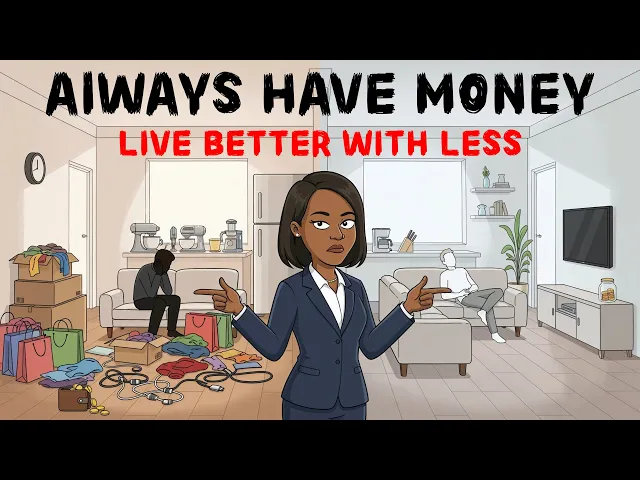
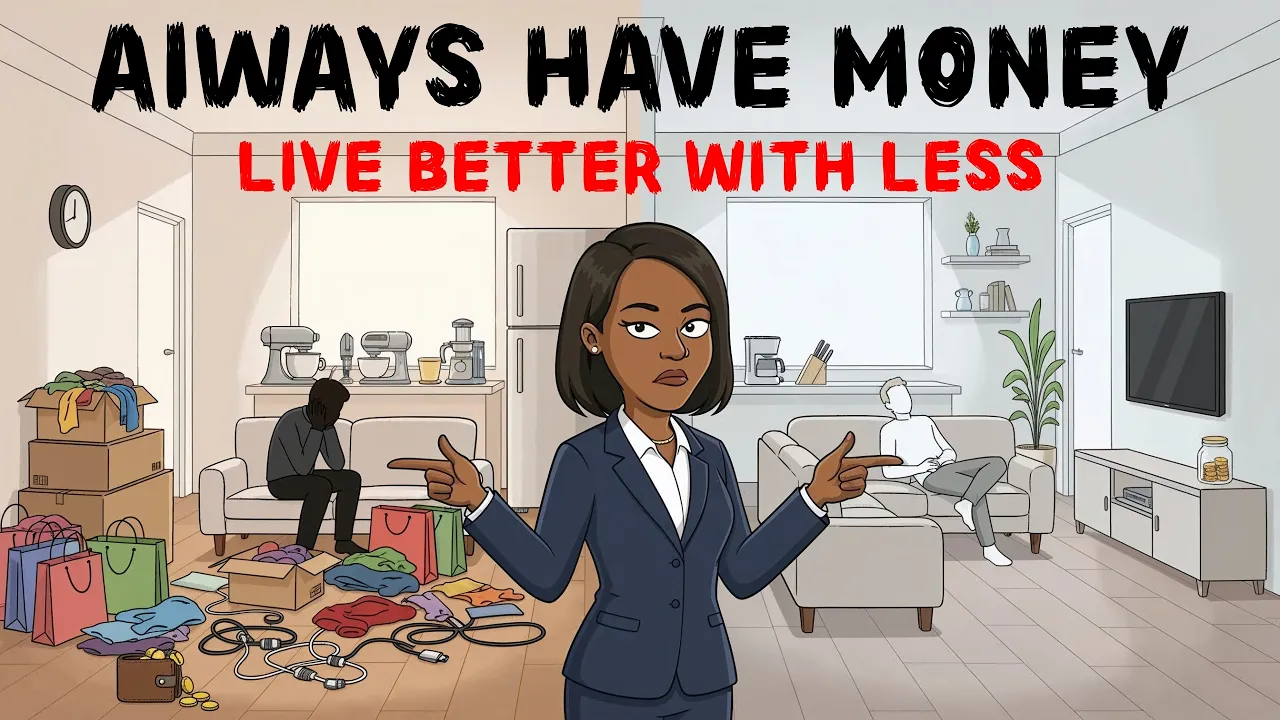
I want you to picture two apartments. Same city, same neighborhood, similar rent. The first apartment belongs to someone earning $95,000 per year.
Walk inside and you'll find a 75-in television mounted on the wall. A leather sectional that cost $4,000. A kitchen full of appliances, most still in their original boxes.
Closets overflowing with clothes, many with tags still attached. A spare bedroom converted into storage for items that haven't been touched in years. This person checks their bank account with a knot in their stomach.
They're two missed paychecks away from crisis. The second apartment belongs to someone earning $52,000 per year. Walk inside and you'll notice space.
A modest couch. A reasonably sized television. A kitchen with exactly the tools that get used regularly.
A closet with clothes that actually get worn. The spare bedroom is actually a bedroom. This person checks their bank account with calm confidence.
They have 18 months of expenses saved and invest 20% of every paycheck. Same neighborhood. The person earning almost half as much has nearly 10 times the financial security.
This isn't a story about income. It's a story about the hidden relationship between stuff and money that most people never understand. The first person isn't bad with money in any obvious way.
They don't gamble. They don't have expensive addictions. They just gradually accumulated a lifestyle that requires every dollar they earn to maintain.
The second person discovered something that changed everything. They learned that owning less doesn't mean living worse. It means living deliberately.
And deliberate living creates financial margin that most high earners never experience. Today, I'm going to walk you through the minimalist money rules that separate people who always have money from people who never do, regardless of income. These aren't about deprivation.
They're about understanding that every object you own has ongoing costs you've probably never calculated. Let me start with a concept that will reframe how you think about every purchase you make for the rest of your life. Everything you own costs money twice.
The first cost is obvious. It's the purchase price, the number on the receipt. But there's a second cost that most people completely ignore, and it's often larger than the first.
The second cost includes storage, maintenance, mental energy, and opportunity cost. That treadmill you bought requires space in your home. Space costs money, roughly $30 to $50 per square foot annually in most urban areas.
A treadmill takes up about 20 square feet when you account for clearance space. That's $600 to $1,000 per year in implicit rent you're paying to store exercise equipment that probably hangs clothes most days. The second cost also includes maintenance and upkeep.
That boat sitting in your driveway needs winterization, cleaning, registration, insurance, and occasional repairs. The industry rule of thumb suggests annual maintenance costs run about 10% of the boat's value. A $30,000 boat costs 3,000 per year just to own, even if you never take it on the water.
I am not done yet. The second cost includes mental energy, too. Every item you own occupies a small slice of your attention.
It needs to be cleaned, organized, maintained, insured, worried about, and eventually disposed of. Researchers have found that visual clutter increases cortisol levels and reduces the brain's ability to focus. Your stuff is literally stressing you out in ways you can't consciously perceive.
Nope, not over yet. The second cost includes opportunity cost. Every dollar locked up in possessions is a dollar not invested.
That $15,000 home gym equipment setup could have been $15,000 in index funds growing to $50,000 or more over 15 years. You didn't just buy a home gym. You bought a home gym instead of future financial freedom.
When you add up these hidden costs, many possessions cost more to own than they cost to buy. The purchase price is just the entry fee. The ongoing costs continue for as long as you possess the item.
Minimalists understand this intuitively. They're not avoiding possessions because they hate nice things. They're avoiding possessions because they've calculated the true cost and decided most things aren't worth it.
This leads to the first rule that minimalists follow religiously. Rule one, calculate cost per use before any purchase. Before buying anything, estimate how many times you'll realistically use it.
Divide the total cost by that number. This gives you the cost per use, which is the only honest measure of value. A $200 jacket worn twice costs $100 per wear.
A $400 jacket worn 200 times costs $2 per wear. The expensive jacket is actually cheaper in any meaningful sense. This calculation destroys most impulse purchases immediately.
That $300 kitchen gadget you'll use twice a year costs $150 per use over the first year. That's an obscenely expensive way to accomplish whatever task it performs. Meanwhile, a $30 tool you use weekly costs less than 60 cents per use over the first year.
Cost per use also reveals which purchases are genuinely worthwhile. A $2,000 mattress used every night for 10 years costs about 55 cents per use. That's extraordinary value for something affecting your health and energy every single day.
A $1,500 espresso machine used daily for 5 years costs less than a dollar per use, likely saving money compared to coffee shop visits. The math cuts through marketing, emotion, and social pressure. It reveals what actually makes financial sense versus what just feels appealing in the moment.
Rule two, apply the replacement test to everything you already own. Walk through your home and look at each item you possess. Ask yourself a simple question.
If this item disappeared today, would I spend money to replace it? Be honest. Would you actually go buy another fondue set?
Would you replace that bread maker collecting dust in the cabinet? Would you repurchase those clothes you haven't worn in 18 months? For most items, the honest answer is no.
You would not replace them. They exist in your life through inertia, not intention. They were impulse purchases, gifts you felt obligated to keep, or remnants of past hobbies and phases you've moved beyond.
These items have negative value. They cost you space, mental energy, and maintenance without providing corresponding benefit. Every hour spent organizing, cleaning around, or thinking about items you wouldn't replace is an hour stolen from activities that actually matter.
Minimalists ruthlessly eliminate items that fail the replacement test. They sell what has value, donate what someone else could use, and discard what serves nobody. The process feels uncomfortable initially and then liberating once complete.
The psychological weight of owning things you don't want or need is substantial. Removing that weight creates mental space that's difficult to describe, but immediately noticeable. Rooms feel larger.
Decisions feel simpler. Cleaning takes half the time. You know where everything is because everything remaining has a purpose.
Rule three, never upgrade out of boredom. There's a pattern I see constantly among people who earn good incomes but have nothing to show for it. They upgrade perfectly functional items simply because they're bored with them or because newer versions exist.
Their television works perfectly, but the new model has slightly better contrast. Their phone operates flawlessly, but the new release has a marginally improved camera. Their car runs reliably, but the New Year's model has updated styling.
Their furniture serves its purpose, but they've grown tired of looking at it. These upgrades feel like improvements. They're actually wealth destruction disguised as progress.
Minimalists maintain a strict policy. Never replace something that functions properly. The phone that makes calls, sends messages, and runs apps does not need replacement because a newer phone exists.
The car that reliably transports you does not need replacement because the neighbor bought something shinier. This policy saves enormous sums over a lifetime. The average American replaces their phone every 2 to 3 years, often, while the previous phone works perfectly.
Over 30 years, this pattern costs $30,000 to $50,000 in unnecessary purchases. Applied across all categories where upgrade culture operates, the lifetime waste easily exceeds $200,000. Minimalists escape this trap by defining functional clearly.
An item remains functional until it genuinely fails to serve its purpose. Boredom is not failure. Desire for novelty is not failure.
The existence of newer alternatives is not failure. Actual mechanical breakdown or genuine inability to perform required tasks is failure. Everything else is marketing convincing you to solve problems you don't have.
Rule four, create friction for spending and ease for saving. Human behavior follows the path of least resistance. If spending is easy and saving is difficult, you'll spend.
If saving is easy and spending is difficult, you'll save. Minimalists engineer their environment to make the right choice the easy choice. Spending friction looks like removing stored credit card numbers from online retailers, requiring a 24-hour waiting period before any non-essential purchase, deleting shopping apps from your phone, unsubscribing from promotional emails, and avoiding stores unless you have a specific intended purchase.
Saving ease looks like automatic transfers to investment accounts on payday. Keeping only small amounts in easily accessible checking, making investment contributions happen before you see the money, and treating savings like a fixed expense rather than an afterthought. These structural changes matter more than willpower.
Willpower depletes throughout the day. Environment is constant. Someone relying on willpower to avoid impulse purchases will eventually fail when they're tired, stressed, or emotional.
Someone who deleted the shopping apps and removed their credit cards simply cannot impulse purchase in that moment. Minimalists don't trust themselves to consistently make good decisions. They design systems that make good decisions automatic.
The 24-hour waiting rule alone eliminates roughly 70% of impulse purchases. Most desires for objects fade within a day if not acted upon immediately. Rule five, count your possessions regularly.
This sounds obsessive until you actually do it. Counting forces awareness. Awareness prevents accumulation.
Pick a category. Count how many items you own in that category. Write it down.
The numbers often shock people who've never examined their consumption patterns objectively. How many shirts do you own? Most people guess low and discover they have three or four times what they estimated.
How many kitchen gadgets? How many pairs of shoes? How many items in your junk drawer?
How many books you'll never read again. The count itself changes behavior. Once you know you own 47 shirts, buying another feels different.
You're not adding a shirt. You're bringing your collection to 48. The absurdity becomes visible.
Minimalists track key categories over time. They set maximum thresholds, perhaps 30 items of clothing total, perhaps 15 books at any given time, perhaps a one-in oneout policy where any new purchase requires removing something existing. These constraints prevent lifestyle creep.
Without intentional limits, possessions expand to fill available space. With limits, each addition requires a conscious decision about what it's replacing. That friction alone dramatically reduces acquisition.
Rule six, rent or borrow before you buy. Most items people purchase get used intensively for a short period and then rarely afterward. The excitement of newness fades.
The initial enthusiasm decreases. The item joins the collection of things owned but seldom touched. Minimalists test this pattern by renting or borrowing before committing to ownership.
Want to get into camping? Rent equipment for the first few trips. Want to try woodworking?
Borrow tools from a friend or use a maker space. Want a kayak? Rent several times before purchasing.
This approach accomplishes two things. First, it reveals whether the enthusiasm is genuine or temporary. Many interests fade after the initial exploration.
Better to discover this while renting than after purchasing equipment that collects dust indefinitely. Second, it clarifies exactly what you need. Firsttime campers often buy too much or buy the wrong things.
Renting lets you learn before committing. When you eventually purchase, you buy precisely what's necessary rather than guessing. The buy first mentality costs people enormously over their lifetimes.
Closets and garages across America contain dusty remnants of abandoned hobbies. Ski equipment from the phase when they thought they'd ski regularly. Photography gear from when they imagined becoming serious photographers.
Music equipment from bands that played two shows. Minimalists avoid becoming museums of past enthusiasm. They test interests before investing.
They maintain the flexibility to explore without the burden of ownership. Rule seven, understand the lifestyle multiplier effect. Every possession you own connects to other possessions.
A boat requires a trailer, a hitch equipped vehicle, storage fees, maintenance supplies, safety equipment, and appropriate clothing. A purchase that seems singular actually triggers a cascade of supporting purchases. This is the lifestyle multiplier.
Major purchases multiply into ecosystems of related expenses. The true cost is never just the item itself. Watch how this plays out with common purchases.
A home gym requires flooring, mirrors, storage solutions, ventilation considerations, and often renovations to make the space suitable. A pool requires chemical supplies, cleaning equipment, covers, furniture, maintenance tools, and often landscaping to complement the installation. A motorcycle requires gear, storage, maintenance equipment, and often a truck or trailer for transportation to riding locations.
Minimalists calculate the full ecosystem cost before any major purchase. They know that a $5,000 purchase might actually represent $8,000 or $12,000 when all the multiplier expenses are included. This full accounting often transforms what seemed like a reasonable purchase into something clearly excessive.
The multiplier effect also works in reverse. Eliminating one major possession often eliminates an entire category of related expenses. Selling the boat means no more storage fees, insurance, registration, maintenance, or towing costs.
The savings extend far beyond the item's value. Rule eight, define enough before you start earning. Here's something that traps high earners constantly.
They never define what enough looks like. So they keep purchasing more without ever arriving at satisfaction. Their income increases, so they upgrade their lifestyle.
The new lifestyle becomes normal, so they need another income increase to feel progress. This cycle continues indefinitely. People earning $300,000 feel just as financially stressed as people earning $80,000 because their expectations and expenses expanded alongside their income.
Minimalists break this cycle by defining enough before they start earning. They decide in advance what kind of home is sufficient. What kind of car meets their needs?
What level of material comfort constitutes genuine satisfaction? Then they earn toward that target rather than constantly moving the goalpost. This might mean deciding that a $350,000 home is enough even if you eventually could afford $600,000.
It might mean deciding that a $30,000 car is enough even when colleagues drive $70,000 vehicles. It might mean deciding that your current wardrobe is enough even as your income could support constant upgrades. Defining enough creates a finish line.
Without it, you're running an endless race where lifestyle expansion always outpaces income growth. With it, you reach a point where additional income flows entirely to saving and investing rather than consumption. The person who defined enough at $60,000 of annual spending and then started earning $150,000 builds wealth at an extraordinary rate.
The $90,000 difference between income and enough goes directly to financial freedom. Meanwhile, someone earning the same $150,000 but constantly redefining enough upward might save almost nothing. Rule nine, measure wealth by optionality, not accumulation.
The conventional view measures wealth by what you have. Houses, cars, possessions, visible markers of success. Minimalists measure wealth differently.
They measure it by what they can choose. Can you leave a job that's destroying your mental health? Can you take 6 months off to handle a family emergency?
Can you move to a new city for a relationship? Can you start a business without guaranteed income? Can you retire before 65?
Can you say no to opportunities that pay well but compromise your values? These options represent true wealth. They're only available to people who've built substantial margin between their income and expenses.
The person earning $200,000 but spending $195,000 has almost no optionality. They're chained to their income requirement. The person earning $80,000 but spending $45,000 has extraordinary optionality.
They can absorb disruptions, take risks, and make choices based on preference rather than financial necessity. Minimalists understand that optionality requires liquid resources more than physical possessions. The money tied up in a car you don't need is money that can't buy your freedom when you need it.
The home equity locked in excess house is equity that can't fund a career transition or extended sbatical. This perspective transforms spending decisions. Each purchase isn't just exchanging money for an object.
It's trading optionality for possession. Is this item worth reducing your ability to make free choices about your life? Sometimes yes, often no.
Rule 10, practice cyclical decluttering rather than annual purging. Most people who attempt minimalism do a massive purge, feel great for a few weeks, and then gradually accumulate back to their starting point. The purge feels productive.
The gradual reaccumulation goes unnoticed. Within 2 years, they're right back where they started. Minimalists avoid this pattern through cyclical decluttering.
Rather than annual massive purges, they perform small regular reviews, weekly glances at incoming items, monthly evaluation of one category, quarterly assessment of overall accumulation trends. This cyclical approach catches accumulation early before it rebuilds to overwhelming levels. Removing three items per week is manageable and sustainable.
Removing 300 items once per year feels overwhelming and often gets postponed indefinitely. The cyclical approach also maintains awareness. When you evaluate your possessions regularly, you notice patterns.
You see which categories tend to grow. You identify which emotional states trigger acquisition. You recognize which marketing tactics work on you specifically.
This awareness enables prevention rather than just treatment. Let me give you a practical implementation of these rules that you can start today. This week, walk through your home with the replacement test in mind.
Identify 10 items you would not replace if they disappeared. Sell, donate, or discard those items. Notice how it feels to remove things you don't actually want.
This month, implement the 24-hour rule for all non-essential purchases. Track how many purchase desires survive the waiting period versus how many evaporate. The data will reveal how much of your spending is impulsive rather than intentional.
This quarter, count your possessions in three categories that tend to accumulate for most people. Clothing, kitchen items, and media or entertainment are useful starting points. Set a maximum threshold for each category based on what you actually use this year.
Define what enough looks like across major spending categories. What home is sufficient? What transportation is adequate?
What wardrobe meets your genuine needs? Write these definitions down. refer to them when temptation arises to exceed your own standards.
The financial transformation from these practices compounds over time. Someone who applies these rules consistently for 5 years accumulates substantially less while saving substantially more. The gap between their lifestyle and their income creates wealth that can't be built any other way.
Here's what nobody tells you about minimalism and money. The relationship is birectional. Owning less creates more money, but having more money also makes owning less feel natural.
When your savings account is robust and your investments are growing, the urge to accumulate diminishes. The psychological need that drives most consumption. The need for security and status get satisfied by financial strength rather than physical possessions.
You don't need the stuff to feel successful because your bank account already tells you the story you want to hear. People trapped in consumption cycles often can't explain why they buy so much. The truth is usually that spending temporarily fills an emotional void that financial insecurity creates.
Address the insecurity through actual financial strength and the compulsion to spend often dissolves on its own. This creates a virtuous cycle. Spending less leads to saving more.
Saving more creates security. Security reduces the emotional drive to spend. Reduced spending accelerates saving further.
Each turn of the cycle reinforces the next. The opposite cycle is equally powerful but destructive. Spending everything creates insecurity.
Insecurity drives more spending as temporary emotional relief. More spending deepens insecurity. The cycle continues until some external shock forces a breaking point.
The choice between these cycles determines financial trajectory more than income ever could. High earners trapped in the destructive cycle build nothing. Modest earners riding the virtuous cycle build everything.
The minimalist rules I've outlined aren't about suffering or deprivation. They're about recognizing that most consumption doesn't actually improve life satisfaction. Research consistently shows that beyond a baseline of security and comfort, additional purchases contribute minimally to well-being.
Yet, most people spend as if happiness scales linearly with spending. Minimalists align their behavior with this research. They spend enough to be comfortable and then redirect the excess toward freedom rather than accumulation.
They end up with less stuff and more life. That apartment I described at the beginning, the one belonging to someone earning $52,000 with 18 months of savings, belongs to someone applying these rules consistently. They didn't get there through exceptional income.
They got there through exceptional clarity about what actually matters. The other apartment, the one belonging to someone earning $95,000 whose two paychecks from crisis, belongs to someone who never question the assumption that more stuff equals better life. Both lifestyles are available to you regardless of what you currently earn.
The choice is simply whether you want to own your possessions or whether you're comfortable with your possessions owning you. The math strongly favors the first option.