In this video, I will teach you how to remember everything you read, learn, and study. Not because I have a perfect memory, but because I went through the cycle of reading, forgetting, learning, forgetting. For years, I thought I had a bad memory.
My experience with subjects like [music] math, as with many others, was mediocre at best. There was a continuous cycle of learning the formula, doing the homework, understanding it, then blanking on the exam day. I thought the issue was that I wasn't really learning, that I wasn't understanding the material, which wasn't the main [music] problem.
It took me a long time to realize the actual issue. The problem was that I was consuming information without ever processing it. And those two are completely different things.
One feels productive and one feels uncomfortable. The reason the system works is because it separates learning into two stages. The first stage is absorbing, taking in the information.
The second stage is processing, actually doing something with it. Most people think that if they focus on absorbing more, they'll remember more. So, they try to read faster, watch lectures at double speed, binge listen to podcasts, highlight entire chapters, and it feels productive.
You're covering material. You're taking action. You're doing something.
But here's a question worth asking. When you're absorbing information, what are you actually doing? You're following along.
You're nodding. You're recognizing ideas as they pass by. Now, think about processing.
What does that require? You have to stop, close the book, and try to recall what you just read without looking. Notice how different that feels.
One feels like progress, and the other feels like a test you didn't study for. So, which one do most of us avoid? If we could remember everything, would it help us learn?
The answer is no. In the 1920s, there was a news reporter in Moscow who would never take notes during his meetings. His editor eventually pulled him aside and accused him of not paying attention.
The news reporter repeated the entire meeting back to back, word for word. His name was Sullivan Sherovski. A neurosychologist named Alexander Luria studied him for 30 years and found that Solomon could recall lists of 50 words or more decades after hearing them.
every detail of every conversation ever had. You'd think this would be a gift. It destroyed him.
He couldn't read fiction. Every word triggered so many images in his mind that he lost the story completely. He couldn't recognize faces because he found them too changeable.
He once tried burning his nose, hoping the wars would disappear. [music] They didn't. He couldn't hold a regular job.
He died in obscurity. He remembered everything but understood nothing. Solomon had a condition called senesthesia.
His senses were cross-wired. Every word he heard triggered colors, textures, even tastes. So information didn't just enter his mind, it flooded it, and he couldn't turn it off.
His perfect memory actually blocked comprehension. He couldn't filter out details, see the bigger picture. And that's the difference between absorbing and processing.
So the question becomes, how do you process information intentionally without hoping your brain somehow just figures it out? That depends on what you're trying to learn. Not all information works the same way.
And if you try to process all information using the same method, most of it won't stick. When you learn how to do something, a skill, a procedure, technique, that engages the basil ganglia and the cerebellum. These are the parts of your brain that are responsible for motor memory and action.
They don't respond to reading, they respond to doing. When you learn why something works, like theories, concepts, relationships between ideas, that goes through your hippocampus and eventually into your neoortex. This is declarative memory.
It responds to connection and meaning, not repetition. And when you're memorizing specific details, facts, stats, dates, that's also declarative, but it's more fragile. It needs retrieval.
Pulling it out is what makes it stick. When you match the method to the material, you're finally sending information to the right address. The first type is practical skills.
Instructions for doing something, how to solve a type of math problem, how to write code, how to structure an argument, how to ace an interview. In learning science, this is called procedural knowledge. And it works differently than other types of information because it's processed by a completely different part of your brain.
Procedural learning engages your basil ganglia and your cerebellum, the areas responsible for motor skills and action sequences. These parts of your brain don't respond to reading or listening. They respond to doing.
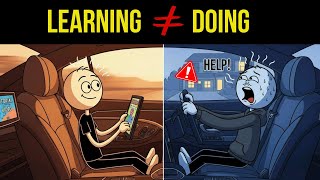
This is why you can watch a 100 tutorials and still freeze when you try it yourself. In 1967, researchers Fitz and Posner identified three stages every procedural skills move through. First is the cognitive stage.
You're figuring out what to do. Movements are slow, clunky, and require your full attention. Second is the associative stage.
You're finding through practice error secret. Things start to feel smoother. Third is autonomous stage.
The skills become automatic. You can do it without thinking. And here's what really matters.
You cannot skip stages and you cannot progress through them by watching. Only by doing. The [music] cognitive stage requires active practice to move forward.
Without it, the information just fades. This is also why timing matters. If you consume three lectures worth of procedural information and then try to practice days later, you've already lost most of it.
Your brain can't hold that much in the waiting room. The balance is learn one thing, practice it, then move on. Not stack, stack, stack, then try to remember what you've learned last week.
Researchers call this the generation effect. Information you produce yourself is remembered significantly better than information you passively consume, even if you get it wrong. The struggle of doing is what creates the memory.
So, if you're learning a practical skill, coding, solving equations, structuring an argument, the only way to process it is to practice it immediately. Not after you finish the video, not tomorrow. You stop and you try it.
You don't learn how by understanding. You learn how by trying. The second type is conceptual information.
Ideas, theories, and relationships between things. How things work, why they happen, how ideas relate to each other. This is the why behind the how.
[music] And it's processed differently than procedural knowledge. Researchers discovered that memory isn't about how many times you see something, it's about how deeply you process it. Shallow processing, like reading words and recognizing them, creates weak memories.
Deeprocessing, thinking about meaning and making connections, creates strong ones. This is why rereading a textbook doesn't work. You're processing the same information at the same shallow level over and over.
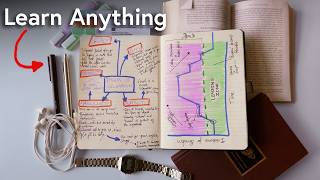
So, what does deep processing look like? Let me show you. A mind map is a visual diagram that shows how ideas connect to each other.
When I mapped out this video, I started with how to remember everything you read in the center. I branched out to the main ideas, the problem, the science, the solution. Then I went deeper subbranches for the two stages, the brain areas, the three types of information.
If I stop there, I just have an outline in boxes. That's not the point. The real work is finding connections across branches.
I started drawing lines between ideas on opposite sides of the map, and that's when I saw it. All three branches point to the same insight. Different information needs different processing, but all processing requires discomfort.
The whole video is about one idea. The gap between absorbing and processing and why we avoid the second one. I wouldn't have seen that by rereading my notes.
The map made it visible. That's what you're looking for. Either you see something you didn't see before or you hit a wall and can't go deeper.
The first is insight. The second is a gap. What you don't actually understand yet.
Both are useful. I've included a link to this mind map so you can see exactly how these ideas connect. Use it as a reference or better yet try building your own from scratch after watching this video.
What you can recreate is what you actually learned. If you can't map it, you don't actually get it. There is another part to processing concepts and it's the one most people skip.
Once you understand an idea, ask yourself where else does this show up? Take cost benefit analysis from economics. Price is determined by how much you're getting versus how much you're giving up.
That's purely economic. Supply, demand, value. But the pattern applies far beyond economics.
Relationships, how much are you getting out of it versus how much is it costing you emotionally and mentally and time? Jobs, is what you're gaining worth what you're sacrificing? [music] Working out, the benefit of being healthy versus the cost of discomfort and time.
living in a certain city, staying in a certain environment, the concept doesn't change, only the context [music] does. Or think about chess. Fast chess and slow chess produce completely different results.
In fast chess, you blunder, you make terrible moves because you're not giving yourself time to think. In slow chess, you see more. You calculate better.
You avoid mistakes. Now, map that to life. rash decisions, rushing through learning, trying to consume information at triple speed instead of slowing down to process it.
Pattern is the same. Speed without thought leads to errors. Once you see the pattern, you see it everywhere.
But noticing the connection isn't enough. You have to critique it. [music] Ask yourself, where does this analogy hold up?
Where does it break down? What's different about the new context that changes how the concept applies? [music] Cost benefit analysis works for jobs.
It works for relationships to a point, but does it work for family? For your health? Not perfectly.
Family isn't transactional. Health isn't something you negotiate with. And noticing where analogy fails teaches you something new about the concept and about the domain you're applying it to.
This is what separates shallow understanding from deep comprehension. Shallow understanding collects ideas. Deep understanding connects them, tests them, and refineses them.
You're not just learning a concept once. You're discovering how it behaves in different environments and where the limits are. That's how you build real knowledge, not isolated facts.
A network of patterns you can apply and adapt. The third type is details, facts, stats, dates, specific examples, the kind of information you need to recall accurately. Think about reading a book and wanting to remember the key research findings, the specific statistics, the names of studies or people referenced, the concrete evidence that supports the bigger concepts.
This type of information is processed differently. It's not about doing something and it's not about understanding relationships. It's about storage and retrieval.
Most people get this part wrong. They try to store it by rereading. You highlight the passage.
You read it again. You recognize information and think got it. But recognition is not recall.
Seeing something and thinking I know this is completely different from pulling it out from your memory when you need it. This is what was happening with the math story I shared earlier. I would sit in class, follow along with the lecture, and understand everything the teacher was doing.
I'd go home, do the homework, and get through it. The formulas looked familiar. The steps made sense.
I felt like I was learning. But by the time the exam came around, I couldn't reproduce any of it. I recognized the concepts when I saw them.
I just couldn't recall them when I needed them. I experienced the same thing when I was studying Russian. The app I was using focused mostly on recognition.
See a word, pick the right answer, match a translation. I would go through the lesson and know every word. I could recognize it every time.
But then I try to speak. No screen and no options, no reference point. And nothing came out.
The word was in there somewhere, but I couldn't retrieve it. And that's the difference. Recognition feels like learning.
Recall is actually learning. Researchers tested this directly. They had students either reread material four times or read it once and test themselves three times.
5 minutes later, the rereading group did slightly better, but one week later, the testing group remembered 80%. The rereading group 36%. Rereading felt productive.
testing felt uncomfortable. But testing more than doubled retention. This is called the testing effect.
And it works because retrieval, the act of pulling out information, is what strengthens the memory. Every time you struggle to recall something, you're reinforcing the pathway. Every time you passively reread, you're just recognizing it without building anything.
There is another piece of this spacing. Cramming feels efficient. You mass all your studying into one session.
the information feels fresh and you think you've learned it, but researchers found that distributed practice spreading your retrieval across days or weeks dramatically outperforms mass practice. This goes back to the forgetting curve. Information decays over time, but if you retrieve it as it's starting to fade, you strengthen it.
Then you wait longer before the next retrieval, then longer again. Each successful recall extends how long the memory lasts. One more thing, mix it up.
When most people study, they focus on one topic until it feels solid, then move on. This is called blocking. It feels like progress.
But interle, mixing different topics together, produces better results. Researchers found that students who alternated between problem types scored 63% on a test one week later. Students who block their practice 20%.
Interle feels messier. It feels like you're learning slower, but that friction, constantly switching, constantly retrieving from different categories is what builds retention. So, if you're trying to remember specific details from what you've read, don't reread.
Test yourself. Space it out. Mix it up.
And one more note, not all details deserve the same effort. Some you need to actively recall the evidence that supports your arguments, the stats that inform your decisions. Others you just need to be able to find, like formulas you can look up and reference numbers you rarely use.
Know the difference. Don't waste effort memorizing what you can store somewhere accessible. Retrieval is uncomfortable.
That's why it works. And that's the system. Two stages: absorbing and processing.
Most people only focus on absorbing because it's easy. It feels productive. But it just puts information in a waiting room.
Processing is what actually moves it to long-term storage. And how you process depends on what you're learning. Practical skills, practice immediately.
Concepts, map them out. Connect them across domains. And with details, test yourself.
Space it out. Mix it up. The methods that feel easy, don't build memory.
The methods that feel uncomfortable, do that. Discomfort is a sign that you're doing it right and that you're actually learning. Thank you for watching.
Remember, think better, live better.