Oh hi, wow, what a surprise seeing you here I didn't see you coming let me put these to the side Would you like a little cup of coffee? I just prepared it, it's still hot I'll leave it here on the side just for you, okay? Make yourself comfortable But I'm glad you came.
I was just needing you to come to answer a question for me: tell me, do you happen to like paying lots of money on bad products? Shitty laptops, like these clearly overpriced earbuds And these wagons that we call "everyday" cars in Brazil. Do you like to send billions of taxpayer's money to rich owners of car factories?
Do you like to defend failed policies so much that you, for the 80th time, want to protect and subsidise a sector that is already protected for more than 70 years, and even then still LOST productivity? If you answered yes to all of these questions, you will love the brazilian automotive sector. And also, you are insane, for the record.
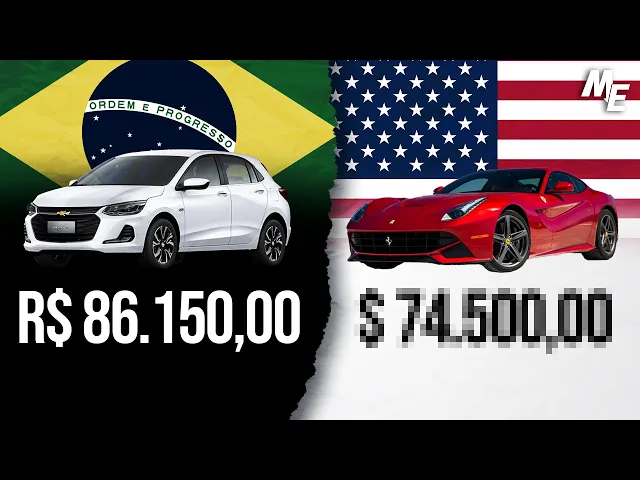
I already dislike the brazilian industry as a whole, except for rare exceptions, but this week I literally turned upside down when I found out how much you pay to buy a car abroad. The fact that you have to spend more than R$100,000 to buy an Onix Plus is already revolting enough, but it becomes humiliating from the moment you discover that for R$10,000 less you can buy a BMW 330e in the UK R$90,000, a 2020 BMW look at this optional features list you don't find a third of that in an Onix Plus How about a 2020 Audi A4 then? Or a 2021 Hyundai Sonata or even, if you're feeling good, how about a 2014 Porsche Boxter?
"but André, you are comparing the price of a new car with an used car! " No problem, here is a beautiful example of a Nissan 350Z Nismo for ¥550,000 yen in Japan, or approximately R$18,000 With that money you can buy here in Brazil. .
. a Fiat Marea. 2001.
The comparison is even more insane when you realize that their wage is not in Real (R$), they earn in their own local currency. So it's almost like saying that it would be equivalent to R$15,000 for them to buy a Porsche there. But even if you wanted, you couldn't just import a Nissan or any other car.
There is a law that literally prohibits you from importing any car from abroad unless it is over 30 years old. Hmm. I wonder why that is.
If you look at the law and the explanation for it you will see that "Allowing imports may constitute, dangerous precedent for a flood of new orders. Distortions such as these will reflect in the domestic market of the country, which will possibly end up full of used consumer goods of all species. " Imagine the horror, the nightmare.
A flood of cheap vehicles, from the most diverse brands, more options for the Brazilian consumer, more competition in the automotive industry. Clearly a vision of hell. "As a consequence, Brazilian companies, belonging to various segments, will have to face competition, for which most of them ARE NOT PREPARED.
In function of the LOW PRICES that used consumer goods can reach in more developed countries. [It will destroy the industry, destroy the market, destroy retail destroy, destroy. .
. ] [It's obvious that the industry. .
. ] Okay, what's the real problem here? Why do we pay so much more here, while being so much cheaper abroad?
Let's start with the obvious: TAXES. As far as I know, the tax burden on automobiles in Brazil is the largest in the world (On screen: Taxes in turkey are higher) but I'm not 100% sure of that, because I I didn't research much deeper than the first page of Google, it's not so easy to find and the video is already gigantic That said, let's get a car which is sold both here and in the US, a Nissan Sentra, and compare. If I take out all the taxes of it here in Brazil, I get to the price that it is sold in the US, after converting INCLUDING THEIR TAXES.
Not only that, but in addition to being cheaper, the same model out there is sold with superior technology and more complete. So there is a difference, even after deducting taxes that makes a car more expensive from the factory here than out there. And this difference, as you can see, is even more absurd in the used market.
Okay, so how does this difference manifests itself in real life? First, higher profit margins it is estimated that, in Brazil, the automaker makes about 10% profit per car. While abroad it is, at most, half of that and in the US it is 3%, even less.
There is no exact way to know this, because as far as I know, the balance sheets of these companies aren't publicly available. So this information comes from this article here from a few years ago, and this gentleman here who has already worked in the sector. Secondly our factories are terribly inefficient.
They are a multiplicity of small factories, made to meet internal demand only. There is no competitiveness to export and, in large part of the time, they operate with more than 50% of idleness during the year. Ah, but why are things like this?
Why are our factories more INEFFICIENT and yet they are able to charge MORE from the population? Well, because of 70 years of badly developed industrial policy and. .
. What about Japan? What about South Korea, huh?
Ah. . .
he doesn't talk about Japan and South Korea who were also protectionists. [The US was also protectionist. All countries of the world.
You think the US wasn't protectionist? He wants to transform Brazil into a Big Farm. .
. Do you really think that. .
. Typical liberal. .
. ] Here I have an article about industrial policies in Japan and here one about industrial policies in Korea. In Japan, industrial policy lasted, being lenient, about 20 years, while in Korea it lasted 6 years.
In both countries, the rate of effective protection of the industry didn't come even close to what it is in Brazil. It was much, much smaller there. Also, in both countries, protected industries had broad access to importing intermediate parts and goods necessary for production, something that didn't happen here in Brazil because of "local goods" policies.
Everything, absolutely everything had to be produced here. Also, also, in these countries, many industries that were not covered by protection policies also grew, which perhaps indicates that there is no causal link between these industrial policies and the development of the country. Does it seem Greek to you everything I've been saying?
Great. That's how you understand that 99% of people who come to defend national industry and protectionism with these shitty arguments, don't understand shit of what are they talking about. Wow, who would have thought.
The industrial policy of Korea and Japan have nothing to do with ours. In a nutshell, they were much less protectionist. And for much less time than us.
It's like Marcos Lisboa said: "You want to have a protectionist policy? Have goals for export sectors only, have performance goals and set a deadline for it to end, and then evaluate the results. You can't have an industry that for 70 years needs government protection.
It went wrong. " Now that this is out of the way. Will you let me make my point?
As I was saying, the strategy of protecting the national automotive industry resulted in 2 things, inefficiency of scaling and lack of competition. "How so? " Simple, for a brand to be able to sell here in Brazil, it needs to have her own productive structure HERE.
IN. BRAZIL. This is the essence of protectionism.
You bring the productive structure here and generate jobs here. and add value in the country, instead of generating jobs abroad and sending money abroad. An idea very well intentioned.
But hell is paved with good intentions. One of the programs that we had incentivizing this was Inovar-Auto, which punished companies with 30% more taxes if they imported vehicles or that carried most of the manufacturing steps outside of the country. The The result was that for you to have a car at a minimally viable price, you had to produce in Brazil and buy parts produced in Brazil, even if this was more expensive.
By the program's goals, it was a success. The private sector beat all of them, there was a BMW factory, an Audi factory a Jaguar factory all participating. But even then, the program was shit Why?
Because the most important thing for a program like this to work wasn't considered: productivity Let me give an example for you This here is the Land Rover factory in Itatiaia, Rio de Janeiro. It produces an average of 3,000 cars per year. What's the problem with that?
The problem is that, that is the amount of cars produced by the Land Rover factory in Slovakia in one. . .
WEEK. Yeah. In the same way, this here is the BMW factory in Munich and this one is the BMW factory in Brazil.
What is my point? You can manufacture anything here in Brazil or anywhere. The problem is to do this efficiently and cheaply.
It is possible to literally set up a factory to produce 200 cars a year here and yet it will be terribly inefficient. And expensive It's no wonder these factories often have collective vacations and that they operate at 80% idleness. A factory like that will NEVER produce to export.
They only produce to serve the domestic market. And because we can't import anything. They existing is an attack on economic common sense.
If you open the market to importing, in 2 weeks, they'll break. Which brings us to the second horrific point of protectionism, which is the lack of competition. Forbes once wrote an article practically calling everyone in Brazil an imbecile because of the Jeep Grand Cherokee launch price in 2013 here in Brazil: US$89,500 (Converted) This same car sold for US$28,000 in Miami, United States, where the average income is at least 5 times bigger.
So you can see how being called imbecile is well deserved. I wish that the problem was just the price. The wagons that we buy here and call cars would not be plausible for an American or an European.
The same way that if you handed them a Positivo laptop, they would look at you in pity. Almost as if you were a Neanderthal, a backward being, stuck with a piece of primitive technology, just like the Mayans who used those blocks of concrete, and said it was a calculator And if seeing a car launched in 2023, still having window cranks in the back seat to open the windows. doesn't convince you of what I am saying.
Let's use some concrete data. According to that article from Auto Esporte, the Renault Zoe doesn't go through a significant modernization since 2010 and was discontinued in 2023. Without a substitute in the Brazilian market, the Nissan Leaf doesn't undergo important modernizations since 2017, the new Savero uses the same platform for 14 years, without generation changes and without rear doors.
The Tiguan in Brazil has an outdated configuration in relation to the same model sold in Europe. The Corolla Cross has better suspension in the US. The Renault Duster and Oroch are practically the same since 2010 and Citroen sells a C3 model here, which has nothing to do with the one that is sold in France.
Electronic injection only arrived in the Brazilian market in 1993, a horrible and outdated version called "Monoponto", and we only had mass adoption of electronic injection in cars starting in 1996. Do you know when electronic injection first arrived in the American market? 1957 We were literally 40 years late.
Air conditioning arrived in cars of the world in 1939 In Brazil, this only happened in 1966. Electric windows began to popularize in the American market in 1941, while in Brazil it only arrived in 1981. Are you getting where I'm going with this?
You think that for all this time, almost a century, the Brazilian automotive industry was protected? For what? For you to pay 1/3 of a house in a new car?
For Ford to have left Brazil? What is the solution then? What can we do regarding car prices here in terms of what you can do is very simple, don't own a car.
Walk, ride a bike, take a bus, use Brazilian public transportation, it'll be a wonder, or move to another country. Regarding what could be done in terms of public policies and emphasis on "could" because that's not going to be done. It's also very simple, set a deadline 10 years let's say, for the discontinuation of subsidies and the same deadline for commercial opening allowing imports.
And why this won't be done? Because even a gradual opening would bankrupt the vast majority of these small car factories that exist in Brazil. There is no way to escape.
And in a healthy economy that's exactly what happens. Bad and inefficient companies break while good and competitive companies survive. Creative destruction.
To exist one Netflix, thousands of rental companies had to break. But this creates a very big political cost, because the bad sides of ending protectionism are focused and very visible, while the benefits are diffuse and difficult to estimate. Nobody wants to be the president who was responsible for closing 5 factories and ending 40,000 direct or indirect jobs And that is exactly why these policies tend to do extend so much and just not end regardless of the current government.
Actually, they only tend to expand, even with a horrible history and without proof of its effectiveness, as you can see from the plans of the current government. But before the video ends, I'd better point one thing out, subsidies are costs, tax waivers are costs, subsidized credit is cost. For every R$1.
00 that leaves to go to factories, to go to the Free Trade Zone of Manaus, to go to agricultural companies to go to wherever the fuck, it's R$1. 00 less that the government has to invest in education, in health, in safety, in infrastructure. All this money is like an investment from the Brazilian people into a project that has to eventually sustain itself on its own and generate benefits for the entire population, not only for those employed in the sector.
And generating benefits ISN'T creating 1,500 jobs in Camaçari, Bahia, or 450 jobs in Itatiaia, São Paulo. "Ah, but it creates jobs. " SO WHAT?
Literally every sector generates jobs, damn! Every sector generates employment. Why is your sector so much more important than mine?
If in 70 years these fucking car manufacturers were unable to, with so much subsidies, produce ONE car that was cheaper, more complete than something that I order from the other side of the world, gets in a ship and travels 4,000 KM to get here, it is capital and labor very, very poorly used. And maybe I'm being too harsh with the manufacturers here. But that's because they aren't saints, no.
They all defended these failed policies and subsidies that led us here. But obviously the main fault here lies with the government and, mainly. The intellectual mentors who supported the adoption of these policies, those people of UNICAMP's School of Economics who think that Brazil and any other developing countries can take a shortcut to development, instead of tidying up the house and doing the difficult work.
Marcos Lisboa has been saying the same things for about 20 years yet governments come and go, and he was never heard Here we are, heading, once again, to a policy that provides subsidies for certain sectories of the industry. But who am I to try to guess what the future will be like? And who konws?
Who knows if this time, maybe. . .
things will be different. That was it, thank you very much for having watched this far and I see you guys next time. Support the channel!