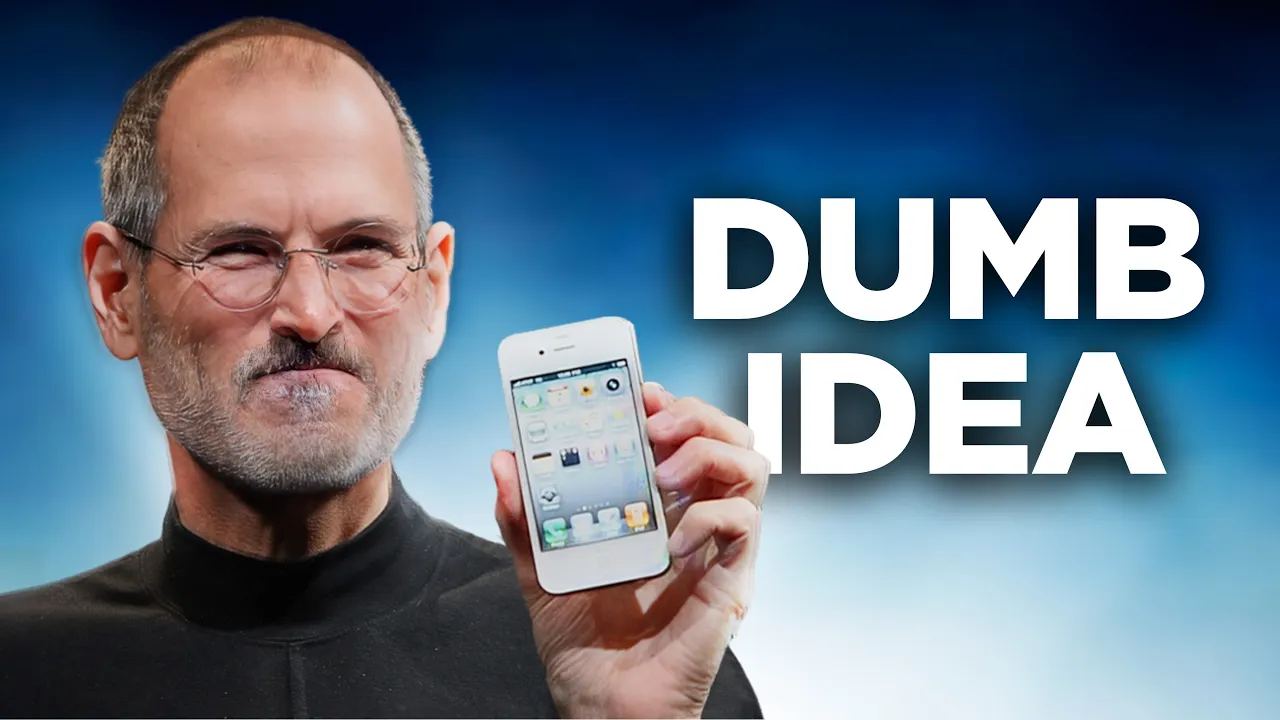
When Apple engineers pitched Steve Jobs on turning the iPod into an iPhone, he responded, “Why the f*&! would we want to do that? ” “That is the dumbest idea I’ve ever heard.
” reported Adam Grant in his book Think Again. Jobs feared creating a phone would undermine the iPod, which sold 20 million units in 2005 and accounted for nearly half of Apple’s revenue that year. Besides, Jobs thought a phone would only appeal to the “pocket-protector crowd”.
He was also concerned that mobile phone carriers would dictate the iPhone’s design and features and force Apple to make a subpar product. But those who wanted an Apple phone refused to give up. Tony Fadell who headed the team that built the iPod, told Adam Grant that in order to convince Jobs, people “had to work as a group, not simply in one meeting but possibly over weeks, to get him to change his mind or to see things from another angle.
” Contrary to popular belief, Steve Jobs wasn’t a success solely because he bent the world to his vision. Much of his success had to do with a willingness to change his mind. And his team knew how to get him to do that.
Before the iPhone, just about everyone at Apple thought cell phones sucked. Jobs was known to smash his to bits when his calls dropped. But pitching to Jobs wasn’t as simple as saying: Wouldn’t it be awesome if Apple built a phone everyone loved using?
It involved strategically chipping away at his resistance. Two years before presenting the iPhone concept to Jobs, a small group of Apple’s designers and engineers experimented with new ways of interfacing with machines. They stumbled upon a small Delaware company, Fingerworks, co-founded by a Ph.
D. student and his professor, who built a touchpad that interacted directly with the screen. Apple would eventually acquire FingerWorks and its patents related to finger gestures.
The Apple team aspired to expand beyond a touchpad to a full touchscreen, perhaps for a device like a tablet. Apple designer Imran Chaudhri explained to Brian Merchant in his book, the One Device, “. .
. we want to be able to move things on the screen like a piece of paper on the table. ” They worked in stealth mode, worried that if Jobs found out about it and didn’t like it, the whole thing could get quashed.
After showing the multi-touch demo to Apple’s chief designer Jony Ive who had Jobs’s ear. Ive told the team, “This is going to change everything. ” But he was careful to show it to Jobs privately because of his tendency to dismiss ideas out of hand.
Ive explained to Walter Isaacson in his biography on Jobs: “He might say, ‘This is sh@! ,’ and snuff the idea. I feel that ideas are very fragile, so you have to be tender when they are in development.
I realized that if he pissed on this, it would be so sad because I knew it was so important. ” After mulling it over for a few days, he agreed touch was the future. But he was still not sold on a phone.
Yet, other phones on the market began to threaten the iPod with their ability to play music, like Nokia’s music phones. Apple then decided to partner with Motorola to incorporate the iPod into a new Motorola cell phone. It’s a pretty cool phone.
Well, actually, the ROKR was neither minimalistic like the iPod nor slim like Motorola’s popular RAZR. It was such a disaster that Wired magazine lamented on its cover: “You call this the phone of the future? ” Putting iPod features into a Motorola phone “.
. . just seemed ass-backwards to me.
” recalled Apple senior executive Mike Bell in Merchant’s book. Bell was one of those who had lobbied Jobs to build an Apple phone for months. In November 2004, he emailed Jobs late at night: Steve, I know you don’t want to do a phone, but here’s why we should do it: Jony Ive has some really cool designs for future iPods that no one has seen.
We ought to take one of those, put some Apple software around it, and make a phone out if ourselves instead of putting our stuff on other people’s phones. Jobs called him, and they argued for hours. Bell pointed out it was only a matter of time before computers, music players, and cell phones converged.
The team believed that if they made the product compelling enough, they could influence mobile carriers to adopt Apple's terms for design, software, and distribution. Finally, Jobs relented, telling Bell: “Okay, I think we should go do it. ” They considered two different versions of the iPhone.
The first one was modeled after the iPod but the scroll wheel made it tough to dial phone numbers. Jobs humorously added an outdated rotary dial to the mock-up to show the limitations of that design. The second option was multitouch, which was more akin to a mini-computer.
Jobs was convinced touch was the way forward. Selecting the material for the iPhone’s touchscreen was another major hurdle. Just four months before Jobs planned to reveal the iPhone to the world, he decided to switch the screen from plastic to glass because plastic was too easily scratched.
Engineers were in a frenzy because they knew they had to find a glass replacement that would pass the one-meter drop test, and so far, all the prototypes had failed. A friend of Jobs suggested he reach out to Wendel Weeks, the CEO of Corning, an American glassware company that had once prototyped a strong, scratch-proof product dubbed “gorilla glass” but didn’t have a market for it. When they met, Jobs doubted the glass was good enough and started lecturing Weeks on how glass was made.
Weeks boldly interjected, as described in Issaacson’s book: “Can you shut up, and let me teach you some science? ” In the end, Jobs was convinced. But then Weeks said his company didn’t have the capacity to make the gorilla glass in its factories, to which Jobs said: “Don’t be afraid.
Yes, you can do it. Get your mind around it. You can do it.
” And Corning did do it. Weeks told Isaacson: “We did it in under six months. We produced a glass that had never been made.
” The day the iPhone came out, Jobs sent Weeks a message that’s now framed in his office: “We couldn’t have done it without you. ” And we are calling it iPhone. Today, Apple is going to reinvent the phone.
When Jobs unveiled the iPhone to the world in January 2007, it lacked a key feature. The original iPhone had no external apps. It was limited to Apple’s pre-installed apps.
There was no App Store. Jobs was worried that a poorly written third-party app would cause the iPhone to crash, especially in critical situations where someone might need to call 911. However, Scott Forstall, head of the iPhone’s software division, saw the potential of a rich app ecosystem.
He told Jobs that they could isolate and manage any security risks. The push for third-party apps wasn’t just internal; developers were advocating for an open platform. And they got it.
What we call the App Store Apple officially launched the App Store in the summer of 2008. Allowing third-party apps immediately pushed iPhone sales through the roof. Four years after its launch, the iPhone made up nearly half of Apple’s total revenue.
And it still accounts for half of Apple’s revenue today! With well over 2 billion iPhones sold, tech industry analyst and Apple expert Horace Dediu put the stunning success of the iPhone this way: The iPhone is not only the best selling mobile phone but also the best selling music player, the best selling camera, the best selling video screen and the best selling computer of all time. It is, quite simply, the best selling product of all time.
All because Steve Jobs was willing to change his mind. Steve Jobs changed his mind about building the iPhone because he thought like a scientist. He had the flexibility to reconsider his views when presented with compelling arguments.
If you're looking to sharpen your problem-solving skills and develop a scientific approach to thinking, I highly recommend Brilliant. Brilliant is a website and app where you can brush up on your math, computer science, and data science skills interactively, and it’s FREE for you to try out. In Brilliant's Scientific Thinking course, you can explore the laws of physics and the principles of engineering by solving interactive puzzles.
I like to take 10 to 15 minutes every day to go through Brilliant’s Logic puzzles, which I find have improved my analytical thinking. Brilliant is great whether you’re starting out on your STEM journey or want to improve on what you already know. You can try out Brilliant for FREE by heading to the custom link in my description: brilliant.
org/newsthink. If you’re one of the first 200 people to sign up with my link, you’ll receive 20% off Brilliant’s Premium subscription, giving you full access to a world of knowledge. Thanks for watching.
For Newsthink, I’m Cindy Pom.