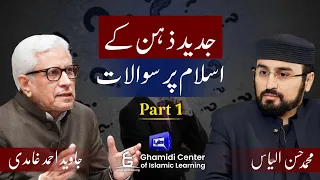
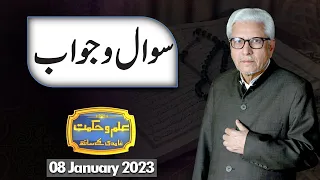
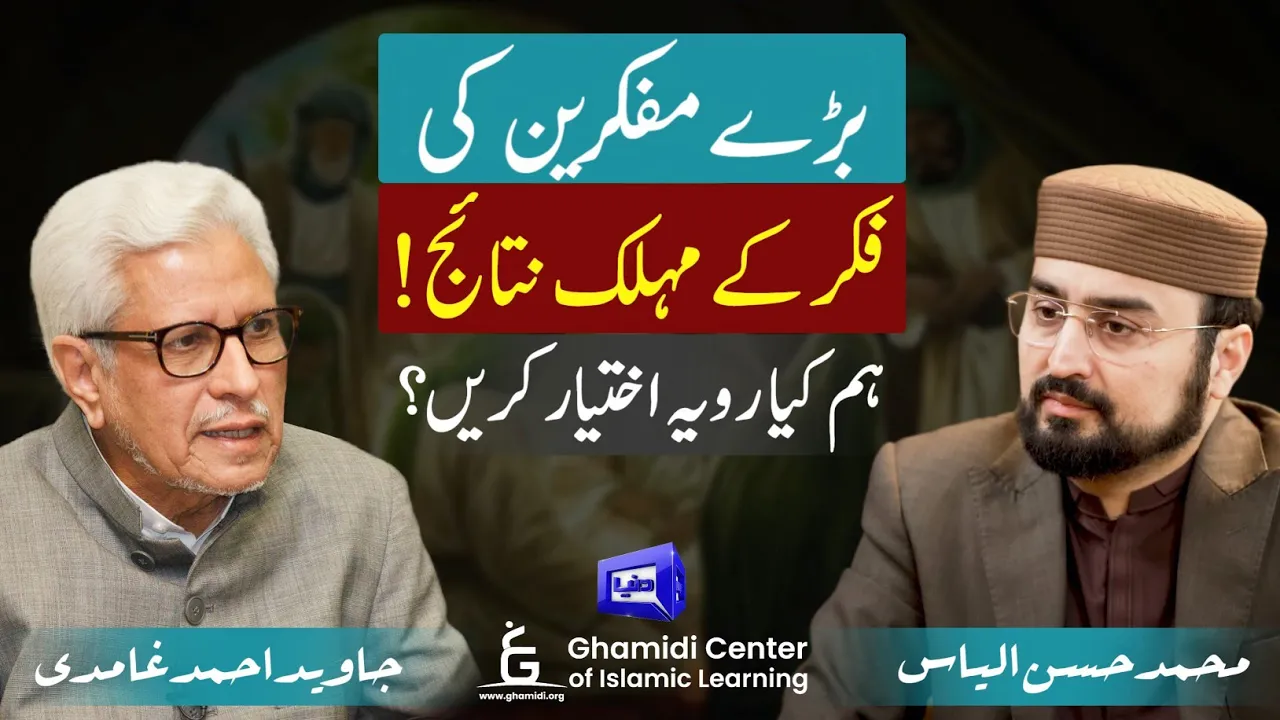
Knowledge and Wisdom with Ghamidi Negative Outcomes of Religious Ideology. In the name of God, most benevolent, most merciful. As Salam Alaikum Welcome to the Program 'Knowledge and Wisdom'.
I am Muhammad Hassan Ilyas. Dear viewers, we have a session on various questions. The different questions that arise in your minds and hearts.
The questions reach us through the social media platforms and emails, and are under discussion in different WhatsApp groups. We consult Ghamdi Sahab on various practical and principled topics, on religious, moral, and historical topics, and you sometimes even criticize them, you may think that some aspects of it need further clarification and some new questions also come up. We are at your service in this regard, and as usual Javed Ahmed Ghamdi Sahab is present with us.
Salam Alaikum Ghamidi Sahab. [Javed ahmed Ghamidi] Wa Alaikum As Salam [Hassan] Thank you very much Ghamidi Sahab for your time. We begin.
Ghamidi Sahab, the Poet of the East, Allama Iqbal, who holds an extraordinary position in our Ummah, quite often you mention his name in your discussions too. Please tell us, the point which he often and on mentions in his poetry as well as in his sermons too that Islam is a civilization, a culture, and only after being connected to this community, it completes the circle. What does it mean when Iqbal says that Islam is a civilization?
[Ghamidi] There are two aspects of it. Both should be understood separately. One, Islam as per its teachings is a civilization, a culture, or a collective system.
Secondly, the structure of Islam is such that when people accept it, it will compulsorily have an impact on civilization, culture, social system and the collective society. I think that it is the second point which is correct, and this is perhaps what Iqbal wishes to express. Otherwise, if you look at the content of the Deen, that is not its nature.
If you look at the components of the Deen, it comprises of the beliefs, in which is said that Allah is the sole Creator of this universe, the Master, the King and the One and only to be worshipped. One day the human beings are to appear in His Presence. It is this answerability for which we have been sent into the world, and the thing which has the status of its objective is the Tazkiyah (Purification).
[Hassan] Right. [Ghamidi] i. e.
, I have to purify my collective and individual life. If you see from this aspect, some systematic rules for governing a civilization or culture have not been given in it. However, when the entire life of a human being is addressed, when he is seen from the perspective of a servant of God in this world.
When he starts to live with the consciousness of this servitude, i. e. , I am not the Master of this world, I was not given the power of this Earth as its conqueror, rather, this is the result of the Blessing and Bounty of my Lord, that He has bestowed power to me, has graced me with understanding, and if I will serve Him from my birth till my end it would be a matter of of pride for me, and then making purification or Tazkiyah as his objective, he would carry out the purification of my body, and likewise, he would purify his morals, and keep pure his eating and drinking, then his entire life will have its impacts felt.
When these impacts would be seen, if you contemplate, these impacts will reach each and every aspect of his life. i. e.
, a different civilizational form will also appear as a result of it. The cultural traditions will also be a little different. It will affect your home, lifestyle and your ettiquettes in life.
From this perspective the point of Iqbal is absolutely right that the case of Islam is not that of a religion which imparts some spiritual teaching to us, when it has changed the course of your entire life, A person at work, when he makes human beings as the focus of his entire attention, he has been told that he is the servant of Allah on earth, and now he will have to live a life with the awareness and consciousness of his servitude to Allah, and with the acknowledgment that servitude is his reality he will have to spend the life, then everything should be impacted with it. When it leaves such influence, this will result in the existence of a new form. I think that this is what he wishes to express, what remains is that it is a reality that in the capacity of a poet, and in the capacity of a prolific author and philosopher, the language and style or the structure which he adopts is at times not so precise and technical, to enable us to separate things completely.
The consequences are often expressed in the manner that the premises which are made the basis of the knowledge and reasoning that should be backing them with are not explicit enough. This leads to misunderstandings, otherwise, I think this is the right meaning of his words. [Hassan] Right, Ghamidi Sahab, you elaborated this point.
This is what he expresses in his poetry, "Apni millat par Qiyas Aquame Maghrib se Nakar Khas hai Tarkib me Qaume Rasoole Haashmi" Just tell us Ghamidi Sahab, whenever, he highlights the individual status of Islam, or its progress or its civilizational aspect, then he compares it with the West, it seems like the West gives a complete concept of life, and has its own philosophy, and Iqbal presents Islam against it, so, is the West referred to as a temporal concept or is this a reference to the beginning of human civilization, i. e. , since the times Islam has presented a way of life, and the elements which have become a part of western civilization stand in opposition to it.
[Ghamidi] This does not refer to the historical West. The historical West was Christian in character. The West referred to here is the West which was created post Renaissance, in which the human being assumed the central status.
In this case, the consciousness of servitude (to God) took the back seat. This West in its concept and philosophy did not remain God-centric. Iqbal presents this point and it is correct.
i. e. , if we look purely on the basis of philosophy, or if we look purely on the basis of wisdom, then these are two separate and parallel rails on which two civilizations are running.
i. e. , the Islamic civilization or the civilization of Muslims in essence, stands on the servitude to God, [Hassan] It is God centered.
[Ghamidi] It is God centered. In it, God is made central for viewing the whole matter of life and creation. [Hassan] Okay.
[Ghamidi] And in this case, human being is made central to look at the whole matter of life and universe. This gave birth to a parallel situation which Iqbal wishes to highlight. Did this condition reach to that extent?
It is not so. Something that is thought of in philosophy and poetry need not necessarily be pervading in all human relationships. Therefore, the Christian West too is traversing along with its own history, where Christianity exists in the form of religion too, it roots the fundamental sentiments of Go's worship too, and a big majority of people in it remains firm on its basic human nature too.
All these things blend together in their existence. However, when philosophy or wisdom or those narratives are compared on a large scale, based on which a civilization is formed it can be said that in the last 300-400 years in the West whatever civilizational tradition has taken birth has basically been man-centric and Islam and Islamic civilization is God centric in its spirit. [Hassan] Right.
Okay Ghamidi Sahab when you say that whatever has come up, in it the civilization does not appear to be religion centered rather it appears to be human centered. The biggest representative of the West presently is the United States of America. We see it written in its currency note too, 'In God do we believe' and all of its Presidents have also been religious till now, and another is Britain.
The religion looks firmly rooted there too, so, in which aspect has it not remained God centered? [Ghamidi] That is what I meant to say that it is not that the entire western civilization has come off the religion totally, rather, its entire history accompanies along with it too. If you observe, its history is advancing along in the capacity of history itself.
In other words, being God-centered means that what the human thought in all its aspects, considers the source of the Divine inspiration? This situation has not remained in the West, rather, the big philosophers that have taken birth in them especially those who have worked on civilization, culture, and political system, it is their thoughts and philosophies which now govern the constitutions of the West. It is their thoughts and philosophies which generally become the reference point in the West.
It is their thoughts and philosophies become decisive in situations, and they have moved on even further after Modernism, now all philosophies or meta-narratives have even lost their relevance, i. e. , an influence of post-modernism is what we see now, and the entire philosophy and thought of the West has seen its appearance.
That is a different matter, however, it is human beings who inhabit the West, and a big number of people are religious like before, they are associated with the human tradition, walks hand in hand with religion, and religion still plays the role of a spiritual element in them, so, these things always go in parallel, there is never a deviation in it to that extent, it is against human nature, like in the case of our own civilization, that if we see in essence of its philosophy, it makes God as its center. However, is it actually following this? It has also been heavily influenced by the West.
It has also been heavily influenced with modern philosophers. It has itself adopted many influences of post Modernism in its thoughts. Many such things have found their inclusion in its own intellectuals and scholars.
The human societies always follow such a pattern, when some comment is made about them it is done in the general perspective, it never implies that the entire civilization or the entire culture its way of thinking and all its people have had some radical change in themselves, and at times this process of change requires hundreds of years. [Hassan] Right. The point is clear Ghamidi Sahab, one last question on which I request you to throw some light, we saw that the Western nations in the world, the time when proliferations were made in technology, they brought the revolution in the industry too, modern arms and armaments were also produced, and ruling countries in the form of worldwide colonization, overpowering and controlling nations, and the complete history of colonization appears, do you think that the gap which exists between Muslims and the West, or the Muslims are considered to have an alternate way of thinking, and Islam having a parallel civilization.
Politics too has a big role in this, as it were the Western countries who were the ones who had ended the Muslim Empire and made its conquest. So, are political factors also playing a role in this? [Ghamidi] Political factors create reactionary psychology, and that is fully present among us.
The people who have seen those times or those who have seen the collapse of the Ottoman Empire, or those who experienced conditions which prevailed in the first and the second world wars, and likewise, the control the Western nations had right across the East to the West, and it is still there, so, it gives rise to a natural reaction. The reactionary psychology does not let things remain in the actual state in which they had taken place. This takes place everywhere, and this happens even among the Western people.
What you term as Islamophobia, what is it? It is the same thing. i.
e. , when a group or party affects some ugly situation, like a reaction has taken place from the West, some organizations and some individuals, and some nations in the capacity of a nation have expressed that reaction against the West. Some big examples of that reaction was also seen like the occurrence of the incidents as a consequence of which the chain of terrorism started.
So, all these things create a reaction everywhere. Like the reaction of Islamophobia is seen here among some groups, in the same manner a reaction has taken form among us as a consequence of the dominance and control of the West. The right approach in this is that though the common people become a victim of reactionary psychology, big intellectuals and sages, rising above this become successful in placing things in their rightful place, And they realize the fact that neither the West is emptied of the moral values, nor is ridden itself of the religious base that is ingrained within Human Nature.
And neither has it declared apostasy at the individual or at the national level. They too have gone through this phase in a gradual manner, and have achieved great heights as a consequence of being human centric. That is the reason that at times, intoxicated by these successes they indulge in some excesses as well.
The same is the case among us too. i. e.
, we are not what the representatives of a God-centric civilization used to be. Neither that history of ours remain, nor is there the existence of religion or religious morals in our collective system. Nor our decisions are of those standards, we are also standing at a point of decline, digression, and downfall, hence, instead of talking by taking a superior position, of superiority and talking, both the things should be placed in their appropriate positions.
When such a thing happens it would unite human beings, and create a sentiment of respect for each other. They would be in a better position to understand the stand of each other. If this does not happen then the reactionary attitude would lead to oppression and reproach for each other.
I think nothing would be achieved out of it. [Hassan] Right Ghamidi Sahab, you explained the point, taking the discussion along. Ghamidi Sahab, another aspect on which I wish to gain some insight from you, you often speak of people like Allama Iqbal, or Maulana Maududi and the like, and confer your reverence upon them as Ummah's great, You hold them to be a boon for the Ummah, possessing great insight, being great thinkers, they have provided the Ummah with an ideology which instigate people to contemplate, however, we see that the results of the thoughts of these great people like we say the sentence that Islam is a civilization, however, based upon it was formed a way of life, and based on that way of life organizations were formed, they carried out the movements for the dominance of the Deen throughout the world, or the movements for the establishment of the Deen, or the destruction of the regimes of the disbelievers, or carrying out Jihad or occupying countries, organization were formed, resulting in killing and bloodshed.
The point that I wish to ask you is that these great people, how can they be called great, when their thoughts had such harmful and grievous consequences such as the killing of human beings on a large scale, in spite of all this, how can these people be considered important, and how their value and goodness can be appreciated? [Ghamidi] The greatness of a person is not measured on this scale. People sometimes draw bad results from any kind of thought, and such people also come under their influence who do not let things remain as it should have remained.
These things always go on in the history of the world. Karl Marx analyzed the tradition of his times, and subsequently stated his philosophy of history. He has applied Hegel's dialectics on our material existence in general, and has argued that this is actually the economic struggle of man which forms relations and start bearing the results.
There have been great consequences of it, and there has been rampant killing and destruction as a result of it. If you look at the erstwhile Soviet Union or even now, the States that are influenced by their ideology, there you would find authoritarian regimes. They are still not ready to accept Democracy at par.
These things happen in this way. Keeping them in view, you do not form a positive or a negative opinion about a person, rather you see his entire thought and concept. The elders whom you have mentioned, we need to have a complete perspective of their personalities.
i. e. , were they in possession of destructive mindsets?
No, they were the among the sincerest well-wishers for this Ummah, they were renowned scholars, the challenges they faced, keeping them in view they tried to understand their religion, as well as the times they were in. If at some place the limit has been crossed, or if some misinterpretation has become the reason for it, then we can separate that out and show. With regard to human endeavors, to expect that their work like the work of the Prophets would remain free from criticism and not vulnersble to counter arguments, or those would never yield any bad result is not possible, rather, I would say that even in the work of the Prophets, certains points are given to misinterpretations.
For example, see the case of the law of 'Itmam-e Hujjat' as described in the Quran by Allah (swt), people misinterpret that very law of 'Itmam-e Hujjat', and draw such inferences from it which at times become unacceptable. It should not be seen in this way, rather, we should see what is the general contribution of a person? What is his personality in general?
How sincere is he in his intentions? The stream of knowledge which he adopted for himself to spend his life did he really possess its real ability? All these elders fulfill these standards in every possible way, post that they have their own opinions, and there definitely are some opinions which have been harmful.
We have to eliminate that harm, and their laudable and good work should be related to the people. Now, if you have a look at Iqbal's contribution in arousing communal or national sentiments in people, the way he wrote poems to awaken the Ummah, the manner in which he tried to create emotions of love for the Prophet (pbuh) especially among the modern literate class, and provided us with such a literature which can be called representative literature of the religion. That is praiseworthy.
That is a great feat. Along with this, there is an error or omission in the way of human thought that should also be pointed out. Hence, I do not consider it a good attitude that the general achievement of a person is measured in terms of the ill consequences of it in some sphere of life.
[Hassan] Right Ghamidi Sahab. You have given a very good example. Another point was coming to mind Ghamidi Sahab, among us, for example, the scientists who have made great achievements and which has resulted in immense benefits to the mankind, however, it has also resulted in the making of the atom bomb which results in the taking away the lives of millions of people.
[Ghamidi] This is the way it happens. i. e.
, no person in this world is of the type that he commits no mistake at all, or the people do not make use of his thought for some wrong ends. That happens even in case of the work of the Prophets too. Hence, I do not think that we can judge people with this yardstick, for me, the people who you are generally not willing to accept, I bear the sentiments of respect for their overall achievements.
[Hassan] right. [Ghamidi] When I consider that they have been of service to humanity in general, it is not that you can demarcate between people as evil and good in forming an opinion about them. Whether it is Allama Iqbal or it is Maulana Syed Abul Ala Sahib Maududi, they are the assets of the Ummah, i.
e. , they are among the greats of our community, and when we maintain their respect and disagree and point out their mistakes then this would lead to opening newer horizons of knowledge, and this will lead to the opportunities for the progress of mankind. And this would make clear the point to the thinking people among us that whether we wish to understand the Deen of Allah or we have to make progress in the principles of knowledge and intelligence, there is no space for absolute taqleed in it, rather, we should always have an attitude of critical analysis of things.
[Hassan] Right. Okay Ghamidi Sahab, this point of yours brings another secondary aspect to mind that some people also say that when you declare some people as great, as a result of it the common people start thinking that since these are great people, the possibility of a mistake from them is ruled out, now, when you have called them such a great person, and when they are criticized, not only the people do not heed to their criticism, rather, it does not have a practical impact on them. Why it cannot be done in the way that their mistakes are pointed out in a candid manner irrespective of claiming any greatness for them.
[Ghamidi] No, while analyzing the mistakes, the greatness of a person is not taken into consideration, the critical analysis should be done impartially, the lesson given by our Deen is that we remain 'Qaim bil Qist', this Qaim bil Qist does not merely take place in practical matters, these first of all this take place in academic matters as well. My respected Ustaz Maulana Amin Ahsan Islahi, you are aware that I look critically at his works too, and carry out harsh criticism on some of his inferences too. Criticism is one thing and disrespecting someone's greatness is quite another thing.
People should be appreciated for their masterly contributions. It actually is the small scale manifestation of the Mastery of Allah (swt) Himself. If Allah (swt) has bestowed someone with His Blessing that should also be acknowledged.
In the same way, if some person has done some service, it is possible that for a particular matter it is objectionable to me, however, it can be of exceptional worth in a dozen other aspects. If you look at these two elders whom you have mentioned, they have created the spirit of religion among the people. and established a relation of the Deen with the people, and to proceed with a sentiment and passion for the Deen, and to serve the Deen and likewise to propagate a brotherhood and love among the Ummah they have aroused exceptional passion in them.
That should be respected, and along with that respect and appreciation and acknowledging their masterly expressions, we should also look at the point where they erred, and that point of error should not be overlooked as well. This is the right attitude. The interpretation that the Quran has adopted for being Qaim bil Qist what does that imply?
That implies that whatever is the truth you acknowledge it of being the truth. And if there is a some wrong attached to it then there should not be any impartiality or overlooking of the fact. It cannot mean that when you find some element of error in it, so, you go on a step further and negate the truth that he had presented.
[Hassan] Right. [Ghamidi] So keeping both of them separate, acknowledging both of them separately is a must. Now the question about the common masses, I think it would be a wrong training for them to reject everything while criticizing some point of theirs.
The right education for them would also be that they understand the fact that these people were not the Prophets, they were ordinary human beings. They are the Prophets whom Allah (swt) safeguards, and if they too are not under the safeguarding of Allah (swt) then such errors and shortcomings would also be accompanying them. Since there is a Divine Guidance for them, hence they remain above such human errors.
These are ordinary mortals, and while going through their matters in the capacity of common men, we have to deal with them differently. When there is a mistake or where some point ought to be criticized, and what are the areas in which they have provided commendable service, so, their services should be accepted with full respect. [Hassan] Right Ghamidi Sahab, you stated a fine piece of advice.
Please tell one last point about it that there is a psychological unease among the people that if these elders had laid the foundation of some thoughts, and based on that there are organizations formed. And those Organizations for example if they have carried out some destructive work in application of it, at some level with respect to morality, then it can also be said that if these elders were alive today and they have had an idea of the fact that such is the outcome of some initiative of theirs, then they would themselves have stopped them so, it is not necessary that whatever is going on in their name, we put all of its blame to them and censure them. [Ghamidi] Whatever is going on in the name of religion, if someone says that all that is directed to our Prophet (pbuh), will you accept it?
[Hassan] No, absolutely not. A very beautiful point. [Ghamidi] Although all Muslims, in essence, associate themselves to the Prophet (pbuh).
And if these people are saying something, they too are interpreting and explaining the Deen given by the Messenger (pbuh) of Allah (swt). So, can you rise above this, so when you cannot do that here too we should speak the point justly. And the just point is that whatever is right should be called right and whatever is wrong should be called wrong.
[Hassan] Right. The point is clear, we move further ahead in this discussion. Ghamidi Sahab, we have received one question, the gentleman asks that you in the explanation of the text and its interpretation kept it bereft of the interpretation of Ijtihad, whereas in the eyes of the experts of jurisprudence this is one of the fundamental points in Ijtihad (Religious Innovation).
It can be seen that these topics are discussed in any book of principles of jurisprudence. So, is this matter merely concerns the dispute of words, or according to you does it have the nature of a fundamental disagreement which happens as a result of contemplation on some Ayah or a written text, so our scholarly tradition interprets it as Ijtihad itself, while you dismiss this altogether. [Ghamidi] I think it gives rise to a lot of misunderstanding.
i. e. , there we are in possession of a directive of Allah, a Guidance of Allah or some point from the Prophet of Allah (swt), we try to understand them, there according to me the words of 'Faham' (understanding) are suitable.
That understanding could be wrong or could be right too. The sphere of Ijtihad should remain up to the point which is ascertained through Hadees of Ma'aaz. According to me the point from which this term has arisen we should use it in that very sphere, otherwise, there may be confusions over the things which concerned with the humans and which were stated Divinely.
There is a lot of difference between the two. Something which Allah (swt) has directly revealed in the Quran, or which was issued as a Sunnah by His Prophet, or something was elaborated by the Prophet of Allah at some point in time, with regard these and the thing that I am making an application of something, according to me this difference should be maintained. i.
e. , the instances for which we have the texts available, the interpretations there should also be different. So, this difference has to be maintained and I have insisted on maintaining this difference in the rest of the places too.
Like I had drawn attention in the term 'Sunnah' too that it should remain limited to the category of independent directives. Whatever follows after it, whether you call them Narrations, or you call them Hadith, or if you adopt some other expression for it, the admixture that happens as a result of mixing expressions this is the effort to remove that and I think this is a regular practice in the world of learning and knowledge and this has been the regular practice of the earlier scholars too, and if someone disagrees with me in this, then it is not a matter concerning the Deen or the belief in accountability and in the Hereafter. A person may speak as per his own ways and styles, nonetheless, I find it necessary to differentiate between the two.
[Hassan] Right. Okay, Ghamidi Sahab, in both the places, it is the human being who does the work, the work of understanding and of contemplation, be it the translation of the Ayah of the Quran, or it be some new issue of applicability, or in case of a similar situation, the work of application of its guidance. The effort is from the human end, a work of contemplation and thinking is going on, however, when this work relates to the Quran, there actually we have to move by sticking to the word, and in that particular context we do that work, therefore, this work and the other work of thinking and pondering should remain separate.
[Ghamidi] It has been separated in that Narration. The conversation of the Prophet (pbuh) as reported there if it has been attributed rightly, you see what has been said there? Refer to the Quran, if it is not found there, refer to the Sunnah, and post that is said "Ajtahidur Raii", so, now the rationality has stepped in.
[Hassan] It has been separated. [Ghamidi] It has been separated. i.
e. , rationality has to be factored in. There the word Ijtihad has been used.
Although something was to be done earlier while referring to the Quran, i. e. , the Quran will not speak itself, it has to be understood, so according to me the word 'Fahm' (Understanding) is more suitable, and the word Fahm and Tafhim and similarly description and exposition are more appropriate.
However, when you are making application of a directive based on rationality or you are trying to understand it as per your own times, since the intellect and opinion become the basis of argument, i. e. , by establishing a rational case, you make its application, the word of Ijtihad has been used beautifully, and according to me that should remain its sphere.
[Hassan] The point is clarified, moving ahead further, another question of a scholarly nature and further clarity of your thought is sought. He says is the point true that Maulana Amin Ahsan Islahi considers self evident propositions of the Shari'ah as a requisite of Shari'ah, whereas you consider the ingraining of human nature separate from the Shari'ah. Is this difference merely relates to the placement of the directive or is it a difference in some basic conception as well which makes a further impact on the understanding of the Deen too?
[Ghamidi] There isn't any fundamental difference. The Deen that has been ingrained in Fitrah that comprises the Deen too, however, it is necessary to state it separately. I am telling you that I try and categorize things in such a way that no confusion is created whatsoever.
For example, something which becomes necessary in human nature, the human nature requires such a thing, that too is the directive of Allah, Allah (swt) has Himself stated about it "Haisu Amarakumullah". i. e.
, these words with regard to a directive of Fitrah were also mentioned in the Quran. It is the directive of Allah which has been ingrained inside me. When I follow it, I am following the directive of Allah, rather, the directive of Allah mentioned in His Book, or has been received through the Prophets, the former is much more closer to me, it is much more self-evident, it has been the first to have been received by me, if I had been in any region of the world where the Dawah of a Prophet was not sent, then too, it had reached me - this is its status.
However, we apply the word Shari'ah on that Divine decision which He has issued through the Prophets in the capacity of law. Therefore, this difference is also taken in consideration in it. Hence, there isn't any change in the significance of either.
[Hassan] Ghamidi Sahab, another question for clarification, the Sunnah according to Maulana Amin Ahsan Islahi are totally deduced from the Quran, and according to you those are totally independent, and its proof in the Quran is not compulsory. Is this difference also there between you and your Ustaz? [Ghamidi] There isn't any doubt that the way this point is stated, that from the Quran you move towards that side, whereas this does not happen in reality, Sunnah is the way issued by the Prophets.
It precedes the Quran, it had been existing earlier, and Allah gave the directive to follow them with brevity in the Quran. i. e.
, after mentioning the Prophets Allah (said), "Fa Bi Hudahum Iqtadih" i. e. , the guidance of the Deen which those Prophets have left behind in the world, 'O Ye Prophet, you too should follow it'.
In the times of the Prophet (pbuh) it was present as the tradition set by the Abrahamic tradition or as it is called - 'the religion of Hanifs'. In this regard it is superior to the Quran. We cannot move from the Quran towards it, rather, along with it we will come towards the Quran, thereafter, the Quran itself will decide whether it accepts it, or whether it rejects it.
It is the Book of Allah which has been given the decisive status. However, the directive or guidance was given that the Deen that had been given by the Prophets of Allah you have begun your life by following it. The Quran was revealed to the Prophet (pbuh) over a period of 23 years, however, Sunnah had been issued right from the start.
And the Prophet or his Companions started to follow them similar to the faithful of this Ummah following them now. Therefore, all the aspects of the purification of the body, all aspects of manners and etiquettes, all the prohibitions of the eatables, all Ibadaat (Worshipping) thus became part of the Deen, the Quran has at times stated them, or made some changes in them, or brought about some rectifications in them, or gave some advise for them, so, it didn't happen in the manner that the Quran gave the fundamental guideline, and then inferences were drawn from them, rather, the practice was existing, the Quran mentioned them, or made some elaboration regarding them, so, the mutual association of both became clear to us. [Hassan] Okay, Ghamidi Sahab, you spoke a sentence just now that the Quran is the final authority and has the real capacity to accept or reject something, although the Sunnah had initiated separately.
When it has not initiated something, how can it decide on its acceptance? For example, the Sunnah of Tashmiit i. e.
, one must say Alhamdulillah on sneezing, so, if we approach the Quran for its approval, but it hasn't been discussed in the Quran, so, what does acceptance of it implies? [Ghamidi] We won't approach for its approval, since that has been issued separately, Did the Quran deny it? [Hassan] This is the point.
[Ghamidi] Has it been negated or abolished? Was the rectification made for any the mistake been committed in it. These things will be sought for in the Quran, since the Quran itself has directed for something that was existing earlier.
i. e. , if you accept the point of Ustaz Imam that the Quran has directed for those things, as a result of which it has become necessary to follow them.
In this way the Quran become their indirect source too, however, those have not been initiated by the Quran. [Hassan] Right. [Ghamidi] i.
e. , when the Quran said, 'Whatever is the guidance of the Prophets should be followed'. "Ittabi'uu Millat Ibrahima Hanifa" 'The Abrahamic tradition should be followed'.
In this way, that has been accepted in brief and directive was given for it. So, the example which you mentioned of Tashmiit or similar examples, these have been accepted as the directive of the Quran. These have been accepted in brief, and no separate list was made and given, now the question of the acceptance or rejection of the Quran would only arise when it especially mentions any of them.
If it does, like it did on Hajj and some aspects of prayer and like it did on fasting, then Quran's statement would be decisive and final. [Hassan] Right. Okay Ghamidi Sahab, another aspect when we discussed Sunnah in detail in the 23 Questions Series, there you mentioned a point i.
e. , wherever the requirement of rectification or addition was required, then this work was carried out by the Quran itself. In this context the point of Maulana Islahi, where Maulana says that since we have a final verdict revealed for Sunnah, and wherever the alterations or additions were required, that work was done by the Quran itself.
So, now the existing sunnahs that we are in possession of those can confirmed from the Quranic derivations? [Ghamidi] From the perspective that those things which have formed part of the Quranic discussions, those obviously are absolutely confirmed by the Quran. However, the things which did not come under discussion in the Quran, for example, circumcision wasn't discussed, or for example Tashmiit didn't come into discussion, there are several other things too, which have not come up in that manner in the discussions of the Quran, those will also maintain their status as the Quran, in short, has directed for their following.
Hence, the directive exists in the Quran but that directive is not in the form of separate lists, it was given by saying that the directives which are in practice among the nation of Ibrahim, if there isn't any alteration or modification done by Allah (swt) in them then that should be followed. [Hassan] The point is clear Ghamidi Sahab, the last question for today's session, and recently this question was also featuring on the fb, in the light of your principles the question was asked that if a Muslim negates the Sunnah of Tashmiit, so, will his Iman still be there in such a case? Sunnah is the basic source of the Deen, and in that list you have included the point that in case of sneezing the standard reply is to be made, and the listener will also recite a dua, if someone refuses to accept it, will his Iman remain intact?
[Ghamidi] What is the reason for this refusal? A person may refuse anything. He would be reasoned with, what is the point of issuing a decree for him?
i. e. , it will be discussed that he does not understand something, or a point is not clear to him, so, what is his argument for it?
So, according to me, when someone refuses, if a person refuses to accept the Ayah of the Quran, he may do that as well, however, what is the reason for refusal? This is the question to be asked. Hence, for all such things, since they being widely practiced is another point, however, what their status is?
There are many things stated in the Quran too, like the story of Zulqarnain, like the story of Ashaab-e Kahf, it is possible that a person makes another interpretation of it, that is not called denial, it is the difference of interpretation, understanding and the expounding of it. For the differences of understanding discussions are done, and the decrees of acceptance or denial are not issued for it. [Hassan] Ghamidi Sahab, the point became clear.
Dear viewers, this was a session of different questions. The time has run out now. Insha Allah we shall be back in your service again.
Thank you very much for your time till now. [Ghamidi] Thank you very much.