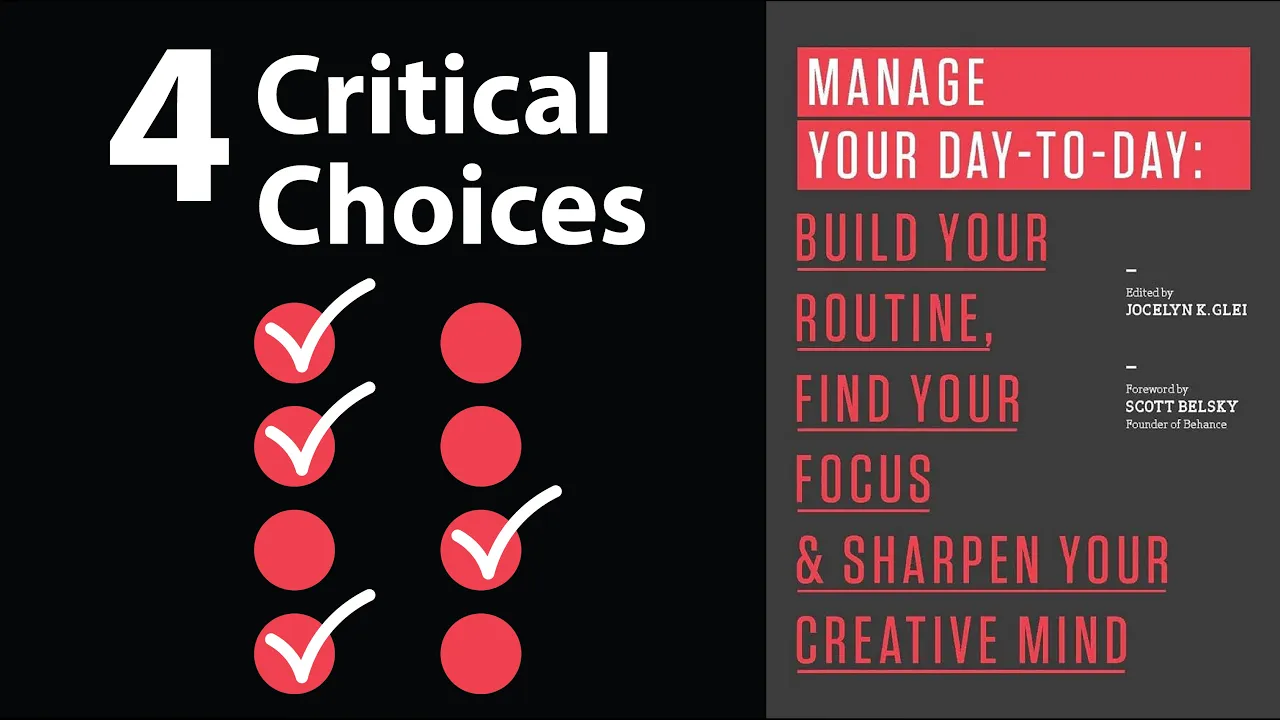
I recently read manage your day to-day by Joselyn gly editor at 99u if you had a significant project you had to complete the next two weeks be a keynote speech a school paper a book proposal or software program how would you optimize your creativity and maximize your productivity over the next 14 days Joselyn gly and her team at 99u consulted some of the smartest people in the productivity space like Seth golden Kell Newport and Gretchen Ruben to find some answers these productivity experts highlighted four critical choices if you spot these choices in your work life and consistently make the right choices you'll be well in your way to insane productivity and creativity on your most important project Choice number one do a little every day or a whole bunch at once when life is busy it's easier to block out a Saturday or Sunday to work on a project than make time for it each day but if you spread that same block of time across several days you'll be significantly more productive thanks to the power of frequency working on a project every day will make you more likely to get started less likely to be interrupted and more likely to have great ideas first approaching several hours of work feels overwhelming which leads to avoidance and when you know you have several hours of work you tend to believe that delaying an hour isn't a big deal but if you plan to work every day even just for a few minutes you create a work Cadence and create momentum you can bring into the next day helps you bypass procrastination next when you work a little every day it's far easier to temporarily block out distractions since most things that demand your attention can wait 30 to 45 minutes while you put in your project work and lastly the more frequently you work on a project the more your subconscious works on tackling problems related to your projects between work sessions which leads to more creative insights therefore whatever time you have to complete a project divide it across several days and put in at least 15 minutes of project work every day no matter what author Gretchen Ruben says day by day we build our lives and day by day we can take steps toward making real the Magnificent creations of our imaginations Choice number two which work mode should I enter first work life oscillates between two modes reactive and creative in reactive mode we respond to problems and requests from others in creative mode we temporarily block out the world and focus on creating original work we all tend to gravitate toward reactive work because checking the email is like pulling a slot machine lever we never quite know if our inbox will be full of boring messages or exciting developments until we check it however going into your emails and messages and entering reactive mode creates attention residue for the rest of the day which impairs your ability to concentrate on complex projects it's because when you start answering people's requests part of your mind is left thinking about what you just said what else you could have said and what people's responses might be we must give our highest priority projects our freshest attention and that occurs in the morning when distractions are minimal and a full night of sleep has just restored our ability to focus deeply if you want to make progress on your projects you must be purposely neglectful in the morning that is you must postpone your responses to so-called urgent requests as author Mar mcginness puts it it's better to disappoint a few people over small things than to surrender your dreams for an empty inbox otherwise you're sacrificing your potential for the illusion of professionalism if you want to achieve optimal productivity and creativity create first react second choice number three should I be rigid or flexible that is should I plan to execute my first Project work session with military Precision or should I allow myself the freedom to start when where and how I wish since having autonomy is energizing well the answer is both you should begin with strict discipline then let your mind create freely the most productive and creative people have learned that certain levels of discipline are needed to unleash creativity as author David Brooks put it great creative minds think like artists but work like accountants aim to execute the first five minutes of your project work sessions in the exact same way every time Stephen King for instance sits at the same desk at the same time every day takes the same vitamin pill and listens to the same music he then rearranges the papers on his desk the same way to Kickstart his creative writing block King says the cumulative purpose of doing these things the same way every day seems to be a way of saying to the mind you're going to be dreaming soon starting the same way every time is a form of self-induced pavlovian training where you associate a creative work state to a specific starting sequence so that your brain notices when you're executing this sequence and begins automatically tuning out distractions and honing in on the upcoming task over the past few months I've repeated the same series of actions every workday and find it easier and easier to slip into a deep and creative workstate my sequence is feel my watch Buzz at 5:15 a. m. then step out of bed and put on the same hoodie and sweatpants then walk to the fridge to grab the same Topo Chico carbonated water then walk upstairs to sit in the same chair and open a new word document to continuously type questions I have for the upcoming work session for one minute this writing and questioning period stoked my curiosity and puts me in a creative work mode where I freely explore different ways to get to my project objective so I pose the following question to you what sequence of actions will you execute to reliably trigger a deep and creative work state Choice number four sustain or cycle if you can extend your work project session Beyond 20 minutes you must cycle your attention by stepping away from your work at least three times every hour why well the longer you remain seated in one place while working the more you're breathing shallows and shallow breathing means the brain is getting less oxygen stepping away to get a drink of water walk around the block or go to the bathroom to splash water on your face allows you to consciously regulate your breathing and get oxygen to your brain the instant you get up from your work to initiate your mini work break perform box breathing like Navy Seals do before combat this involves a deep 4-second inhale a 4C hold a 4C exhale and another 4C hold or you could do a 5.
5 second breast cycle simply think 1 2 3 4 5 in 1 2 3 4 5 out 1 2 3 4 5 in research from the University of Pavia in Italy showed that subjects who alternated between a 5. 5 second inhale and 5.