It's day 16 of the United States and Israel's war on Iran, and the consequences of Operation Epic Fury continue to be felt around the world. The US and Israel have launched further widescale strikes on Iran, targeting what they called regime infrastructure. Residents of Tehran also reported explosions overnight.
Well, the US President Donald Trump says the US is not ready to make a deal to end the war. Overnight strikes in southern Lebanon killed at least four people as Israel said it was pressing on with its campaign against the Iranbacked Hezbollah. The French president, Emanuel Macron, has already said the Lebanese government was ready to engage in direct talks with Israel and he offered to host the negotiations in Paris, but the Israeli foreign minister has said his country has no plans for talks at this stage.
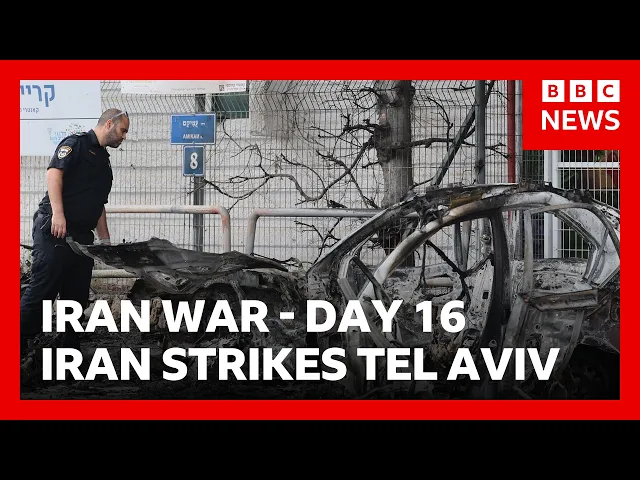
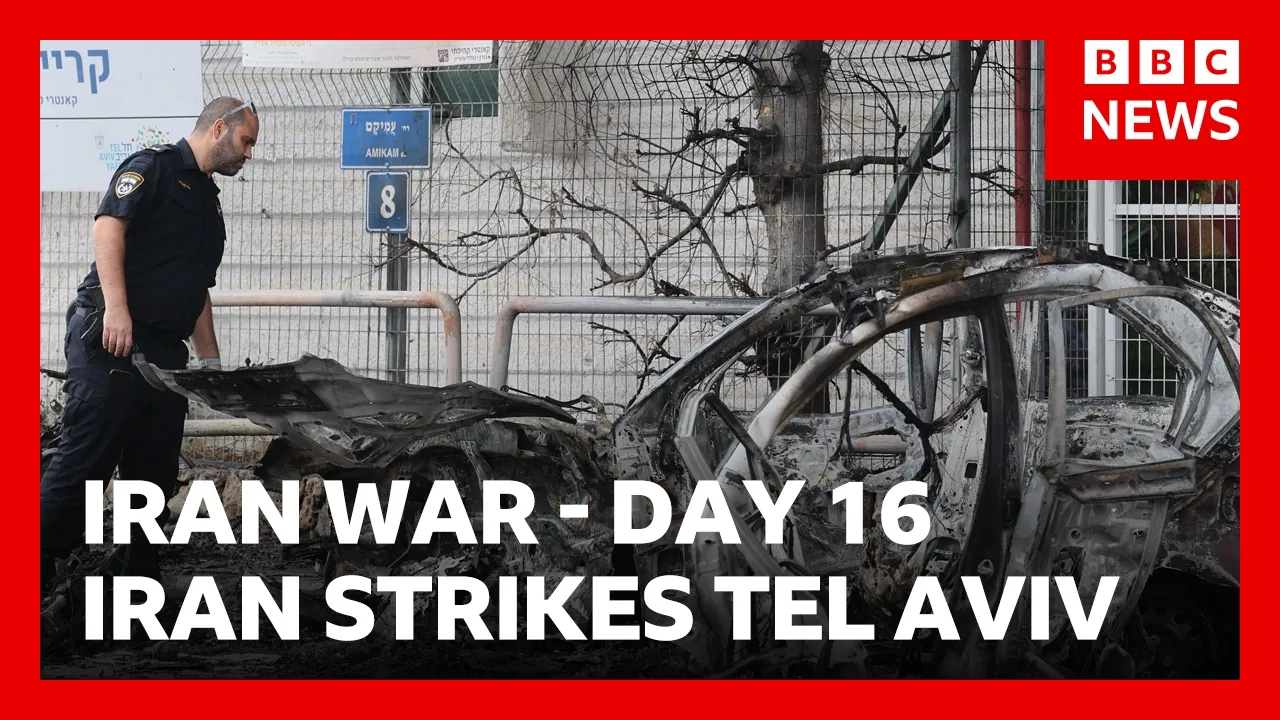
While a wave of missiles has struck central Israel, cars were burned out and overturned in a district of Tel Aviv when it was hit by a missile with cluster munitions. Iran's Revolutionary Guard has threatened to target the Israeli Prime Minister Benjamin Netanyahu, saying he would be pursued and be killed. Well, as well as ruling out a deal, President Trump said US attacks had demolished most of Iran's main oil hub of Kak Island.
He hinted at future strikes there which he described as just for fun. Well, the island which is critical for the econ economy of Tehran has become very much a focal point of the war. Well, let's get the latest now from our correspondent in Riyad, Frank Gardner.
A US Air Force B-52 taking off from Arya Fairford this morning. Its destination Iran. This war is now in its third week and showing no sign of stopping.
These oil storage tanks were hit in Fujera yesterday, part of the United Arab Emirates. While oil and gas tankers are backing up, unable to get through the straight of Hormuz without fear of attack by Iran. That in turn is driving up oil prices.
I think it's a priority for the world that the strait is uh reopened. Obviously, the best and simplest way to do that is to deescalate the conflict. And I think it's important to underline that.
Yet, the stakes have been raised after the US bombed Khar Island, Iran's main oil export terminal in the Gulf. They think that by striking Khark or some of the islands, they can put pressure on us. On the contrary, all the pressure will fall on the US and European linked oil companies.
That's why we face no problem in this regard. Oil and prochemical sites are highly vulnerable on both sides of the Gulf, and governments here know this could still get worse. The Gulf Arab states did not support this war.
But if it had been over quickly and the threat from Iran's drones and missiles reduced, they could have accepted that. But that hasn't happened. And every day that it drags on, they worry more about the damage to their petrochemical industries, the global economy, and stability in this entire region.
Tel Aviv was targeted again by missiles last night after Israeli warplanes carried out numerous air strikes on Iran. Israel reported some light injuries while Tehran has vowed to step up its attacks. And the Lebanese capital Beirut was hit by Israeli air strikes today as they target the Iranian-backed Hezbollah militia.
Even sport has not been immune. Both Bahrain and Saudi Arabia have canled their Formula 1 events. This war is casting an ever wider shadow over the Middle East.
Frank Gardner, BBC News, Riad. Well, let's focus on those attacks on Israel, which happened in the last couple of hours. Hezbollah claims it's fired what it called an advanced missile at an Israeli base south of Tel Aviv.
Our Middle East correspondent John Donison has been to the outskirts of the city where one of the attacks today took place. Right, you can see here we're just on the outskirts of Tel Aiv and just as we were driving in the sirens went off and you can see here where we've got the impact. What you've got couple of cars completely destroyed, fires burning and a bit of a sense of panic here amongst the people here.
A lot of people running towards this spot presumably to try and find out if anyone they knew had been hurt. We've not heard that there have been any casualties here, but you can see it's a pretty built up residential neighborhood. And these Iranian missiles, most of them are getting shot down, but some get through.
And some of these missiles, what happens is they break up in the sky and form these smaller cluster bombs that don't do as much damage when they fall, but they're still potentially deadly. In the last hour, Israel's foreign minister Gideon Sar has been visiting the site where a missile landed near the town of Zazia. It's in the north of the country.
It's reported around 13 people were injured in the incident on Saturday. Sar has also been speaking to reporters and was asked about Israel's military preparedness and also about the diplomatic situation with Lebanon. Can you confirm or comment on reports over the weekend that Israel has informed the United States that it is running low on missile interceptors?
Is that correct? And secondly, can you confirm reports that Israel and Lebanon are set to hold direct talks in the coming days? And if so, what would that be about?
For the two questions, the answer is no. Asbalah is working accordingly to instructions from Thran, not from Beirut. They are acting against the will of Lebanon and its citizens.
If the Lebanese government and the Lebanese army um want to change something, they should do something in order to stop the attacks being done by Hezbollah from Lebanese territory. Until now, they hadn't done anything significant in order to stop it. Well, overnight strikes in southern Lebanon killed at least four people as Israel said it was pressing on with its campaign against Iranbacked Hezbollah.
Lebanese officials have just released their latest figures on the impact of the war on Lebanon. They say Israeli strikes have killed more than 800 people since the start of the months. The figure is now 850 according to the Lebanese Health Ministry.
In terms of displacement, well, more than 800,000 people have been displaced. That's according to the United Nations. Well, Israel has said it's continuing to launch air strikes on targets it says are linked to Hezbollah.
It's accused the armed group of using ambulances and medical facilities for military purposes after Lebanese government said an Israeli attack had killed 12 health workers. Our Middle East correspondent Lena Sinjab is in Beirut. I asked her about the latest attacks.
There's another issue is that you know Hezbollah is not adhering to any calls from the government to stop this aggression and they're continuing to firing rockets into Lebanon. They say that they are uh you know having a legitimate right to fight back an aggression uh on the country. Um and these talks I mean there are lots of diplomatic pressure to find a solution to deescalate and especially France is pushing for this.
Uh that also came after the Lebanese president himself announced that Lebanon is ready to talk. And to remind our audience, Lebanon has been in war with Israel since the 1980s, which is this is the first uh invasion uh of Lebanon by Israel. And this is the time when Hezbollah was established uh trained and funded by Iran.
So it's decades of this uh group you know taking control of the battle against the enemy as they call it. They call themselves the resistance group. Uh but I think over the past decade they started to lose uh credibility whether in Lebanon or in the region as they started to uh in be getting involved in wars in the region.
They fought with Assad against the opposition. They fought in Iraq uh with Iraqi militias. they fought in Yemen um with the also Shia militias and this is all serving Iranian agenda you know according to many here in Lebanon or in the wider region and that's what's causing furious anger among the Lebanese that they took the sole decision to to get into war with Lebanon with the Israel and drag the country into war uh leaving large sways of the the country in in rubbles and hundreds of thousands displaced not knowing when they would be are be able to go back to their towns and villages and if they will go back at all.
Well, Iran is lashing out at its neighbors as well. Salvos of ballistic missiles and drones have inflicted damage in several Gulf countries. As we've been hearing, it's now calling on the United Arab Emirates to begin evacuating its population away from those port zones, including Abu Dhabi, Dubai, and Fujira.
Oil loading operations have resumed at that port in Fujiraa. their crew. They're crucial to the economy.
They were halted, weren't they, for a short while following that Iranian drone attack and huge fire on Saturday. Well, for Washington's Gulf allies, who had hoped to stay out of the conflict, it's been shocking to find themselves in the firing line. They're also deeply concerned about the situation in the Strait of Hormuz, which Iran has largely blocked is preventing oil being transported to international markets there.
Well, our correspondent Azade Masher is monitoring the situation from Dubai and she gave us an update on the latest number of interceptions that have taken place in the UAE. Yes. So, they put this roundup out every day, the Ministry of Defense does here in the United Arab Emirates, and they've said that as of this 15th day of war, uh, that they have intercepted four ballistic missiles and six drones.
Now that number is significantly lower than what we've seen uh so far and especially this week. Just yesterday the figure was about 33 drones and nine ballistic missiles. Earlier this week you also had some cruise missiles.
So a lower figure and that could hint at various things. Of course it could suggest some sort of military hit, some hit to Iran's military capabilities, some sort of depletion. But you can also look at some of the statements that have been coming out from the Islamic Republic.
When you look at the statement that first statement whether it was written by the supreme leader Moshab or not uh it talked about maintaining friendship with uh countries in the Gulf Pishkan the president said similar things and then earlier today uh you had a denial from the foreign minister Abbasi about uh targeting any civilian or residential areas and that they were still open to anyone who was willing to start some sort of initiative to get out of this war. So either way, whether it's because of of some sort of change in strategy, some negotiations, or whether it's about that sort of military depletion, the figure is lower. And what we had earlier today was that rare statement from a presidential adviser here uh in the UAE who said that they while they maintain their right to defense uh as they were reacting to this imposed terrorist aggression as they put it, they were still turning to reason and logic uh to find a way out when it comes to this conflict with Iran.
Now whether reason and logic is going to work against a regime that is focused on its survival despite what that means for its economy and for it there's their their residents that remains to be seen but clearly here they're still feeling the impact of this war and as I know you've spoken to people from inside Iran. What have they been telling you? Yes, I've been keeping in touch with uh some people throughout this war and it's very difficult to do so because of the internet blackouts because of landlines that people in in Iran fear are monitored.
But when you do get a few minutes in the day, it's like a glimpse, a sort of creek of a window into their lives there. Now, one man in his 40s who is a Tahran resident, when he heard the bombings initially at the beginning of this war, he took his family and he fled to the countryside as many others have, he told me. But he still had hope.
He was hoping that this could mean the end of the regime, that this could be the day he hadn't really ever thought was possible, where there could be some sort of democratic future or at least a less repressive one for him. But that hope is gone. He said he is worried that the United States is just going to declare some sort of victory now, leave the regime in place, and that instead the future that they're going to get is one where the price of goods is higher.
He talked about difficult he talked about difficulty in getting food, medicines. He also talked about his fear of further unrest that would come with bloodshed as he put it. Referring back to uh the protests and the brutal crackdown we saw earlier this year that had thousands if not tens of thousands according to some rights groups killed.
Now, someone else I spoke to was still feeling I I wouldn't use the word positive, but optimistic about whether this war could deliver a future he was hoping on. And he was saying there are people who are still supporting this wall that believe that Donald Trump could deliver a future where the regime is no longer in place. But he said a few days away from NU's Persian New Year, these are very difficult days for him and others.
And he ended that message simply by saying, "Long live Iran.