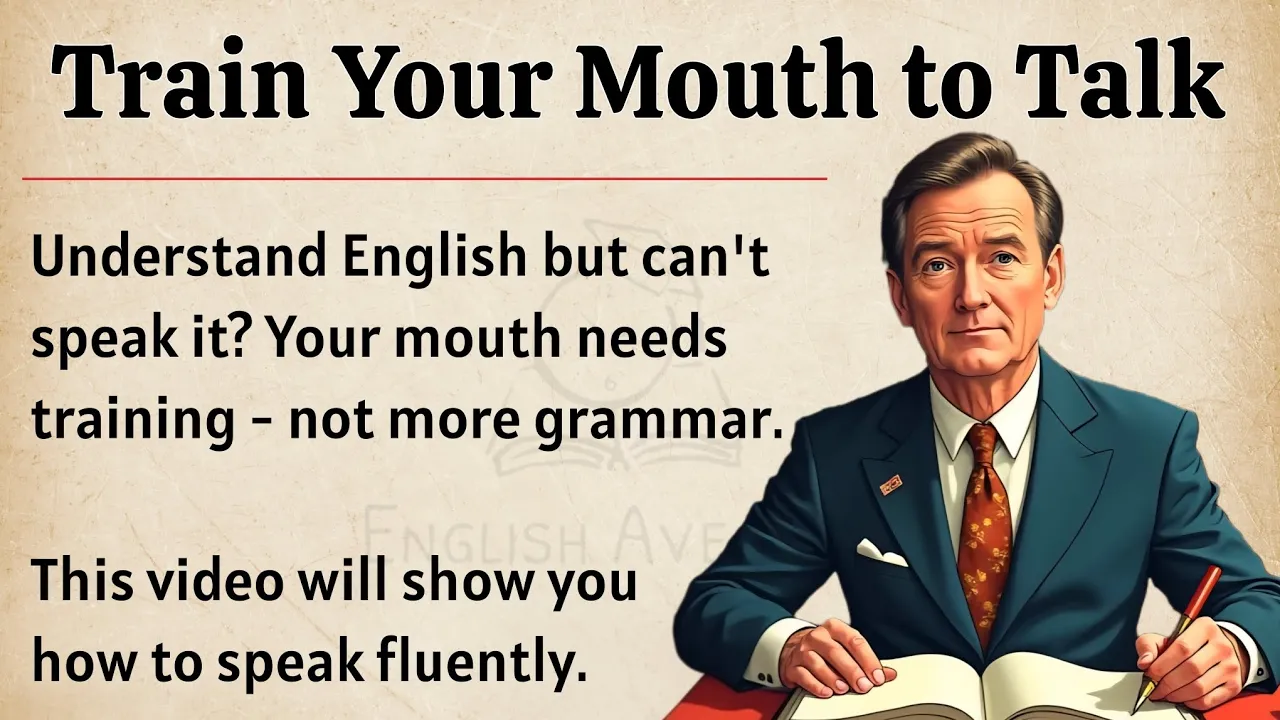
Welcome everyone. In today's video, we're not just going to talk about English. We're going to transform the way you speak it.
We're going to fix something no one ever told you about. And by the end of this video, I promise you'll look in the mirror and say, "Yes, now I can speak. I finally understand how to train my mouth to talk.
" So, listen till the very end. Subscribe to our channel because this video may become the most important turning point in your English journey. Let me ask you something simple.
How many videos have you watched about English? How many grammar rules have you learned? How many hours have you listened silently?
But when it's time to speak, your lips freeze. Your tongue shakes. Your voice disappears.
Your brain goes blank. Not because you're stupid, not because your English is bad, but because your mouth is untrained. Yes, that's the truth nobody told you.
You're not learning to move your mouth like an English speaker. You're reading, watching, listening, but you're not training your speaking muscles. That's why nothing changes.
That's why you stay stuck. That's why your confidence dies when you open your mouth. Let me say something very clearly.
English is not just in your head. It's in your lips, your tongue, your jaw, your sound flow. And until you train those, you'll always feel like something is missing.
But today, that ends because this video is going to be different. This is not some boring grammar lesson, not another list of phrases, not another YouTuber saying, "Repeat after me. " This is a journey.
We are going to break your fear, wake up your mouth, and build real spoken English fluency, starting from zero. And no, you don't need to be perfect. You don't need an accent.
You don't need expensive courses. All you need is 5 minutes a day, the right method, and the courage to sound like a beginner so you can become a fluent speaker. This is the video I wish someone gave me years ago.
This is the truth your English teacher never told you, and this is your moment to stop just learning English and start speaking it like it's your first language. So, let's begin. Part one, the shocking truth nobody told you.
Let's start with something powerful, something that might hurt a little, but will set you free. Your mouth doesn't know how to move like an English speaker. Read that again.
It's not your grammar. It's not your vocabulary. It's not your memory.
It's your mouth. You've been training your brain, but not your mouth muscles. And that's why when you try to speak English, you sound slow, broken, nervous, or unnatural.
Because English is a physical language. It has a different rhythm, a different shape, a different set of sounds. It's not just what you say.
It's how your mouth produces those words. Let's compare it to fitness. Imagine reading 100 books about push-ups.
You understand the form. You know the technique. You can explain it to others.
But you never actually did a push-up. What happens when you try? You collapse because your muscles are weak.
That's exactly what happens with English speaking. You know the words, but your mouth hasn't been trained to move fast, smooth, and confidently. your tongue, your lips, your jaw.
They're lazy. They're used to your native language. They don't know how to handle English speed, stress, and sound patterns.
And when your mouth is untrained, no matter how many lessons you watch, no matter how many books you read, you'll always freeze when it's time to speak. That's why you say, "I understand everything, but I can't speak. " Because you're missing the one thing nobody talks about.
Speaking is not only mental, it's also muscular. Now, here's the truth. In your native language, you've repeated every sound thousands of times since childhood.
That's why your mouth moves fast and confidently. But in English, you've never trained your mouth to say thrlv soft t silent letters, linking sounds, rising, falling tones. You skip them, you mumble them.
You feel awkward saying them. So your speech becomes broken. And that's what destroys your confidence.
But here's the good news. You can change this. You can train your mouth.
You can build speaking muscles just like you build muscles in the gym. And the best part, you don't need hours. You don't need perfection.
You don't need to sound like a native. You just need to practice the right way with focus and consistency. Part two, the daily fiveinut mouth training routine.
Let me start with one bold promise. If you do what I'm about to show you for just five minutes a day, every single day for the next 30 days, your English will sound different. Not just in your mind, but in your mouth, your confidence, your conversations, your career, your life.
Because now we're going to train your mouth like a muscle, not like a memory. Let's begin. You might think just 5 minutes, that's too little.
But here's the truth. It's not about how long you practice. It's about how you practice.
Your goal isn't to become fluent overnight. Your goal is to build tiny repeatable habits that rewire your mouth, reshape your sounds, and reprogram your speech patterns. You don't need 5 hours.
You need 5 minutes of focused physical daily repetition just like brushing your teeth. Remember this forever. Reading is knowledge but speaking is movement and movement requires muscle memory.
So now let's go into the exact 5-minute training system step by step. Step one, mouth warmup 1 minute. Yes, just like in the gym, you need to warm up your mouth muscles.
Why? Because you've spent most of your day in your native language rhythm. Now, you need to shift your lips, tongue, jaw, and breath into English mode.
Here's how. A lip rolls. Gently buzz your lips like a motorbike.
Say for 5 seconds, three times. A B tongue stretch. Push your tongue out of your mouth and back in.
Do it slowly 10 times. Jaw loosening. Open and close your mouth wide, gently.
Repeat five times to release stiffness. D. Smile stretch.
Stretch your smile wide like you're laughing. Hold for 5 seconds. Relax.
Repeat twice. Why it works? Loosens tension.
Activates muscles you never use. makes your English sound smoother and more natural. You don't need to be perfect.
You just need to move. A warm mouth is a ready mouth. Step two, the mirror technique.
One minute. This is your secret weapon. Your mirror is your coach, your feedback system, your confidence booster.
Here's what to do. Stand in front of the mirror. Look into your own eyes.
Choose one simple sentence in English like I am learning to speak confidently. This is my voice. I own it.
English is becoming my second language. Say the sentence slowly. Focus on your lips, jaw, tongue movement, and eye contact.
Don't rush. Watch yourself. Feel the sound.
Say it five times. Each time slightly faster. Why?
It works. Builds awareness of how you look and sound. Kills fear of judgment.
Builds speaking presence and clarity. Gives you power to control your voice. It may feel awkward at first, but after 3 to 4 days, you'll start feeling natural.
And after 10 days, you'll feel powerful. Remember, you can't build speaking confidence if you never face yourself. Step three, shadow speaking.
2 minutes. This is where the real fluency training happens. Shadow speaking means you listen to a sentence and immediately repeat it aloud, trying to match the speed, tone, rhythm, and emotion.
Here's how to do it. Choose a short audio clip, 5 to 10 seconds. It could be from a YouTube video, a movie scene, a TED talk, your own recording.
Example, you hear, "I don't think that's a good idea. " You repeat exactly the same rhythm, speed, and tone. I don't think that's a good idea.
Not your version, not your accent, not slowly. Just match the original. Do it over and over.
Even if you make mistakes, keep going. This is not grammar. This is muscle training.
Why it works? Builds realtime speaking reaction. Builds fluency rhythm.
Trains your ears, mouth, and brain together. Helps you sound smoother and more natural. This is how babies learn.
They hear, they copy, they repeat, and they grow fluent. Step four, fluency loop. 1 minute.
Now, let's finish strong. This is your fluency loop drill, a rapid repetition system that helps you say the same sentence in three different speeds. Slow, normal, fast.
Here's how. Take a sentence like, I'm going to improve my English. Say it very slow.
I'm going to improve my English. Focus on every sound clearly. Normal.
I'm going to improve my English. Smooth and steady. Fast.
I'm going to improve my English. Linked confident like a native. Now repeat the loop three times.
Choose three to five such sentences per day. Don't change them too much. Repeat them for a few days until your mouth gets used to them.
This is how your brain says, "Oh, this is easy now. Let's move on. " Why it works?
Builds comfort with speed. Helps you stop overthinking. Makes you feel fluent even if your vocabulary is small.
Step time what you do. Warm up 1 minute. Lip rolls.
Tongue stretch. Jaw loosen. Smile stretch.
Mirror technique 1 minute. Say one sentence five times in front of mirror. Shadow speaking 2 minutes.
Copy two to three real sentences from native speakers. Fluency loop 1 minute. Practice same sentence.
Slow, normal, fast. Total time 5 minutes. Total impact.
Lifechanging. Most learners skip this. They chase grammar books.
They download vocab apps. They binge watch English shows silently, but they never train their mouth. And that's why they stay stuck.
But not you. Because now you have a system. You have a practice.
You have a daily English gym in your own room. And guess what? You don't need anyone.
You don't need a partner. You don't need a perfect accent. You just need your voice, your focus, and 5 minutes of real practice.
Because when your mouth becomes fluent, your English will follow. Part three. Speak like a native.
Sound clusters and flow. Let me start by telling you something brutally honest. Most learners don't sound fluent even when their grammar is perfect.
Why? Because they speak like robots. They break every word.
They separate each sound. They speak English like their native language. One word at a time, flat, slow, and mechanical.
But native English speakers, they do something magical. They speak in clusters. They don't speak words.
They speak groups of sounds that flow like music. That's what we call sound clusters, word linking, natural flow, rhythm, speech music. And once you learn to speak like that, even if you make small grammar mistakes, you'll still sound fluent, natural, and confident.
Most English learners are taught to speak like this. I am going to the market. But native speakers don't say that.
They say, "I'm going to the market. They connect the words. They remove extra sounds.
They blend syllables. They speak in flow units, not word by word. It's like music.
You don't play one note, stop, then another note, stop. You play in phrases. You create a melody.
You make it sound smooth and natural. That's exactly what English speaking is about. From this moment on, I want you to stop thinking what words should I say and start thinking how should I say it in one smooth unit.
That's where fluency starts. Not in your vocabulary list, but in your sound flow. A sound cluster is a group of three to six words that you say together with no break, no stop, no space.
Let's look at a few examples. What are you doing? You may say, "What are you doing?
" Too slow, too broken. But native speakers say, "What you doing? " Cluster.
What you doing? It's fast, blended, smooth, natural. Here's the breakdown.
What are becomes, "What are you doing? " becomes doing. Final version.
What you doing? Practice it right now. Five times in one breath.
Most learners say, "Did you eat? " Native speakers say, "Did you eat? " Sounds like one word.
Because did you equals did you eat equals eat? Final version. Did you eat?
This is natural spoken English. Many say, "I don't know. " But fluent speakers say I don't know.
Not perfect grammar problem, but perfect fluency. Why? Because fluency is not about being perfect.
It's about being comfortable, natural, and fast. You might think, "But I don't have an English accent. " That doesn't matter.
You don't need a British or American accent to sound good. You just need to speak in clusters, flow smoothly, and use rhythm. Because when you sound broken and choppy, people notice.
But when you sound smooth, even with a slight accent, they say, "Wow, your English is really good. " That's the power of speech flow. Now, let me give you a powerful daily practice that will transform your speaking rhythm.
Step one, choose three clusters daily. Pick three common sound clusters that people say in daily life. Examples.
Going to go now. Going to go now. Want to see it?
Want to see it? Let me know. Let me know.
Write them on paper. Step two. Speak them like a song.
Don't say them like words. Say them like a short song. For example, let me know.
Let me know. Let me know. Repeat it 10 times like a rap.
Why? Because rhythm creates memory. Your mouth will start feeling natural with that flow and soon it becomes your speaking habit.
Step three, create your own sentence with the cluster. Example cluster. Going to go now.
Your sentence. I'm going to go now. See you later.
Now say the whole sentence as one smooth sound. I'm going to go now. See you later.
Repeat it five times. Then try another one. Step four, record your voice daily.
This is non-negotiable. Use your phone. Record yourself saying three sound clusters, three short sentences using them.
Then listen back. You'll notice your speed, naturalenness, confidence. It might sound strange the first day, but on day three, you'll feel the change.
On day seven, you'll be a different speaker. Step five, use music track practice. Put on soft background music and speak your sound clusters on the beat.
It builds breath control, rhythm, speaking flow. English is not a language of silence. It's a language of flowing sound.
So, let your voice flow like music. Here are five secret phrases that fluent speakers use, and you can, too. What do you think?
What do you think? Let me help you. Let me help you.
Give me a minute. Give me a minute. I've got to go.
I got to go. I want to do it. I want to do it.
Practice these daily. Feel the music. Repeat until it flows.
Don't try to sound like someone else. Don't fake a British or American accent. Don't force anything.
Just feel the cluster. Blend the sounds and own your voice. Your goal is not to sound perfect.
Your goal is to sound smooth, clear, and confident. You're not here just to learn words. You're here to create a sound, a voice that moves, flows, dances, and speaks with power.
Sound clusters are the heartbeat of fluent speech. If you master them, you'll never speak like a robot again. Because real fluency is not about big words.
It's about small words spoken with rhythm and flow. So every day, choose three clusters, say them like a song. Use them in a sentence, record yourself, and feel the transformation.
Part four. Train your brain and mouth together. Let's begin with a simple but painful truth.
Most English learners only train one side of the system, the mouth. They try to pronounce, they try to repeat, they try to sound fluent, but inside their mind, there's noise, there's fear, there's judgment, there's overthinking, there's self-doubt. And that's the reason they freeze when it's time to speak.
Let me tell you the truth. Your mouth cannot speak what your brain doesn't believe. You can memorize a thousand sentences.
You can repeat phrases for hours. But if your brain still says, "What if I sound stupid? What if I say it wrong?
What if they laugh at me? " Then your voice will break. Your fluency will die before it even begins.
So in this part I will teach you how to train your brain and mouth together. So your speaking becomes natural, confident and fearless. Let's begin.
Think of your brain as the pilot and your mouth as the airplane. If the pilot is nervous, slow or unprepared, the plane won't fly smoothly no matter how good the engine is. That's what happens when you only train your lips.
but don't upgrade the software in your brain. So, how do we fix it? We go step by step and reprogram your thoughts, emotions, memory, and confidence.
Step one, speak with emotion, not just accuracy. Here's the big mistake most people make. They focus on correctness instead of connection.
They ask, "Is my grammar okay? Did I say the right tense? Is it present perfect or past simple?
But here's the truth. People don't remember your grammar. They remember your energy, your emotion, your voice.
English is not a machine language. It's not a code. It's a living emotional sound.
That's why you need to train your brain to feel the sentence, not just say it. Instead of saying, "I'm happy to be here. " Like a textbook robot, say it with emotional presence.
I'm happy to be here, smile, feel it, own it. Train your brain to connect with meaning, not just words. Say this out loud right now.
English is not just words. It's emotion in sound. Step two, speak like an actor, not a student.
This is one of the most powerful techniques used by people who become fluent fast. Instead of practicing like a student, practice like an actor preparing for a movie role. Here's how.
Pick a short sentence. I'll be there in 5 minutes. I can't believe this happened.
It's going to be a great day. Say it with three different emotions. Excited, angry, nervous.
Watch your voice change. Watch your body move. Watch your confidence rise.
Why? Because when you act, your brain forgets fear. You stop thinking about mistakes.
You stop judging your voice. You become the sentence. You own the energy.
You feel alive while speaking. This is what fluency is. Feeling, not fear.
So from now on, stop being the shy student. Start being the expressive speaker. Step three, create mental shortcuts.
Automatic fluency. Let me explain a brain secret. Your brain loves shortcuts.
It doesn't want to translate everything from your native language. But that's what most learners do. They think in their language, then try to translate in English, then try to speak, then panic, then forget everything.
That's the slowest path to fluency. So instead, we train your brain to create automatic English reactions. How?
Use the this means that system. Train your brain to instantly connect English sounds with images, emotions, not your native language. Here, let's catch up sometime.
Brain connects. Friendly invitation after long time. No translation needed.
Here I'm starving. Brain connects. Very hungry.
Fast food time. Boom. Understood.
When you train your brain this way, English becomes natural, fast, and thoughtfree. How to practice? Use flashcards.
Use sticky notes. Use video scenes. Write the real life meaning beside every sentence.
You're not building vocabulary. You're building fluency triggers. Step four, combine emotion plus voice plus movement.
Want to supercharge your brain mouth connection? Use your whole body when you speak. Yes.
Stand up. Move your hands. Change your posture.
Look in the mirror. Speak with emotion. Let your arms express your words.
Why? Because when you move your body, your brain remembers better. Your voice becomes louder.
Your speech becomes clearer. Your confidence becomes stronger. You're not just training to talk.
You're training to speak with presence. Step five, the daily brain plus mouth. Practice routine 5 minutes.
Here's what to do every day. Time action. One minute.
Say three sentences with full emotion. Happy, angry, excited. One minute.
Act each one like a scene in a movie. One minute. Repeat same lines while walking around.
Use body. One minute. Mirror speaking.
Look into your eyes and say it with power. One minute. Record yourself and play it back.
Listen for energy, not mistakes. This is not grammar practice. This is real speaking brain rewiring.
If you don't train your brain and mouth together, you will always feel like an English actor wearing a fake mask. But when you combine your emotion, rhythm, voice, thought, and presence, you don't just speak English, you become a speaker of English. There's a difference.
And the world feels it when you speak. This is not just about words. This is about identity.
This is about owning your voice. This is about being proud to speak even if you make mistakes because real fluency is freedom of expression. So from today, don't just train your mouth, train your mindset, train your courage, train your energy, train your emotional connection with English.
Say it with me. I speak with feeling. I speak with truth.
I speak with power. Because English is not a subject. And it's my new voice.
Part five. Repeat, repeat, repeat, but smartly. Let me begin with a warning.
If you repeat the wrong way, you'll stay stuck forever. But if you repeat the right way, you'll speak fluently for life. You see, repetition is not just repeating words like a parrot.
Real repetition is a science, a strategy, a secret weapon of world-class speakers, actors, leaders, and yes, fluent English learners. So, in this part, I will give you the complete system to repeat in a way that builds fluency like a rocket ship. Whether you're a beginner, intermediate, or advanced, this method will change everything about how you speak.
Here's what most people do when they repeat. They pick a sentence like, "I am going to the market. " And say it like this.
I am going to the market. I am going to the market. I am going to the market.
I am going to the market. Over and over. Flat, robotic, no energy, no purpose, no progress.
What happens? Their mouth gets tired. Their brain gets bored.
their confidence goes down and their English doesn't improve. Because repetition is not about quantity, it's about quality. Let me show you how to do it right.
Why do we repeat? Not to memorize, we repeat, too. Build mouth memory.
Build reaction speed. Build sound muscle. Build emotion and flow.
Build confidence under pressure. Repetition is not about saying it again. It's about saying it better each time.
Now, I'm going to give you the five-stage system I call speak like a human, not a machine. Method. Each stage adds a layer to your fluency.
Stage one, slow clarity repetition. Take one sentence. Let's say, I don't know what to say.
Speak it very slowly, focusing on every single word and sound. I don't know what to say. Stretch the vowels.
Feel your mouth shaping the words. Do this three times. Why it works?
You teach your tongue and lips the physical movements. This is like lifting a light weight slowly. Perfect muscle training.
Stage two, flow repetition. Now say the same sentence in one smooth connected line. with normal rhythm.
I don't know what to say. I don't know what to say. I don't know what to say.
Focus on sound clusters, linking, and breath control. Why it works? This trains your real life speaking speed, how you talk in conversation.
Stage three, emotion repetition. Now say the sentence with three different feelings. Sad.
I don't know what to say. Soft, slow, emotional, angry. I don't know what to say.
Sharp, louder, forceful. Confused. I don't know what to say.
Upward tone. Questioning. Repeat the sentence three times per emotion.
Why it works? Emotion trains your brain, not just your mouth. It helps you own the sentence or not just repeat it.
Stage four, pressure repetition. Fast. Now say the same sentence fast but with control.
Push your limits. Challenge your tongue speed. Train your reaction time.
Why it works? You're teaching your brain and mouth to react without thinking, just like a fluent speaker does in real conversation. Stage five, realworld use repetition.
Now take the same sentence and use it in three different real life contexts. For example, job interview. I don't know what to say, but I'm very grateful for the opportunity.
Romantic moment. You're so kind. I don't know what to say.
Embarrassing situation. That was awkward. I don't know what to say.
Why it works? This teaches your brain to use English in emotional real life situations, not just in theory. Now that one sentence has become part of your real voice.
Time what to do? One minute. Pick one sentence and repeat it slowly three times.
Stage one. One minute. Repeat it in natural flow five times.
Stage two. 1 minute. Say it with three emotions.
Stage three. One minute. Speed practice.
Five fast reps. Stage four. One minute.
Say it in three different situations. Stage five. That's it.
Just one sentence per day, but repeated in five powerful ways. Because repetition is not just repeating, it's building layers of fluency, sound memory, mouth movement, brain reaction, emotion control, real world confidence. You're not just saying the sentence, you're owning it, living it, feeling it, using it.
That's how real English fluency is built. Don't just use textbook phrases. Choose sentences that feel powerful, personal, emotional.
Here are some examples. I'm proud of how far I've come. This is just the beginning.
I will speak fluently no matter what. It's okay to sound wrong. It's not okay to stay silent.
English is not my weakness and it's my future. Repeat these sentences because when the words have power, your voice has power, too. Mistake why it's bad.
Saying it flat with no emotion builds robotic speech. Repeating too fast builds tension, not fluency. Skipping context, no real world use.
Not recording yourself, no feedback, no growth. Doing it once and quitting. No mastery without repetition.
Repetition is the bridge between silence and fluency. Every confident English speaker you admire has repeated the same sentences hundreds of times. In the shower, in the mirror, on the bus, in their sleep.
You just didn't see it because repetition is invisible work. But the results, they're unmistakable. Say it with me now.
I don't repeat to remember. I repeat to become. This is how you train your mouth.
This is how you train your mind. And this is how you become a fluent speaker. Not someday, but starting today.
Part six, the final truth. If you don't train, you'll stay silent. Let's stop everything for a second.
Close your grammar book. Turn off the subtitles. Forget the accent.
and just listen because this part is not about learning more. It's about finally doing what you already know. So here it is.
You are not bad at English. You are just not practicing the right way consistently. Let me say that again with full honesty.
You don't need another video. You don't need another tip. You need repetition.
You need rhythm. You need real training. And if you don't do it, you will stay stuck silently, painfully for years.
There are millions of people around the world who understand English perfectly, watch English videos every day, know more grammar than native speakers, and yet they can't speak. They can't introduce themselves fluently. They can't express their emotions.
They can't share their ideas. Why? Because they consume English.
But they don't practice English. They learn passively. They don't train actively.
And the result, a lifetime of silence. You go to job interviews and say nothing. You meet foreigners and smile quietly.
You want to express your heart, but your mouth freezes. All because you didn't train your mouth to talk. And that's the part that hurts.
Because you're smart, you're motivated, you want to speak. But your habits, they are not aligned with your dreams. Let me show you the difference between two types of learners.
One, the passive learner watches three hours of English YouTube, takes notes from five grammar channels, follows 10 English Instagram pages, buys two English learning books, practices zero. Two, the fluent speaker watches 10 minutes, chooses one sentence, repeats it in five different ways, stands in front of the mirror, trains voice, mouth, rhythm every day. That's it.
One is collecting, the other is transforming. One wants information, the other wants fluency. Which one are you?
You already know everything you need. You know you should repeat out loud. Practice daily.
Train your mouth. Speak emotionally. Shadow native speakers.
Use the mirror. Record yourself. Get uncomfortable.
But you're not doing it. Why? Because you're waiting for permission.
Because you're scared of sounding wrong. Because you're afraid someone will laugh. And this fear is costing you your future.
Let me ask you something. How many opportunities have you lost because you didn't speak? The job you didn't get, the friend you couldn't make, the dream you didn't follow, the version of you that you're still not living.
All because of one thing. You didn't train. You can't change your past, but you can change the next 30 days.
You can speak the first sentence today. You can train your mouth tomorrow. You can shadow one video this week.
You can build fluency brick by brick. And by the end of this month, you'll feel your voice rise. You'll feel your fear drop.
You'll feel your confidence grow. All because you did what others refused to do. You trained.
Even when it was hard, even when no one saw, even when you felt awkward, even when you wanted to quit, you showed up, you spoke up, you didn't give up. That's how fluency is born. Fluency is not a moment.
It's not a goal. It's not a number. It's a decision.
I will train my mouth every day and no matter how I feel. That's the secret. Not motivation, not intelligence, not talent, just training.
Fluency is built in the mirror, the living room, the late night, the early morning, the silent spaces, the private practice, the repetitions nobody sees. But one day they will hear you speak and they'll say, "Wow, you speak so well. You're so fluent.
" But they won't know the truth. They won't see the five-inute practices, the shadow sessions, the mirror drills, the awkward recordings, the silent mornings. Only you will know that you earned it, that you trained for it, that you created this voice from nothing.
If you don't train, you'll stay silent. That's not a threat. That's a fact.
And you've already wasted enough time being silent. It's time to train. It's time to speak.
It's time to become you in English. So, here's what I want you to say right now with full voice. I will no longer be silent.
I will no longer wait. I will no longer fear mistakes. I will train my mouth every day.
I will speak English no matter what. Because this voice is yours. This language is yours.
This dream is yours. Now claim it. Let's end this journey with the truth that most people avoid and the truth that could change your life forever.
You've watched the video. You've learned the methods. You've seen the system.
But now it's not about me. It's not about the video. It's about you.
Because you have two choices right now. You can close this video and go back to your old life, watching more lessons, reading more tips, but staying silent. Or you can look in the mirror, stand up, and say, "I will speak English with power.
I will train my mouth, my mind, and my voice every single day. I am no longer afraid. I am no longer a beginner.
I am becoming fluent. Not by watching, but by speaking. " That's how change begins.
Not someday, not next week, right now. Because your mouth is ready, your voice is waiting, and your story is just getting started. Don't let fear control your voice.
Don't let doubt steal your fluency. You don't need to be perfect. You just need to be real, consistent, brave, loud.
This is your language now. This is your voice now. This is your time now.
If this video helped you, subscribe to our channel, share it with someone who's still silent, and comment below. I will train my mouth every day, no matter what. Say it, mean it, live it, and remember, the most fluent people are not the smartest.
They're the ones who refuse to stay silent. So don't stay silent anymore. Your fluency begins when your fear ends.