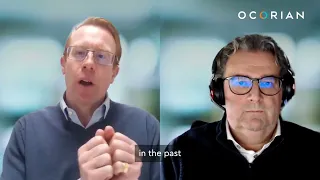
[Music] what AI means for Supply chains today and tomorrow mat Linder is CVP of Industry strategies in the product management group of blue yonder hello Matthew hello Robert uh nice to be with you today let's just give me a portrait of it of AI status right now where it's having the greatest impact on Supply chains today uh it's having a a greatest impact on um efficiency of the planners and on accuracy of the decisions which are made by the planners well how then does it enable capabilities that didn't exist in the past what can you
do with AI now that you couldn't do without it years ago in the past I was able to create for example a forecast just based on shipment history because that was just the little bit of data that we were able to support that a human was able to create and understand but the forecasting as an example of application of AI is much wider it's also about the weather it's about the events it's about GDP it's about all the causal factors which are surrounding our space in the ecosystem which can be in fact learned by AI
in order to come up with a more explainable and accurate forecast you deal with far more data than we ever could as people couldn't get our brains around all the stuff out there of course AI has been around for decades by that name doesn't mean it took the same taking the same form now that it did in the beginning what has happened to AI in the last few years has made it suddenly kind of you know on the on the stage front and center right now so access to the data and the compute power so
we were able you know to have you know preliminary Ai and you could call you know um planning optimization or forecasting you could call that AI but now with the size of the data that we have that we can grasp from know the ecosystem and the cloud system and the ability in fact to scale up scale in you know in the cloud architecture to execute you know that gives us you know a a new you a new dimension for forecasting accuracy for supply chain planning accuracy and efficiency gains a lot of the talk about AI
in the last year or so has circled around generative Ai and large language models is that what we're talking about today or do you see AI in a broader sense also contributing to the supply chain correct you have in fact think about two categories of AI there's the let's say the um predictive AI which is you know what we've done in fact before generative a that's the unsupervised learning that's supervised learning those techniques which have been there for the couple of years which have been maturing yes in the past couple of years uh and and
the Gen is the new category which is indeed uh giving us a a new set of use case again to uh come up with a more efficiency today with with supply chain planning and and we will see later more autonomous decision in supply chain planning MH but it's not just gen we're talking about it's not just gener much larger universe correct absolutely yeah and machine learning as well which I assume is can be considered like a subset of AI getting better as it goes I mean the very name machine learning implies that it the model
gets better I I take it that you know every day it's more effective absolutely absolutely it continues learns yes yeah okay so you bring it into an organization of people who are still there in the organization who haven't had experience with it what kinds of new skills must managers and workers acquire in order to work side by side with AI in the supply chain yeah correct there's a a significant change in terms of skill there's a little bit of of unlearning you know for the experienced people which have been using you know the the former
Technologies and experts in Excel so in macro they have to unlearn that because these all the things that are being in fact automated uh they need to in in fact Embrace a little bit more of the out output of of AI and and that's where that way it's not just the output it's also on our side to make to make the AI explainable you know that's the condition in fact for users to on board accept trust the result of AI so our research is is not just you know I I I we give you we
you know we give you a a new AI it's also an exp inexplainable AI um the skills the skills are are also changing right when it comes to geni um it will be more like we're going to train you know demon planner is going to be training think about training Avatar or training agents uh to do what that person was doing before right and and and and maybe we are going towards a you know an upscaling of people that are you know less hands on the keyboard you know to make simulations and add manage the
data but more training different different skills of of of AI agents right U building up maybe a a fleet of of of AI agents where do you think that AI is being overly hyped or oversold right now gen you know appeared you know a bit more than a year ago so um you know all the all the new use case that that have been released or that have been communicated to the market you know may not be uh may be on the hype it means that they may not be in use at scale right and
and we know we know that gen can derail completely with more data with hallucination so it needs a lot of experience so looking to the future we can only assume that the AI technology is going to get better and better how do you see it evolving in the future in particular applications supply chain and you had mentioned prescriptive AI which is still in its early phases as opposed to descriptive or predictive where it's actually making decisions how is that all going to evolve and you know I'd hate to ask you to look into crystal ball
say how soon but what is your vision of AI in the future uh there there is a there is absolutely that Vision which is uh which is now near right and in fact you know the the prescriptive a is something we've been talking for for four or five years that we've been in fact a pro that companies have been prototyping that idea where I've got a problem and I could have an AI that in fact resolves automatically my problem uh that is you know that has been uh let's say something that was born maybe four
or five years ago and with the execution with the uh client on boarding I think we are we are getting more mature where where there is still a Jour is is exactly on the Gen side which is having more of a um you know where where the role of the demand planner of the supply planner uh today is kind of more making the decision on its own on his own on her own by clicking on the button by making decisions maybe maybe the maybe the the shift with jni is going to have actually to the
Gen to run you know what we call the microservices to run the planning services and to orchestrate the decision so that is that is a fundamental shift and and and this is this is probably technically possible from a you know a service and a technology standpoint but the maturity is going to be the maturity journey is going to be huge from organization so I think technology Robert technology is there but the uh onboarding we have to learn also from from the clients on how to onboard that change in organization so it's probably another another two
to three years before we can really before organization we can really scale with that full automation thank you very much mat for those insights into the state of AI and the supply chain now and in the future may I take a moment though to ask you a little bit about blue yonder specifically where do you guys fit into the picture of the subject we're talking about today we've uh we've been uh we are an R&D company right we are um um we have we are engineering heavy right we've um we've been building releasing patents on
on AI for decades uh and uh as you may know you know we are predicting more than billion points of of predictions every day uh across large retailers at scale and and as we just talked about you know um AI breaks when it moves to high scalability and that's where we are so we are supporting you know a high level scalability of machine learning predictions so we are we are in a we are blue yonder is is is in a good spot Matthew Linder of blue yonder once again thank you very much for your insights
into the state of AI in the supply chain and telling us a little bit about blue yonder as well thank you very much for being with me today thank you Robert