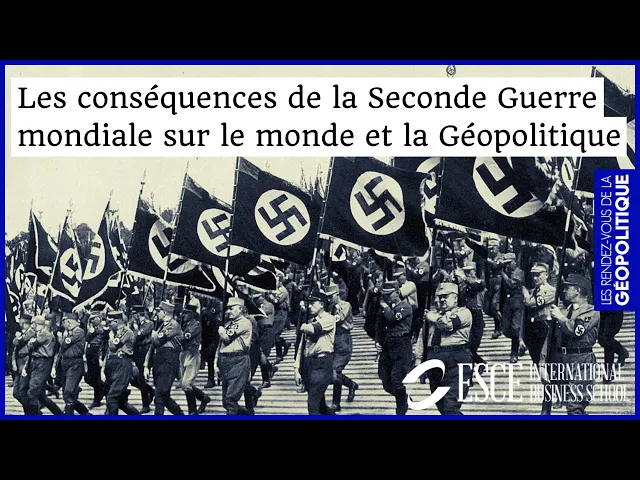
Hello everybody. Welcome to this new interview of Geopolitics Rendezvous. It is my pleasure to talk again with Fabrice Ravel about another geopolitical issue.
And look a bit at history. We will talk about World War II. A period you have widely studied in school.
But let's try to look at it from a strategic and military perspective. With an interest to lessons, and consequences of World War II on the 2018 world and geopolitics. Hello, Fabrice.
Hello, Olivier. Hello everyone. So I'm not going to insult our students’ knowledge of World War II.
I think this is something they already know, including, dates and periodisation. But it is interesting to go back to the sequence and chronology of the events that occurred during this war. Yes, so actually the first idea on our topic is, as you have rightly pointed out, to try first to talk about the strategic and military rationales.
We often talk about social, ideological, political, and humanitarian issues. And this in favour of, this is less true in Anglo-Saxon countries, as we’ll see in references, the military and strategic aspects, which have had consequences and impacts that today still remain very important. To maybe start addressing this rationale, I think we should actually try to redefine it in terms of dates, even if this is quite very easy for our students.
First of all, the time sequence of the events. Most importantly, if you will allow me, the sequencing, or different sequences that have occurred during World War II. Because this is what might bring about a slightly different consideration.
And a strategic extension. Then in terms of determining the dates, this is relatively simple. Even if some authors sometimes try to split hairs when it comes to reflections.
The beginning of World War II is usually considered 1st September 1939 when the Germans attacked Poland about the Corridor and the City of Danzig. Some authors sometimes noted that there were conflicts, and, in particular, a major one between Japan and China. So, we could say that following the invasion of what today is Manchuria, at the beginning of the 1930s, and, most importantly, the start of the clash between Japan and China in July 1937.
We could say that this is when it started. I admit that this is a bit artificial in comparison to what happened later. And after that, there are others who would say that World War II really started on 7 December 1941 with the Pearl Harbor attack.
And why? Because all the major powers are now involved in the conflict. Namely, the Soviet Union and the United States, which are the most powerful, the most important during the Cold War.
Me, I believe we should stick to the classics. As for the end, we’ve got two dates. It is not uninteresting to look at them.
Because in Europe, people often talk about 8 May 1945, which is the actual date when the Nazi Germany surrendered. Again, we should say that for the Soviets, that is what today we call Russians, it’s 9 May. Because Stalin, we will come back to this, signed separately.
Given the importance of Russia in the victory, we should highlight this aspect, which is sometimes not mentioned in the West. But we should also remember another date, 2nd September 1945. It’s when Japan surrendered and we see this scene on the Missouri cruiser.
Since well, sure, Japan was part of the Axis forces, and we can't say it ended before the surrender of Japan. So, that’s it for the dates. After that, in terms of sequences, we have three that I think are important.
Like cut-outs, as if we did a book or memoirs. And besides, I would like our students to go over the book of Lee Delarte. It’s called World War II.
It is an author that we have talked quite a bit about. And I think we’ll come back to him later. Lee Delarte believes there are three major periods.
Which is what everybody agrees on. Essentially, we’ve got 1st September 1939 til 7 December 1941. Using a sea analogy or a tides analogy, he says that we’ve got an upward flow and the flow is still being developed.
And what will be interesting to point out is that, in reality, I think that in France in particular, we don’t highlight enough this phenomenon. It's the time of the German victories. Roughly speaking, we’ve got 24 months when the Germans won victory after victory, occupied Poland, Denmark, Norway, Benelux, France, and then Greece, Yugoslavia, and then they entered the Soviet Union just short of Moscow.
And it's all the more amazing, we’ve got a country that ultimately rearmed only after 1935. So, for just 5 years, and they don’t have lots of raw materials. And, we are well aware, they go into war again with several other countries which normally have much greater powers.
Each of them. Which suggests that from the beginning, Germany loses this war. So, how is it possible under these circumstances Germans can and manage to win as many victories.
It can be a question that we’ll mention later. So, that would be the first sequence. Then we’ve got a second sequence.
But this is essential. It’s what Lee Delarte calls the flow at its peak. And the beginning of the withdrawal.
There is another author that has often been mentioned in a book, Paul Kennedy, but Paul Kennedy has also written a book on World War II, which is “Le Grand Tournant”, and he talks about this year, 1942, which is essential. And if we want to be specific, it is 1942 very unusual, since it’s 7 December 1941. Pearl Harbor, til 2 February 1943 which is the fall of Stalingrad, and it’s the first major victory for the Soviets.
On the Eastern front. So here, we would have 13 months, and what I am asking our students to understand, and this is essential, in fact, during these 13 months, why do we call it The Great Turning Point? Because on the key fronts of World War II, and we're going to talk about it quickly, there is a major turning point.
There is a decisive victory for the allies on each of the major fronts. For the first time, and therefore, when the Germans or the Japanese had the control, or their allies, for 24 months, now it's the Allies that will take control and resume the offensive. It is really important to understand it in terms of military strategy.
And so, to try to devise these fronts as synthetically as possible, first there are the frontlines in Africa, with the famous Africa Korps of General Rommel that is about to go to in Egypt, to Alexandria. And there is a standstill in the battle of Alamein. Beginning of November 1942, with General Montgomery.
And from there, the Germans obviously counterattacked occasionally, but will be pushed on the defensive. Then there is another aspect which we must mention. The air battle.
Starting 1942, the Western allies managed to have Germany on the defensive, including, what we call, strategic bombing. We should mention that on a daily basis, the Americans mainly during the day and the English at night, there was bombing of all the central points of industrial Germany. And a point that is much more questionable and much more disputed, but we must mention it unfortunately, is the civilian population, since there is not a single German city of over 35,000 inhabitants, which was not razed to the ground in ‘45.
This is one of the things sometimes we somewhat cover and don't like to come back to it. But we think there are more than a million of German victims of the bombing. The bombing of Hamburg, in August ‘43, led to 30 to 35,000 dead.
Much later in Drsdre, it is estimated there were 100,000 dead. So, there’s the Allies’ ambition, frustrated not having had a victory in 24 months, to constrain again the Germans. So that’s the second front.
There is a third front that we have to talk about. It's the Battle of the Atlantic. That will actually be strategic for the evolution of World War II and it was about controlling the oceans and the seas in order to retake control over the land.
And shortly after, overall, there is a fourth. I think if we're trying to get to the point, which is of course, then there is the Pacific, sorry, because whilst trying to make things simple, I end up forgetting that one and this is important because it's the American’s Midway victory on 4 June 1942. And it's doubly important, firstly because it is the first major World War II victory of the Allies.
Because the Battle of Britain, as Lee Davis would say, the Germans were stopped, but they were not defeated. Basically, the English were successful, with England, to ensure the war continue. But the Germans were not stopped.
So at Midway, the Japanese, 6 months after Pearl Harbor, lose 4 aircraft carriers in 24 to 48 hours, and permanently lose the strategic control in the Pacific. Which shows how quickly the Americans will be able to regain control. And then the fifth front, it’s the Eastern front.
And here I would ask our students to well understand what we're going to say because this is a front that explains a lot also about the history of Russia today, about Vladimir Putin. It seems very important to note that the Russians will have, so the more Dantean the numbers, and the authors do not agree on this. Meaning they vary between 13 to 14 million dead overall.
Up to 20 million dead. And here I would ask our students to well understand the numbers. We, the French, we had a million dead in ‘14-’18.
One and a half, and you can see how terrible it has been, how it has affected the French collective spirit. And that may explain several uncertainties in the 1930s. The Russians, what they have though to be between 13-14 up to 20 million dead in 4 years.
And so there are those who have been decisive in the victory over the Nazi Germany. And besides, this is just a statistic, 85% of losses of the German army on the Eastern front. What still is quite revealing.
And it's going to be very long, because there is the battle of Stalingrad, and then there are other battles. So, after the battle of Stalingrad, overall, end of September, beginning of October 1942 til 2nd July ‘43, when Marshal Von Paulus surrendered, it was the first time the Germans were defeated on land in World War II. So there was a breath of hope blowing over all of occupied Europe.
We must be clear. And so, this time is a decisive period because it is clear the Germans and the Japanese were stopped on the one hand. And the Allies won a decisive or major victory on each of these fronts, and are about to regain control.
Which brings us to the third period. Overall from 2nd February ‘43 til 8 May ‘45, then until 2nd September ‘45. When the flow goes backwards, as Lee Delarte says.
It’s when Allies win victories until the final victory, which is decisive. So we had three periods, one being absolutely crucial. That lasted 13 months, but in 13 months there was a major geostrategic upheaval as the power changes hands.
Precisely. And it's possible to see how this has had an impact until today on the current strategic and geopolitical rationale. One year that will change the face of the world.
Completely. So we'll go back maybe to the geopolitical or border-related disruptions afterwards, but you are right to insist on the fact that it will change everything. First, we must discuss, without going into too many details regarding military orders, and be tedious about these issues.
We need to discuss, I think, the tactical logic in perspective, to understand the split of 1942. At the end of 1918, the French are considered the best strategists in the world. They won World War I.
Not only given the number of dead, but also given all the suffering and the fact that the French together with the British managed to implement on land a tactic with, we know first, the evolution of tanks and blinders. And we think that we need to have massive, very powerful tanks that go very slowly, that we associate with infantry, and so that gain on the opponent in defensive positions. During which, we should mention that in Verdun, we basically lost 260,000 to 300,000 men.
In 6 months, to win 10 kilometres. So, they had a rationale at the end of 1918, early 1920s, we call it the offensive war, it would not come to that. And precisely, we'll have defensive wars and burnouts for a very long time.
And why must we recall this? Because in fact, at the beginning of 1939, no one expects a strategic phenomenon called the Blitzkrieg, or the lightning war, that will, in part, contribute to the invention of the Germans, these are topics that I already had the opportunity to look into. And, in fact, what is quite striking, it is a German General, Hanz Guderian, whose memoirs have come out, by the House of Perrin, if I recall, in June 2017.
“Souvenirs d'un soldat”. It's kind of interesting, the first 110 or 120 pages, because precisely, Hanz Guderian, said given the central position from a geographical perspective of Germany, the fact that it is completely depleted of resources and raw materials, inevitably, during a major conflict, time is against Germany, so they needed to win very quickly. And so, there it is all.
It starts with a strategic dimension. Then we have a tactical solution, which is to say, we must recreate a movement war, with division blinders, so it's the opposite. I will not cover these aspects we covered together.
And so in fact when Stalin signed the Molotov-Ribbentrop Pact on 23 August 1939, in fact, he thinks the war will last 4 or 5 years, and the allies, the Germans, will deplete all resources and afterward he could benefit from that. There is no way to imagine, Franklin Roosevelt never imagined, that the French army, which is the most famous in the world, will crumble in 5 weeks. But the Germans seemed to have found an insider’s tip.
That will bring them a tactical win. However, they multiply the tactical victories, but this does not win them World War II. So 1942 is essential, because at one time the allies will ultimately realise three things.
First they find how to adapt. We must be clear. When going back to the ‘14-18 system, that is to stop the German army, we must accumulate manpower and materials just to prevent the Germans from winning quickly.
But what is more interesting is that they switch to an aerial dimension. With intense bombarding, we mentioned the bombing of Germany. However, there is a bombing raid on Tokyo in March 1945.
These are things that again are discreetly set aside, and we'll understand why. It is estimated there were 190,000 to 200,000 dead in Tokyo because the Americans raided the city with firebombs, on a city that is 90% wood. So the idea it is to bring terror to the opposing side, so that it pushes its own government to surrender.
And besides, the major lesson of World War II, one that we do not often enough take into account, namely during the Vietnam conflict or current wars in the Near and Middle East, is that we are going to have the opposite effect. The populations have been extensively pushed into entrenchment and, in a bombing, they tend, whatever the nature of the political regime, to cower behind it because we feel that in any way we are in a Manichean or radical situation and there’s no way out but victory or final squashing. So, any rise in aerial bombardments, the air rationales, including through the drones today, we can consider it as World War II, that is the Genesis.
If I can use the expression. And then, most important, the fact than the land, it’s the sea, and if we can't dominate the seas, we can't win World War II. In fact, the Germans begin World War II though a conventional reading of the Europeans, which is rather limited and contained in Europe.
So that Americans especially, the Anglo-saxons, and the Russians understand that to win this conflict one must think on a rather global level. And here, we will talk about an example. John Costello, who is an American author, wrote a very good book on the Battle of the Atlantic, that explains one thing for us.
Often, when we have amongst our students a dialogue, we have more critics of the American power, which can be understood, they say, the Americans, we often put them forward. But eventually, World War II began on 1st September ‘39, as it was pointed out, and they eventually landed in Normandy only on 6 June ‘44, so they were late to arrive. Just like they did in 1918, when they arrived in 1917.
I think that is a very poor understanding of maritime strategy. And, in France, despite that we have a large seafront, we are rather linked to a continental approach, and it's hard for us to integrate a factor which to me seems important. So the US go to war on 7 December 1941 following the attack on the Japanese at Pearl Harbor, on a Sunday.
First let's remember anyway, despite that some movie lyrically showed it, I am thinking about Hollywood, it is not a victory, it's a defeat. 8 Americans of 16 are at the bottom of the water. The Americans lost 450 planes, they had 3,000 dead, and basically, it will take them time to to rebuild a fleet.
We forget this often, and also that, from 1939 until 1941, the Germans launched a submarine warfare whose objective was to deplete the United Kingdom, and it pushed a bit, due proportion observed, the Continental Blockade Napoleon wanted to put up against the British during the Napoleonic Wars. Basically, the idea is to say, I can’t land in the United Kingdom, but I'm destroying the convoys to take away the United Kingdom’s supplies. I will force the English, totally dependent on of what the Empire allows them to have in terms of supplies.
I will force the English to make peace. And the problem is that from ‘39 til ‘41, not to step on our statistics students’ toes, and we see it in the book of John Costello, the problem is that the Germans are destroying more and more of Allies’ convoys or ships. And so we're at a strategic moment.
However, the U. S. went back into the war, and the first 3 months of 1942 are misleading, because Allied naval losses increased, and so we have the feeling that the sea battle is about to be lost.
In reality, it is about to be won. And here, I ask our students to pay attention to statistics. What happened?
Obviously, it’s easy for the German submarines to destroy many more Allied convoys because now there are also American targets being added. On the other hand, the real statistic that is interesting is not the number of Allied convoy destroyed, it's not even the number of German submarines produced, it's the phenomenal American industrial capacity to multiply exponentially the production of ships. In reality, the Germans may well increase the number of Allied ships destroyed that were produced by the Americans.
In reality, there were 4 or 5 or 6 times more at sea than before. And as in a concerted way, by developing technology, the Allies destroy many more German submarines than before, so we are in a situation where precisely, as the Allies begin to regain supremacy over the Atlantic Ocean. And here, at this moment, we could note all that, that's fine.
But what is truly useful? But, Olivier, to be able to land in Normandy on 6 June 1944, they had to gather millions of men and hundreds of tons of materials in the United Kingdom, but to do so, they had to begin by controlling the Atlantic Ocean to be able to carry everything from the U. S.
to the UK. And this is where is interesting. Because finally, we believe that the Americans regained control over the Atlantic from 7 December 1941 until end of December ‘42, so, basically, they put in just 11 to 12 months in.
Then they needed 10 to 12 months to transport the men and the materials, which is still relatively short if we look at it and I’d like our students to look very closely, it's interesting from a logistical point of view compared to their job in the traditional sense. And we realise they do it in only 12 months, so December ‘42 to December ‘43. And afterwards, whenever they have the opportunity, they land.
If we are to remember The Longest Day, we well see that in a scene, General Eisenhower, 48 hours before the landing, the weather very bad, we need to combine the logic behind the tides, the full moons, Eisenhower takes a considerable risk, the weather, and the Germans think that the Allies are not there, because the weather is too bad, and Eisenhower, said, no, let's go. So in reality, I think it's a starting point, clearly opposed to the one we usually have. I think that the Americans could have gone faster.
And control the Atlantic Ocean, and it shows that it is essential, in order to have a land-based influence, and this reminds us, compared to the Cold War, and especially to today's world, than, to control the land, one must start by controlling the seas. From this point of view, This period is essential in its aerial dimension, in its military tactical dimension, and in its naval dimension. And what is inspiring is also that we've got a wold war, as we all know.
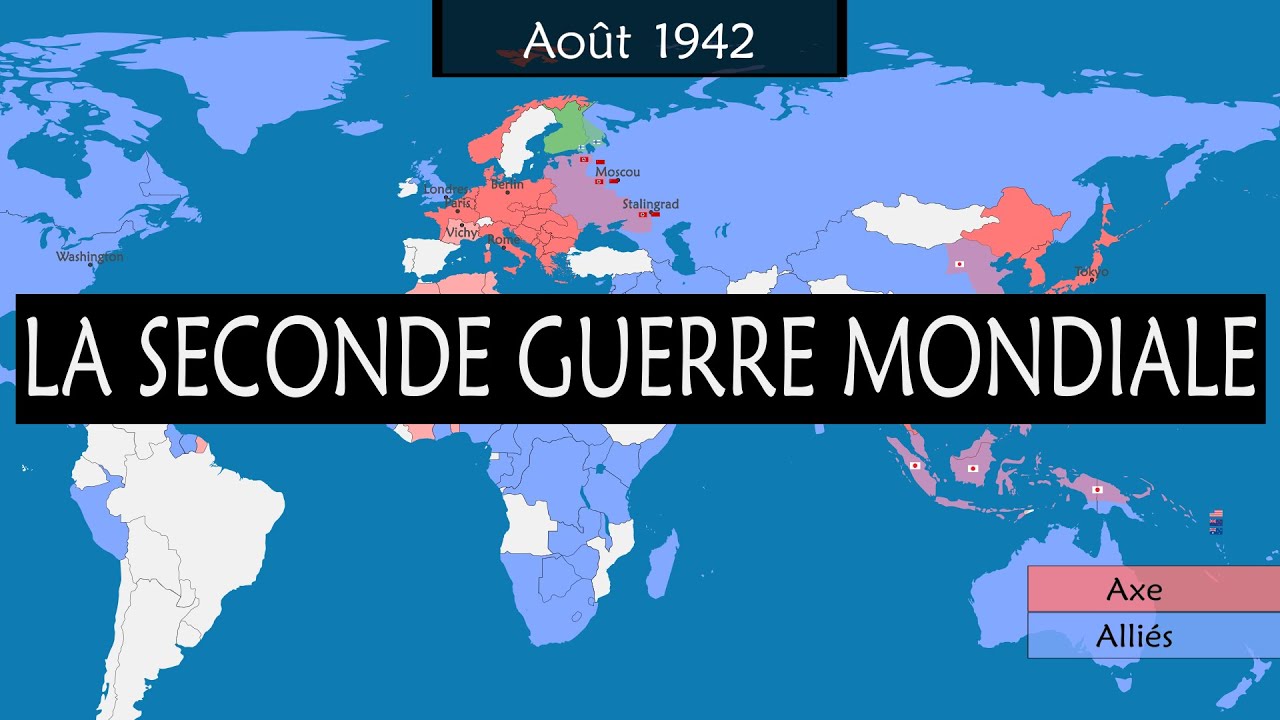
This means that different global players, of different powers are invested in the conflict, but it also means that the theatre of operations is the entire world. It shows it, it highlights it. So we’ve got especially when we look at a world map, we will turn more towards the U.
S. , and all of a sudden, it becomes the centre of the world. There is a shift in the geopolitical balance that occurs in a lasting manner.
There is an upheaval on the old continent, which is ours, of the borders and also a sort of decline of Europe, which was already underway, but which is still picking up speed. So this is World War II. It is clear and that's why we’ve got a split, but I believe that if we were to be precise, the most important terms are split and accelerator.
Meaning if we imagine, because they are the disruption, we could begin if you want, you're right, with the statements. In my drive to go fast, we may still begin with the disruption. First of all, I think it completes the decline of the Western powers, as one already began to foresee it after the end of World War I, we feel it already, like several authors, and an author, little known, but Spingler, when he talks about the decline of the Occident, there is already some kind of fear combined with a fantasy, a fear really, we feel it already, the Europeans, on the surface, they seem to dominate the world with their colonial empires, etc.
We feel that already deeply, on the long term. This will necessarily be raised into question. So, there is the decline of the West, which is very clear, and so frankly, France and the UK will totally disappear as the leader of geopolitics.
We must note one thing that our students are struggling with, and it is warranted they can’t remember, they’re too young, it's when, for example, we mention the Treaty of Munich of 30 September 1938, the Americans are absent and the Russians are absent, for different reasons, but the French and the English are present, and we're talking about the territory of Sudetenland and Czechoslovakia. Because the French, the English, respectively, are the first and second geopolitical power in the world. To say that today, in 2018, it's almost surprising because it was 80 years ago.
Given continents under empires, industry, banks, they are the two biggest powers in the world. After 1945, it is clear that there are no more European countries that will be for future decades, we can't predict the future, but for decades to come, during the 20th century, a power in the world. So, already, there's a collapse of the influence of the Europeans, that is very clear.
Then there is a growing power, a second major phenomenon, of the United States of America and Russia. And that too is something long term, as Alexis De Tocqueville said in “De la démocratie en Amérique”, that was in the mid-19th century, given their size, that too is something that was mentioned. So I'll go quickly over this, due to their population size, area, means, it is clear that the United States and Russia will be playing a major role in the 20th century.
So it’s been a long time that this development has been anticipated. And then there's the third phenomenon that is decolonisation, I say it often during class, when the French signed an Armistice on 22 June 1940 in Rotunda, I think that were thousands of eyes across North Africa, in sub-Saharan Africa, who realised well that now the de facto power suffered a great military defeat. Because here too, risking it to sound unpleasant for us, France left the winners’ side, but France was defeated in 1940 from a military standpoint.
So it is very important to note, it is an exactness that is essential. So, ultimately, we have a collapse of the influence of European countries in geopolitics, the rise of Russia and the United States, and the emergence of a new world, even if this expression is a little overused, when, in 1945, there were barely 40 or 50 countries part of the United Nations, now, we're at 193 today, and we can see that the decolonisation is moving forward. So what's kind of interesting it is that this was felt, but it was not necessarily as lucid, and I use two examples for this.
Churchill, at the time the hardest Battle of England, would say we will win. And if the British Empire still was to last 1,000 years, we will remember these hours as the most beautiful. Our finest hours.
Churchill, for whom I have a great respect, in fact provided more clarity on other subjects, but if the British Empire would last another 1,000 years, when we know that he would die 10 years later. But it's not worth for us French to tease the British, because General de Gaulle made a speech in Brazzaville in ‘44 when he talks about the future of the French colonial empire. There will be no future, it is over.
So, we have the colonial empires that collapse completely. And the point that seems the most important maybe on this issue is that a lot of people say that World War II created a split. I have the feeling that it has sped up a rationale on the long term, on a very short time, given the major clashes, but it wasn't the source, it's the things that were already perceptible.
On the other hand, it was obvious that, in 6 years’ time, we have a geopolitical upheaval which I often like to repeat to the students that it is identical to the technological upheaval. Even when it was World War II, it is something we can not do but mention, but it shows something in terms of analogy, the rise to power in 6 years. We created the first ballistic tests, we went on the first jet aircrafts.
We go out on submarines that are autonomous for hours and depend more on diesel, and of course there's the terrifying progress, if we can call it that, the nuclear weapons. We know that war is always a factor of innovation, this is pretty terrible to say, but often for the better and then for the worse. Even for World War I we can speak of broken faces, so of plastic surgery that was born at this time.
We are in a logic of geopolitical upheaval, but also, we're maybe in a logic of a change in mentalities. We have had two major conflicts in less than half a century. World War II is of course known for its eastern front, we did not talk about the concentration camps, but this will be a subject in its own right as, and I think our students are aware of it, at least I hope so.
The war report is shocking. The war report is shocking, then this is a question that is essential because in geopolitics, there is still the human spirit, the logical, political report to states. And, besides, your question is, I think it is exciting, will it bring us perhaps another discussion later.
Because it is shocking, but is it shocking in the same way to all cultures? And maybe even within cultures. Because if we look at European States, I think I can say, there is a term that is sometimes used, the Great European Civil War, either by Western authors and non-Western authors alike.
Much more controversial is the ideology of Western authors, looking to see if there were links between Communism, Nazism, and democracy. This is less political reading and more geopolitical. For example, the Chinese, who say that finally Europeans have dominated the world, but they face 20 years' intervals, so this is not uninteresting to note.
Finally, Queen Victoria, the great aunt of Keiser Wilhelm II who runs Germany, himself cousin of Tsar Nicholas II, and so for the Chinese, we have a family that would be the Europeans, because France was the only republic in 1914. So, we have this introspection, it is a special case. And finally, we realise we have been slaughtering each other for 40 years.
That overall, if we combined the two conflicts, there are a hundreds of millions dead, which is terrifying, we think that the most successful civilisations, but all traces of morality or humanity disappeared. Then there's the extermination camps which are terrible themselves. The pictures are what I call in Latin “lacle namunde”, tears of the world.
It is an injury to the soul. Here, we say, but if we are there, the sentence of Obbs, if omni lupus is, the man is a wolf to man. And often, I tell my students, never a wolf will do to its peers what human beings are able to inflict onto each other.
Moreover, we have strategic bombing, we had two nuclear weapons, and to see how it was celebrated in the United States, that is pretty amazing. It took time to realise the suffering and what led to it. And besides, the nuclear weapon here is decisive, because we were talking about Clausevitz, war is necessarily the continuation of politics by other means, but if the means are so disproportionate, we'll blow up the planet and all civilisation.
So not only we must see it all in a moral or human perspective, but there is almost a technology perspective too, because now, the means used are such, that. . .
Normally this brings a being normal in geopolitics, and so it brings a balance of power which must be perceived differently. Because here, it's different, but I also think there are conflicts that are very reduced. The civil war in Yugoslavia from ‘41 til ‘45, has given rise to abominations.
Purges, torture between Cerbes, Croatians, Slovenians, the war in Yugoslavia. Yugoslavia is the only country that freed itself on a territory of about 90% forests or hills, valleys, it gave rise to fights between SS divisions, Communist resistance, which were terrible. All this in Europe, the door, on the other hand, it is interesting that in the United States, paradoxically, if except for Pearl Harbor, the country has never been physically bombed, so there is a link to nationalism, even if we remain within Western civilisation, which is not at all the same between European countries, so it looks like they are definitely scarred.
1914 is far behind, when we worn red pants with flower bracelets and we’d say we’d be in Berlin in 3 weeks, there was almost a kind of lyrical and festive dimension. But not only in Berlin or Moscow. And where very quickly we realise that there are no more heroes, such that showcased in the movies.
There are men who are afraid in the trenches, in the battlefields. So, yes, I think that there is a link to war in the West that has nothing to do with it. Finally, we no longer perceive the heroic dimension, or the lyrical dimension, we perceive however the abyssal dimension, and above all, I think that through the sociological or philosophical work you mentioned, we first thought of physical pain, but I think that ultimately we only started to understand the psychological pain, or psychological traumas on several soldiers from the battlefield, and this will be reinforced by the Vietnam war.
When we realise or the war in Iraq, when American soldiers have not necessarily been touched in their tanks, but they can’t no longer integrate into a civil society. And I think that World War II is a decisive split, does it has a same influence in other countries? On other continents, that would be a real question.
Fabrice, I suggest we stop for now. Thank you much for this discussion. Thank you.
So we are at the end of this interview of Geopolitics Rendezvous. Thank you.